Circle: Book, Hand, Book

As the light fades, no attempt to bring on artificial lighting. This is how “A Happy Birthday” ends — on the image of the hand.

I could easily have switched on a lamp,
but I wanted to ride this day down into night,
to sit alone and smooth the unreadable page
with the pale gray ghost of a hand.

This is the last poem in the collection and the “ghost hand” merges with that of the reader who has the leisure afforded by (artificial) light to resume reading at the beginning which is indeed a kind of ending…

This evening, I sat by an open window
and read till the light was gone and the book
was no more than a part of the darkness.

The descriptive opening in the past indicative has great serenity compared with the optative of the closing lines — the hand trembles at what is intimated. And so we move the hand and close the book, for now, on this selection from Ted Kooser’s Delights and Shadows.

And so for day 2160
11.11.2012

Posted in Poetry | Tagged | Leave a comment

Lines & Lives

“Stop. Start Again.”
from Richard Sanger
Dark Woods

On the last day of the year, in the last year
of the century I was born in,
I went into the woods with my brothers.
It was cold, there was a wind,
and we skied to warm ourselves
and harder still as we raced, testing each other
the way we did when we were boys.

[…]

We stood, the creaking stopped,
and then we started off again,
our skis imprinting their lines
in the uncomplaining snow, lines
that would be there, or gone, in the morning.

I like how the temporal determinations of mortality are abridged, for a while, until morning be past or the traces gone.

And so for day 2159
10.11.2012

Posted in Poetry | Tagged | Leave a comment

Blousy Blooms

Gillian Sze has an impeccable eye for the cartographies of sensuality. Take this bit from “Mapping the Garden” in Peeling Rambutan . . .

A brothel of lilacs
Four bushes of heavy-chested women.
Their embraces can last two weeks.
They jostle you between them,
their perfume solid as solder.

In my first quick glance over these lines, I carried over the “i” of “solid” and found a “soldier” under the “solder”. No wonder: apply a bit of heat and it fuses.

And so for day 2158
09.11.2012

Posted in Gardens, Poetry | Leave a comment

Love of a Bookish Sort

Edmund White The Burning Library “Nabokov: Beyond Parody”

I may also seem to be saying that if Lolita, the supreme novel of love in the twentieth century, is a parody of earlier love novels, we should not be surprised, since love itself — the very love you and I experience in real life — is also a parody of earlier love novels. I have even intimated that conflicts in love, whether they are those between Onegin and Tatiana or Humbert and Charlotte or you and me, are attributable to different reading lists — that amorous dispute is really always a battle of books.

How subtle to play the you and me game of identification and place the reader (me) in parallel with the love object.

And so for day 2157
08.11.2012

Posted in Booklore | Tagged | Leave a comment

How inexhaustible is the human mind?

This passage from Northrop Frye strongly suggests the verum factum principle of Vico that links the true and the made.

Truth is always a beginning; it can never be the end of anything in this world, for there is no end it can come to except the mind in which it began. When the reason discovers a rational order in the universe; when the artist discovers that the world is beautiful, these discoveries are partly a matter of falling in love with one’s own reflection, like Narcissus. Even when submarines swim under the pole and rockets circle the dark side of the moon, it is still the shadows of truth that are outside us; the substance is in ourselves. It is not the world that we contemplate but the world that we create which is important to us. The sources of creative power in the human mind are inexhaustible. If we could realize that they are infinite and eternal as well, and that the human mind is therefore linked in its nature and destiny with a divine mind, that would be the final motive for learning and the final guarantee of its value.

From By Liberal Things [his address upon his installation as Principal of Victoria College, 1959]

The tautology rests on the distinction between the created and the contemplated. A phenomenologically inclined view would be less easy with the separation. Perception is in part a power of filling in what is there. And is in part limited.

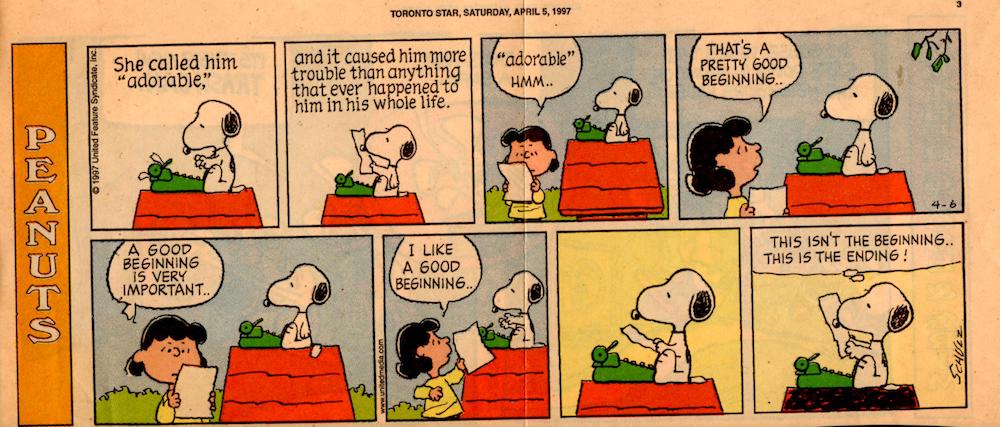
Though Frye begins and ends in the infinite and the divine, there are other ways to square the circle and find reason for human humility. Take this example offered by Charles M. Schulz in Peanuts where our characters have a different take on what constitutes a beginning.

peanuts - lucy and snoopy - beginnings and endings

And there is no telling which came first in my encounters: Frye or Schulz. Or in your reading.

And so for day 2156
07.11.2012

Posted in Perception | Leave a comment

Set and Setting: Cognitive Cogitations

A few generalizations…

5.32

Pedagogical situations are sensory. They are also interpersonal. Because they are sensory this makes even learning by oneself interpersonal. Egocentric speech is like a dialogue between the senses. In Vygotsky’s and Luria’s experiments, children placed in problem-solving situations that were slightly too difficult for them displayed egocentric speech. One could consider these as self-induced metadiscursive moments. The self in crisis will disassociate and one’s questionning becomes the object of a question.

http://homes.chass.utoronto.ca/~lachance/S6.HTM

An encounter with similar preoccupations…

Learning Edge

When we are on the edge of our comfort zone, we often are in the best place to expand understanding, take in a new perspective, and stretch awareness. We can learn to recognize when we are on a learning edge in this course by paying attention to internal reactions to class activities and other people in the class. Being on a learning edge can be signalled by feelings of annoyance, anger, anxiety, surprise, confusion, or defensiveness. These reactions are signs that our way of seeing things is being challenged. If we retreat to our comfort zone, by dismissing whatever we encounter that does not agree with our way of seeing the world, we may lose an opportunity to expand understanding. The challenge is to recognize when we are on a learning edge and then to stay there with the discomfort we are experiencing to see what we can learn.

Source: Adams, M., Bell, L.A., Griffin, P. (2007). Teaching for Diversity and Social Justice. Second Edition. New York: Routledge Taylor & Frances Group. (p. 55)

Still there is a distinction to be drawn between discomfort and distress.

A few lessons from the past via an interview with Michael Pollan.
After decades of dormancy, psychedelic research makes a comeback

People do have bad trips on these drugs. They’re very powerful and they don’t have a set response in people. For some people, it brings up trauma they haven’t dealt with. “Set” and “setting” are really key terms, [which refer to] your mindset going in and the setting in which you take the drugs. And if these are frightening in any way, that will be exaggerated.

In a clinical setting, bad trips actually become very productive because they bring up important psychological issues.

Similar observations can be made whether sitting zazen or practicing walking meditation …

And so for day 2155
06.11.2012

Posted in Uncategorized | Tagged , | Leave a comment

Before Commodities

Echoes of an economy of the gift…

When I was six, my grandmother also took me with her to the newly harvested rice fields to take part in the open-air feast that fulfilled so many functions, practical and symbolic. It rewarded all the neighbours who had helped to cut, thresh and bring in the rice, for everything had to be done by hand. It “paid off” her debts of hospitality to people who had invited members of our family to their celebrations. For poorer families, not only was it a treat that provided nourishment for those who came to the feast, but it fed those left at home as well: more food was provided than the guests could possibly eat, and everyone was expected to take away a share of the unserved dishes for those who were unable to work in the harvest. This was not charity, but a reward for what the grandparents had done, and what the children would one day do, to carry on the life of the community. In a more prosaic way, the feast was a contest among the neighbourhood wives, each determined to show off her cooking skills and, if possible, those of her marriageable daughters.

Sri Owen. The Indonesian Kitchen

And so for day 2154
05.11.2012

Posted in Food Writing | Leave a comment

Intersection of Temporalities

To the writing belongs one time series.

cover of Wabi Sabi by Mark Reibstein illustration by Ed Young

In Wabi Sabi, a book by Mark Reibstein with art by Ed Young, there “are Japanese haiku that appear decoratively throughout the book.” They are also gathered at the end with transliterations and translations. This one by by Shiki caught my eye because of its phenomenological inflections.

for me leaving
for you staying
two autumns

To the reading belongs another time series.

And so for day 2153
04.11.2012

Posted in Poetry, Translations | Tagged , | Leave a comment

Pause and Tumble

from “Beds” in Can I Finish, Please? by Catherine Bowman

These lines float like a haiku in the onrush of lines…

you are enskied
         in the mockingbird’s
              indwelling song

See what I mean by tumble…

you are enskied
         in the mockingbird’s
              indwelling song

as it concocts
        a soporific
              of wolves apples,

and aftershave,
        gossip and flattery
              and all the daily

contradictions,
        salty and unmelodious—
              this scent bottle,

clouds of cosmos,
        mallow and iris
and marigold—

[and so on]
[and so on]
[and so on]

“Enskied” and “indwelling” harken to Hopkins but the riot of flowers lead elsewhere, to Chaucer, perhaps…

And so for day 2152
03.11.2012

Posted in Poetry | Tagged , | Leave a comment

elegance

Diana Vreeland in Allure

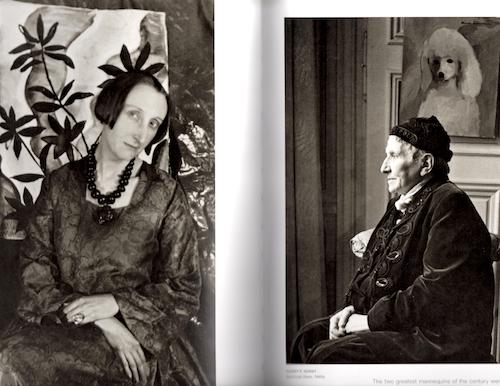
Fashion is a passing thing — a thing of fancy fantasy, and feeling. Elegance is innate. It has nothing to do with being well-dressed. It’s a quality possessed by certain thoughts and certain animals. […] Elegance […] is refusal.

And introducing the evidence from one of her own spreads in Allure

from Allure - edith sitwell - gertrude stein

On the left, Edith Sitwell by Cecil Beaton; on the right, Gertrude Stein by Horst P. Horst.

And so for day 2151
02.11.2012

Posted in Uncategorized | Tagged | Leave a comment