Empathy and the Place of Reason

I have been reading through the comment-available publication of Kathleen Fitzpatrick’s Generous Thinking and have been led to observe:

Are there two empathies? Empathy of feeling and empathy of imagination. And is not reason and critique that which allows the participant in a communicative situation to ferry between the focus on the self (how do I feel?) and a focus on the other (what is the other feeling?). Inserted into this space is judgement which of course is open to inspection. Empathy invites a sort of mapping and a consideration of the rightness of that mapping.

Such a tripartite view of empathy is rooted in a belief that all communication is mediated. It addresses Paul Bloom’s reductio ad absurdum: “The necessity of feeling exactly the same things as another person makes empathetic connection, especially with those whose life experiences and personal values may be quite different from our own, all but impossible.” Empathy actually operates in the gap, in difference, and in an awareness that the map is not the territory. It doesn’t flatten or transfer affect. It brings the mind to bear on emotion.

Comments I made before engaging with Paul Bloom, Against Empathy: The Case for Rational Compassion.

Inspired by Fitzpatrick, I picked up Bloom’s book.

The library catalogue I consulted gave an abstract of Bloom’s book based on the paratext (the dust jacket):

“We often think of our capacity to experience the suffering of others as the ultimate source of goodness. Many of our wisest policy-makers, activists, scientists, and philosophers agree that the only problem with empathy is that we don’t have enough of it. Nothing could be farther from the truth, argues Yale researcher Paul Bloom. In [this book], Bloom [posits that] empathy [is] one of the leading motivators of inequality and immorality in society. Far from helping us to improve the lives of others, empathy is a capricious and irrational emotion that appeals to our narrow prejudices”–Dust jacket flap.

Within the book, the case is made in a less outlandish fashion (see page 35). For one, Bloom has a highly focused target: “I’ve been focusing here on empathy in the Adam Smith sense, of feeling what others feel and, in particular, feeling their pain.” This reminder comes after a paragraph outlining the argument and the marshalling of examples:

The issues here go beyond policy. I’ll argue that what really matters for kindness in our everyday interactions is not empathy but capacities such as self-control and intelligence and a more diffuse compassion. Indeed, those who are high in empathy can be too caught up in the suffering of other people. If you absorb the suffering of others, then you’re less able to help them in the long run because achieving long-term goals often requires inflicting short-term pain. Any good parent, for instance, often has to make a child do something, or stop doing something, in a way that causes the child immediate unhappiness but is better for him or her in the future. Do your homework, eat your vegetables, go to bed at a reasonable hour, sit still for this vaccination, go to the dentist. Making children suffer temporarily for their own good is made possible by love, intelligence, and compassion, but yet again, it can be impeded by empathy.

How odd to arrive in the same place; one of us using a bulldozer and the other tweezers.

And so for day 2109
21.09.2012
Posted in Uncategorized | Leave a comment

Self as Experiment

Plethora leads …

It was inevitable that these new versions of nature would complicate traditional moralities. Conflict, chance, survival, reproduction, the family, sexual satisfaction and death were newly minted words in these stories, quickly shedding some of their more familiar associations. Darwin and Freud had produced scientific and quasi-scientific redescriptions of nature as continual flux. There was no longer such a thing as a relatively fixed and consistent person — a person with a recognizable identity — confronting a potentially predictable world, but rather two turbulences enmeshed with each other. If through increasingly sophisticated scientific experiments a new nature was emerging, the new nature was revealing that lives themselves were more like experiments than anything else.

Adam Phillips. Darwin’s Worms: On Life Stories and Death Stories

And so for day 2108
20.09.2012

Posted in Uncategorized | Leave a comment

Random Pairing

Seduced by its alliteration on the sound of “s” we here lay down the last line of “Sherbourne Morning” by Pier Giorgio Di Cicco in The Tough Romance

sun above them spins halos for angels gone beserk

Coupling this selection with a plucking from Camille Paglia Break, Blow, Burn, selected in a sort of Sortes Vergilianae fashion we come upon her comments on William Blake’s London:

Wandering through London’s hell, Blake follows the model of Dante as poet-quester cataloguing the horrors of the Inferno. A visitor to the storied British capital in 1793 would have seen a grand, expanding city in economic boom. But the poet, with telepathic hearing and merciless X-ray eyes, homes in on the suffering, dislocation, and hidden spiritual costs of rapid social transformation. The Industrial Revolution, which began in England in the 1770s and would spread globally over the next two centuries, profoundly altered community, personal identity, and basic values in ways we are still sorting out.

Muddling through the themes of angels and Dante, we learn that Di Cicco published a book under the title The Dark Side of Angels and that critics note

There is a marked difference between Di Cicco’s early personal poems, which deal with ethnic identity, social conflict and family relationships, and his later poems about philosophical questions, spiritual ideas and broader global problems.

http://www.thecanadianencyclopedia.ca/en/article/pier-giorgio-di-cicco/

But those questions, we see, are there from the beginning in a kind of Blakean fashion (thanks to the uncanny juxtaposition with Paglia).

Aquila

you want to get rid of these
little harpies

you want to confess they aren’t yours
take the one called song
the way it turns everything you say
into gold
take the one called love
the way it brings out the best in you

get rid of them
there is the real you, ugly and taloned
with eyes like an angel
ready to eat the world
for the first time

from in The Tough Romance

Of course “aquila” translates as “eagle”. And “paglia” as “straw”. And hence our Rumplestiltskin moment. A rough romance.

And so for day 2107
19.09.2012

Posted in Poetry | Leave a comment

Play: Wonder, Delight, Choice

Like being open to randomness…

Indeed, bringing play into a central role in a school entails creating a culture that values the core tenets of play: taking risks, making mistakes, exploring new ideas, and experiencing joy.

[…]

what is emerging is a model of playful learning with indicators in three overlapping categories: delight, wonder, and choice.

from Towards a Pedagogy of Play: A Project Zero Working Paper by the Pedagogy of Play Research Team [Ben Mardell, Daniel Wilson, Jen Ryan, Katie Ertel, Mara Krechevsky and Megina Baker].

And so for day 2106
18.09.2012

Posted in Uncategorized | Tagged | Leave a comment

Myth Marking

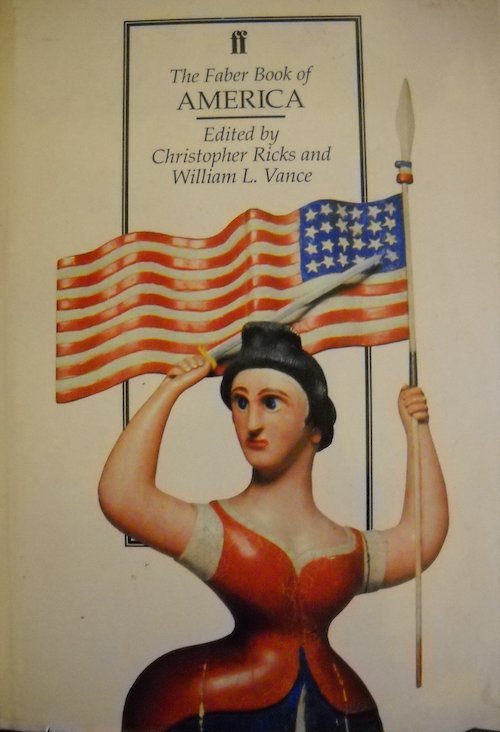
A feminine figurine fighter is graces the cover of the 1992 edition

cover faber book of america 1992

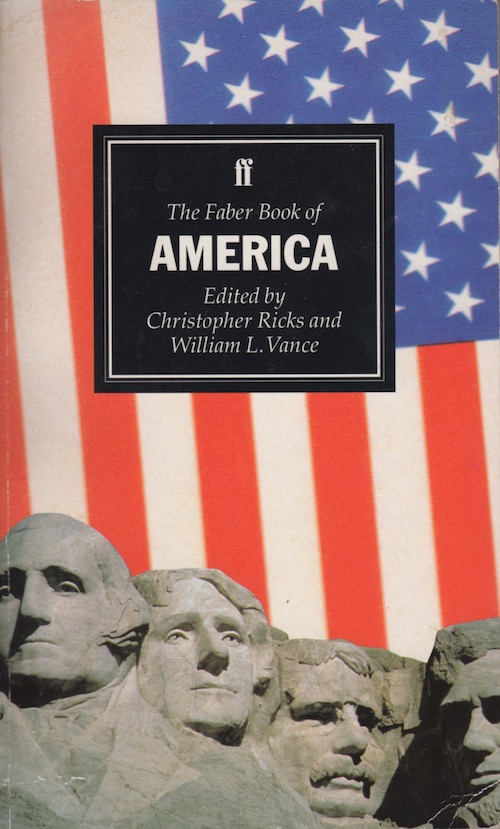
The 1994 edition is of flag and Mount Rushmore

cover faber book of america - flag plus rushmore illustration

It’s the back cover that attracted by attention with its encounter with the theme of myth-making

back cover faber book of america - confederate flag

Here transcribed

A triumph, transcending the usual pot-pourri of anthologies, and offering us an analysis of North America itself — land of mythology and contradiction.
Observer

The Faber Book of America resembles the country it celebrates: a big fat grab-bag filled with brilliance, junk, dizzying contrarieties, fast dreams and rich comforts.
Times Educational Supplement

There are black, Spanish, Chinese, Indian Americas; there are gendered and religiously divided Americas; there are Americans with and without homes. It is a great virtue of Rick’s and Vance’s anthology that it represents all these strands in American life without losing the thread of the country’s hopeful myth about itself.
Independent

Ricks and Vance have a lively sense of the troubles that tend to accompany American virtues.
Times Literary Supplement

The Faber Book of America edited by Christopher Ricks and William L. Vance.

And so for day 2105
17.09.2012

Posted in Booklore | Tagged | Leave a comment

Propagation

Some history and some speculation…

The saga of Jefferson and his favorite herb, tarragon, is a typically exasperating story of failure and futility. Jefferson likely encountered tarragon, or estragon, while in Paris as minister to France. After returning home in 1793 he wrote his French neighbor Peter Derieux that it “is little known in America.” Perhaps because of tarragon’s noticeable absence from the French cuisine at the President’s House, Jefferson in 1805 asked J.P. Reibelt, a Swiss book dealer in New Orleans, to procure him seed. The genuine tarragon used for cooking and vinegar rarely produces seed but is easily propagated from root divisions. Jefferson never realized this, and his fervent search for the seeds is a key reason tarragon may never have been established in the garden. By 1813, after various plantings of roots, plants, and seeds, Jefferson reported tarragon in both square XVII and in the submural beds below the garden wall. These were seed-propagated plants from steamy New Orleans and were more likely what is today called Russian tarragon, an inferior sort that mimics but fails to match the sweet, liquorice-like flavor of the genuine article.

Peter J. Hatch. A Rich Spot of Earth: Thomas Jefferson’s Revolutionary Garden at Monticello

And so for day 2104
16.09.2012

Posted in Food Writing, Gardens | Leave a comment

Homophonica

Michele Leggott
Milk & Honey
“tourbillon 1”

I am arrested by a line and a reduplication of sound across meaning

almost the lobe of l’aube

a sliver of morning light comes to mind and the “lobe” becomes breast-like

almost the lobe of l’aube
or the painted nipples sucked hard
and squirting rosewater
full of pectin full of petals, the parallel
world is a mouth mapping

It reminds one of an aubade, a morning love song filled with a serene eros…

And so for day 2103
15.09.2012

Posted in Poetry | Leave a comment

Ecce Ecco

Look here!

I was intrigued by the “half” anaphora in these opening lines by Pier Giorgio Di Cicco.

Love breaks where no light shines,
this is the dark heaven;
the real thumbnail;
the rain of sadness

Just itching to re-imagine a fulsome anaphora

this is the dark heaven;
this is the real thumbnail;
this is the rain of sadness

But later in the poem I understand the appeal of the “half” anaphora for we come upon a “full” anaphora:

this song is made up of three terrors;
one is the terror of self;
one is the terror of others,
one is the terror of having loved and missed it;

For the life of me I can’t follow the punctuation at the end of the lines. It seems as capricious as the terrors — half broken as love.

The unadulterated lines are from “Ecco” in The Tough Romance.

Ecce = Latin for “look”
Ecco = Italian for “here”

And so for day 2102
14.09.2012

Posted in Poetry | Tagged | Leave a comment

how sweetly flows that liquefaction

Michael Lavers
from The Burden of Humans in New Ohio Review
https://www.ohio.edu/nor/a/content/pdfs/lavers.pdf

The frost tattoos its sermon on the rose,
but in a language only you can read;

Calls to mind poems by Lorna Crozier in The Garden Going On Without Us
ARTICHOKES

Artichokes never
take off their clothes.
They want seduction,
melted butter, a touch
of wild garlic

It is the implied notion of stitch in the frost tattoos that puts me in mind of the clothes in the poem of the vegetable which is gathered under the title “From The Sex Lives of Vegetables”. And yet there is a distance between the lightheartedness of Crozier and the pathos of Lavers whose lines continue as the subject continues to regard what is read

The frost tattoos its sermon on the rose,
but in a language only you can read;
you have to know that all things pass and perish,
and that what you’ve said is finite, but continue—
as if grand exceptions might be made—
raking the leaves, stacking the wood, hoping
the child falls asleep against your chest,
hoping the blizzard swerves, knowing the wreckage
of the present will be gathered but
not soon, and not by you, because you’re in it,
there somewhere, under the sheet of snow.

And we are out of it licking the butter-soaked artichokes reading Herrick.

And so for day 2101
13.09.2012

Posted in Food Writing, Gardens, Poetry | Tagged | Leave a comment

The Secret to Dip and Sip

Naomi Duguid
Taste of Persia: A Cook’s Travels Through Armenia, Azerbaijan, Georgia, Iran, and Kurdistan

Occasionally an older person in Iran will dip a sugar cube into the tea and then take a bite of it. This is the story I was told to explain the practice: Sometime long ago (in the late 1800s it seems), there was a dispute between the authorities and some of the foreign (mostly English) sugar merchants about pricing. The authorities wanted the price to stay down, the merchants wanted a higher price. The authorities played hardball by having the mullahs at the mosques declare that sugar was haram, or unclean. Suddenly no one would buy sugar. This forced the merchants back to the negotiating table and eventually a deal was reached. But how to change the decree about sugar being haram? Simple: The mullahs declared that dipping sugar into tea made it clean.

Graham Plaster gives a another take on the story

This came about because in the late 1800s, the Shah of Iran gave a sugar cube concession to a Belgium monopoly which resulted in the bazaari merchants and clergy protesting and issuing a fatwa declaring the Belgian sugar cube as “haram”. The royal court swiftly had another mullah issue a rebuttal fatwa declaring that because the Iranian tea was pure and “halal”, all Iranians had to do was to dip the sugar cube into the tea and purify it before drinking the tea. To this very day some Iranians do this ritual, many of them not knowing why they do it.

http://www.cultureready.org/blog/tea-culture-around-world-legend-tradition

Looks like Plaster drew upon Dariush Gilani

When the bazaari merchants protested against sugar cube concession given to Belgium a clergy gave a fatwa declaring the Belgian sugar cube as “haram”. The royal court swiftly had another mullah issue a rebuttal fatwa declaring that because the Iranian tea was pure and “halal”, all Iranians had to do was to dip the sugar cube into the tea and purify it before drinking the tea. To this very day some Iranians do this ritual, many of them not knowing why they do it.

https://iranian.com/main/2011/aug/iran-owes-mullahs-one-government.html

A good story is worth copying but a note to the source would be nice. One more variation offered by Arron Merat [asked what team is he rooting for and offered tea on the basis of the response]:

“You are for Esteghlal?” one man asks me pointedly. I nod, hoping to guess right. “Then you are my friend.” From under his chair he pulls out a little bag from which emerge several tiny glasses, saucers, a flask of tea and a silver dish containing jagged sugar cubes. He pops one between his front teeth as he sips his tea.

He explains that a hundred years ago a cleric issued a fatwa to boycott sugar because the Shah had permitted Belgium an official monopoly on Iran’s sugar. Iranians duly followed the fatwa but deemed it highly inconvenient and were relieved when another mullah decreed that it was OK, religiously, to consume sugar with tea as long as it is not mixed in the glass but held in the mouth. Even now, almost all Iranians take their sugar this way.

https://www.theguardian.com/travel/2014/jun/21/discovering-iran-tour-caspian-sea-persian-gulf

Now off to put the kettle on…

And so for day 2100
12.09.2012

Posted in Food Writing | Leave a comment