The Human Element: Modern Business Managment

At the beginning of Mast Brothers Chocolate: A Family Cookbook one finds the business principles that guide their philosophy and practice. They are called “Seven Crowns” and they are:

  • Love, respect, and serve family and community
  • Master your craft
  • Make everything delicious
  • Waste nothing
  • Connect customers to the source
  • Innovate through simplicity
  • Be honest and transparent

I want to focus in particular on connecting customers to source. The Mast brothers describe this as

We are nothing without our farmers. In every way possible, we must pay tribute to them and share their work. Connect the dots.

For me, this sets the stage for blockchain technology to be used in the service of source verification. It also speaks to the need for human relations in supply chain management. No technology will suffice on its own.

I like how the crowns interlock. And if one fails, the whole edifice topples.

And so for day 2099
11.09.2012

Posted in Food Writing | Leave a comment

Charm Bibbles Over and Over

I had seen the title many times offered by various booksellers over the years. It was Ruby Tandoh’s savouring of the mean aunts that tipped me into actually reading James and the Giant Peach by Roald Dahl. And indeed Aunt Spiker and Aunt Sponge are as Tandoh’s says “really quite funny”.

Who is your favourite literary hero or heroine? Antihero or villain?

This is terrible and deeply childish, but Aunt Sponge and Aunt Spiker in James and the Giant Peach. They’re so cruel and awful and I kind of love them. They feed James burnt crumbs from the oven and make him run around after them all day and chop wood. They’re always bickering between themselves – you’re too thin, you’re too fat, you’re too lazy – I think they’re really quite funny. Merged together, I see something of myself in them.

https://www.theguardian.com/books/2018/feb/05/ruby-tandoh-fine-to-enjoy-ready-meal-eat-up-interview

Quentin Blake captures their essence

Quentin Blake - the aunts in James and Giant Peach by Roald Dahl

And now to the words of Dahl to see how captivating indeed is their description.

Their names were Aunt Sponge and Aunt Spiker, and I am sorry to say that they were both really horrible people. They were selfish and lazy and cruel, and right from the beginning they started beating poor James for almost no reason at all. They never called him by his real name, but always referred to him as “you disgusting little beast” or “you filthy nuisance” or “you miserable creature,” and they certainly never gave him any toys to play with or any picture books to look at. His room was as bare as a prison cell.

All that in one paragraph. Dahl is a prose master — rhythms build inside sentences and among them and occasionally an uncommon word sparkles. Take for instance this description of the bobbing peach:

And indeed they were. A strong current and a high wind had carried the peach so quickly away from the shore that already the land was out of sight. All around them lay the vast black ocean, deep and hungry. Little waves were bibbling against the sides of the peach.

To bibble: the OED informs us is like the dabbling of ducks.

Perfect word in the perfect place and likewise the virtuoso performance of course is at play when describing a virtuoso, the Old-Green-Grasshopper:

He was using only the top of his back leg (the thigh), and he was stroking this up and down against the edge of his wing with incredible skill, sometimes slowly, sometimes fast, but always with the same easy flowing action. It was precisely the way a clever violinist would have used his bow; and the music came pouring out and filled the whole blue sky around them with magic melodies.

Apt self-description of the words on the page!

And so for day 2098
10.09.2012

Posted in Food Writing | Leave a comment

What is a Godlfish?

Pier Giorgio Di Cicco
“Aunt Margaret” from The Tough Romance
1979 rpt Guernica Editions, 1990

[…]
There was a marshy patch behind her house. When Sundays
brought the family to her rooms, I’d hunt the
puddled grass for frogs and drown them in a jar, fling them
     at
walls, singe ants with glasses. Inside the house
I drowned the goldfish, choked the parakeets, and made
a paraphernalia of hell the size of those too big to kill.

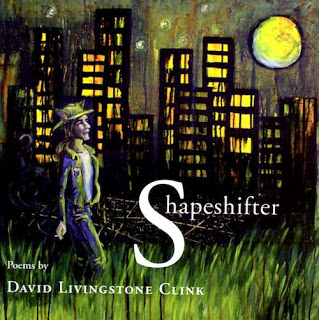
In Shapeshifter “The Last Breath of One Such As Us”, David Livingstone Clink writes a glossa based on this passage and introduces some accidentals (single for singe and godlfish for goldfish) and the lineation is off.

… I’d hunt the puddled grass for frogs
and drown them in a jar, fling them at walls,
single aunts with glasses. Inside the house
I drowned the godlfish, choked the parakeets

A trip to the library to check against the 1979 edition by McClelland and Stewart. The lineation is closer to Clink’s quotation.

There was a marshy patch behind her house. When Sundays
brought the family to her rooms, I’d hunt the
puddled grass for frogs and drown them in a jar, fling them at
walls, singe ants with glasses. Inside the house
I drowned the goldfish, choked the parakeets, and made
a paraphernalia of hell the size of those too big to kill

Almost made a transcription error of my own. Reading “puddle grass” for “puddled grass”. Such is the power of shapeshifting letters…

cover - David Livingstone Clink - Shapeshifter
Believe Your Own Press, 2004

And so for day 2097
09.09.2012

Posted in Poetry | Tagged | Leave a comment

Bundle Magic

I have thought about the similarities of carrying a bundle and having ready-at-hand a smartphone. Both are portable and both offer access to a phenomenological experience that lifts one out of the now into a future-to-be-built-on-the-past. As Beth Cuthand says about bundles

And where he walks, his bundle walks
humming softly old sounds in new time.

Closing lines of “His Bundle” in Voices in the Waterfall (Lazara Press, 1989)

The affinities came to mind again in reading this piece from the Globe & Mail.

Can we ever kick our smartphone addiction? Jim Balsillie and Norman Doidge discuss

Privacy and mental health are inextricably linked, especially for young people. You need periods of privacy to form a self and an identity, a task not completed until at least the late teens. Having an autonomous, spontaneous self is the result of a long psychological process where you have time to “step back” from the crowd, and from your parents, to reflect. It requires time to let that self – your true feelings, your own quirky, uncurated reactions – emerge, spontaneously.

Time alone with the objects of one’s bundle.

But the smartphone in their account falls short. A note of caution is sounded — one of the technologies delivered by a smartphone is a net to capture attention:

The new phones foster enmeshment with parents, and the world, and hamper individuation, the process of becoming a unique individual, because kids are overconnected. And peer groups at that age can be Lord of the Flies cruel – and often love to mercilessly hunt down, expose and denounce the eccentricities of emerging individuals.

Still, even in that enmeshment there must be uncurated moments where one uncrates history. Still.

Louis David, to you
   I transfer my bundle.
It is small and humble
   wrapping little things,
   a bone
   from the last buffalo,
   a stone
   from the Assiniboine,
   a small pipe and
   tobacco pouch
and
   a feather
   from the broken wing
   of one
   who flew too low.

From Beth Cuthand “He Told Me” in Voice in the Waterfall

On being tracked (and not being located)…

In Star Trek: The Original Series (TOS), communicators functioned as a plot device, stranding characters in challenging situations when they malfunctioned, were lost or stolen, or went out of range. (Otherwise, the transporter could have allowed characters to return to the ship at the first sign of trouble, ending the storyline prematurely.[1]) https://en.wikipedia.org/wiki/Communicator_(Star_Trek)

On carrying (and being carried)…

In many Indigenous cultures, bundles play an important role in health and well-being. Physical bundles (i.e. a collection of sacred items that are important to a given person, such as eagle feathers, medicines, a pipe, etc.) are often carried by Indigenous peoples attending ceremony. Similarly, some Indigenous cultures believe that when a child is born they come into the world with a spiritual bundle which holds all of the gifts the Creator gave to them. Both physical and spiritual bundles serve the purpose of helping a person to engage with creation in a healthy and balanced way.

Working with Indigenous families: An engagement bundle for child and youth mental health agencies published by Ontario Centre of Excellence for Child and Youth Mental Health.

Exploring the techne analogies further one comes to appreciate the temporality of use which leads to either interrupted stories or disruptions for stories? Breaks in time to produce the privacy necessary for a strong sense of self.

And so for day 2096
08.09.2012

Posted in Uncategorized | Tagged | Leave a comment

Name Game Dream

A lexically-inflected oneiric moment…

I had a dream about the Indigenization of the [Ontario] civil service.

The Ministry of Education would be known as the Ministry of Human Development. And the Ministry of Advanced Education and Skills Development would be known as the Ministry of Later Human Development (and Seniors Affairs and Long-Term Care would now fall under its purview). Cabinet Office would be known as “All My Relations”. Ministry of Indigenous Relations and Reconciliation got oddly but aptly renamed “Indigenous Interfaces”.

I woke up before the changes could be ratified.

I truly grok the interfaces piece.

And so for day 2095
07.09.2012

Posted in Uncategorized | Leave a comment

Lines, Designs, Reflections

Robbie Robertson “Unbound”

Oh nothing is forgotten
Only left behind

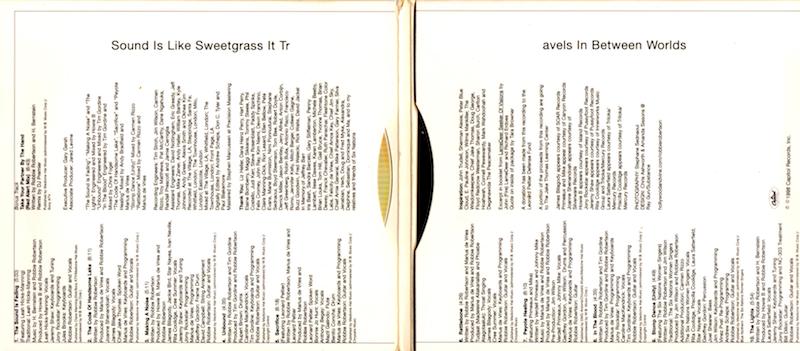
And I open the CD envelope for this production doesn’t come in a jewel case.

Red Boy - inner sleeve of CD cover - Sound is Like Sweetgrass It Travels in Between Worlds

The eye traverses the space; the mind mends the breach. So like the themes of many of the songs on the album.

Sound is Like Sweetgrass It Tr        avels in Between Worlds

CD Cover - Robbie Robertson - Contact from the underworld of Redboy

The cover complicates contact by reversing the “C” and other letters — ʇɔɐʇuoɔ brought to life here by the mirror generator https://www.web2generators.com/text-related-tools/write-upside-down

Finding a way to lost tools.

And so for day 2094
06.09.2012

Posted in Uncategorized | Tagged | Leave a comment

Appreciation

At the very beginning of her introduction, Elisabeth Andoh sets the bar high:

KANSHA means “appreciation,” an expression evident in many aspects of Japanese society and daily living. In a culinary context, the word acknowledges both nature’s bounty and the efforts and ingenuity of people who transform that abundance into marvellous food. In the kitchen and at table, in the supermarket and out in the gardens, fields, and waterways, kansha encourages us to prepare nutritionally sound and aesthetically satisfying meals that also avoid waste, conserve energy, and sustain our natural resources.

from Kansha: Celebrating Japan’s Vegan & Vegetarian Traditions

And so for day 2093
05.09.2012

Posted in Food Writing | Leave a comment

Pity the Partitions

Juxtaposing Emily Dickinson with Jean Genet’s Un chant d’amour and its famous exchange of smoke.

I plucked at our Partition
As One should pry the Walls —
Between Himself — and Horror’s Twin —
Within Opposing Cells —

I almost strove to clasp his Hand,
Such Luxury — it grew —
That as Myself — could pity Him —
Perhaps he — pitied me —

It is the reciprocal emotion — so near —

And so for day 2092
04.09.2012

Posted in Poetry | Leave a comment

Tapping Into Shaker Love of Rhyme and Rhythm

I have grown in my appreciation of the literary and artistic productions of the Shakers (not just their exquisite buildings and furniture) thanks to the Hamilton College Library, Clinton, NY

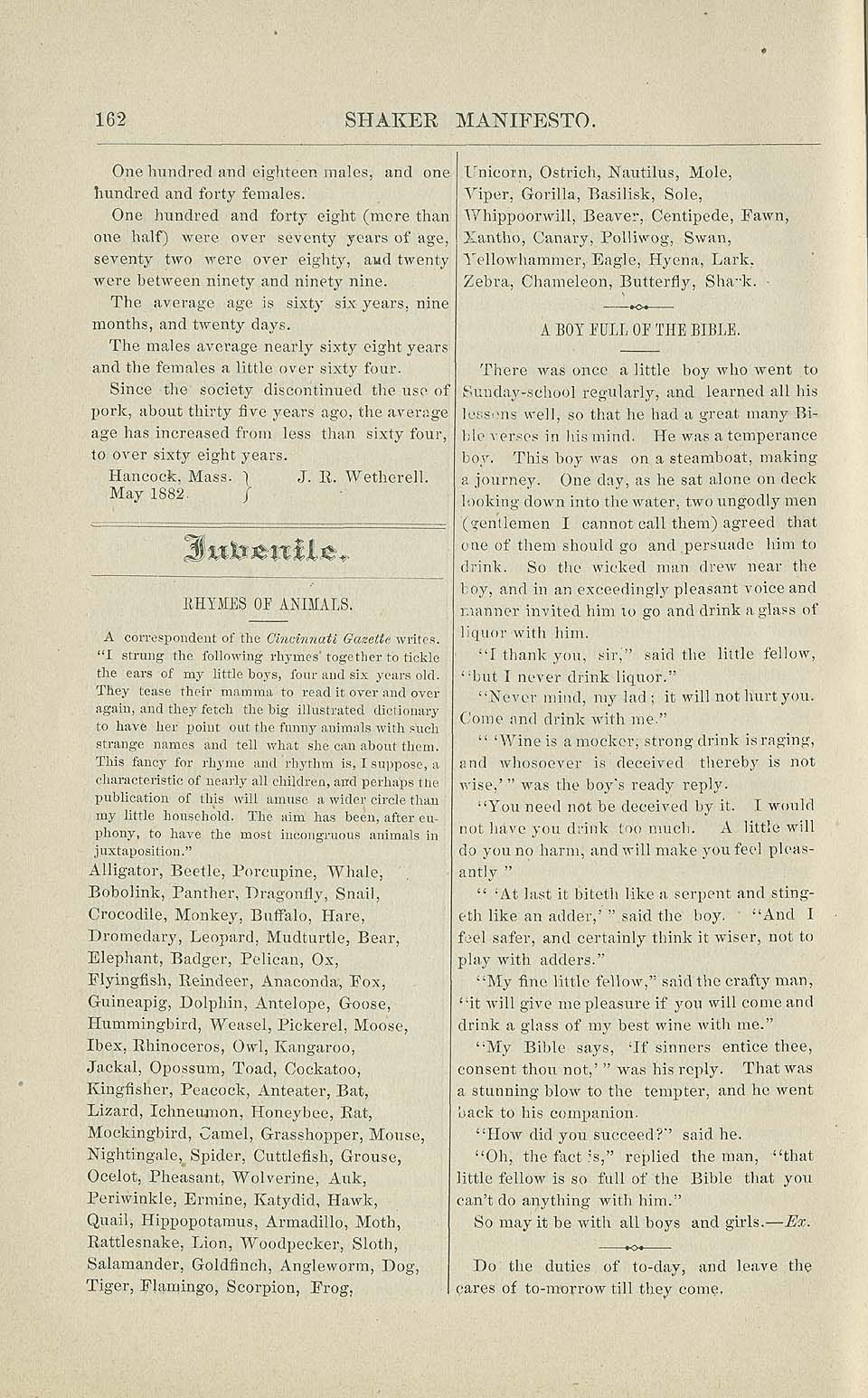
Shaker Manifesto – Rhymes of Animals

from Shaker Manifesto - ABC - rhymes of animals

Rhymes of Animals

A correspondent of the Cincinnati Gazette writes. “I strung the following rhymes together to tickle the ears of my little boys, four and six years old. They tease their mamma to read it over and over again, and they fetch the big illustrated dictionary to have her point out the funny animals with such strange names and tell what she can about them. This fancy for rhyme and rhythm is, I suppose, a characteristic of nearly all children, and perhaps the publication of this will amuse a wider circle than my little household. The aim has been, after euphony, to have the most incongruous animals in juxtaposition.”

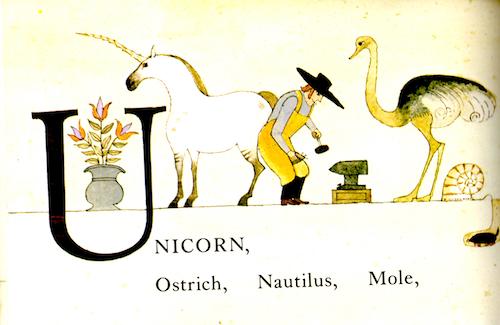
I was sent to the source (Shaker Manifesto, July 1882) by A Peaceable Kingdon: the Shaker Abecedarious illustrated by Alice and Martin Provensen. I note some variants. The Provensens split Guinea Pig into two words and add an “s” to Xanthos. Otherwise it is the same fascinating list. Augmented by their delicate drawing which a scan doesn’t do justice.

page from Shaker ABC - Unicorn, ostrich, Nautilus, Mole

While reading the Shaker Manifesto, I notice on the page previous to the ABC in the Society Record – death announcements including the suicide of Charles Miner done in a very understanding fashion, touching by its approach to mental health.

http://dlib.hamilton.edu/dl-sha/parse/display_hdr.php?display=object&page=21

And so for day 2091
03.09.2012

Posted in Booklore | Leave a comment

Zen of Cooking – Zazen of Eating

Ruby Tandoh invites us to be contemplative…

Waiting for a pan of water to come to the boil is a kind of therapy — being forced to slow down, chill out and be patient while you watch a shimmer of movement creep across the water, as the heat brings it to life.

And immediately knocks us for a loop into sensuality.

And that’s before you’ve even started eating…

from the introduction to Flavour: Eat What You Love.

And so for day 2090
02.09.2012

Posted in Food Writing | Leave a comment