Whither Eros

Howard Gardner (5 Minds for the Future) on the Respectful Mind…

We homo sapiens must somehow learn how to inhabit neighboring places — and the same planet — without hating one another, without lusting to injure or kill one another, without acting on xenophobic inclinations even if our own group might emerge triumphant in the short turn. Often the desideratum tolerance is invoked, and it may be the case that it is all that we can aspire to. Wordsmiths of a more optimistic temperament opt for romantic language; on the eve of World War II, poet W.H. Auden declared, “We must love one another or die.”

Gardner sets this up as mere pretty words. Indeed he continues in the next paragraph to accept neither love nor hate.

I prefer the concept of respect. Rather than ignoring differences being inflamed by them, or seeking to annihilate them through love or hate. I call on human beings to accept the differences, learn to live with them, and value those who belong to other cohorts.

After this dismissal, I needed to see for myself just what the poet was advancing. That bit from Auden is the last line of the penultimate stanza of September 1, 1939 which ends with this stanza:

Defenceless under the night
Our world in stupor lies;
Yet, dotted everywhere,
Ironic points of light
Flash out wherever the Just
Exchange their messages:
May I, composed like them
Of Eros and of dust,
Beleaguered by the same
Negation and despair,
Show an affirming flame.

Composed: both made up and serene. The key is in the affirmative irony. Although Gardner poses Auden’s adage as if it were a completely isolated sentence, we can construe a less than monological meaning upon reviewing its context. It’s part of a series that actually endorses Gardner’s beyond-the-cohort view:

There is no such thing as the State
And no one exists alone;
Hunger allows no choice
To the citizen or the police;
We must love one another or die.

That “we” becomes more complex in context. We, both citizen and police, are not alone. And hunger impels the choice. Or rather negates the choice. We die. But how we die depends upon how we love.

And so for day 2079
22.08.2012
Posted in Poetry | Tagged | Leave a comment

Again A Gain

Like playing hangman.

REPETITION. — It is an excellent thing to express a thing consecutively in two ways, and thus provide it with a right and a left foot. Truth can stand indeed on one leg, but with two she will walk and complete her journey.

Nietzsche, Human All Too Human

Came across this via a recommendation by Dr. Herbert Wender to look at “The Wanderer and his Shadow” and was assured that a walk through this text was “virtually a real ‘Wanderlust'”.

And so for day 2078
21.08.2012

Posted in Uncategorized | Leave a comment

Setting The Pace: Pacing the Set

The opening chapter of Rebecca Solnit’s Wanderlust: A History of Walking brings the simple act of walking into the gambit of cogitation.

Moving on foot seems to make it easier to move in time, the mind wanders from plans to recollections to observations. The rhythm of walking generates a kind of rhythm of thinking, and the passage through a landscape echoes or stimulates the passage through a series of thoughts. This creates an odd consonance between internal and external passage, one that suggests that the mind is also a landscape of sorts and that walking is one way to traverse it.

And as if she were ringing the changes on the notion of inventio — the finding:

A new thought often seems like a feature of the landscape that was there all along as though thinking were travelling rather than making.

If we retrace the paragraph we hear the consonance between “traversing” and “travelling”. It is all mapped out and yet open to rediscovery.

And so for day 2077
20.08.2012

Posted in Uncategorized | Tagged | Leave a comment

Where Has Been There Will Be

This begins like a call and response and turns into a round and then closes with a synoptic clincher.

Answer July … #386

Answer July –
Where is the Bee –
Where is the Blush –
Where is the Hay?

Ah, said July –
Where is the Seed –
Where is the Bud –
Where is the May –
Answer Thee – Me –

Nay – said the May –
Show me the Snow –
Show me the Bells –
Show me the Jay!

Quibbled the Jay –
Where be the Maize –
Where be the Haze –
Where be the Bur?
Here – said the Year –

Emily Dickinson varies the verbs in the questions and thereby conditions the move out of time to view the whole cycle. Each of the three initial stanzas has a single speaker. The last stanza has two. And the one last voice has only one line — adding a curt aspect to its decisiveness.

And so for day 2076
19.08.2012

Posted in Poetry | Tagged | Leave a comment

Almost a Scar

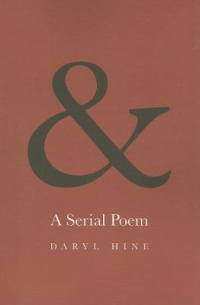
It’s a wonderfully rambling poem & A Serial Poem by Daryl Hine which through a circuitous route brings you back to a variation on a Latin tag about omens and spirit once in a negation and once in an affirmation and both times apt for the spot in the cycle.

Here are two lines (from #280)

Psychosomatic pain is all it takes
To convince us every poem is an open wound.

There is a tiny grain of skepticism here. It is salutary.

Like the cover

cover - & A Serial Poem by Daryl Hine

We are asked to think the next turn and recall “and”

And so for day 2075
18.08.2012

Posted in Booklore, Poetry | Leave a comment

Breath Unto Breath

Deep calleth unto deep at the noise of thy waterspouts: all thy waves and thy billows are gone over me. (Psalm 42:7)

Some, of course do pass out — right out of the circle. But if anything besides rage is clear in these drowning surroundings, it’s the clarity of those few who seem to quicken in their sickness and dying, those gifted few who stay awake as they fall away, and offer to us attendant comrades instructions from the beyond, or the going-beyond. [1991]

Aaron Shurin “Further Under” from Unbound: A Book of AIDS collected in The Skin of Meaning: Collected Literary Essays and Talks.

How to live to the very last moment these our teachers gave to us. And what does this mean? An example is how Shurin reads Jean Genet’s trail of smoke in Un Chant d’Amour: “When one prisoner passes his lifebreath of cigarette smoke through a hole in the wall along the length of a straw to his friend, it contains the beauty of every secret exchange, glance, letter, or touch passed from man to man or woman to woman through the ages of heterosocial domination. And honey, nobody — not even Bette Davis — has ever, before or since, smoked on screen like that! [1990]

A going-beyond…

And so for day 2074
17.08.2012

Posted in Uncategorized | Leave a comment

Counting Sections

Phillip B. Williams

“He Loved Him Madly” is a partial (15-section) pecha kucha for my father, Calvin Ford, and uses titles from Miles Davis compositions (odd-numbered stanzas) and various Hip Hop and spoken word tracks (even-numbered stanzas). In order of appearance, artists of the even-number stanzas are Boogie Down Productions, Jay-Z, The Notorious B.I.G., Amiri Baraka, Wu-Tang Clan, Scarface, and Nas.

from the notes to Thief in the Interior

And with the note that makes 16.

And so for day 2073
16.08.2012

Posted in Poetry | Leave a comment

Protected: The Text Stares Back – materials

This content is password protected. To view it please enter your password below:

Posted in Uncategorized | Enter your password to view comments.

The Text Stares Back

In John Edgar Wideman’s Hiding Place there is a passage which puts one in mind of Story of the Eye by Georges Bataille if only because of the preponderance of eyes.

Once upon a time. Once upon a time, he thought, if them stories I been hearing all my life are true, once upon a time they said God’s green earth was peaceful and quiet. […] You’re in a story. […]

And it continues. [with password: stanza]

And so for day 2072
15.08.2012

Posted in Uncategorized | Leave a comment

Nobody’s Mama

John Edgar Wideman. Hiding Place.

When you finish you bring that bowl up here. That’s all there is and ain’t nothing else. Just set it here by mine. We ain’t got no waitress service here. I don’t like to cook. Never did and never will. Don’t like people talking about my cooking, neither. If people like what I fix they can eat. If they don’t they can leave it setting. Don’t like all that Mother Bess stuff neither. Wish I knew who started that Mother Bess mess. I ain’t nobody’s mama. Was once but that was a million pitiful years ago and ain’t nobody on this earth got the right going around calling me mother now. I told them that. Don’t know how many times I told them. But it’s Mother Bess this and Mother Bess that like I ain’t got sense enough to know my own name and they ain’t got sense to listen when I tell them I ain’t nobody’s mama.

If you think that this diatribe is gratuitous, you need to be mindful of the step and fetchit grinning and praise of the soup that preceded this: “You make some dynamite soup, Mother Bess. It’s not him talking. it’s some jive jack-leg preacher grinning and wiping grease from his liver lips and rolling his eyeballs at the platter of fried chicken he’s already eateh half of…”

And so for day 2071
14.08.2012

Posted in Food Writing | Leave a comment