Follow the Breath

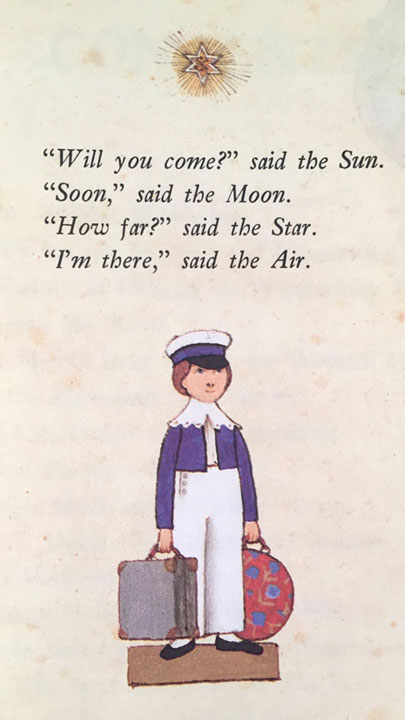
This little set of verses set as an “exergue” reminds one of the practice of being mindful of breathing.

“Will you come?” said the Sun.
“Soon,” said the Moon.
“How far?” said the Star.
“I’m there,” said the Air.

verse from A visit to William Blake's Inn by Nancy Willard - illustration by Alice and Martin Provensen

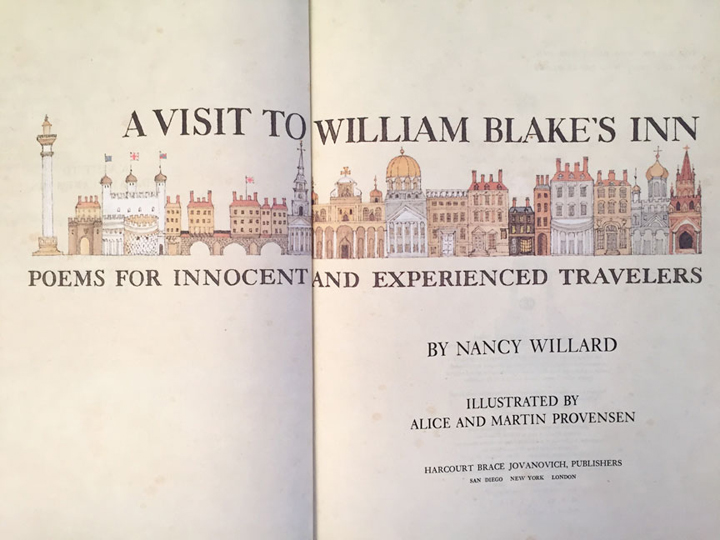
Title page - A Visit to William Blake's Inn - illustrated by Alice and Maretin Provensen - poems by Nancy Willard

A Visit to William Blake’s Inn: Poems of Innocent and Experienced Travellers by Nancy Willard. Illustrated by Alice and Martin Provensen.

And so for day 2060
03.08.2012

Posted in Poetry | Leave a comment

Perspective & Proportion

Mary Cornish
from “The Laws of Japanese Painting”
in Red Studio

If a mountain is ten feet high, the trees
should be one foot, the horse one inch, and a man
the size of a bean.

The image of the bean brings to mind for me those primary school projects where a bean is sprouted in a glass and we could see the hairs on the roots and the leaves unfold from the cotyledon. Without proper soil of course they perished. Of course any plant eventually perishes. Such are the thoughts that grow from contemplating man as bean.

And so for day 2059
02.08.2012

Posted in Poetry | Tagged | Leave a comment

Blackboy Utopia

Danez Smith in Don’t Call Us Dead creates a utopian space in which to reinvigorate the Black psyche through an artful homoerotics. He saves the body. The mind bends the body politic to imagine another place and another time beyond wounds.

that boy was Trayvon, now called RainKing.
that man Sean named himself i do, i do.

O, the imagination of a new reborn boy
but most of us settle on alive.

from “summer, somewhere”

The fanciful can take a whimsical turn (which then turns to a deep contemplation of the logics of culture).

let’s make a movie calld Dinosaurs in the Hood.
Jurassic Park meets Friday meets The Pursuit of Happyness.
there should be a scene where a little black boy is playing
with a toy dinosaur on the bus, then looks out the window
& sees the T.rex, because there has to be a T.rex

[…]

no bullet holes in the heroes. & no one kills the black boy. & no one kills
the black boy. & no one kills the black boy. besides, the only reason
i want to make this is for the first scene anyway: little black boy
on the bus with his toy dinosaur, his eyes wide & endless

                                        his dreams possible, pulsing, & right there.

from “dinosaurs in the hood”

As crazy as a Barmecide feast in Peter Pan or a generalized ability to manipulate illusions

if you don’t
eat the imaginary potato (grown in an
imaginary field, baked in in imaginary
oven) your real capacity
to imagine illusion lessens:

A.R. Ammons from The Ridge Farm

Worth noting that “illusion” has in its etymological roots in the verb “to mock” — a defence mechanism. [Middle English (in the sense ‘deceiving, deception’): via Old French from Latin illusio(n-), from illudere ‘to mock,’ from in- ‘against’ + ludere ‘play.’]

And so for day 2058
01.08.2012

Posted in Poetry | Tagged | Leave a comment

Balance and Schadenfreude

A poetic take on predator-prey cycles.

“The Hinge of Spring”

The jackrabbit is a mild herbivore
[…]
eating the color off everything
rampant-height or lower.

Rabbits are one of the things
coyotes are for. One quick scream,
a few quick thumps,
and a whole little area
shoots up blue and orange clumps.

Kay Ryan collected in The Best of It: New and Selected Poems

And so for day 2057
31.107.2012

Posted in Poetry | Leave a comment

Rough Notes from Eells on Pater on Mona Lisa

Emily Eells
Proust’s Cup of Tea: Homoeroticism and Victorian Culture (2002)

p. 183-148

Pater – homoerotic ’Conclusion’ of The Renaissance dropped from second edition; replaced by frontispiece

His description of it makes his meaning clear:

a face of doubtful sex, set in the shadow of its own hair, the cheek-line in high light against it, with something voluptuous and full in the eyelids and the lips.

The title of the 1873 edition – Studies in the History of the Renaissance – was changed to The Renaissance: Studies in Art and Poetry in the 1877 edition.

p. 190

Pater’s implicit stress on the sexual ambiguity of the Mona Lisa is particularly perceptive, as computer-generated images have revealed that the face with its enigmatic smile in fact conceals a self-portrait of da Vinci. Until recently, John the Baptiste hung alongside the Mona Lisa in the Louvre, a juxtaposition which made the striking similarity in their androgynous faces all the more apparent.

See Lillian Schwartz, “Leonardo’s Mona Lisa” Art and Antiques (January 1987) pp. 50-54

Assessment of the claim : Antoinette LaFarge (Oct 1996). “The Bearded Lady & the Shaven Man: Mona Lisa, Meet Mona/Leo”. Leonardo: The Journal of the International Society of Art, Science, and Technology.

And so for day 2056
30.07.2012

Posted in Uncategorized | Leave a comment

Intellectuals and Poses

I am fond of exploring group dynamics and the plurality of roles. For some reason, I find myself thinking about the Divergent Factions in the fictional universe created by Veronica Roth (see http://divergent.wikia.com/wiki/Factions). I am intrigued by how they resemble the poses of the intellectual vis-a-vis society [Abnegation • Amity • Candor • Dauntless • Erudite • Factionless].

It’s a reach but not so much when I read this in a profile of Robert Morrison, an expert on De Quincey

“I once had a teacher who told me that the scholar has two roles,” says Morrison. “He [she] is both a monk and an actor. The monk is the scholar when [s]he’s doing research, the actor is when [s]he’s in the classroom, teaching.”

http://www.queensu.ca/research/humandimensions/morrison

And so for day 2055
29.107.2012

Posted in Uncategorized | Leave a comment

Still Life and A Fan of Links

The idea that nests and insects (butterflies) can figure the regeneration of life in a nature morte stems from this blog entry

https://berneval.hcommons-staging.org/2010/06/02/on-tulips-vanitas-and-collecting/

and a search of vanitas + birds + nests

led to the work of Kimberly Witham https://www.kimberlywitham.com

From an interview: http://atlengthmag.com/tag/vanitas/

KW: I once heard an expression about artists—that their favorite pieces are the ones they are about to make. I can’t say I have favorites exactly, but there are images which continue to resonate with me – I find myself thinking – “wow, I made that?” I am still in the process of moving into my new home, but I do have a print of “On Ripeness and Rot #10 (raccoon)” ready to hang on the dining room wall. That photograph is an ode to Jan Weenix, a Dutch painter I love. The image expresses abundance and decay in equal measure. It reflects my current mind set well. I also have work by many other artists in my home. I have some of Sarah Sudhoff’s pieces (we traded years back). I also have a portrait of Francesca Woodman, and a really beautiful sculpture by a former classmate of mine, Petra Kralickova.

More names, more links…

https://en.wikipedia.org/wiki/Jan_Weenix

http://www.sarahsudhoff.com

https://www.artslant.com/global/artists/show/3274-petra-kralickova?tab=PROFILE

Fanned out for display… grace notes.

And so for day 2054
28.107.2012

Posted in Uncategorized | Tagged | Leave a comment

Breasts

A sketch I made back in the 70s.

pencil drawing - breast caress

The gesture depicted brings to mind lines from “Journey” by John Williams collected in The Broken Landscape

[…]

           Toward evening when the wine
Ran out we turned as lovers should
To touch as petals on a darkened vine.

The first Philip Roth novel I read was The Breast: a story of transformation, like so many stories.

And so for day 2053
27.107.2012

Posted in Uncategorized | Leave a comment

Time and In-Betweenness

What is amazing in Mary E. Galvin’s Queer Poetics: Five Modernist Women Writers is her ability to draw upon sources that might be disdained in academic or theory circles. Witness what she does accomplish with an image from Judy Grahn while discussing the figure of the Poetess in H.D. [of course she also draws upon Robert Duncan’s The H.D. Book). What emerges is a fuller understanding of the figure and its import.

Motivated by the need to open up social/intellectual/psychic space for queer existence, H.D. sought, in the freedom of modernism, to piece together the significance of her personal experiences through the techniques of imagism within the palimpsest of myth. This is the ancient role of the Poetess, the role H.D. recreated for herself. In Another Mother Tongue, Judy Grahn has described this office:

In tribal culture we often formed a pool of potential initiates some of whom became the shamans and medicine people, who can enter the spirit world, the wind, the mountains and rivers and the bottom of the sea; the worlds of the dead, or spirits, of other people’s minds, of the gods and their forces; we it is who bring back the strange and old messages, interpreting them for the benefit of our tribe. Anciently we were sometimes rewarded and esteemed for this (Grahan, 273)

The difficulty in reading H.D.’s poetry arises not because she was being intentionally obscurantist in regard to the facts of her life, but because she was attempting to convey “another state of emotional life or being, a life of being that contained the past and the future.”

Galvin is quoting from H.D.’s Paint It Today

The past and the future, morning and evening star, hung there, a beacon in the darkness between this world and the future, the present and the future. She had, through the clarity of her youth, through the intensity of her passion, and through that fate or chance that had thrown her in Josepha’s way at a curious psychological moment (at the moment when she had been touched by the shadow of an understanding, stirred by it, but not awakened), surprised a curious secret, surprised the secret and found the door to another world, another state of emotional life or being, a life of being that contained the past and the future.

Such transhistorical moves are of course of their time.

In its own reach, this discourse with its universalizing the of the interstitial function works in the context of some poets such as H.D. and Robert Duncan. Odd. As in queer.

And so for day 2052
26.07.2012

Posted in Uncategorized | Leave a comment

Filial Fragments

Richard Ronan. “Violets”. Flowers.

this is a farewell poem:
stephan was like my son
in many ways I mean:
like a son I maybe wanted
to have and didn’t and
evidently won’t have I
know that part of wanting
a son for any man is a
bid for something immortal
or at least a second swing
at what he left unresolved
and
another part is like lust

Andrew Holleran. “Foreword”. The Man I Might Become: Gay Men Write About Their Fathers.

In his book Being Homosexual, Richard Isay suggests that this alienation between gay men and their fathers begins in childhood when the father, sensing they are different, withdraws. This is not to say that fathers are still not enormous presences in the lives of their gay sons. Fathers have always been, in life and literature, a mystery we believe we must decipher before we can understand ourselves.

Robert Glück. “Robert Duncan: Tribute”. Communal Nude: Collected Essays.

In the late seventies, a poetry event took place over two nights at the Gay/Lesbian Center on Page Street. Twelve gay men and twelve lesbians read together. This was a very novel idea at the time because the two communities hardly spoke to each other, and the atmosphere was tense. One woman read a poem about a mother verbally abusing her little boy on a bus. There was nervous laughter from some of the men, and the poet stopped midway. Trembling with rage, she told us that she had read the poem many times at women-only events and had never experienced laughter. There was total silence, till Robert called out from the audience that none of those women had ever been the boy in her poem.

Two memories of my own father:

Sitting on one end of the couch nestled close to him, an open book on my lap. He taught me to read.

At potato harvesting or planting (I’m not sure which), a spade raised against me in anger. It never descended.

I now read a queer subtext into the lyrics of “Father and Son” by Cat Stevens: at the very least the song is dual-voiced. A paternal figure in the refrain “Find a girl, settle down / If you want, you can marry / Look at me, I am old, but I’m happy” and what we take to be the son coming to the realization that he must go, he is not heard, “From the moment I could talk I was ordered to listen”.

There are other songs. Other fragments. To read. To query identifications.

And so for day 2051
25.07.2012

Posted in Uncategorized | Leave a comment