Sound Twins

Robin Blaser sounds like Carl Sandburg.

Listen to any of the recordings of Blaser at PennSound.

Compare to Carl Sandburg reading from The Windy City [Chicago] from the Caedmon Poetry Collection: A Century of Poets Reading Their Work.

Chi-ca-go

And so for day 2040
14.07.2012

Posted in Poetry | Tagged | Leave a comment

The Song Still With You

Dane Swan in A Mingus Lullaby displays a piercing humanity.

gess dey scuuured. Cawl de men in da white suites,/tayk me to da pinkhouse on de hill, da funny fawm,/giv’ me a room wit pillows on da wallz, takeway/mi turntable, hav da priest pray ova me, tell mi repent!/I do no such ting! ‘least ma mine iz free. ‘least deez songs/still wit me.

This is the concluding stanza to “Lullaby” which narrates the tale of a music lover that skips church on Sundays and comes to this unhappy end. Swan captures voice well. And not always to achieve pathos.

If it wasn’t for decorum
(and laws) my Hell-o’-Weens
would be a play on irony.
Assaulting Black-faced White people,
While wearing Blackface,
screaming, “Black on Black crime!”

Or eschew irony, wear a white hood
and call them nigger right before I attack.
Watch the glint of innocence
in their eyes fade —
reliving my acts of tyranny on tear-filled pillows

I know I am, but what are you?

This from “Fear — a work in two voices”.

And so for day 2039
13.07.2012

Posted in Poetry | Leave a comment

Just Staring Just Writing

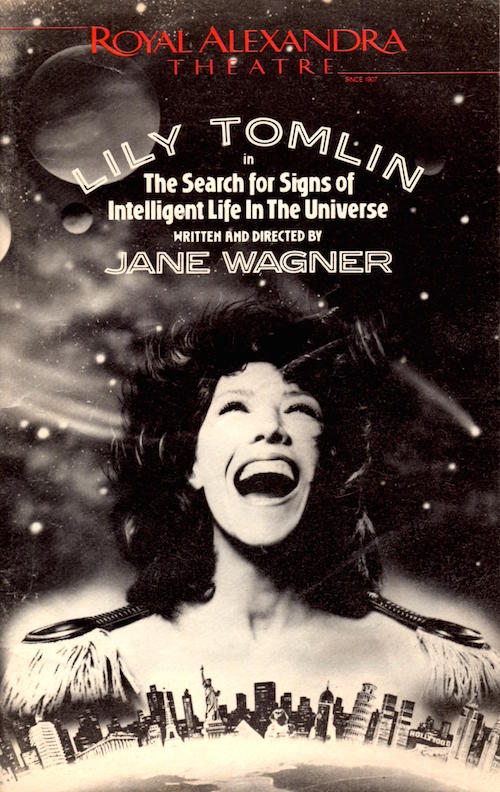
Ephemera from the Royal Alexandra show opens up to a reprinted interview and old chestnut.

cover - program Lily Tomlin Jane Wagner - Search of Signs of Intelligent Life in the Universe

From the programme to Lily Tomlin in The Search for Signs of Intelligent Life in the Universe written by Jane Wagner, this bit on the nature of writing work…

I know I lack discipline. But I also think that being at the typewriter is not absolutely the most important thing about writing. I find it hard to get Lily to understand that I’m writing even when I’m just staring out the window.

Excerpt from an interview with Lily and Jane by Stephen Saban appearing in May 1986 issue of Details. Reminds one of the James Thurber self-reported anecdote:

I never quite know when I’m not writing. Sometimes my wife comes up to me at a party and says, ‘Dammit, Thurber, stop writing.’ She usually catches me in the middle of a paragraph. Or my daughter will look up from the dinner table and ask, ‘Is he sick?’ ‘No,’ my wife says, ‘he’s writing something.’

James Thurber, The Art of Fiction No. 10 interviewed by George Plimpton & Max Steele, Paris Review, Fall 1955.

And so for day 2038
12.07.2012

Posted in Ephemera | Leave a comment

Of Taste and Origins

Originally appearing in the journal Petits Propos Culinaires

The name of the confection in its various forms — French massepain, Italian marzapana, Spanish mazapana — has been a puzzle. “Pain” or “pana,” it is thought, means bread. But what about “maza” or “masse”? I would suggest that it arose from the experience of the Franks and other Westerners in Outremer. They encountered Saracen food and also Saracen alchemy, and may have been aware of the echoes of the alchemical elixir of life in the dietary of the Arabs. The Saracen name for the art was alkhimia. But the Franks called it by a Greek word, maza (Latinised as massa), which had earlier been a term for the bronze used in some of the experiments. For the Franks, the delicious golden pastes of sugar, ground almonds and saffron may well have seemed magical creations, brought into being by the alchemy of the Saracen cooks, and thus earning the name of maza pana — alchemical bread.

C. Anne Wilson. “The Saracen Connection: Arab Cuisine and the Mediaeval West” reprinted in The Wilder Shores of Gastronomy: 20 Years of the Best Food Writing from the Journal Petits Propos Culinaires.

And so for day 2037
11.07.2012

Posted in Food Writing | Leave a comment

A Particular and Peculiar Pair

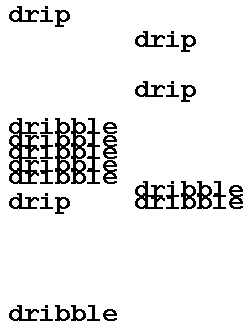
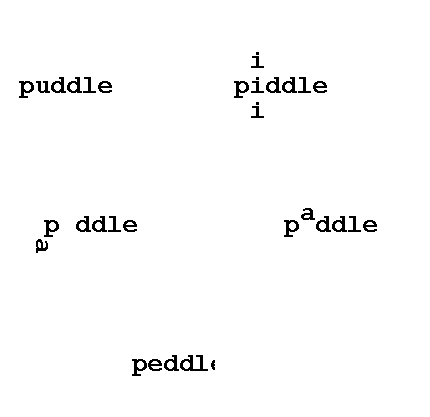
Neil Hennessy has produced a gif(t) set worthy of displaying on the same page.

animated gif - puddle - neil hennessy

Puddle

animated gif - paddle - neil hennessy

Paddle

They have popped up in a number of places (in the past in the Coach House Books archive) persisting at deluxe rubber chicken #2 from 1999. Preserved by the kind folks at the Electronic Poetry Center at the State University of New York at Buffalo.

And so for day 2036
10.07.2012

Posted in Poetry | Leave a comment

Distracting Disorders

Phoebe Wang has a hilarious piece in BookThug’s The Unpublished City curated by Dionne Brand.

cover - Unpublished City - anthology

It’s the tale of an invigilator and the student conditions requiring special accommodation: ASUD – Attention Surplus Underactivity Disorder; the student with a light-sensitive condition who only took classes in winter months; and the Syntactical Dyslexic.

A hint of envy creeps in and quickly creeps out.

Lily almost envied their specialness, their impairments, disorders and fixations that exempted them from the ordinary masses. If she’d had the choice, which of — but this was no way to think. If she wanted to emerge from today with all her faculties intact.

Through the humour shines the evident delight in diversity.

And so for day 2035
09.07.2012

Posted in Uncategorized | Leave a comment

Impact of the Cumulative

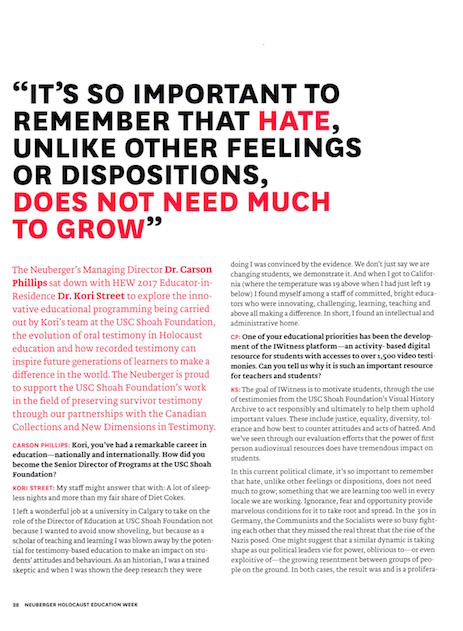
It may be difficult for the colour-blind to spot the red…

call out on page from pamphlet - Holocaust Education Week

What jumps out is the message that hate does not need much to grow.

The goal of IWitness is to motivate students, through the use of testimonies from the USC Shoah Foundation’s Visual History Archive to act responsibly and ultimately to help them uphold important values. These include justice, equality, diversity, tolerance and how best to counter attitudes and acts of hatred. And we’ve seen through our evaluation efforts that the power of first person audiovisual resources does have tremendous impact on students. In this current political climate, it’s so important to remember that hate, unlike other feelings or dispositions, does not need much to grow; something that we are learning too well in every locale we are working.

Ignorance, fear and opportunity provide marvelous conditions for it to take root and spread. In the 30s in Germany, the Communists and the Socialists were so busy fighting each other that they missed the real threat that the rise of the Nazis posed. One might suggest that a similar dynamic is taking shape as our political leaders vie for power, oblivious to—or even exploitive of—the growing resentment between groups of people on the ground. In both cases, the result was and is a proliferation of fear, hate and a loss of democracy and decency. We are in danger of falling into the same trap when we set up a dynamic of “us” and “them.”

Interview with Kori Street

Vigilance: the action or state of keeping careful watch for possible danger or difficulties.
Cumulative: increasing or increased in quantity, degree, or force by successive additions.

And so for day 2034
08.07.2012

Posted in Uncategorized | Leave a comment

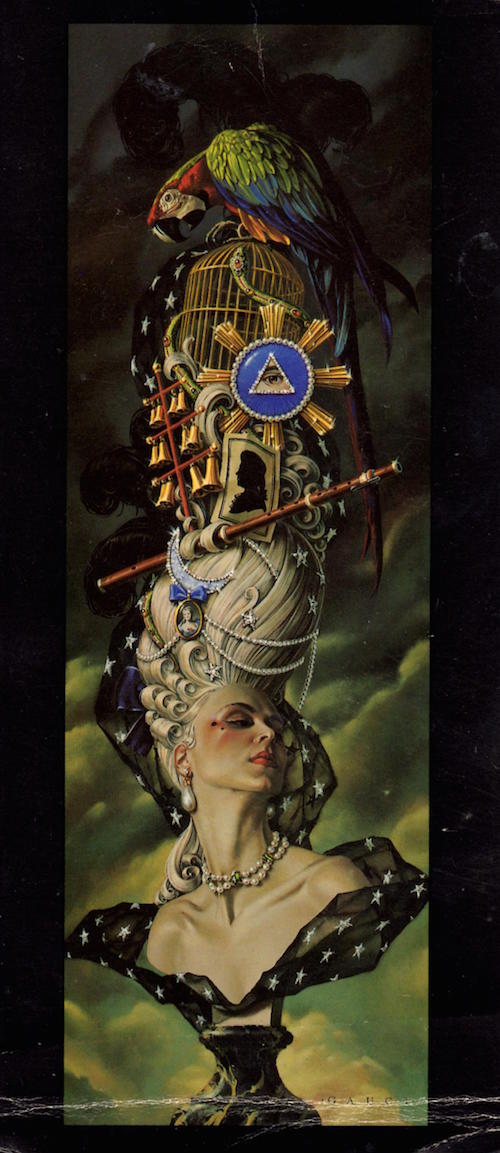
Floating Signifier: Die Zauberflöte

Mozart’s Magic Flute has spawned many a gorgeous visual treatment in materials advertising the opera. Perhaps none so elaborate as this emblem-endowed figure.

ephemera - advertising for The Magic Flute

Opera Atelier, 1991.

My copy of this ephemera was used as years as a book marker witnessed by the crinkling at the base.

And so for day 2033
07.07.2012

Posted in Ephemera | Leave a comment

Word, World, Flesh

Stephanie K. Dunning in the acknowledgements to Queer in Black and White: Interraciality, Same Sex Desire, and Contemporary African American Culture signals the contributions of a care giver — a type of acknowledgement that one rarely sees.

In addition to my friends and colleagues, I’d like to acknowledge a few people who played a more indirect role in the publication of this book. I must give credit to Crystal Haymes, a positively amazing child-care provider, who came into our lives and transformed everything for the better. Without her cheerful, reliable, and excellent child care, I would not have been able to complete this project.

I want to be slightly naughty and tie this acknowledgement to the paean to swearing that is highlighted in her epilogue “Reading Robert Reid-Pharr

From that moment, my love of Robert Reid-Pharr’s writing began. How can one not love a writer who can academically deploy the word “fuck”? I am a person who says fuck, cock, pussy, shit, and muthafucka with great regularity. I delight in introducing my students to the powerful rhetorical pleasure of actually saying precisely what several adjectives and a discrete noun mean to one simple word: fuck. (My students, I must say, are not always as delighted.) What the use of such frank language suggested to me was that there was a place for me in academe — a place for me in language — that I had previously thought was unavailable.

And what name do I invoke to tie these passages together? Bakhtin.

I find hilarious, Nicole C. Kear’s rules in the Salon article Mommy’s got a potty mouth which reminds us that there are elaborate discursive dimensions even in the employment of the most course language.

I’m sure my perspective will change as they get older, but my children are still mastering basic language skills, and you have to learn the rules before you can bend them. Unlike other parents I know, I have a perfectly traditional perspective here: I don’t think it’s OK for my kids to swear, not at home, not at third-grade recess, not on special occasions. Until they can scan iambic pentameter or explain dramatic irony, my kids will have to keep their language G-rated.

In her conclusion, Kear appears to be channelling Dunning with profit.

And so, apparently, will I. The only question is, how? Resolutions are made to be broken, cuss jars are no deterrent, and substitutions only remind me of what I’m missing. It would appear I’m going to have to kick this habit with good, old-fashioned willpower, by biting my tongue. Until bedtime, at least. After all, I’m only fucking human.

Merde! always translated as “Break a leg!”

And so for day 2032
06.07.2012

Posted in Uncategorized | Leave a comment

Wry: using or expressing dry, especially mocking, humor

I have always gone through the mental motions of ducking when I finally unscramble the title of Rita Mae Brown’s book of poetry: The Hand That Cradles the Rock. Relish the irreverence of “The Great Pussblossom” is lobbed to the reader.

Hoisting her tail to the vertical
Pussblossom plants a kiss of suspicion upon her spouse,
“Tell me, dear, have you been eating mouse?”

Just the appropriate note of outré.

And so for day 2031
05.07.2012

Posted in Poetry | Tagged | Leave a comment