Whence Pederasty?

Adrienne Rich. Compulsory Heterosexuality and Lesbian Existence.

Lesbians have historically been deprived of political existence through “inclusion’ as female versions of male homosexuality. To equate lesbian existence with male homosexuality because each is stigmatized is to deny and erase female reality once again. To separate those women stigmatized as “homosexual” or “gay” from the complex continuum of female resistance to enslavement, and attach them to a male pattern, is to falsify our history. Part of the history of lesbian existence is, obviously, to be found where lesbians, lacking a coherent female community, have shared a kind of social life and common cause with homosexual men. But this has to be seen against the differences: women’s lack of economic and cultural privilege relative to men; qualitative differences in female and male relationships, for example, the prevalence of anonymous sex and the justification of pederasty among male homosexuals, the pronounced ageism in male homosexual standards of sexual attractiveness, etc. […] the term “gay serves the purpose of blurring the very outlines we need to discern, which are of crucial value for feminism and for the freedom of women as a group.

Signs: Journal of Women in Culture and Society 1980, vol. 5, no. 4 (1980); reprinted by Antelope Publications, in 1982, as a pamphlet; collected in The Signs reader : women, gender, & scholarship (Chicago : University of Chicago Press, 1983)

But in 1986 there is a shift. Mention of “pederasty” is dropped. “Serves” becomes “may serve” and a footnote is added. The revisions are to be found in in her 1986 book Blood, Bread, and Poetry.

Part of the history of lesbian existence is, obviously, to be found where lesbians, lacking a coherent female community, have shared a kind of social life and common cause with homosexual men. But there are differences: women’s lack of economic and cultural privilege relative to men; qualitative differences in female and male relationships — for example, and the patterns of anonymous sex among male homosexuals, and the pronounced ageism in male homosexual standards of sexual attractiveness. I perceive the lesbian experience as being, like motherhood, a profoundly female experience […] the term gay may serve the purpose of blurring the very outlines we need to discern, which are of crucial value for feminism and for the freedom of women as a group.*

* [A.R. 1986: The shared historical and spiritual “crossover” functions of lesbians and gay men in cultures past and present are traced by Judy Grahn in Another Mother Tongue: Gay Words, Gay Worlds (Boston: Beacon, 1984). I now think we have much to learn both from the uniquely female aspects of lesbian existence and from the complex “gay” identity we share with gay men.]

When I encountered Rich’s “In Memoriam” in Poets for Life: Seventy-six Poets Respond to AIDS (1989) and in a revised form in Time’s Power: Poems 1985-1988) where it appears with the initials D.K in its title [David Kalstone?], I thought that the apparent change in the view of gay men related to the AIDS crisis. But now in reviewing the evidence, I see that transhistorical studies such as Grahn’s played a part.

From far on the other side: Gerald Hannon ends the article “Men Loving Boys Loving Men” The Body Politic, Issue 39, December 1977/January 1978 with an appeal to consider the Anita Bryants of the world as the real child molesters.

“Save Our Children, Inc” is the name of the game, although the organizers seem to be cynically aware of just what that means: “The molestation tactic was the thing that particularly got the headlines. We now know how effectively it can be used,” said Robert Brake, one of the top officials of that organization. Who wouldn’t want to save our children, after all, save them from things like the Houston mass murder horrors, save them from being pawed by nasty old men? That’s what molestation means to most people, it’s what the media encourages them to believe, it’s a belief “Save Our Children” does nothing to discourage.

They’ve added a refinement. Recruitment. Because homosexuals can’t reproduce, they must recruit.

Anita should know. Because recruitment is what she is all about. She wants our children. And, yes, they’re our children too.

More on the charges and acquittal provoked by Men Loving Boys Loving Men see Queer Story video which features Jane Rule commenting. This from the Xtra! obituary by Marilyn Schuster

Rule, a lifelong opponent of censorship, wrote a bold column that condemned the police action and engaged the central issues of the offending article. In the column, called “Teaching Sexuality,” Rule acknowledged that the controversy raised difficult questions for her. “On the one hand I deplore repressive police action designed not only to stifle any discussion of… sexual activity across generations but to intimidate anyone even so involved with the paper as to be a subscriber,” she wrote. “On the other hand I understand the rage against sexual exploitation by men not only of children of both sexes but of women and other men, the pleasures of which The Body Politic can sometimes be accused of advertising.”

The real target of her essay was the hypocrisy of a society that is so fearful of sexual initiation that we deny that childhood sexuality exists. The taboo against sexual behaviour between children and adults, she argues, facilitates the exploitation of children. “Children are sexual,” she concluded, “and it is up to us to take responsibility for their real education. They have been exploited and betrayed long enough by our silence.” Her argument, bold in 2007, was unprecedented in 1978.

Complexities.

And so for day 2030
04.07.2012
Posted in Uncategorized | Leave a comment

Protected: Homophobic Trigger – materials

This content is password protected. To view it please enter your password below:

Posted in Introductions, Poetry | Enter your password to view comments.

Homophobic Impotence

Righteous indignation with a hook. (from Home Coming). Let’s set the stage. Don L. Lee in the intro: “are no trees in Harlem or on the westside of Chicago. The only use/beauty she/we see in a tree, at this time in space, is the number of rifle butts it will produce.”

Homophobic Trigger [password – stanza]

She’s come a long way: “You rescued us from the tyranny of racism, sexism, homophobia, class and economic poverty . . . You. Prodigious singer. Of life and actions. And words . . .” Sonia Sanchez introduction to Audre Lorde’s A Burst of Light and Other Essays.

In those days we were caught between the Right (pinko commies) and the Left (bourgeois decadence). Why rehearse the wounds? Because in the historical record stand the judgements of critics such as Houston Baker Jr. who is called out by Kristi S. Anderson (Post-Poststructuralism: Gender, Race, Class and Literary Theory) “Rather than critiquing the obvious (hetero)sexism of the particular poems of Sanchez’ which he chooses to highlight, Baker celebrates the “heterosexual bonding and collaborative journeying” he claims they represent (334).” Her calling out is in a dissertation not circulating widely. Houston Baker Jr. does shift as did Sanchez. Here is his blurb on Marlon Riggs’s last film (Black Is… Black Ain’t): “A remarkably courageous work of art…Riggs shows us a rare type of black heroism and it is profoundly moving.” Which is now on my viewing list.

Still Sanchez’s poem has a bite. Worth remembering the conditions that led to its utterance. We use the weapons at hand. And do well to remember Lorde: the master’s tools will never dismantle the master’s house.

And so for day 2029
03.07.2012

Posted in Poetry | Leave a comment

Mapping, Proximity and Simultaneity

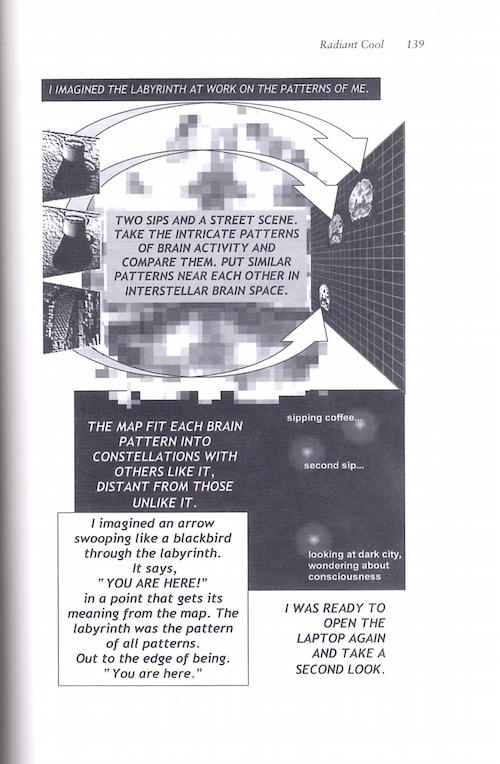
Dan Llyod. Radiant Cool: A Novel Theory of Consciousness

Caffeine intake; computer interaction. Provide epiphany.

page from Radiant Cool

I imagined an arrow swooping like a blackbird through the labyrinth. It says “YOU ARE HERE!” in a point that gets its meaning from the map. The labyrinth was the pattern of all patterns. Out to the edge of being. “You are here.”

A few pages later, our hero moves on from here.

I nudged the mouse and set the universe into a slow spin. I had spent two years in graduate school sorting labels into piles: subject vs. object; mind vs. body; body vs. world; perception vs. action. As I looked across the nebula, none of these big distinctions seemed quite right. Each planet overlapped both sides of every ‘vs.’ All the pattern planets were ways of interacting with the world, and the whole map showed bodies animating perception while perception illuminated bodies. The world and I get along. We collaborate with hands, with eyes, with ears and lips. Our getting along is the world; it’s me, too. I make the world that makes me.

Tucked into this book, written on an index card, was an injunction to “confront the anti-text bias.” It poses a question.

What causes or sets up the instruction to “put similar patterns near each other in interstellar brain space”? Alternative. Computation — with rewrite rules & history of rewrites — i.e. not about holding pattern but about shifting pattern to and fro and then up & down. “I make the world that makes me” Contraries —> contradictions. There has to be oscillation of a digital nature then a leap to 4 via not here/not there and not[not here not there].

There is a little diagram to accompany these words. It presents P at t1 —> Pa at t2.

P & Pa, I take to mean sets of patterns. And it seems that the route between sets is accomplished through the trajectories of a semiotic square. Which at this late date we can gloss as me/not me and not[me not me]. Bringing the far apart closer? Wedging the close apart?

And so for day 2028
02.07.2012

Posted in Perception, Reading | Tagged | Leave a comment

Brrr!

Those that love the crisp chill in the air have a soul mate in Nigel Slater on winter:

The icy prickle across your face as you walk out into the freezing air. The piercing burn to your sinuses, like wasabi. Your eyes sparkle, your ears tingle. The rush of cold to your head is stimulating, vital, energising.

The arrival of the first snap of cold is invigorating, like jumping into an ice pool after the long sauna of summer. Winter feels like a renewal, at least it does to me. I long for that ice-bright light, skies of pale blue and soft grey light that is at once calm and gentle, fresh and crisp. Away from the stifling airlessness of summer, I once again have more energy. Winter has arrived.

https://www.theguardian.com/lifeandstyle/2017/oct/08/nigel-slater-extract-the-christmas-chronicles-cook-b

For a larger treatment of Winter as idea and cultural construct treat yourself to Adam Gopnick’s Massey Lectures: Winter: Five Windows on the Season.

And so for day 2027
01.07.2012

Posted in Uncategorized | Leave a comment

Not Zen

Patrick Lima. The Art of Perennial Gardening: Creative Ways with Hardy Flowers.

There may be some folks of a more Zen cast who come to gardening with a built-in appreciation for leaves. I admire the austerity and clean lines of a Japanese meditation garden—but not in my backyard. Italian gardens, all green and gravel, fail to move me. A hearty amen to the writer who said, “I continue to feel that flowerless garden is a sad place.” But when the bloom is off, so is a garden planned entirely around flowers. Balance is called for. Grow the flowers you admire, but understand that they will look lovelier in a setting of enduring foliage.

And similar principles may be applied to culinary practices — a bed of good rice to support the curry or the stir-fry.

And so for day 2026
30.06.2012

Posted in Food Writing, Gardens | Leave a comment

Step Out into the Abyss

The first chapter is suitably entitled “Approach” for this phenomenologically-informed discourse.

Every approach needs to presume upon its reception. And, so, in beginning we never fear that we shall be wholly misunderstood, we trust that our hesitancy, our stumbling talk, and our choice of words are not a search in the dark. To begin is confidently part of the work of building and sharing an understanding. It is ideally the institution of making sense together within a common life and a common world.

John O’Neill. Making Sense Together: An Introduction to Wild Sociology

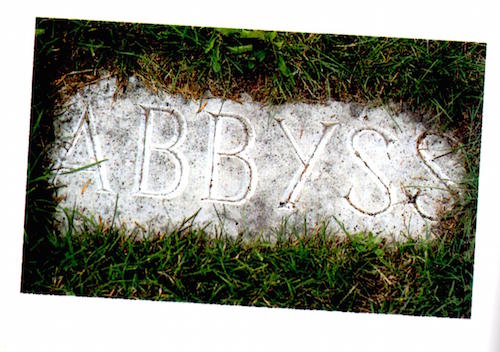
By some form of association this calls to mind a marker placed in the ground at the parting of a cedar hedge into a view of the meadow with one word “abbyss” to indicate the leap not only of perception but of imagination (seen at the garden created by Douglas Chambers, Stonyground) which is an allusion to “Upon Appleton House” by Andrew Marvell

And now to the Abbyss I pass
Of that unfathomable Grass,

I let Chambers explain its origins himself (and you gentle reader to judge its aptness for juxtaposition with wild sociology):

That summer I was writing an article on Andrew Marvell’s poem “Upon Appleton House”: the first record of an Englishman’s recognition that the landscape is also a garden. Marvell has provided several texts for my landscape but perhaps none is so apposite as the one that now sits at the edge of the west lawn, just as you walk into the meadow. “Abbyss”, it says, in Marvell’s spelling: a signal that you are about to pass across an abyss from the fixed architectural formalities of the garden into the true abbeys [sic] of nature.

There is a picture of the “Andrew Marvell quotation at the border of garden and landscape” in Stonyground: The making of a Canadian garden. Chambers’s “true abbeys of nature” recalls as does Marvell’s poem that the seat of Fairfax’s estate, Appleton House, was once a nunnery. Common life and common world.

Abbyss - stone marker at Stonyground

And so for day 2025
29.06.2012

Posted in Gardens | Leave a comment

All Shapes and Sizes

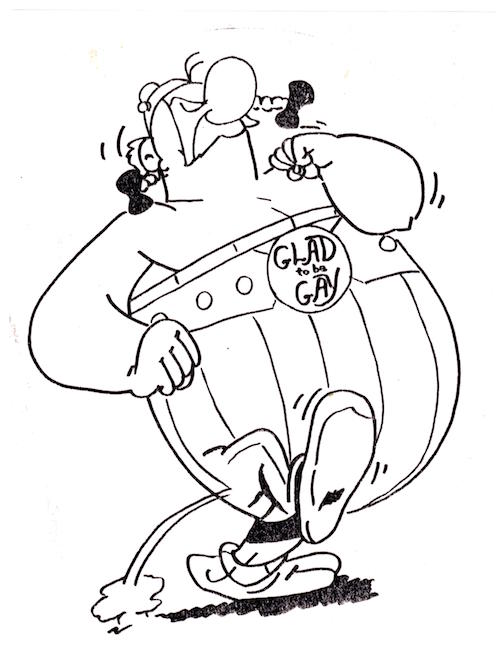
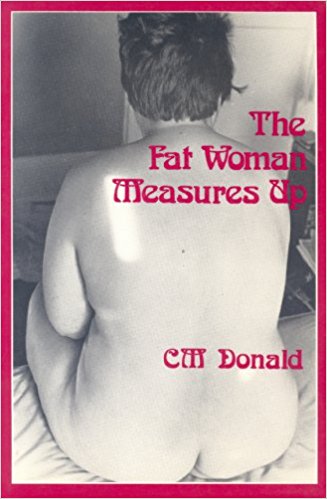
It was Hilary Clare (formerly C.M. Donald) who introduced me to fat liberation. I have in my library a copy of The Fat Woman Measures Up. I also have a gift — a laminated poster of Obélix sporting a gay pride button.

ephemera - Obelix wearing a Glad to Be Gay button

It contrasts with the meditative cover of The Fat Woman Measures Up. The cover photo of the book is by Marty Crowder and called “I Love Women and Rainbows”.

cover - CM Donald - The Fat Woman Measures Up

And the last stanza from the last poem — the last word belongs to the poet:

I’m out of bounds,
out of breath,
out of sight,
outfront and
out of the closet
and what was it, actually,
that needed to be under control?

And so for day 2024
28.06.2012

Posted in Booklore, Ephemera, Poetry | Leave a comment

Rapture and Ripeness

“Pistachio Music”

The moon has risen full, softly illuminating the inky sky above a pistachio orchard near Aleppo, in Syria.
[…]
The farmer stands at the edge of the orchard, waiting. He thinks tonight the bright green nuts may grow that final bit to burst the shell and skin. His head, bathed by moonlight, inclines in the dark, a tiny puff of air floats through the orchard, audible to itself. Then there is another and another as nut follows nut with its final spurt of growth bursting its shell, until all through the orchard the tiny hot breaths become music. Out under the moon more and more farmers come to hear pistachio music, the hauntingly joyful tune of the harvest.

Susan Herrmann Loomis. Nuts in the Kitchen.

And so for day 2023
27.06.2012

Posted in Food Writing | Leave a comment

Protected: Canada Customs Protest – materials

This content is password protected. To view it please enter your password below:

Posted in Uncategorized | Enter your password to view comments.