Placing Feeling

E-motion: don’t quite know how the rhetoric of neither/nor moves me.

Affect is a different kind of intelligence about the world, but it is intelligence none-the-less, and previous attempts which have either relegated affect to the irrational or raised it up to the level of the sublime are both equally wrong-headed.

Nigel Thrift, “Intensities of Feeling: Towards a spatial politics of affect” in Geografiska Annaler, Series B, 86, 57-78.

And so for day 1992
27.05.2012

Posted in Uncategorized | Leave a comment

Stupidity, Humility and Pride

I first encountered this striking serigraph reproduced in black and white in the Graphex 4 catalogue of the 1976 juried exhibition at the Art Gallery of Brant (in Brantford, Ontario). I immediately recognized the parody of Matisse’s Dance.
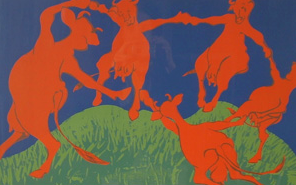
vernon chitin painting - parody - matisse

The image is the work of Vernon Chilton. It is called The Rite of Spring. Measures: 24 1/2 x 37 1/4 inches. Was purchased by the Art Gallery of Brant through a Gift from Sonoco Limited ($130.00).

The 1980 publication of the catalogue Art Gallery of Brant Permanent Collection provides some bare biographical details: Chilton was born 31/10/50 and studied at York University and Carleton University.

Chilton went through a cow period. With at least one show at the Royal Agricultural Fair. I know this thanks to the librarians at the Toronto Reference Library who have maintained vertical files on Canadian artists and they have a copy of the poster announcing the Royal show. Also in the clippings file was microfiche preserving an article from the Globe (August 23, 1975) by Bryan Johnson reviewing a show at Harbourfront under the catchy title: “The artist addicted to the bovine charms”.

Chilton’s favorite is The Pasture, nine-foot-wide acrylic in which a dozen cows gaze out at the viewer with the curious mixture of stupidity, humility and pride which seems to have captured artist Chilton entirely.

“The way I think of it,” he says, “is that this is their group portrait. They’ve grown up together and soon they’re going to split up for the meat market, so, you know, they figure they need a portrait to hang in the barn.[“]

Chilton goes on to describe his encounters with a herd. A picture of The Pasture accompanies the article. But my favourite is still The Rite of Spring.

And so for day 1991
26.05.2012

Posted in Uncategorized | Leave a comment

After Glow Rash

Joseph Chadwick “Toward Gay Reading: Robert Glück’s ‘Reader'” in Easthope and Thompson Contemporary Poetry Meets Modern Theory (1991) pp. 40-52.

Reading, this sentence, suggests, doesn’t stop when one puts down the book; rather, it continues as long as one remains alive to the possibilities of “what everything could be” rather than becoming immured in fixed definitions of what and how things are.

Although Chadwick doesn’t continue this line of thought, we have here an infection model. Or as William S. Burroughs would say: language is a virus.

And so for day 1990
25.05.2012

Posted in Metaphor, Reading | Leave a comment

Don Quick Shot

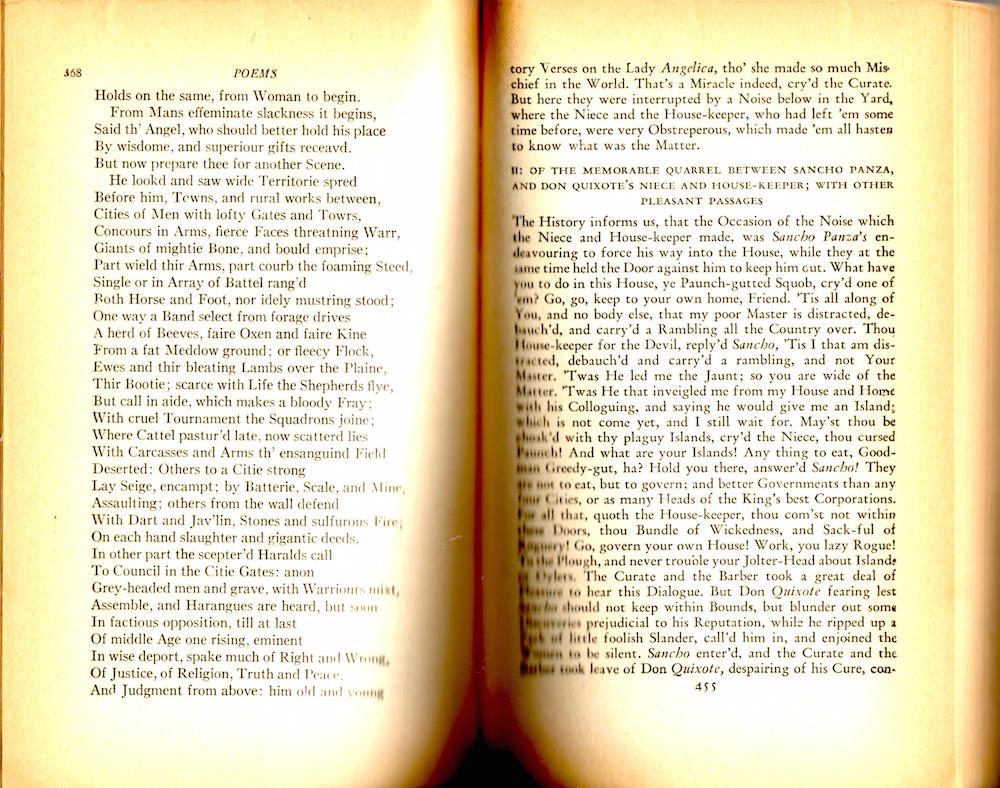
I may not be the first to play on the name of the windmill-tilter nor the first to be surprised by the eruption of a good chunk of Cervantes in a 1959 printing of The Complete Poetry and Selected Prose of John Milton (with introduction by Cleanth Brooks) published in the Modern Library College Editions series.

milton and cervantes bound together

On the left, we are in midst of Book XI of Paradise Lost; on the right, “Of the Memorable Quarrel Between Sancho Panza, and Don Quixote’s Niece and House-Keeper; With Other Pleasant Passages”.

A bit disconcerting for the student. How very intriguing for the comparatist.

And so for day 1989
24.05.2012

Posted in Booklore | Leave a comment

Error Localization

In transcribing this, I so want to introduce a spelling mistake.

But we cannot judge in the same way the charm of a person who is, like everyone else, exterior to ourselves, painted upon the horizon of our mind, and that of a person who, in consequence of an error in localisation which has been due to certain accidents but is irreparable, had lodged herself in our own body so effectively that the act of asking ourselves in retrospect whether she did not look at a woman on a particular day in the corridor of a little seaside railway train makes us feel the same anguish as would a surgeon probing for a bullet in our heart.

Proust The Sweet Cheat Gone in the translation by C.K. Scott Moncrieff.

The image in one’s mind, a simple error? How then can the obsession be corrected? Displaced by spelling?

And so for day 1988
23.05.2012

Posted in Transcriptions | Leave a comment

Sharpening the Knives

From a review that appeared in Books in Canada Volume 28, Number 6.

The book in question: The Medium and the Light: Reflection on Religion, Marshall McLuhan.

Surely, McLuhan’s editors would grant that rhetoric, especially when allied with dialectic, does concern itself with rules of evidence. Dialectic is the art of asking questions. McLuhan’s aphorisms and provocative statements function like questions. McLuhan himself says he provides probes. Pierre Babin, interviewing McLuhan, most felicitously characterizes the probes as “interpretative keys”. Surely, it is also the role of editors to parse the questions and situate the probes in their historical context, lest the reader be left with a clanging bunch of keys and no lock to pick.

Without dialectic, McLuhan’s grammar loses its critical edge. It does not matter if the sage of Wychwood denies the validity of dialectic. There is no doubt that McLuhan’s probes functioned as questions, trenchant questions, and it is up to his editors to strop the text.

I do take to editors to task. But I do like the final image of the barber-editor sharpening the razor. Supporting the text with an adequate critical apparatus.

And so for day 1987
22.05.2012

Posted in Metaphor | Leave a comment

Depth and Surface

Jean Petitot-Cocorda
Les Catastrophes de la parole. De Roman Jakobson à René Thom
Paris: Maloine, 1985.

En général, l’explication concerne de mécanismes sous-jacents, supposés êtres explicatifs, dérivables des lois générales et susceptibles d’être mathématisés. C’est-à-dire exprimés dans un formalisme génératif. La description concerne en revanche les morphologies macroscopiques observables dans leur corrélation à la langue naturelle et à la perception.

And what links explication to description? Elaboration, justification? Petitot does reference P. Delattre, “Le Problème de la justification des modèles dans le cadre du formalisme des systèmes de transformations” in P. Delattre and M. Thellier dir. Élaboration et justification des modèles (Paris: Maloine, 1979). Which book is not available in a library near me. : (

And so for day 1986
21.05.2012

Posted in Uncategorized | Leave a comment

To Describe Telling

I have had a longstanding interest in the relations between narration and description (and the assumption that nothing is happening while something is being described). I love this bit from John Dewey: “[…] a mountain, which to the layman [sic] is a standing symbol of permanence, is to the geologist the scene of drama of birth, growth, decay and ultimate death.”

In Volume 12 (193) of the Collected Works in Part Two of Logic: The Theory of Inquiry we find a passage where we can note that Dewey begins with temporal and goes to spatial aspects. He does say that either aspect may be uppermost. His symmetrical treatment is evoked by the parallelism of his sentences.

Existential subject-matter as transformed has a temporal phase. Linguistically, this phase is expressed in narration. But all changes occur through interactions of conditions. What exists co-exists, and no change can either occur or be determined in inquiry in isolation from the connection of an existence with co-existing conditions. Hence the existential subject-matter of judgement has a spatial phase. Linguistically this is expressed in description.

I think this can be brought fruitfully into contact with the work of Lubomír Doležel on possible worlds and fictions. I have always been puzzled as to what triggers world construction especially how persons emerge from states. Dewey offers part of answer to the mysteries of generation.

And so for day 1985
20.05.2012

Posted in Storytelling | Leave a comment

Category Mistake

John Berger from About Looking

Duchamp was not an iconoclast: he was a new type of curator.

Berger’s 1974 observation shapes an approach to art that is useful for understanding those assemblages that are in essence collections of objects with tags.

And so for day 1984
19.05.2012

Posted in Uncategorized | Leave a comment

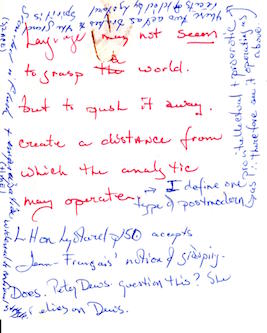
Grasp

A visual two colour note that partakes of the margins.

handwritten note in two inks

In blue there is a reference to Linda Hutcheon drawing upon the work of Peter Dews (likely Logics of Disintegration: Post-Structuralist Thought and the Claims of Critical Theory) to discuss Lyotard’s notion of grasping which of course is at the centre in red:

Language may not seem
to grasp the a world
but to push it away
create a distance from
which the analytic
may operate

Retained from the blue around the rim: one type of postmodern —> as prointellectual + proerotic therefore see it operating as above —> —> these two act as brakes to the grand récits [identified] by Lyotard       Spirit is grounded (space) in flesh + emancipation (time)       widened to continual struggle.

And so for day 1983
18.05.2012

Posted in Transcriptions | Leave a comment