Elevated in the Passive Voice

08/03/01 entry in a notebook

Jut read a passage in Apollinaire

Voici s’élever des prophètes
Comme au loin des collines bleues
Ils sauront des choses précises
Comme croient savoir les savants
Et nous transporteront partout

The last line of this stanza could be (and is by some translators) rendered “And they’ll transport us everywhere”. My temptation is to play with the “transport”.

And from anywhere we will be transported.

I.e. from anywhere we will have access to transport

This passive form in English does a fair job of translating the (reflexive pronoun + verb) form of the French (if one chooses to read it that way). As well the Petit Robert gives for transport au sens figuré voir agitation, élan, enthousiasme, exaltation, ivresse. All apt for the rising prophets of the first line. We are less preoccupied by a destination (everywhere) and by a process or state of being (transport).

And so for day 1982
17.05.2012

Posted in Translations | Leave a comment

Writing the Line

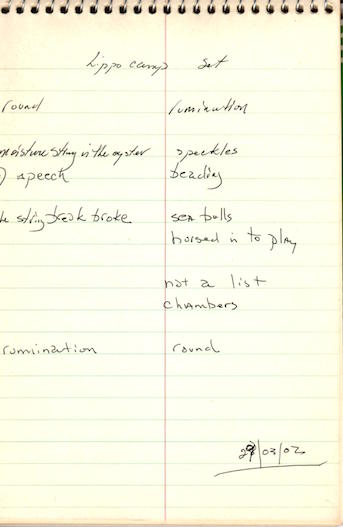
Steno pads sometimes get buried in the book shelf which results in an asynchronous dialogue between entries distanced in time. For example, this entry from 2001 is revisited in 2002.

13/03/01

Rumi has a line about being the moisture in an oyster that helps form a pearl. Interesting how so much of the creation of a pearl is credited to the speck of irritant that launches the process.

And the very page of the steno pad gives us a string — a red line down the page.

hand written poem - round rumination

hippo camp set
round rumination
moisture string in the oyster
of speech
speckless
beading
the string break broke sea bulls
horsed in to play
  not a list
chambers
rumination round
  29/03/02

Very happy with the play on words: nautilus, not a list. And the spiral image it conveys out of two columns.

And so for day 1981
16.05.2012

Posted in Poetry, Transcriptions | Tagged | Leave a comment

Nip Nip Na Poo

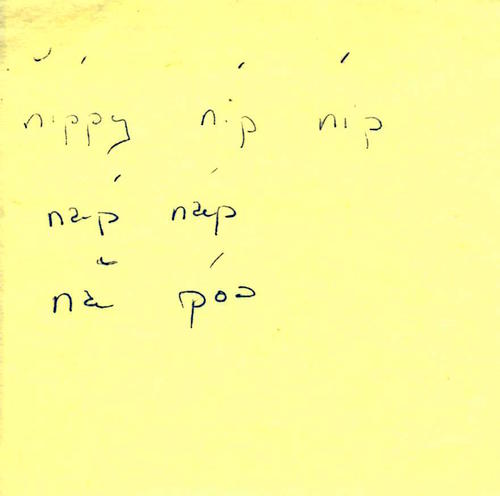
I have been intrigued with matrices since high school algebra. The layout of this little bit was influenced by the square form of the sticky note.

transcription - nip nip - na poo

nippy nip nip
nap nap  
na poo  

Baby talk: sheer love of sound. Calming mantra.

And so for day 1980
15.05.2012

Posted in Ephemera, Transcriptions | Tagged | Leave a comment

Stepping Out by Stepping In

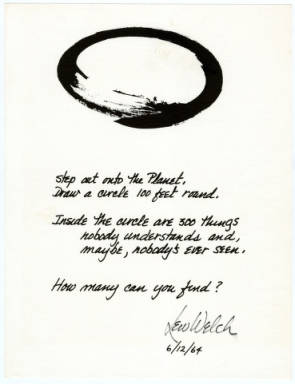
Lew Welch, transcribed.

Step out into the Planet,
Draw a circle two feet round.

Inside the circle are 300 things
     nobody understands and,
     maybe, nobody’s ever seen.

How many can you find?

Lew Welch
6/12/64

Can you hear the intonations similar to Stein’s in the 1967 recording housed at PennSound https://media.sas.upenn.edu/pennsound/authors/Welch/Magic-Lantern_04-22-67/Welch-Lew_18_Step-Out-Onto-The-Planet_Magic-Lantern_Santa-Barbara_04-22-67.mp3? He did after all write a thesis on Stein.

I came across this reproduced in a catalogue from Ken Lopez Bookseller. The description:

454. WELCH, Lew. “Step out onto the Planet…” [San Francisco]: [Four Seasons], 1964. A broadside poem, 9 1/2″ x 12 1/2″, reproducing Welch’s handwriting and design, limited to 300 copies sold on the occasion of a reading by Welch, Gary Snyder and Philip Whalen, longtime friends who first met when they all attended Reed College, a progressive school in Oregon, and who later became three of the most influential poets of the Beat generation. The sentiment of this poem — a sense of the mystery and wonder of the earth, expressed in a few simple lines — captures an essential element of the sensibility ignited by the Beats in our culture. Signed by Welch, who, although less well-known than his former classmates, was nonetheless one of the most important poets of the era. Matted; fine.

What of course attracted to me was the calligraphy and the brushwork of the circle at the top of the broadside.

Lew welch - setz out into the planet - calligraphy 1964

It looks ripe for contemplation.

And so for day 1979
14.05.2012

Posted in Booklore, Poetry | Leave a comment

Composition in Contraries

Plank versus bridge. Some thoughts.

D’après Miss Moore Going Over

To throw before some way
what is a gang plank to a
bridge? Not just the
appropriate tool at
the appropriate place.
A bridge is full of
particulate plurals.
A bridge of stone, steel
or wood, is still a
construction constitution of parts
in the memory of imagination
it is as
a single entity the
span resides. The
plank — no matter
how much in actuality
it may be riveted
of pieces — stands alone
at an angle, like a
ramp.

30/12/02

And now years later I turn to Marianne Moore and quote some lines from “Granite and Steel”. “way out; way in; romantic passageway / first seen by the eye of the mind / then by the eye. O steel! O stone!”

And so for day 1978
13.05.2012

Posted in Poetry | Leave a comment

Atoms of Discursive Formations

Someday perhaps English will adapt the term “vulgarization” to denote “popularization”. *smile*

La répétition didactique, sous sa forme proprement pédagogique, ou même sous une forme plus vague de vulgarisation, est indispensable au fonctionnement de l’espace intellectuel, même si elle ne contribue pas à son avancée théorique. Par définition cette dimension n’innove pas, mais notre situation intellectuelle n’est pas compréhensible sans elle. Quant à la diffusion de l’information, la vulgarisation répercutée, les redites de la mode, le jargon des sectes, la problématique de la saison, tout cela constitue un bruit spéculatif qui appartient lui aussi à la situation intellectuelle et qui la marque.

Judith Schlanger, L’invention intellectuelle

My gloss from a while back

Speculative noise is wedded to the elaboration of intellectual space. However, jargon and fashion serve primarily not innovation but comprehension.

One wonders if Schlanger may have on the periphery of her concerns noted the title of a work by Roland Barthes: Système de la mode. They may only collide in the longer view from the 21st century.

And so for day 1977
12.05.2012

Posted in Uncategorized | Leave a comment

Petit Récit

From a paper comparing chaos to catastrophe theory. One being an invention of science journalism and the other a branch of mathematics. In my peroration I get quite polemical.

Reconciliation with nature, chaotic or otherwise, is the avatar of a theocratic theme and it cannot serve to legitimate either science or criticism in a postmodern age. Hayles’s hostility to Lyotard now becomes understandable. He is a prime critic of meta-narratives of legitimation. And his is a secular, wholly secular, use of paradox.

She sees his work as contributing to “a cultural metanarrative, and its peculiar property is to imply incredulity not just toward other metanarratives but toward narrative as a form of representation. It thus implies its own deconstruction.” [Chaos bound: orderly disorder in contemporary literature and science (Cornell University Press, 1990)]

But didn’t Lyotard advocate for localized narratives?

Furthermore, there’s a distinction to be made between the skeptical and the cynical. Not all challenges are to be read as reductio ad absurdum deconstructions.

And so for day 1976
11.05.2012

Posted in Storytelling | Leave a comment

Premises and Premises

Within a few paces, one straddles the erotic, the synesthetic and the memento mori.

Because an opulent tongue contours my hip
bone

Because the music arrived in ochres, greens,
yellows

Because I wanted the music to articulate me

Because lacking ardour, the surroundings were
impoverished

Because I am pronoun in disguise as sediment

Oana Avasilichioaei Limbinal

The anaphoric piling on of “because” clauses never culminates in a complete sentence. All is arrested. Be cause. Have effect.

And so for day 1975
10.05.2012

Posted in Poetry | Tagged | Leave a comment

The Curled Kitten

Warm is a Circle
Written and Illustrated by Hilary Thompson
Hantsport, Nova Scotia: Lancelot Press, 1979

It was the title that attracted me to this book, I thought it had something to do with synesthesia. What I discovered is true artistic accomplishment. The words are not grand but they are not simple repetitions one expects in children’s books. They can appeal to readers of any age — they provoke the imagination. And the pictures are in shades of gray and sometimes they offer stark contrasts of black and white. They always invite the viewer to look again.

I like how over the last two sections one is immersed in a nocturnal wandering followed by an awakening.

When it is dark I rest.
Dark, where the walls make patterns.

And when I wake I see
my window.
Light is a square in the wall.
A window is a place.
It is full of other places.

Such a rich invitation to the play of the imagination from the very start at the title page…

cover - Warm is A Circle - Hilary Thompson

The copy I viewed came to me all the way from the University of Calgary. Sad to see it leave my hands but happy that I have a scan of that curled kitten to remind me that warm is circle.

And so for day 1974
09.05.2012

Posted in Booklore, Poetry | Leave a comment

Dépayser

Modes of Being Out of the World

Sara Guyer Reading with John Clare: Biopoetics, Sovereignty, Romanticism explores the poetics of homelessness. It takes on an existential character. For example, about the poem “I am” she references Bridget Keegan

Bridget Keegan reads the end of this poem as aiming for the possibility of experiencing the “world without us” in “The World Without Us: Romanticism, Environmentalism, and Imagining Nature,” in A Companion to Romantic Poetry ed . Charles Mahoney (Malden, Mass.: Wiley-Blackwell, 2010), 554-68.

I juxtapose this with a performance by The Four Horseman [bp Nichol, Steve McCaffery, Paul Dutton, and Rafael Barreto-Rivera.] who use lines from this Clare poem in counterpoint to a Spanish/English line (“My shoes are dead, oh microphone”). A recording of the Four Horseman is on the Canadada album, digitally available from the Penn Sound archive, see Matthew’s Line.

Stephen Scobie in relating the The Four Horseman performance situates the poem as less about imagining a world without humans [Keegan] and more as a sad poem about isolation (its author being confined to an asylum). He interprets as he quotes in bpNicol: What History Teaches:

The poem speaks pathetically of Clare’s sense of despair, abandonment, and isolation, both within the physical asylum and within his increasing insanity:

I am: yet what I am none cares or knows
   My friends forsake me like a memory lost,
I am the self-consumer of my woes

The poem then moves to Clare’s longing for escape, even if only through death:

I long for scenes, where man hath never trod
   A place where woman never smiled or wept —
There to abide with my Creator, God,
   And sleep as I in childhood sweetly slept,
Untroubling, and untroubled where I lie,
The grass below — above the vaulted sky.

Out of context, the poem is a fine example of the Romantic desire for transcendence into a pantheistic unity of Nature; in the context of Clare’s life, it points to the fineness of the dividing line between extreme Romantic sensitivity, the solitary genius of the poet and clinical insanity.

Here I turn again to Sara Guyer who like The Four Horseman in a sense makes John Clare strange. This she does in part by resisting the mad poet reading and insisting on the dash (“‘untroubled,’ unmoved, stable, blank, or flat like a dash, despite the catastrophe everywhere around him”). She also in her concluding chapter juxtaposes the poetry of Clare with the condition of abandoned houses in Detroit. A picture of one graces the cover the book.
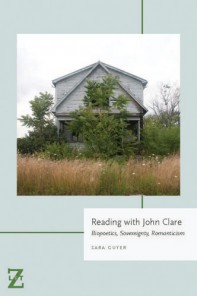
cover - Reading with John Clare - Sara Guyer

What a clear way of bringing the poet back in the world and avoiding transcendence.

And so for day 1973
08.05.2012

Posted in Poetry | Leave a comment