More Making Making More

Julia Child on crème anglaise

This is the basic custard sauce that you want to have in your repertoire, to transform any plain pastry or poached or fresh fruit into a special dessert. Crème anglaise is an essential component of such classics as floating island, and the foundation of many other dessert preparations — when frozen, it becomes ice cream; if you add gelatin and fold in whipped cream, it becomes Bavarian cream. If flour is added before cooking, you have pastry cream, and then if you fold in beaten egg whites you have a dessert soufflé.

Julia and Jacques Cooking at Home. Julia Child and Jacques Pépin

Nella Cotrupi on Frye and Bakhtin

It has been easy for some to misconstrue Frye’s references to ‘the total form of art’ or the ‘total body of human culture’ as representing a closed, monolithic entity or unity. Such a view would be quite antithetical to Frye’s process approach to poetics and to its philosophical footing, the verum factum principle. This view emphasizes nothing if not the infinite scope or creative potential of human imagination to conjure and contrive. In a sense, this brings Frye close to Mikhail Bakhtin, who, in his preoccupation with the relationship between the mind and the world, opted much more for ‘the Kantian heterogeneity of ends’ rather than the ‘Neo-Kantian lust for unity’ (Michael Holquist, Art and Answerability xv). In Bakhtin, where the emphasis is on ‘perception as an act of authoring’ (xv), one distinctly senses the kind of Vichian reverberations that are explicitly evoked in such comments of Frye’s as ‘reality is in the world we make and not in the world we stare at’ (MM 122) and ‘what is true we have made true’ (WP 135).

Northrop Frye and the Poetics of Process. Caterina Nella Cotrupi

MM = Myth and Metaphor
WP = Words with Power

Making more more…

And so for day 1972
07.05.2012
Posted in Food Writing | Leave a comment

Greek Sleep

A charming passage on the effect of soporifics on the ability to quote Greek… one almost falls asleep trying to keep track of who is quoting who.

I have always said — and have proved by experiment — that the most powerful soporific is sleep itself. After having slept profoundly for two hours, having fought against so many giants, and formed so many lifelong friendships, it is far more difficult to awake than after taking several grammes of veronal. And so reasoning from one thing to the other, I was surprised to hear from the Norwegian philosopher, who had it from M. Boutroux, “my eminent colleague — pardon me, my brother,” what M. Bergson thought of the peculiar effects upon the memory of soporific drugs. “Naturally,” M. Bergson had said to M. Boutroux, if one was to believe the Norwegian philosopher, “soporifics, taken from time to time in moderate doses, have no effect upon the solid memory of our everyday life which is so firmly established within us. But there are other forms of memory, loftier, but also more unstable. One of my colleagues lectures upon ancient history. He tells me that if, overnight, he has taken a tablet to make him sleep, he has great difficulty, during his lecture, in recalling the Greek quotations that he requires. The doctor who recommended these tablets assured him that they had no effect upon the memory. ‘that is perhaps because you do not have to quote Greek,’ the historian answered, not without a note of pride.”

I cannot say whether this conversation between M. Bergson and M. Boutroux is accurately reported. The Norwegian philosopher, albeit so profound and so lucid, so passionately attentive, may have misunderstood.

Marcel Proust, Cities of the Plain in the translation by C.K. Scott Moncrieff.

And so for day 1971
06.05.2012

Posted in Uncategorized | Tagged | Leave a comment

Let Us Compare Ecstasies

With apologies to Leonard Cohen (Let Us Compare Mythologies)

Body and mind — words and things.

Les extases de Nane Yelle, dans l’histoire de sa passion pour un chamane de l’enchâssement vertigineux du réel, ces extases mentales ne sont rien à côté des désirs dont le halètement de feu dans tous mon corps me ravit au gré de mes investissements libidinaux sur le timbre de voix, le grain de la peau, l’œil bleu de noir, le corps variable de mes jeunes amants qui, tous, s’allègent dans le sommeil au point que l’extase matérielle se diffuse en réverbérations heureuses dans le continuum de l’amour fou des mots et des choses.

Yolande Villemaire La Vie en prose (Montreal: Les Herbes Rouges, 1980)

And so for day 1970
05.05.2012

Posted in Uncategorized | Leave a comment

Let the Fossil Record Show

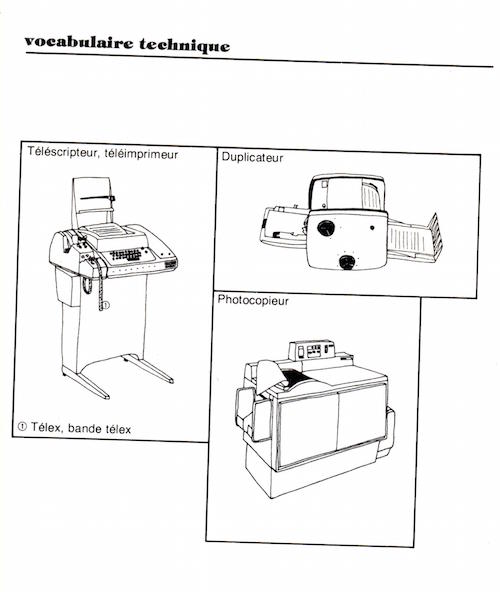
Le français au bureau Cahiers de l’Office de la langue française No 26 [1977]

office machines from the paper era

A teletype machine, a mimeograph machine, a photocopier.

Extinct or vanishing.

And so for day 1969
04.05.2012

Posted in Ephemera | Leave a comment

Liminal Ball Tossing

Oana Avasilichioaei
Limbinal

As suiting a book about margins and perimeters, the book begins with a poem called “Bound” which itself begins with an apostrophe to “Border” which I misread as beginning “Border, you tenderly.”

Border, you terrify. Border, you must dictate your own dismantling or we will perish. Purge. Border, are you listening? Are you empire?

Just why I remember the opening line as tender is perhaps attributable to the erotic charge of some of the stanzas and perhaps also related to the figure of the child in conjunction with the sonorities and semantics of sound’s traveling: “We wanted to theorize the voice, give it credence in the angle of an article.” [Here I detect traces of Nicole Brossard in the wish to theorize and of Gertrude Stein in the emphasis on the little word or article — it may just be me and the borders I have visited.]

“And the child grasps the wall of sound can and will become language.”

And so for day 1968
03.05.2012

Posted in Poetry | Leave a comment

Temporal Transports of a Different Sort

If there were not language there would only be music.

And, just as certain creatures are the last surviving testimony to a form of life which nature has discarded, I asked myself if music were not the unique example of what might have been — if there had not come the invention of language, the formation of words, the analysis of ideas — the means of communication between one spirit and another.

Marcel Proust, The Captive in the translation by C.K. Scott Moncrieff.

Reminded of Steven Mithen, The Singing Neanderthals: the Origins of Music, Language, Mind and Body (Harvard University Press, 2006)?

And so for day 1967
02.05.2012

Posted in Uncategorized | Leave a comment

Spreading the Sensuality

This opening brings to mind the need for expanded food security and food literacy so that more can enjoy the pleasures rehearsed here.

For countless Americans living on their own, cooking for one is a fact of daily living. Far from dreading it, many people find it to be a satisfying, fun, rewarding activity — not just a chore. It’s a way to get back in touch with a familiar rhythm of daily living. The pleasure of seeking out the best ingredients, preparing them to their own preferences, experimenting with new flavors and ingredients, and the sensory pleasures of cooking — the feel of chopping something, the sound of foods sizzling in a wok, the aroma of a simmering soup — are as important to their sense of well-being as daily exercise is.

Mark Erickson and Lisa Erickson Cooking for One.

And so for day 1966
01.05.2012

Posted in Food Writing | Leave a comment

Auto Error Correct or Auto Correct Error

From a legal newsletter

Fun with Spelling

Clients and/or opposing parties may be puzzled or insulted if you accidentally recommend ‘medication’ or ‘meditation’ rather than ‘mediation’, even though the former two may be more appropriate to the case. It has happened!!

Configurations calling for a team with a wide scope of practice.

And so for day 1965
30.04.2012

Posted in Uncategorized | Tagged | Leave a comment

Fiddlehead Farrago

Other titles in the series are Touch Will Tell and Walk With Your Eyes. The one that interests me is Listen to a Shape. It seems to harken more to the synesthetic experience. All are with words and images by Marcia Brown.

Listen to a Shape positions its opening under the sign of a curled fern frond or fiddlehead. It promises to bring to fruition the metaphorical import of roundness.

ROUND curls up
       on itself.
Round things
       bring you back
       to where they
       started.

And faithfully the book ends with an illustration of unfurled fronds.

Round objects also fly you around the world in this age of searchable clip art.

There was once a restaurant in Nanaimo called the Fiddlehead Bistro and I have here borrowed its logo with a horizontal flip.

fiddlehead crest

Almost like a Japanese crest. Trace of an artist who has truly listened to shape.

And so for day 1964
29.04.2012

Posted in Perception, Poetry | Leave a comment

Boys Will Be Girls Will Be Boys

In retrospect there is a hint of gender politics in Eric Partridge’s entry on “boys will be boys”in his 1964 compilation A Book of Essential Quotations. He adds to the quotation from Edward Bulwer-Lytton, Anthony Hope‘s gloss:

“Boys will be boys.” “And even that,” I interposed, “wouldn’t matter if only we could prevent girls from being girls.”

The source of that quip is The Dolly Dialogues [1894].

And so for day 1963
28.04.2012

Posted in Uncategorized | Tagged | Leave a comment