Purrfect Pun

In the age of cat videos, one comes across an apt little bit of verse from John S. Crosbie in Crosbie’s Book of Punned Haiku. (New York: Workman Publishing, 1979).

There is nothing worse
Than poems about cute cats
It is all perverse.

If you think this is bad, I’ve seen worse — from Crosby himself — a haiku that ends limerick-like with “caramel knowledge.”

And so for day 1962
27.04.2012

Posted in Poetry | Tagged , | Leave a comment

Setting Up the Punchline

Playing against Type” by Doug Gibson – review of Gutenberg’s Fingerprint: Paper, Pixels and the Lasting Impression of Books by Merilyn Simonds

The final section of the book allows Merilyn Simonds, the early adopter, to predict where books are going. She notes that readers are now “encouraged to explore and engage with the text. The reader’s role is no longer passive, it is active, even though he or she can’t actually affect the outcome.”

The latest catchphrase-which may well be obsolete before this book is printed-is “augmented reality,” or AR: virtual images laid over real ones to create an “augmented” display. AR integrates graphics, sounds, touch (haptics), and smell into a real-world environment, blurring the line between the actual and the computer-generated.

“Smell.” Really? Hold that unlikely thought.

The key phrase here, I think, is “which may well be obsolete before this book is printed.” Certainly, anyone reading this book to learn about the future of reading will find that while Merilyn Simonds’s book raises many questions, it is too sensible to produce many confident predictions. Although it is notable that she has put a lot of time and effort in turning her out-of-print paper books into digital e-books.

A final detail, one that Bob Gottlieb [American editor and publisher] would like: the endpapers for the precious little book are specially created, with the help of the artist Emily Cook, from paper whose fibre comes from daylilies picked from Merilyn Simonds’s garden. In discussing this process, Merilyn the Essayist tells us that way back, about 1780, Matthias Koops in London decided that for printing books, paper made from straw would be ideal. Nicholas Basbanes, in his 2013 book, On Paper: The Everything of Its Two-Thousand-Year History (published by Gottlieb’s old company, Knopf) writes about handling a book based on straw. After more than 200 years, the paper still held “the agreeable aroma-of fresh-cut grass.”

Worth holding the thought to catch that whiff.

And so for day 1961
26.04.2012

Posted in Booklore, Perception | Leave a comment

Triggers, Paratexts and Interpretations

Lynne Pearce in Woman Image Text: Readings in Pre-Raphaelite Art and Literature suggests that the figure depicted in John Everett Millais’s Mariana is caught in a distinctive moment: “Mariana is presenting her body for inspection, while she gazes desirously into the eyes of the Archangel Gabriel represented in the stained glass.” Curious to observe if the gaze is returned, one turns to plate three to inspect the reproduction. Inconclusive. Indeed it is difficult to confirm that the figure of Mariana is indeed looking at the angel. However, one notices that plate three (Mariana) is situated on the right page and plate two (Beata Beatrix by Dante Gabriel Rossetti) on the left page of the open book and that the figures of Mariana and Beatrix by their positions as reproduced in the book might be seen to converge on the stained glass angel. He may be looking at her but is she looking at him? Reproductions in Pearce’s sources are marshalled to make the claim. The article “Subliminal Dreams” by George MacBeth in Narrative Art edited by John Ashbury and Thomas B. Hess provides a black and white detail of the upper left quadrant followed by a colour reproduction. The layout induces a subtle repetition: left page the b&w detail, right page the first page of the article, [turn the page] left page the colour reproduction of the full painting. The manner of the disposition of the illustrations supports the critical story that is being offered. Interestingly Pearce in introducing a quotation from an Andrew Leng article that quotes Macbeth’s article fails to mention that Leng remarks upon the tone of Macbeth’s “post-Freudian enthusiasm” in whose prose “[t]he erotic implications of the painting which Ruskin ignored are made abundantly if facetiously clear […]”. Leng’s article is now available on the Victorian Web. In “Millais’s “Mariana”: Literary Painting, the Pre-Raphelite Gothic, and the Iconology of the Marian Artist”, Leng draws upon how knowledge of Tennyson’s poem affects the reading of the painting. In the online verision of the article there is to be found a thumbnail reproduction of the painting that is hot linked to a larger image.

Paratexts push if not produce the interpretations of the painting: that gaze is certainly askance.

And so for day 1960
25.04.2012

Posted in Uncategorized | Tagged | Leave a comment

Cartes Postales

A plug for Adam Bunch’s Toronto Dreams Project

Postcards left about public spaces. Postcards that connect to historical anecdotes and figures. Postcard drop off spots are documented in a blog and via Instagram.

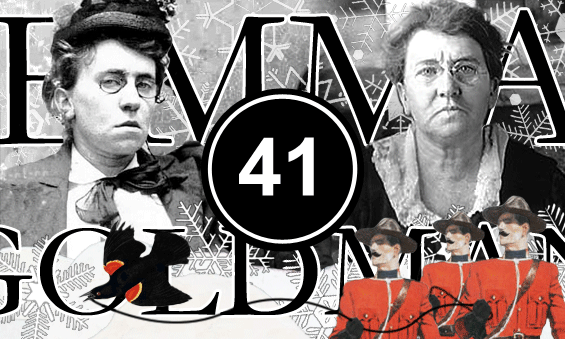
No 41 – one of my favourites

Emma Goldman No 41 Toronto Dreams Project

Emma Goldman was the world’s most notorious anarchist in the late 1800s and the early 1900s. Exiled from her home in the United States, she would eventually spend some of her final years living in Toronto, giving speeches, organizing meetings and raising money for the causes in which she believed including pacifism, labour rights and birth control. She died while staying at a friend’s home on Vaughan Road.

http://torontodreamsproject.com/1pages/41-Goldman.html

Postcards have been left at the place she died and places where she spoke.

And so for day 1959
24.04.2012

Posted in Ephemera | Leave a comment

They Are Other

Marilyn Dumont
The Pemmican Eaters

The anaphora would be oppressive if these last three lines were not broken off into a separate stanza.

these are not the lines between English and French
these are not the lines between oral and written history
these are not the lines of the rope that hung Louis

The poem is cunningly entitled “Lines” for what we have here are lines of flight. Two lines referencing bisections followed by a line that coils.

And so for day 1958
23.04.2012

Posted in Dichotomies, Poetry | Tagged | Leave a comment

Stein – Ashbery – Chiasson

To – from – of

William James described consciousness as the “alternation of flights and perchings,” suggesting that we tend to overvalue the “perchings,” the nouns or the primary verbs in a sentence that steal the spotlight from the little words, like “in,” “and,” “but,” “or,” and “of.”

From The New Yorker, Dan Chiasson reviewing poetry by John Ashbery

I find it interesting that the reference to William James is also applicable to Stein. One recalls her many experiments with words like “with” such as “if” and other such words. Take for instance this excerpt from “Miss Furr and Miss Skeene” where we have highlighted with

There were some dark and heavy men there then. There were some who were not so heavy and some who were not so dark. Helen Furr and Georgine Skeene sat regularly with them. They sat regularly with the ones who were dark and heavy. They sat regularly with the ones who were not so dark. They sat regularly with the ones that were not so heavy. They sat with them regularly, sat with some of them. They went with them regularly went with them. They were regular then, they were gay then, they were where they wanted to be then where it was gay to be then, they were regularly gay then. There were men there then who were dark and heavy and they sat with them with Helen Furr and Georgine Skeene and they went with them with Miss Furr and Miss Skeene, and they went with the heavy and dark men Miss Furr and Miss Skeene went with them, and they sat with them, Miss Furr and Miss Skeene sat with them, and there were other men, some were not heavy men and they sat with Miss Furr and Miss Skeene and Miss Furr and Miss Skeene sat with them, and there were other men who were not dark men and they sat with Miss Furr and Miss Skeene and Miss Furr and Miss Skeene sat with them. Miss Furr and Miss Skeene went with them and they went with Miss Furr and Miss Skeene, some who were not heavy men, some who were not dark men. Miss Furr and Miss Skeene sat regularly, they sat with some men. Miss Furr and Miss Skeene went and there were some men with them. There were men and Miss Furr and Miss Skeene went with them, went somewhere with them, went with some of them.

Notice just how queer the with-less passage sounds: They were regular then, they were gay then, they were where they wanted to be then where it was gay to be then, they were regularly gay then.

And so for day 1957
22.04.2012

Posted in Poetry | Leave a comment

Finding Ideal Grace: Resisting the End to the Ends of Being

The tension builds and resolves itself into a theory of becoming the genius of the place — our matter returning to scatter throughout the niches of the ecosystem.

How will they view us, the receiving angels
Who perhaps find it easier when the dead are shipped in smoothly
Headfirst, arms across the breastbone, smiling
As if all along this is where they had wanted to be
How will the angels receive our kind
Who will be dragged in feet first, face down, hands
Far outstretched, the broken nails
Black with the dirt of some local habitation?

“How will they view us, the receiving angels…?” by David Constantine collected in Elder

And so for day 1956
21.04.2012

Posted in Poetry | Leave a comment

Well-Placed Errors

Weird spellings to capture less-weird distinctions…

What is exposed to computability is not the object in and of itself but one of its phases observed in a site-specific location open to a given machine-process.


Back in April 2004, Adrien Miles and Jeremy Yuille composed a Manifesto for Responsible Creative Computing in which one of the key statements is that computer literacy is synonymous with network literacy. I am venturing the suggestion that network literacy deals with “computible” objects. Such objects are indeed computable they are also as often remarked fungible.


And yet I am totally unhappy with this ible/able play I have initiated if it doesn’t keep in mind that there is a material substratum. The digital technologies allow us to play with faithful copies. Replication is at the heart of the matter. And an ethics in its structure. Yuille and Miles, in the context of their manifesto and from the perspective of teaching students who work with the soft artifacts of the creative industries, place _praxis_ between _knowledge transfer_ and _learning_. Under the rubric of praxis is the following single sentence: “Breaking, gleaning and assembling is a theory of praxis for these literacies.” Sure if you are dealing with the breakible copies, the gleanible copies and the assemblible copies — morphs on the computible.

Morphiblia — the object of study of humanities computing.

Banking on the fungible … As Yuille and Miles write “Learning happens when things work, different learning occurs when things don’t work.”

And so for day 1955
20.04.2012

Posted in Uncategorized | Leave a comment

The Leisure Problematic

On Kellogg’s Six-Hour Day (1996) by Benjamin Hunnicutt

Do we live to work or work to live? The question of how important work is in our lives is central to Hunnicutt’s study of Kellogg’s daring social experiment, which began in 1930 and lasted until 1985. At the start of the depression, W.K. Kellogg replaced the traditional three eight-hour shifts at his cereal plant with four six-hour shifts. In the downsized world we live in, it is hard to conceive of a CEO who would add a shift in order to employ people laid off by other plants and raise the six-hour shift workers’ wages more than 12% to make up for the loss of two work hours per day. The other half of his plan was to increase people’s involvement in their community and their families’ lives. Kellogg workers, especially the women, managed to find things to do with their extra time until WWII; after the war, workers, particularly men, seemed less able to find ways to fill their unstructured time. Using interviews with Kellogg employees dating back to the program’s beginning, as well as various studies on work, Hunnicutt (Work Without End) paints a sad picture of a society where people prefer buying things to socializing, a world where a shorter work day is no longer desirable because few know what to do with their spare time. When the six-hour day came to an end in 1985, women were the only ones who protested. Most men had succumbed to the belief that working longer was more manly and that going home after six hours to be with the family was not really the thing to do. This examination of the American attitude toward work is not light reading, but it could serve as a wake-up call for a nation in big trouble if the jobless future comes to pass.

From Publisher’s Weekly

I wonder if the gendered dynamic would still apply in the 21st century.

And so for day 1954
19.04.2012

Posted in Uncategorized | Leave a comment

Understanding Situations, Developing Scripts

Jerome Bruner
Actual Minds, Possible Worlds

Egocentric perspective

Michael Scaife and I [Bruner] discovered, as I mentioned in passing, that by the end of the first year of life, normal children habitually follow another’s line of regard to see what the other is looking at, and when they can find no target out there, they turn back to the looker to check gaze direction again. At that age the children can perform none of the classic Piagetian tasks indicating that they have passed beyond egocentrism. This finding led me to take very seriously the proposals of both Katherine Nelson and Margaret Donaldson that when the child understands the event structure in which he is operating he is not that different from an adult. He simply does not have as grand a collection of scripts and scenarios and event schemas as adults do. The child’s mastery of deictic shifters suggests, moreover, that egocentrism per se is not the problem. It is when the child fails to grasp the structure of events that he adopts an egocentric framework. The problem is not with competence but with performance. It is not that the child does not have the capacity to take another’s perspective, but rather that he cannot do so without understanding the situation in which he is operating.

Listening to Cat Stevens “Where Do The Children Play?” Tea For The Tillerman

And so for day 1953
18.04.2012

Posted in Storytelling | Leave a comment