Perfectly Steeped in Its Lore

Robert Finch. “A Cup of Tea” in The Grand Duke of Moscow’s Favourite Solo

This begins with a description of the equipment needed and goes on to muse about labour and climate.

[…]

How many gestures till a cup of tea
Is there to drink! The kitchen tap must free
What in the kettle goes, where it must stay
Until it boils. Meanwhile a simple tray
Will come in handy, with a spotless cloth
And napkin, that the whole array be couth.
Next, cup and saucer, most important these,
Since they may make or mar the best of teas,

[…]

The hands that pick and dry and pack the leaves,
Oh, the poor pittance that their work receives

[…]

There are the gestures, too, of sun, wind, rain,
Their cultivating labours and, again,

[…]

The tea is ready. Could more gestures be
Even thinkable? Yes, one more — pour the tea

Sipping tea has rarely been so informed.

And so for day 1942
07.04.2012

Posted in Food Writing, Poetry | Leave a comment

Patents

Not always driven by profit motive.

‘War,’ said I to myself, ‘is the evil genius of a time; but good food for all is a daily and a paramount necessity.’ These reflections led to a further communication with Messrs. Smith and Philips, of Snow Hill. I took out a patent for the stoves. This I did not like to do before I had introduced them to the Government, as every one would have supposed that I wished to make money by the patent. The object of a patent, after such a decided success, was to secure the solidity and perfection of the article. As it was difficult to make, and certain to be badly imitated, my reputation must have suffered. Instead of being expensive, they will be sold at a reasonable price, sufficient to repay the manufacturers, and to leave a fair profit; thus placing them within the reach of all — the million as well as the millionaire.

Alexis Soyer The Chef at War

And so for day 1941
06.04.2012

Posted in Uncategorized | Leave a comment

No Exit: Many Entrances

Written as if in the shadow of Derrida.

Fresh air always seems freshest outside an archive. We wander down to one of the cafés on campus and sit staring over a sun-drenched lawn dotted with students out enjoying the day. And when talk turns to the Bay Area light and the way Berkeley today looks like a painting from the Sixties or Seventies by David Hockney or Richard Diebenkorn, we catch ourselves wondering whether we can ever really leave the archive.

Deaths of the Poets Paul Farley & Michael Symmons Roberts

And so for day 1940
05.04.2012

Posted in Uncategorized | Leave a comment

Notes on Slave Gardens

Zones…

Scholars have long understood that the slave plantation system was the model and motor for the carbon-greedy machine-based factory system that is often cited as an inflection point for the Anthropocene. Nurtured in even the harshest circumstances, slave gardens not only provided crucial human food, but also refuges for biodiverse plants, animals, fungi, and soils. Slave gardens are an underexplored world, especially compared to imperial botanical gardens, for the travels and propagations of myriad critters.

From Note 5 on “Plantationocene”
Donna Haraway “Anthropocene, Capitalocene, Plantationocene, Chthulucene: Making Kin”
in Environmental Humanities, vol. 6, 2015, pp. 159-165
www.environmentalhumanities.org

A debate waged among southern plantation owners about the desirability of these gardens. Some argued they encouraged domestic tranquility and tied slaves more securely to the land. Others felt the gardens, and the independence they encouraged, led to discontent and distracted slaves from labor in the fields. https://www.monticello.org/site/house-and-gardens/african-american-gardens-monticello

Babbette Block’s sculpture
Brookgreen Gardens Lowcountry Trail Sculptures, Murells Inlet, South Carolina
Female Enslaved African Stainless Steel, 8 1/2′ high
Male Enslaved African Stainless Steel, 9′ high

babette block womanbabette block man

There is another garden pointing to modern slavery — design by Juliet Sergeant
modernslaverygarden cultivating a different kind of awareness.

And so for day 1939
04.04.2012

Posted in Gardens | Leave a comment

Observations on School for Indians

The poet bears witness.

[…]

We walked through the crowded class-rooms.
No map of Canada or the Territories,
No library or workshop,
Everywhere religious scenes,
Christ and Saints, Stations of the Cross,
Beads hanging from nails, crucifixes,
And two kinds of secular art —
Silk-screen prints of the Group of Seven,
And crayon drawings and masks
Made by the younger children,
The single visible expression
Of the soul of these broken people.

Upstairs on the second storey
Seventy little cots
Touching end to end
In a room 30 by 40
Housed the resident boys
In this firetrap mental gaol.

F.R. Scott “Fort Providence” (Section V of Letter from the Mackenzie River 1956) in The Dance Is One (McClellan and Stewart, 1973).

And so for day 1938
03.04.2012

Posted in Uncategorized | Leave a comment

Process is Not the Same as Flow

My Mother Was a Computer by N. Katherine Hayles.

[…] the world is not a collection of preexisting objects but a continuing stream of processes. Although we customarily assume that the world preexists the processes, from a perceptual point of view the processes come first, and the objects we take as the world emerge from them. It is precisely this flux, this ongoingness of process from which the world emerges, that the realist in effect erases by privileging the underlying forms as the essential reality.

I am moved to ponder sedimentation. “Flux” is the kernel of the concretion. A rest. Arrest.

And so for day 1937
02.04.2012

Posted in Uncategorized | Leave a comment

Profs and Porn Star Names

A most curious error crept into My Mother Was a Computer by N. Katherine Hayles. Montreal professor Eric Savoy appears as Ric Savoy in a discussion of a Henry James story (In the Cage). The name change takes on a deliciously twist since the passage in question is about rent boys and “Ric Savoy” sounds like a hustler. Here is the context in Hayles:

One might generalize this argument by noting that it applies to anyone occupying the subject position of woman. There is historical evidence that at the time James wrote the story he may have been aware of recent scandals involving telegraph boys and prostitution. In Ric Savoy’s reading of the story, the allusions to prostitution stand in for the more scandalous prospect of male homosexual prostitution and the fear that the lower-class telegraph boys would testify against their aristocratic clients.

Google Books review function is useful for tagging such errors and generating a list of errata.

And so for day 1936
01.04.2012

Posted in Uncategorized | Tagged | Leave a comment

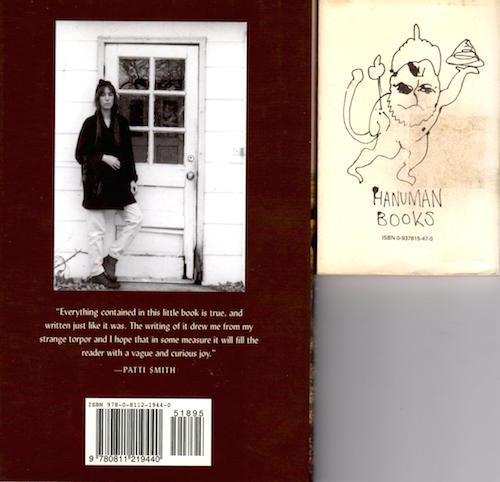
One Little One and Another

It was tiny in its first edition. It grew a little. Still palm sized.

Covers - Patti Smith - Woolgatheringback covers - patti smith - woolgathering

Patti Smith Woolgathering

On the back of the dust jacket of the second edition: “Everything contained in this little book is true, and written just like it was. The writing of it drew me from my strange torpor and I hope that in some measure it will fill the reader with a vague and curious joy. — Patti Smith”

And so for day 1935
31.03.2012

Posted in Booklore | Leave a comment

The Voyages … The Voices

Star Trek Beyond

Captain James T. Kirk: [epilogue] Space: the final frontier.
Commander Spock: These are the voyages of the starship…
Montgomery ‘Scotty’ Scott: …Enterprise. Its continuing mission…
Doctor ‘Bones’ McCoy: …to explore strange new worlds…
Sulu: …to seek out new life…
Chekov: …and new civilizations…
Lieutenant Uhura: …to boldly go where no one has gone before.

This coda delivered by a team rings true: I am struck by the pluralism (throughout the movie) and I like the update on the signature send off to make it more gender inclusive.

And so for day 1934
30.03.2012

Posted in Uncategorized | Leave a comment

Addressing Nonaddressing

David Mitchell: What my son’s autism has taught me

First up, is that we stop assuming a communicative impairment denotes a cognitive one. Let’s be wary of assuming that behind autism’s speechlessness lies nothing, or nothing to speak of. Instead, let’s assume that we’re dealing with a mind as keen as our own, and act accordingly. Talk to the person. Don’t worry if there’s no evidence he or she understands. Maybe there is evidence, but you’re not recognising it as such. If the person is there, never discuss them as if they’re not, or as if they’re only there like the coat stand is there. If they don’t notice this courtesy, no harm is done; but if they do, then someone who is often treated as a part-object, part-human, total nuisance gets to feel like a real, valid, card-carrying member of society.

The Guardian

And so for day 1933
29.03.2012

Posted in Uncategorized | Leave a comment