The Walk

John Edgar Wideman. Hiding Place.

The character misses the trolley. Forced to walk he turns the event into an aesthetic moment.

Nothing for it now but to walk. He had to walk that night and in the darkness over his head the cable swayed and sang long after the trolley had disappeared. He had to walk cause that’s all there was to it. And still no ride of his own so he’s still walking. Nothing to it. Either right or left, either up Homewood or down Homewood, walking his hip walk, making something out of the way he is walking since there is nothing else to do, no place to go so he makes something of the going, lets them see him moving in his own down way, his stylized walk which nobody could walk better if they had some place to go.

The prose has its own gait. Its own down way.

And so for day 1922
18.03.2012
Posted in Uncategorized | Leave a comment

latex of our lives

Kaushalya Bannerji
A New Rememberance
(Toronto: TSAR, 1993)

“THIS IS NOT AN ELEGY”

What to say when a friend
becomes a corpse

[…]

And what life is this?
The constant vigilance or weariness.
The latex of our lives
stretched to snapping.

There is a head note: “I wrote this poem in an attempt to come to terms with the sense of loss and homophobia that can surround the lesbian and gay communities when we are so often confronted with AIDS-related deaths.”

I hear in this image all the pent up frustration of trying to get safe sex messages out in the face of attempts to muzzle the plain speaking.

And so for day 1921
17.03.2012

Posted in Poetry | Leave a comment

Reading Howe

The Kingdom of Ordinary Time “Reading Ovid” Marie Howe

The thing about the Greeks and Romans is that
   at least mythologically,

they could get mad. If the man broke your heart, if he
   fucked your sister speechless

then real true hell broke loose:
   “You know that stew you just ate for dinner, honey?—

It was your son.”
   That’s Ovid for you.

A guy who knows how to tell a story about people who
   really don’t believe in the Golden Rule.

Sometimes I fantasize saying to the man I married, “You know
   that hamburger you just

gobbled down with relish and mustard? It was
   your truck.”

And it continues though I must admit with such a strong opening one loses the appetite to carry on *sigh* but it is worth reading Howe to see what she makes of this opening and by poem’s end the reader is expected to ponder the words of Jesus about the kingdom of heaven being within you. Not sure how a reader can digest it. Somehow after the beginning one would rather cook than eat.

And so for day 1920
16.03.2012

Posted in Poetry | Leave a comment

Crash Course in Tact

In a conversation with a colleague interested in the institutions of liberal democracy, I urged her to consider scribling a top ten tips for engaging in civil society. It led me to meditations of my own on the topic of relationship management and working across cultural and social differences. Here’s my take on the basics.

Listen: stay tuned to repetitions and mantras. Detect patterns.

Ask questions: elicit narratives: where have you been? where are you going? (of course, actual questions have to be more specific and tailored to the circumstances [remember the point about listening]).

Adopt and adapt vocabulary. Take on the words that resonate with your interlocutors. Be prepared to explain how your organisation works and what it aims to achieve. Either way, check the translations you make in either adopting the other’s vocabulary or adapting your own (remember to validate with questions).

Be open for future contact — relationship building is not instantaneous, be prepared to invest.

Seems so simple and recursive now that its laid out here. Seems a wise course for communications internal to an organisation too.

And so for day 1919
15.03.2012

Posted in Uncategorized | Leave a comment

Rhythm: Seen and Heard

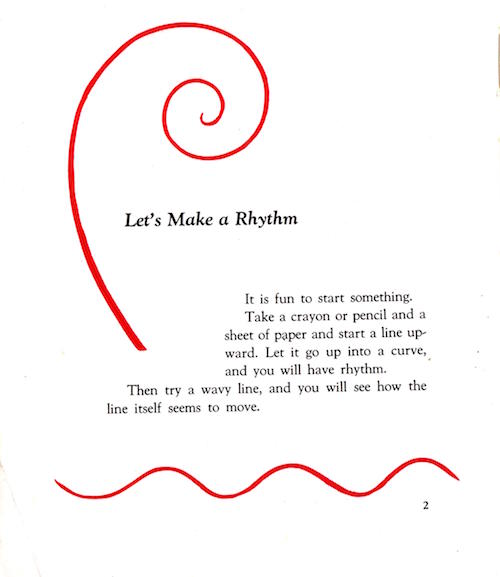
This 1954 book by Langston Hughes with pictures by Robin King provides from its first pages evidence that there was an alternative to the eye-ear dichotomy championed by Marshall McLuhan in the 1960s – a more holistic view of the world and the senses.

The First Book of Rhythms

Langston Hughes - rhythm

From the outset the reader is invited to draw and later to hear. The book ends with paean to the human place in the universe and the glory of rhythm.

But your hand controls the rhythms of the lines you make with your pencil on a paper. And your hand is related to the rhythms of the earth as it moves around the sun, and to the moon as the moon moves around the earth, and to the stars as they move in the great sky — just as all men’s lives, and every living thing, are related to those vaster rhythms of time and space and wonder beyond the reach of eye or mind.

Rhythm is something we share in common, you and I, with all the plants and animals and people in the world, and with the stars and moon and sun, and all the whole vast wonderful universe beyond this wonderful earth which is our home.

/\/ /\/ /\/ /\/ /\/ /\/ /\/ /\/ /\/ /\/ /\/ /\/ !!

And so for day 1918
14.03.2012

Posted in Dichotomies, Perception | Leave a comment

like playing a video game: ohsoprecisely

Kaushalya Bannerji ~~ A New Remembrance ~~ “World War”

There is a headnote that gives us place and time of composition: “written during the Gulf War of winter 1991” These are the concluding lines and I note the “ohsoprecisely” accurate control of spacing

black espresso
hot and bitter
as our past passion
we’re not prepared
for this Nintendo wargame
which flickers
ohsoprecisely onto satellite screen
to interface with death
has never been so easy

To this I add a Wikipedia-derived gloss: “The word Nintendo can be roughly translated from Japanese to English as “leave luck to heaven”.” Takes skill to push the button. Takes skill to write the poem.

And so for day 1917
13.03.2012

Posted in Poetry | Leave a comment

Guarding Gardens

John Edgar Wideman. Hiding Place.

Late now for putting seeds in the ground. There was a time they turned the ground from the back porch all the way to the trees at the edge of the hill. Long straight furrows combed in the earth and they’d grow enough to can and get through the winter. Beans and peas and tomatoes and cucumbers and lettuce and turnips and mustard greens. Sticks marching in regular rows and strings stretched for the vines to climb. Corn and grapes and parsley. Once her brothers had shown her where sausage grew and the hole where she should lay the hambone and cover it with ash to grow a new ham. You see anything yet? Ought to be sprouting up pretty soon now. You sure you spread them ashes careful? You sure you been watering it every day? Maybe you put your ear to the ground you hear it oinking. A fence then to keep out stray dogs and cats. Raccoons still around too. Her daddy kept a shotgun in the cupboard but never got a shot at one. They thought they might catch one in their pigeon trap and baited it with bacon instead of bread but nobody was allowed to sit up all night and hold the string which was attached to the stick which held the box up in the air. None of the children could stay up all night at the window to pull the string when the raccoon went after the bacon under the box, so we never catched one either.

Corn and grapes and parsley. Nous sommes au pays de cocaigne. And the tall tales turned practical jokes trick out the ever trickling stories.

And so for day 1916
12.03.2012

Posted in Food Writing, Gardens | Leave a comment

Food

I just finished reading Eden Robinson, The Sasquatch at home: traditional protocols and modern storytelling. There is a passage that put me in mind of the important ongoing work on food security.

Economics

[…] mentally taking notes about the irony of food fishing in the imperial era of McDonald’s. For instance, you have to [be] fairly well-off to eat traditional Haisla cuisine. Sure, the fish and game are free, but after factoring in fuel, time, equipment, and maintenance of various vehicles, it’s cheaper to buy frozen fish from the grocery store than it is to physically go out and get it.

Ecology & Culture

If the oolichans don’t return to our rivers, we lose more than a species. We lose a connection with our history, a thread of tradition that ties us to this particular piece of the Earth, that ties our ancestors to our children.

Spent a lovely hour with the 49 pages of these lectures/stories delivered at the University of Alberta in 2011 thanks to the non-circulating Toronto Reference Library — nice surroundings and always stocked.

And so for day 1915
11.03.2012

Posted in Food Writing | Leave a comment

Sounds of the House

Kaushalya Bannerji ~~ A New Remembrance ~~ “My Dida’s House”

The poem ends with a stark image of a gender divide.

My world was always one of communicative women, harsh-voiced or sweet, and silent men appearing like fullstops at the end of hurried sentences.

Strategically locating this at the end of the poem ties the telling to the told in a memorable fashion.

And so for day 1914
10.03.2012

Posted in Poetry | Leave a comment

Deep River of Song Within the Story

Sounds of congregation from Damballah by John Edgar Wideman …

I wanted to dwell on Sybela’s first free morning but the chant of the Gospel Chorus wouldn’t let me sit still. Lord, reach down and touch me. The chorus wailing and then Reba Love Jackson soloing. I heard May singing and heard Mother Bess telling what she remembers and what she had heard about Sybela Owens. I was thinking the way Aunt May talks. I heard her laughter, her amens, and can I get a witness, her digressions within digressions, the webs she spins and brushes away with her hands. Her stories exist because of their parts and each part is a story worth telling, worth examining to find the stories it contains. What seems to ramble begins to cohere when the listener understands the process, understands that the voice seeks to recover everything, that the voice proclaims nothing is lost, that the listener is not passive but lives like everything else within the story. Somebody shouts Tell the truth. You shout too. May is preaching and dances out between the shiny, butt-rubbed, wooden pews doing what she’s been doing since the first morning somebody said Freedom. Freedom.

Improvisation within convention is what the alert listener is on the lookout for whether or not they have sat in butt-rubbed pews.

And so for day 1913
09.03.2012

Posted in Uncategorized | Leave a comment