Poverty of Means & Proper Nuance

Philip Stratford “Translation as Creation” in Figures in a Ground: Canadian Essays on Modern Literature Collected in Honor of Sheila Watson edited by Diane Bessai and David Jackel.

It is preferable to struggle to find the right word in your own mind and in your own vocabulary than to rely on the push-button response of thesaurus or dictionary. It may even be preferable, since dictionaries are sometimes indispensible [sic], to use a modest rather than a too extensive one, just to insure a close and personal engagement in the search.

When I first read this, I took “extensive” as “expensive”. And my big two volume OED (with the magnifying glass) informed me that “indispensible” is an obsolete form for indispensable and which here serves as an indice of the Canadian pronunciation. BTW the Oxford English Dictionary in my possession was purchased at a cut rate price since “the definitive record of the English language” has migrated to a subscription service online and many persons have been offloading their old paper behemoths.

The point that Stratford is making is that a poverty of means induces a valuable outcome when mediated by skill (in internalizing the resources of target and source languages). The other point that he is making is that there is a personal stake in the enjeu.

And so for day 1912
08.03.2012

Posted in Translations | Leave a comment

Suspension Before Entanglement

N. Martin Nakata, Victoria Nakata, Sarah Keech & Reuben Bolt
Decolonial goals and pedagogies for Indigenous studies
Decolonization: Indigeneity, Education & Society Vol. 1 No. 1 2012

At the introductory level, we do not dispute the usefulness of presenting the Indigenous-settler relation in binary terms. Nor do we dispute, that non-Indigenous students in the course of their learning need to or will be confronted and “unsettled”. But we would suggest, initially at least, teaching the practice of “suspension ” viz., suspension of pre-suppositions and suspension of foregone conclusions while engaging the implications of the knowledge interface for Indigenous analysis, Indigenous resistance, Indigenous knowledge revitalization, Indigenous practices, and Indigenous futures. This is [a] disruptive but intellectualized practice of a less personalized nature which still engages students in the politics of knowledge production and ultimately the politics of their location and of social reproduction. It is not an easily mastered practice either and requires academics to think about how to manage dialogue and discussion in lecture rooms so students do not revert to resigned fence-sitting but move on to re-thinking and re-articulating more complex positions. We argue it is a worthwhile skill to develop in students who will graduate into the human service professions which engage Indigenous people and practices at the interface of ongoing knowledge entanglements.

What gains traction here with me is the questioning of binary positioning, the enumeration of analysis, resistance, revitalization, practices and futures, the characterization of the interface as a set of entanglements. There is a whole ecosystem of knowledge production and social reproduction at work here.

And so for day 1911
07.03.2012

Posted in Introductions | Leave a comment

Seduced by the Paratext

Leo Babauta Zen Habits: Mastering the Art of Change [2014] has a lovely cover by Lisa Class

cover - Zen Habits

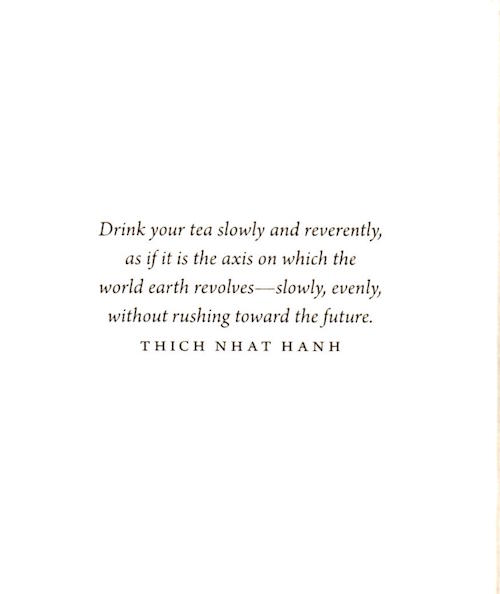
And the design by Matt Avery on the flyleaf offers this sensitive layout of a quotation by Thich Nhat Hanh.

drink tea - Thich Nhat Hanh

Drink your tea slowly and reverently, as if it is the axis on which the world earth revolves — slowly, evenly, without rushing toward the future.

And so we read books — slowly, evenly, without rushing toward the future.

One bibliographic oddity. The book in its 2015 incarnation has a longer title despite touting briefness: Essential Zen Habits: Mastering the Art of Change, Briefly.

And so for day 1910
06.03.2012

Posted in Booklore | Leave a comment

Riposte

F.R. Scott in The Dance is One has a poem answering McLuhan’s The Mechanical Bride. It is entitled “The Miniaturized Groom” and is a series of short statements about the adage the medium is the message. Scott quips that McLuhan is a “Master misunderstander!” The poem ends on salvo against technocratic triumphalism.

Message is man
not machine.

In the stanza before this terminal assertion, Scott lists a number of synonyms for what the medium does: mouthpiece, mirror, magnifying-glass, multiplier.

The letter M becomes the medium for delivering the message that “the medium is meant to massage the message / and make it more meaningful.”

And so for day 1909
05.03.2012

Posted in Poetry | Tagged | Leave a comment

Herbs: to crush, smell and cook

The introduction to Sauce Chivry begins

I like herb sauces. They mean summer, when so many fish are at their best — and look their best, served with a pale green sauce. I like walking down the garden — the genius of man having placed the herb patch as far away from the kitchen as possible, on the principle, I suppose, that exercise is good for cooks — past catalpa and hibiscus, to find chives, tarragon, and parsley which flourish at the foot of a most entangling rose.

The arch tone belongs to Jane Grigson (Fish Cookery) but what I particular like about this passage is the finesse with which it deploys the present and the infinitive. It lends a liveliness that propels the reader on to trust the directives that follow about judging an appropriate amount of herb to add. After a little tour of English, French and Italian geography we are urged: “So be guided by the season, and by your own taste and climate. Be prepared to use far more than I — or anyone else — suggest.” By this stage we are already complicit in the imperative.

And so for day 1908
04.03.2012

Posted in Food Writing, Introductions | Leave a comment

High on Novels

The postmodern braiding of diegetic elements with those of the narration is accomplished with panache in Laurent Binet’s La septième fonction du langage. Our hero is at a party at Cornell and reviews in picaresque terms the péripéties that have accumulated along his novelistic journey.

À Bologne, il couche avec Bianca dans un amphithéâtre du XVIIe et il échappe à un attentat à la bombe. Ici, il manque de se faire poignarder dans une bibliothèque de nuit par un philosophe du language et il assiste à une scène de levrette plus ou moins mythologique sur une photocopieuse. Il a rencontré Giscard à l’Élysée, a croisé Foucault dans un sauna gay, a participé à une poursuite en voiture à l’issue de laquelle il a été victime d’une tentative d’assassinat, a vu un homme en tuer un autre avec un parapluie empoisonné, a découvert une société secrète où on coupe les doigts des perdants, a traversé l’Atlantique pour récupérer un mystérieux document. Il a vécu en quelques mois plus d’événements extraordinaires qu’il n’aurait pensé en vivre durant tous son existence. Simon sait reconnaître du romanesque quand il en rencontre. Il repense aux surnuméraires d’Umberto Eco. Il tire sur le joint.

« What’s up, man? »

[…]

« I think I’m trapped in a novel. »

[…]

« Sounds cool, man. Enjoy the trip »

And Dear Reader, you too are enjoined to enjoy the trip and its telling.

And so for day 1907
03.03.2012

Posted in Uncategorized | Leave a comment

Piscine Delights

From the Glossary of Fish Names in Jane Grigson Fish Cookery

Nannie Nine Eyes (sea lamprey: eel)
Nanny nose (soft clam)
Nanny shad (gizzard shad; shad)
Nassau grouper (grouper)
Native oyster (oyster grown in UK, Ostrea edulis)
Navaga (cod)

Pure Found Poetry

And so for day 1906
02.03.2012

Posted in Poetry | Tagged | Leave a comment

Praising the Quilter Through the Quilt

It is the description of the objects that underwrites the discrediting of the discrediting. We are reminded of the opening lines phrased as a pointed question in Marge Piercy’s “Looking at Quilts”: Who decided what is useful in its beauty / means less than what has no function besides beauty / (except its weight in money)?

The patchwork quilts are rightly celebrated as objects of great beauty. Made from thousands of pieces of shaped and coloured fabric, sewn into elaborate and intricate patterns, they produced rich colouristic effects and contained symbolic meanings. They were given a variety of suggestive titles, ‘Mariner’s Compass’, ‘Jacob’s Ladder’, ‘Star of Bethlehem’ and ‘Sunburst’, the last superbly conveying the effect of the radiating beams of the sun and the beneficence of its golden light. But some of these names, rather than being specific titles of quilts, refer instead to categories of basic methods of putting the fabrics together. This has often, erroneously, led to a dismissal of quilt-making as mere repetitious use of pattern. But, individual quilt-makers used the basic patterns to dramatically different effect by choice of colours, size of pieces, optical illusion and intended meaning.

Old Mistresses: Women, Art and Ideology Rozsika Parker and Griselda Pollock.

And so for day 1905
01.03.2012

Posted in Uncategorized | Leave a comment

The Print, The Step

Two lines from #121 in Daryl Hine &: A Serial Poem

[…]

As if each moment were a monument

[…]

Not every happening qualifies as an event.

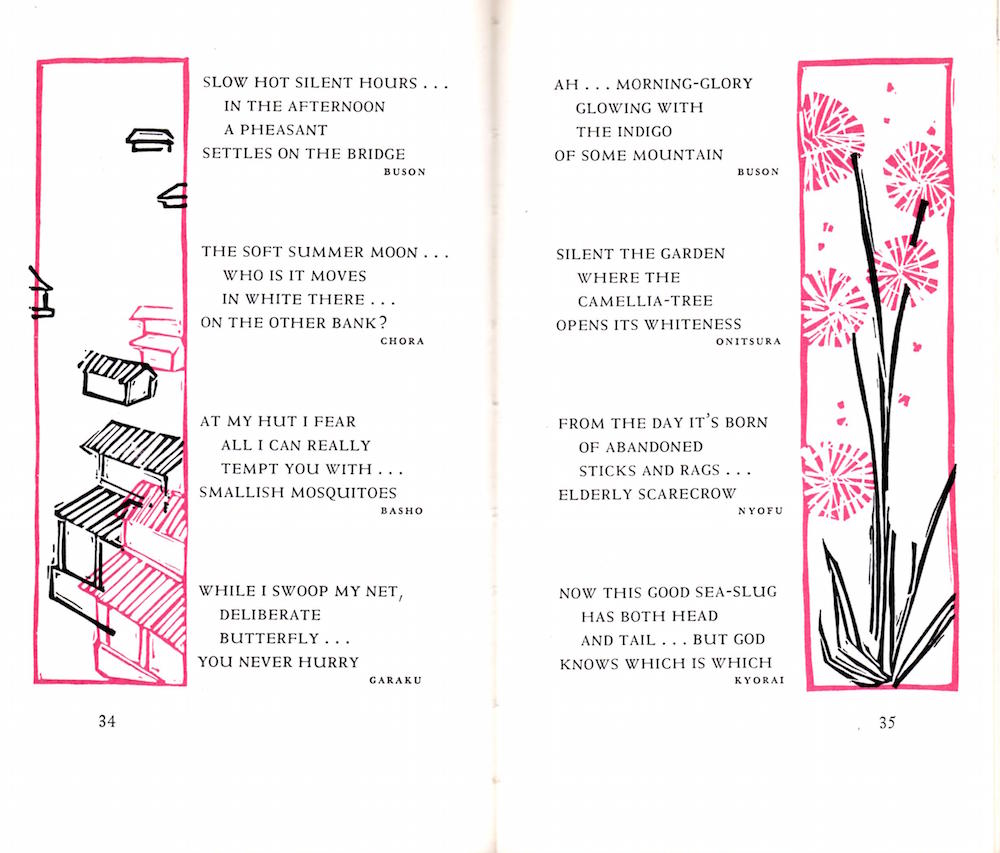
Two lines that bring to mind for me the subtle art of Jeff Hill who did the decorations and lettering for Peter Pauper Press’s Cherry-Blossoms: Japanese Haiku Series III (1960)

haiku - peter pauper press

I treasure the finesse of the block like elements of the houses or huts on the left. Some just over the window-like frame. Some overlapping red on black.

Such illustration is worthy to be called an event. It happens as if each monument were a moment.

And so for day 1904
29.02.2012

Posted in Poetry | Tagged | Leave a comment

To See Anew

Alison Uttley
Grey Rabbit’s May Day

“Unwilling to steal ritual flowers, but unable to speak and explain their need, the animals leave gifts in exchange — among them a Roman glass tear bottle, found by the mole in a tunnel and filled by the rabbit with fresh May dew. Initially bewildered, Miss Susan [the nearly blind women who tends the garden] finally rubs her eyes with that dew and finds that she can again see ‘the feathers of the birds, the petals of the flowers.’”

House and Garden
March 2000
p. 78
Also published under the title Little Grey Rabbit’s May Day

And so for day 1903
28.02.2012

Posted in Uncategorized | Leave a comment