Tour de force

Nasser Husain in SKY WRI TEI NGS

offers

TEN DRR BUT TON (FOR GER TIE)

Rewrites the “Contents” page from the Food section of Gertrude Stein/s Tender Buttons using 3 letter airport codes

Read aloud at PennSound:

http://writing.upenn.edu/pennsound/x/Hussain.php

And so for day 3052
20.04.2015

Posted in Poetry | Leave a comment

Of Types of Tokens

Tokens are digital assets or access right tools that have the ability to facilitate collaboration across markets and jurisdictions. They allow more transparent, efficient, and fair interactions between market participants, at low cost.

  • What is the Token Economy? Shermin Voshmgir
    O’Reilly Media, Inc. October 2019

In this report, Shermin Voshmgir, director of the Research Institute for Crypto Economics at the Vienna University of Economics, walks you through the different types of tokens, along with their properties and both operational and conceptual use cases.

NFTs = Examples would be real estate tokens, crypto-collectibles, or tokens that represent unique pieces of art. Representing such assets with a token makes the assets more easily tradable and divisible, thus creating more liquidity for some assets that might not have been that easily tradable off-chain. [Still don’t understand the difference between fungible and non-fungible tokens. It seems to have some thing to do with the temporalities of liquidity.][See definition of “liquidity”] [Better terminology offered by Voshmgir is “unique tokens”]

And so for day 3051
19.04.2015

Posted in Uncategorized | Leave a comment

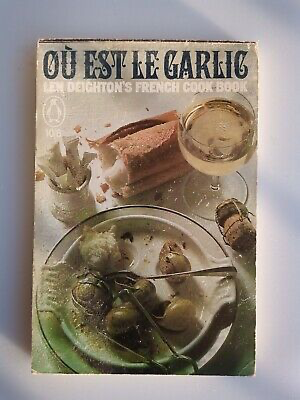
Où est le Garlic?

Alice B. Toklas
Aromas and Flavors of past and present
“Preface”
1st paragraph

Very few people are indifferent to either the aroma or flavor of garlic. One is affected favorably or unfavorably. It may have been the odor of garlic with which Henry James was greeted when he went to call upon George Eliot for the first time and which he later described as the right odor in the wrong place.

Reminds one of the definition of a weed and the title of a book …

Cover of Où est le garlic? = title of a book by Len Deighton.
Len Deighton’s French Cook Book

And so for day 3050
18.04.2015

Posted in Food Writing, Uncategorized | Leave a comment

Eggs Florentine – The Old Way

Waverley Root
The Food of Italy
1971; 1992 (Vintage Books Edition)
p. 44

Before the ubiquitous hollandaise there was sauce mornay …

Uova alla fiorentina are lightly poached eggs bedded on spinach, which has been first boiled and then sautéed in butter, in a buttered baking dish. Mornay sauce is poured over it, then it is sprinkled with grated cheese and bread crumbs, and baked in the oven.

Mornay sauce is easier to adjust for vegans than butter and egg rich hollandaise.

And so for day 3049
17.04.2015

Posted in Food Writing | Leave a comment

On readiness and redness

Umberto Eco

Kant and the Platypus: Essays on Language and Cognition

Translated from the [1997] Italian by Alastair McEwen

New York, San Diego, London : Harcourt Brace & Company

2000

PAGE: 62

But all things considered, Peirce distinguishes the two moments: both are identified with the naming of that which is experienced, and to name its always to make a hypothesis (just think of Marco Polo’s efforts in this regard). But the names given to recognize sensations (such as the sensation of redness) are casual, not truly motivated; they serve only to distinguish (as if by sticking a label on them) a certain sensation from others; I say that I sense redness to exclude other possible chromatic sensations, but the sensation is still subjective, temporary, and contingent, and the name is attributed to it as a signifier whose meaning is still unknown. Instead, with the concept we move on to the signified.

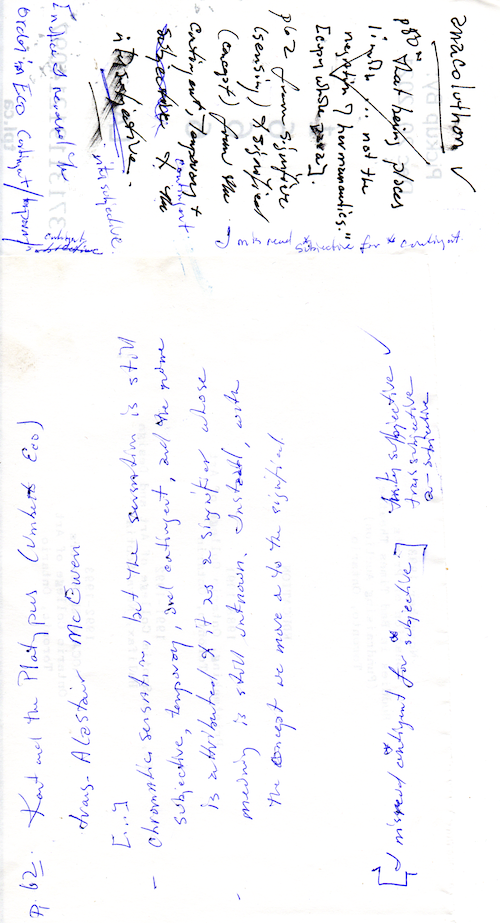
my initial resorting:

from signifier (sensing) to signified (concept) from the contingent, temporary + subjective to the intersubjective

Note: as evident from my crossing and recrossing, I was/am having some thoughts about the subjective, intersubjective and the trans-subjective

Note: I mixed up *contingent for *objective

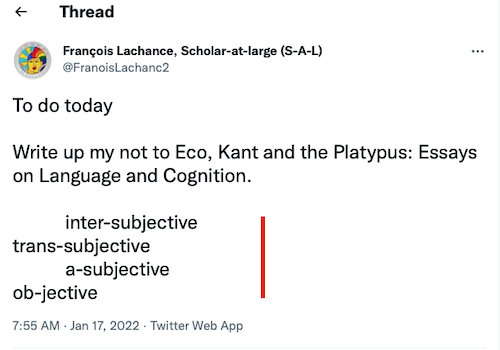
inter-subjective
trans-subjective
a-subjective
ob-jective

           inter-subjective
trans-subjective
           a-subjective
ob-jective

Screenshot Twitter Feed 17.01.2022 -- a nod/note captured as -not- -- inter-subjective | trans-subjective | a-subjective | ob-jective
* Note (seems nod/note came to be represented by not)

All this work was done under the sign of anacoluthon — expecting the missing unexpectedness …

Notes taken on several occasions from December 2021 to mid January 2022 - not anacoluthon at head -- this was about missing the unexpected
Under the sign of anacoluthon

And so for day 3048
16.04.2015

Posted in Transcriptions, Uncategorized | Tagged , | Leave a comment

Naming as a Calling into Being Named

Commentary narrated by Millicent Marcus at 00:03:19

Now we hear a voice. It’s disembodied. But we see it is the voice of an older woman. She is the mother. And she is calling into being her son by naming him.”

Cinema Paradiso. DVD, Disc 2 – Theatrical Version. (Shengley, England : Arrow Academy, [2017]) at 3:19.

What is important to note here is the installation of the character’s existence depends on another character naming them. (How things get created has always puzzled me in possible world semantics in particular in its application to fiction.) As Marcus notes the eucharist ritual returns and so does a theme of transubstantiation.

This commentary is not mere plot summary. It enhances the viewing of the film. If I had time enough and energy I would transcribe the entire commentary to make it available to those that see to hear and those interested in possible world semantics. However I stop at this snippet because of the naming that arises from a woman’s voice — she creates him — and am intrigued by the notion of rigid designation in possible world semantics (Still on my reading list is Saul Kripke’s Naming and Necessity). I have a sneaking suspicion that Marcus’s commentary suggests that names may not be as rigid as commonly thought in some quarters. I am not against rigidity per se butt…

And so for day 3047
15.04.2015

Posted in Perception, Translations | Tagged | Leave a comment

Art + Fact

Further to the meditations on ancestral objects and stories offered by Bonnie Devine …

Artifacts may only be remnants left behind by the people who went before us, but to me, holding an artifact is like shaking hands with the ancestors. They are teachers who have their own stories of how they were created, utilized, and, sometimes, discarded. I encourage other Indigenous people who may have never seen a sherd of Indigenous ceramic or an intrically flaked projectile point to hold them and see the technical and artistic skill needed to create them. And to feel pride in knowing that our ancestors created these objects that have lasted thousands of years.

Stacey Taylor
“An Indigenous Archaeologist at the Rouge National Urban Park” in Indigenous Toronto: Stories that Carry this Place

And so for day 3046
14.04.2015

Posted in Storytelling | Tagged , | Leave a comment

Distinctions

Catherine Kelsey
Critical Practice
1980

O, an eloquent & interesting passage on the lexical shift in the meaning of “disinterested”

In a quite different area, however, it may be that the recent and increasingly common blurring of the distinction between uninterested and disinterested is also ideologically significant. it could be argued that as capitalism increasingly equates wealth with happiness (while also contradictorily asserting, of course, that the best things in life are free), interest as intellectual curiosity or concern is gradually ceasing to seem distinct from interest as material or economic concern, so that disinterested (detached, having nothing to gain) is become synonymous with uninterested (bored).

In search for a new word for “disinterested” … “unprejudiced” might do.

And so for day 3045
13.04.2015

Posted in Uncategorized | Leave a comment

The Reach … The Remembered

I am reminded of the title The Highest Apple: Sappho and the Lesbian Poetic Tradition by Judy Grahn by a fragment from

Sarah Dowling
“This Word: I Want”
Entering Sappho

apple-pickers forgot, you
missed it — the pluckers

and not forgotten are these renderings:

Anne Carson (and its delicious doublewords), If Not, Winter

as the sweetapple reddens on a high branch
high on the highest branch and the applepickers forgot —
no, not forgot: were unable to reach

Dante Gabriel Rossetti

Like the sweet apple which reddens upon the topmost
    bough,
A-top on the topmost twig,—which the pluckers forgot,
    somehow,—
Forgot it not, nay, but got it not, for none could get it
    till now.

http://www.rossettiarchive.org/docs/1-1881.1stedn.rad.html#p288

Gillian Spraggs published in Love Shook My Senses. Lesbian Love Poems

Fragment 105 (a)

A girl
… like the reddening apple,
at the tip of the topmost twig,
which the apple-pickers missed –
or no, not missed entirely;
the one they could not reach.

There’s a trace or Rossetti in the opening line serving as a title in Spraggs

It is first printed in the Penkill Proofs, the first of the prepublication texts DGR prepared for the eventual publication of his 1870 Poems. When it was reprinted in the Tauchnitz edition (1874) DGR changed the title from “One Girl” to “Beauty”, and he kept the latter in his 1881 Poems. A New Edition.

One more for the basket: Anita George in Poetry June 1994.

Fragment 105(a)

You: An Achilles’ apple
Blushing sweet on a high branch
at the tip of the tallest tree.
You escaped those who would pluck
        your fruit.
Not that they didn’t try. No,
They could not forget you
Poised beyond their reach.

Sarah Dowling rings the changes on the theme of the highest apple for many more lines before and after the two quoted above. But I like how the restricted quotation plays up the pronominal play: missed & missing merge “you” as the picker & picked.

And so for day 3044
12.04.2015

Posted in Poetry, Translations, Uncategorized | Leave a comment

transfigurations and translations

fragments from the frag pool: haiku after bashō
gary barwin & derek beaulieu

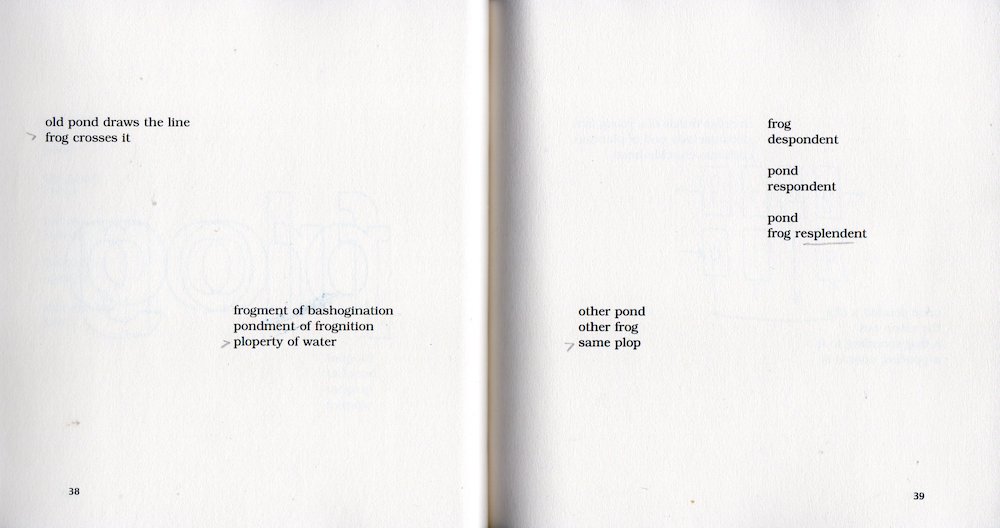
the double spread on pages 38 & 39

fragments from the frag pool: haiku after bashō - gary barwin & derek beaulieu - double spread pages 38 and 39

transcribed (sans the white space between sections)

old pond draws the line
frog crosses it

fragment of bashogination
pondiment of frognition
ploperty of water

frog
despondent

pond
respondent

pond
frog resplendent

other pond
other frog
same plop

****

the found poem based on the markings in the library copy…

frog crosses it
ploperty of water
resplendent
same plop

And so for day 3043
11.04.2015

Posted in Poetry, Transcriptions, Translations, Uncategorized | Tagged | Leave a comment