Not So Long Ago

First a description of the product and its cross-cultural appeal.

Known as croccante to the Italians, praline to the French and turrón to the Spanish, such a golden nutty sweetmeat is better known here in Britain as brittle or, occasionally, cracknel. Although methods and results differ slightly from country to country, the marriage of warm, freshly roasted nuts and glistening caramel lives up to its name. The nuts are cracked, then snap and spit in the caramel. The brittle will crackle as it cools and then shatter as you break it into shards for crunching between the teeth.

Nigel Slater Real Good Food, 1995

Given Slater’s praise of the nut and caramel confection, it is no surprise that I was attracted to a little pamphlet from the Green Orchid in New Orleans presenting the “Story of the Praline”. Its cover should have alerted me but I thought it was similar to pancake mix from Aunt Jemima.
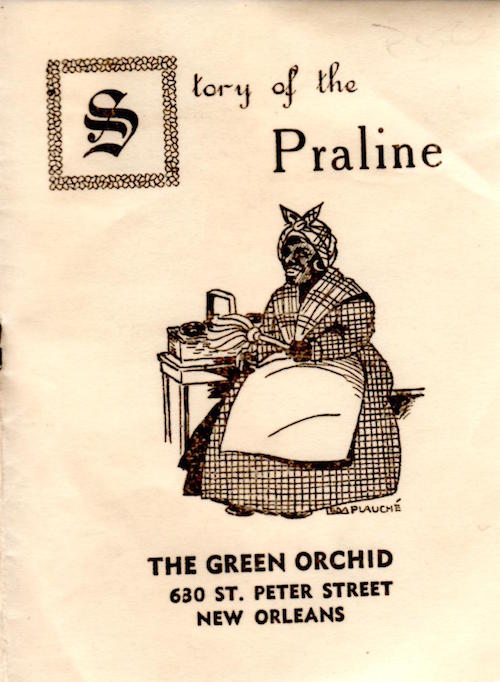
ephemera Green Orchid - New Orleans - Story of Praline

A search for “Green Orchid + New Orleans” led me to the blog of Dave DeCaro who was tempted then put off:

Anyone care to sample Ma-Lou’s Pralines? I wouldn’t mind some crumbled over vanilla ice cream. This one is from June 1962

My inner sign-geek is telling me to get a closer look at the signage of the Green Orchid:

See

close up - sign to Green Orchid - Home of Famous Ma-Lou Pralines

In case, you may wonder about judging by covers, consider this from Creating the Big Easy: New Orleans and the Emergence of Modern Tourism, 1918-1945 by Anthony J. Stanonis

New Orleans businesses capitalized on the mammy image. The Green Orchid, a prominent French Quarter store, offered tourists a booklet that explained how the “outstanding candy of the old Negro mammies, has become synonymous with New Orleans.” Delicious pralines, loyal mammies and the Crescent City were tightly bound together. Léda Plauché, who operated the Green Orchid, named the confections “Ma-Lou Pralines,” an abbreviation for “my old Negro mammy, Marie-Louise.” The shortened version, done for “commercial purposes,” not only stripped the black figure of a name suggestive of her Creole roots — and possibly mixed bloodline — but also presented her as motherly. Playing on tourists’ curiosity, Plauché had cooks don costumes and opened the kitchen to the public, providing “the only place in New Orleans where you may see mammy making pralines.” The Green Orchid was not alone in manipulating the mammy image for financial gain.

We learn more about Ms Plauché from Omnivore Books and their catalogue

(New Orleans) Plauché, Léda. Ma-Lou’s Creole Recipes.

46 pp. Pictorial wrappers. First Edition. New Orleans: Green Orchid Gift Shop, c.1940’s. Inscribed & SIGNED by the author on front free endpaper. Léda Hincks Plauché (Mrs. Henry Plauché) was born in New Orleans in 1886. She designed her first Carnival ball for the Krewe of Nereus in 1916 and, over the next forty years, she included the krewes of Rex, Proteus, Comus, and Momus among her clients. Mrs. Plauché was also the proprietor of the Green Orchid gift shop in the French Quarter. She died in New Orleans in 1980. In 1958, Léda Plauché donated a large collection of Mardi Gras costume and float designs and a smaller collection of photographs to the Louisiana Department (now Division) of New Orleans Public Library. Fine. $65

http://www.omnivorebooks.com/antiquarian_archive01.html

cover - Ma Lou's Creole Recipes - Green Orchid Gift Shop

So the little pamphlet on pralines originates somewhere between the 1940s and the 1960s. But parts of its text still sting (well beyond the appropriation signalled by Stanonis). This for me is simply eye-popping:

These faithful old darkies loved to adopt family names and to mimic what the “Boss” did so mammy named her candy Praline, feeling quite sure that if what came from Paris was good enough for her “Missus”, it was good enough for her. So the Praline, outstanding candy of the old Negro mammies, has become synonymous with New Orleans!

Having explored the discourse surrounding this sweet I have a greater appreciation for what “normalizing” means in an American context.

And so for day 1862
18.01.2012

Posted in Ephemera, Food Writing | Leave a comment

The Insanity of Poetry

From the Republic of Childhood, a tool? a weapon? a field?

We call these children’s games, not children’s work, but isn’t a child precisely one who doesn’t yet observe a clear distinction between what counts as labor and what counts as leisure? All children are poets in that sense. I’m asking you to locate your memory of that early linguistic instability of language as a creative and destructive force. I have done the reading, and the reading suggests that we always experience this power as withdrawing from us, or we from it — if we didn’t distance from this capacity it would signal our failure to be assimilated into the actual, adult world, i.e., we would be crazy.

It seems an echo of Kristeva’s chora here in Ben Lerner The Hatred of Poetry.

And so for day 1861
17.01.2012

Posted in Poetry | Leave a comment

Just a Little Off the Top

This passage in a piece by Darren O’Donnell “Social Practice, Children and the Possibility of Friendship” in Blast Counterblast ed by Anthony Elms and Steve Reinke (Toronto: Mercer Union, 2011) reminds us of the importance of audience.

This displacement of critical categories away from notions of craftsmanship and virtuosity allows for an easier involvement of the nonartist, children and young people, particularly populations who may be marginal to the dominant culture and thus less conversant with the language and postures of art.

Consider the various productions of Haircuts by Children mounted by Mammalian Diving Reflex (with which O’Donnell is associated): a performance about trust, children’s rights, generosity and vanity, where ten-year-olds offer free haircuts to the public. This has been mounted in several cities around the world.

http://mammalian.ca/projects/

And so for day 1860
16.01.2012

Posted in Uncategorized | Leave a comment

Finding Place Finding Story

I am intrigued by the progression. A skip to the past (the boy he was) to traverse some fiction production (the lives of the strangers) to land in the present (place). It seems as if the boy himself is a stranger to himself.

Ask the boy he was if he must invent
the lives of the strangers to find his place.

Bruce Bond. “Homage to a Painter of Small Things” in Raritan Vol. XXXV No. 3.

And so for day 1859
15.01.2012

Posted in Poetry | Leave a comment

Morphemes Metastasize

pages and pages apart is found a description to describe language under pressure

The wire, the wire, the why are, the why are. The why are we here? Listen there was time.

which instantiates what our poet earlier expressed in a finely allitertive phrase: “tumorousness of nurture”

Sina Queyras Lemon Hound

And so for day 1858
14.01.2012

Posted in Poetry | Leave a comment

How Language Travels Bodywise

Desire of the body, desire of the language

something like wait for me
in the braille of scars
tonight can i suggest a little punctuation
circle half-moon vertical line of astonishment
a pause that transforms
light and breath
into language and threshold of fire

Nicole Brossard Ardour translated by Angela Carr.

i like the little “i” — to announce a suggestive soupçon of a pick up line

And so for day 1857
13.01.2012

Posted in Poetry | Leave a comment

Perfectly Saying

I am wondering if the ending of this poem is what is called in French “finir en queue de poisson” or in German “im Sand verlaufen” — a fish tale in the sand. The lines allows the poem to disintegrate gently.

[…]
could be the face I put on everything,
or it could be my way of saying
nothing and saying it perfectly.

The end from Philip Levine “Picture Postcard from the Other World” in A Walk With Tom Jefferson.

And so for day 2222
12.01.2013

Posted in Poetry | Leave a comment

Portals via Allegory

One of the best explanations of allegory and its talismanic appeal to Walter Benjamin…

Allegory was a preeminent aesthetic mode in Christian visual and literary art of the Middle Ages, and its primary role was one of spiritual edification. Like holy relics and statuary, allegorical images or texts were thought to offer portals through which the holy realm outside the senses could be directly experienced.

Victoria Nelson “Walter Benjamin and the Two Angels” Raritan Vol. XXXV No. 3.

And so for day 1856
12.01.2012

Posted in Uncategorized | Leave a comment

Chasing Flavour Enhancing the Moment

After an evening feasting on creamy St. Simon oysters from New Brunswick on offer at Oyster Boy, I encountered this tantalizing passage in Sina Queyras Lemon Hound

moments sliding like oysters on the tongue, salty and filled with dreams of whales

Much like the succulent St. Simon …

And so for day 1855
11.01.2012

Posted in Food Writing, Poetry | Leave a comment

Space and Place Mediated by Language

Or at least this is what I think this is aiming at:

What is the connection
between belonging to a place
moving through a space
+ vocabulary at hand
                    ?

That question mark hooked onto vocabulary or all that goes before ?

I am put in mind of the words propelling attitudes of gay liberation and lesbian-feminist revolution that prompted us to set up an openly gay and lesbian household back in 1982 on Aberdeen Street in Kingston, in the heart of the student ghetto — it was called appropriately Sappho-Wilde House.

And so for day 1854
10.01.2012

Posted in Transcriptions, Uncategorized | Leave a comment