Whistle While You Work

Link this to Audre Lorde’s concept of biomythography.

the lifework of every gay man has been the transformation of the loathed into the loved

John Preston, “Goodbye to Sally Gerhart [1981] in Mark Blasius & Shane Phelan (eds.), We Are Everywhere: A Historical Sourcebook of Gay and Lesbian Politics, pp. 511-520 (1997) also in Michael Denney, Charles Ortleb and Thomas Steele (eds.), The Christopher Street Reader, pp. 368-80 (1983).

And so for day 1853
09.01.2012

Posted in Uncategorized | Tagged | Leave a comment

Positionality Disturbed

Rosalind Coward and John Ellis Language and Materialism

On S/Z, Barthes’s study of Balzac’s Sarazine

On the level of the writing itself, the identity between the signifier and the signified is disturbed. Then, the sexual opposition which is necessary for reproduction is displaced by the entry of a third, troubling term. Finally, gold is shown us being a troubling form of wealth, a new form that is no longer simply the index of physical wealth. These three forms of disturbance are three ‘routes of entry’ into the symbolic code, ‘none of which is privileged’. They are equally the three major forms of exchange by which society reproduces itself (language, sexuality and economics), each of which requires a fixed positionality (addressor-addressee; masculine-feminine; buyer-seller). The disturbance in this text originates in the area of sexual positionality, but its effects are felt equally and necessarily in each of these areas: positionality is disturbed, so each of these modes of reproduction becomes impossible.

This excerpt was found in a folder containing another sheet referencing three types of action in the business sphere: propose, give away, add value.

And so for day 1852
08.01.2012

Posted in Uncategorized | Leave a comment

For the Love of Teleroman

If I were to write a soap opera …

The Brash and the Beloved

I think I will stick to blogging.

And so for day 1851
07.01.2012

Posted in Uncategorized | Leave a comment

Social Hieroglyph to Decode

Chantal Mouffe and Ernesto Laclau. Hegemony and Socialist Strategy

We begin with remarks on predetermination and representation:

But because it is at the same time a fiction and a principle organizing actual social relations, representation is the terrain of a game whose result is not predetermined from the beginning.

Which leads to a consideration of other openness:

Between the logic of complete identity and that of pure difference, the experience of democracy should consist of the recognition of the multiplicity of social logics along with the necessity of their articulation. But this articulation should be constantly re-created and renegotiated, and there is no final point at which a balance will be definitely achieved.

Drawing “representation” into the ambit of “logics”.

And so for day 1850
06.01.2012

Posted in Uncategorized | Leave a comment

The long way round to fast

Odd fragment of a dialogue

… precipitously

I don’t know what that word means.

Take your time finding out.

I like the tension that is introduced by precipitous and taking one’s time.

And so for day 1849
05.01.2012

Posted in Transcriptions | Leave a comment

Angels: Lines of Flight

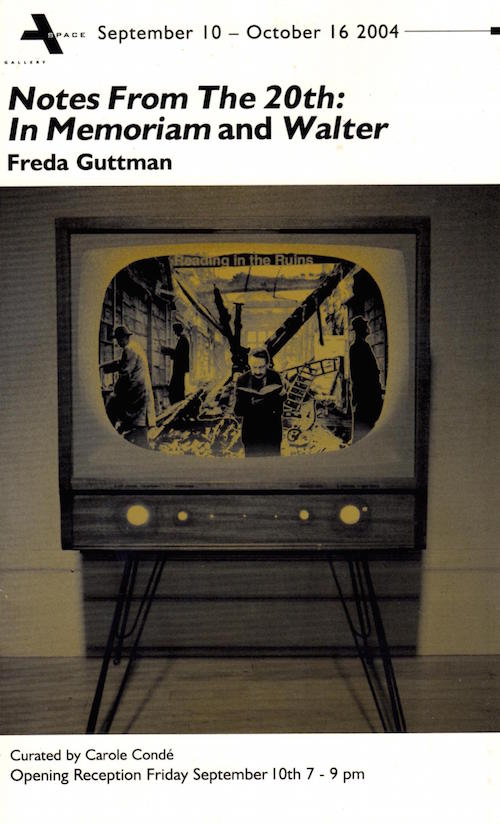
Freda Guttman at A Space http://www.aspacegallery.org/index.php?m=programdetails&id=79

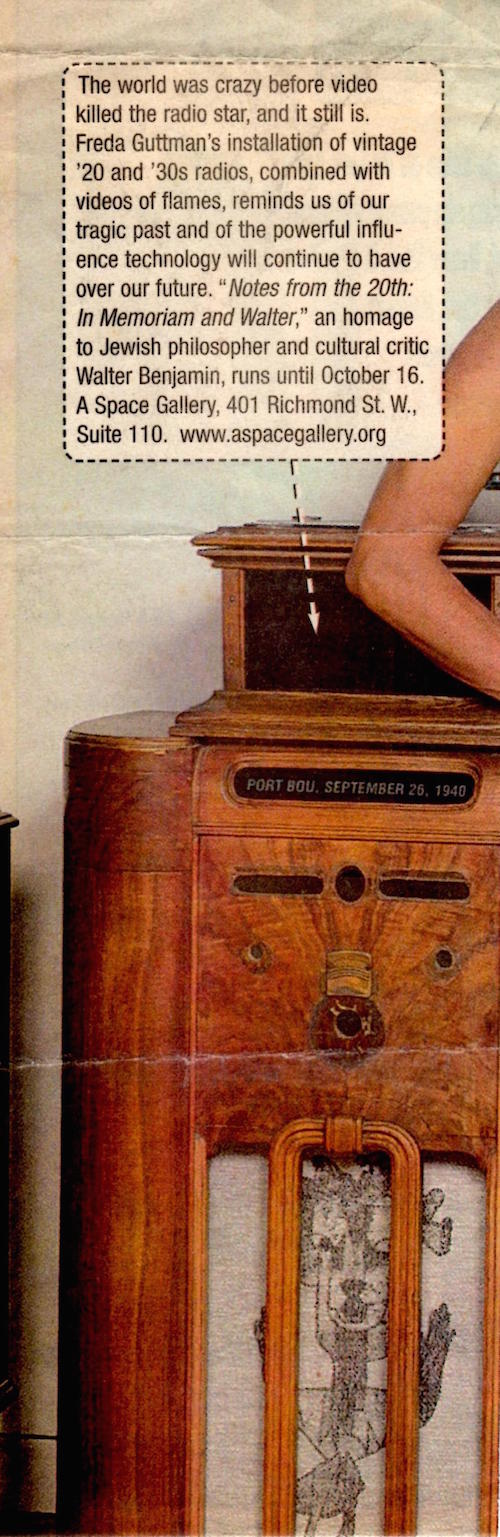
In Memoriam consists of three 1930-40’s upright radios, large and ornate, their inside workings removed. The radios have a metaphorical role — presences, speakers, ghosts of the past, warning voices that remember Walter Benjamin’s life and work, and remind us of his prescient understanding of the revolutionary significance of new technologies, as well as their impact on the production of art. Five large Jacquard tapestries will be hung on the walls in a relationship to the three radios. Thematically, they refer to instances in the 20th century of violent events, such as the coup in Chile in 1973, the Hitler era, the bombing of cities in World War II.

One radio in particular attracts attention. It bears a reproduction of Klee’s “Angelus Novus”.
Freda Guttman - angel - at A space

Guttman presents us with a recontextualization of Klee’s “Angelus Novus”. This rendition and in the particular manner in which is mounted makes one return the ninth of Benjamin’s Theses on the Philosophy of History.

A Klee painting named ‘Angelus Novus’ shows an angel looking as though he is about to move away from something he is fixedly contemplating. His eyes are staring, his mouth is open, his wings are spread. This is how one pictures the angel of history. His face is turned toward the past. Where we perceive a chain of events, he sees one single catastrophe which keeps piling wreckage and hurls it in front of his feet. The angel would like to stay, awaken the dead, and make whole what has been smashed. But a storm is blowing in from Paradise; it has got caught in his wings with such a violence that the angel can no longer close them. The storm irresistibly propels him into the future to which his back is turned, while the pile of debris before him grows skyward. This storm is what we call progress.

On its own, the depicted angel doesn’t quite look as if it’s looking backwards and indeed a rereading highlights the suggestiveness of Benjamin’s prose which indicates that the angel appears to be about to turn away from something. (That something is the viewer which via Benjamin comes to occupy the position of the past.)
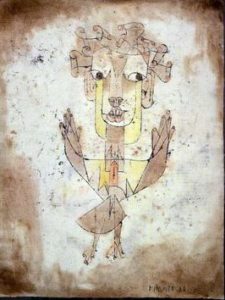
Klee angel are reproduced by Freda Guttman

It is not just having a reproduction of the Klee painting at hand that leads to a reappraisal of the relations between the angel from the painting, the angel from the excerpt from poem by Scholem which Benjamin places as an epigraph to the ninth thesis and the angel caught in Benjamin’s storytelling whose image is taken up again by artists such as Laurie Anderson in her music (Strange Angels).

My wing is ready for flight,
I would like to turn back.
If I stayed timeless time,
I would have little luck.

Mein Flügel ist zum Schwung bereit,
ich kehrte gern zurück,
denn blieb ich auch lebendige Zeit,
ich hätte wenig Glück.

Gerhard Scholem
‘Gruß vom Angelus’

It is very much having a partition over the reproduction — Guttman places the tapestry as the speaker screen in a refurbished radio (an older model from the period when radios were items of furniture) — that guides the viewer to be attentive to the position of the feet and the orientation of the eyes of the depicted figure. Just what counts as backwards is very much a question of “as though”.
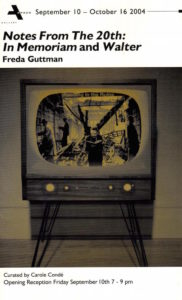
A Space pamphlet Freda Guttman - Notes from the 20th in memory of Walter

In the A-Space take away, Peter White comments on the status of “Klee’s painting Angelus Novus, the pivotal figure of Benjamin’s famous ninth thesis on the conception of history”:

For my part, I seem to want to think about this image of Benjamin as an analogue, but in reverse, for his angel of history. Faced with the accumulated wreckages of history, it is the angel’s fate to be forcibly propelled into the future. I wouldn’t want to describe Benjamin or anyone else for that matter, as an angel, but he is perhaps as close to a prophet as the twentieth century produced. If you think of him in this piece as he imagined the angel, back turned to the future, what is pictured is not so much his era as what he feared so deeply, its perpetuation.

A note on technique:

Ivan Jurakic, “Notes for the 20th” Cambridge Galleries, 2007

Benjamin never so much wrote about his own times as he wrote through it. His writing was constructed in layers and he approached it as means of “drilling” for the truth.* If our postmodern condition tends towards the use of appropriation, pastiche and sampling as the norm, then the foundations of this condition can be traced back to Benjamin’s use of citation and montage as a means of intellectually capturing the vicissitudes and complexities of the Modern age. Guttman not only understands this, but wisely uses this same oscillation as a means to propel her own project effortlessly from present to past and back again.

* “… to plumb the depths of language and thought … by drilling rather than excavating” Walter Benjamin quoted by Hannah Arendt, “Illuminations,” Schocken, 1969 p 48.

And so to conclude let us juxtapose a quotation from Catherine Hume, singer-songwriter, from her 1999 album Hinges. The refrain from “Fallen Angel” …

Choose a poison, choose a weapon, walk on by the gates of heaven, a crooked door, rusty hinges, promises darker riches. So walk through, you know you want to walk through that door, fallen angel, walk through that door etc.

No knowing which way that door leads — a past? a future?

And so for day 1848
04.01.2012

Posted in Uncategorized | Leave a comment

Rouge

Laurie Anderson

[from liner notes to Faraway So Close! (1993)]

Tightrope

In this dream I’m on a tight rope
and I’m tipping back and forth
trying to keep my balance
– and below me are all my relatives –
and if I fall I’ll crush them.
This line this bloodline
the only thing that binds me
in the turning world below,
and all the people and noise
and songs and shouts
this long thin line this song line
this tightrope made of sound
this tightrope made of my own blood

[from the album Bright Red (1994)]

Last night I dreamed I died and that my life had
been rearranged into some kind of theme park.
And all my friends were walking up and down the boardwalk.
And my dead grandmother was selling
cotton candy out of a little shack.
And there was this big ferris wheel
about half a mile out in the ocean,
half in and half out of water.
And all my old boyfriends were on it.
With their new girlfriends.
And the boys were waving and shouting
and the girls were saying Eeek.

Then they disappeared under the surface of the water
and when they came up again they were laughing
and gasping for breath.

In this dream I’m on a tightrope
and I’m tipping back and forth trying to keep my balance.
And below me are all my relatives
and if I fall I’ll crush them.
This long thin line. This song line. This shout.

The only thing that binds me to the turning world below
and all the people and noise and sounds and shouts.
This tightrope made of sound
This long thin line made of my own blood.
Remember me is all I ask.
And if remembered be a task forget me.

Remember me is all I ask.
And if remembered be a task forget me.
This long thin line. This long thin line.
This long thin line. This tightrope.

Remember me is all I ask.
And if remembered be a task forget me.
This long thin line. This long thin line.
This long thin line. This tightrope.

From tightrope to line of memory … stretched and stretching …

And so for day 1847
03.01.2012

Posted in Uncategorized | Leave a comment

Tender Comrades

Lane Reylea “Dear Radical Artist (Unforgettable You) in in Blast Counterblast ed by Anthony Elms and Steve Reinke (Toronto: Mercer Union, 2011)

Flexibility, mobility, transience and dialogue — these are no longer challenges to the system, they are the very attributes the dominant system most loudly promotes. Today’s resourceful DIY artists risk glamorizing the euphemisms of entrepreneurial initiative and individual responsibility used to sell the recent neo-liberal agenda of deregulation, of rolling back state assistance programs, of “ending welfare as we know it.”

Note the keyword: “risk”. Autonomy is still possible.

And so for day 1846
02.01.2012

Posted in Uncategorized | Tagged | Leave a comment

Field Coordination

Jerome Bruner Actual Minds, Possible Worlds

These notes (a mess to a certain degree) focus on description and implies its importance for narration.

Burner introduces his analysis via a discussion of primitive syntax (topic + comment) from the more general form (given + new).

He discusses metaphor substitution from (given + new). Of course he is attempting to point out the flaws in verificationist theories of meaning. He forgets his simple or elementary expression (topic + comment). What strikes me is that topic + comment is not so simple i.e. topic implies a field or isotopy [topos or place]. Already one is caught up in coordinates. The comment is a selection among possible coordinates. It reverberates along the “hidden” structure of force fields (c.f. Arnheim on balance)

Notes which later become an overt challenge to downgrading description in favour of story:

There is slippage between mood (subjunctive) and mode (subjectivization). He has moved the question from one of reference to one of intuition. “Narrative deals with the vicissitudes of human intentions.” His arguments are going to rely heavily on verbs ∴ nomination + narration almost unexamined + establishes a distance between narration & report. B presupposes (yes I’m using his vocab in a verb form) transformation as core of narrative (No surprise since he relies heavily on Iser). Description as core of narration would come closer to Pavel’s extensive use of travel metaphors.

So tempted to restate: Narrative deals with the vicissitudes of human attention.

And so for day 1845
01.01.2012

Posted in Storytelling, Transcriptions | Leave a comment

Flow and Fold

Not a wonder that my reading stumbles and sees “loss” for “less” in these lines from Suzanne Buffam’s Past Imperfect from the sequence entitled “Inklings”: “to retrieve it you’d think / we’d be gifted with less.”

Earlier we encountered this in “Sire Gromore Somyr Joure” which builds upon delicate repetition that becomes slowly attenuated.

Knees were for kneeling. Lashes were for looking
at the sun. The river was slow and it hurried.

And later the notion of loss bites again in the conclusion of a poem called “What is Called Déjà Vu”

like a dream inside which a crouched
animal is awaiting
release, recognition.
Its little teeth glisten.

Same familiar facility with repetitions and alliterations and the zest of the zinger.

And so for day 1844
31.12.2011

Posted in Poetry | Leave a comment