The Built Whorl

Jeanette Winterson
“The Semiotics of Sex”

Art is not a private nightmare, not even a private dream, it is a shared human connection that traces the possibilities of past and future in the whorl of now. It is a construct, like science, like religion, like the world itself. It is as artificial as you and me and as natural too.

Art Objects: Essays on Ecstasy and Effrontery

And so for day 1833
20.12.2011

Posted in Uncategorized | Leave a comment

Time-travel Tricolon

Camella Grace
on Timothy Leary
Design for Dying

He was a man who touched the future, studied the past, and sculpted the present.

Notice how fragile the construction is. It requires the casting of the future-past-present in order to solidify its rhetorical strength. Any other order smashes the implied narrative that peering into the future through an observation of the past yields to moulding the present. We are brought back to our implied point of departure. The present is the past of the future.

And so for day 1832
19.12.2011

Posted in Uncategorized | Tagged | Leave a comment

S-o-r-t-i-n-g Sort of Thing

Robert Bringhurst

SOME REFLECTIONS ON
READING AND WRITING
CULTURE AND NATURE
&
SORTING THINGS OUT

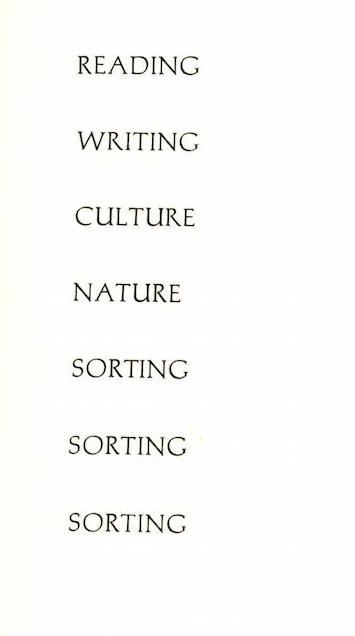
The cover title is nicely “sorted” on the half-title page.

cover bringhurst half-title cropped READING


WRITING


CULTURE


NATURE


SORTING


SORTING


SORTING

A fine production from the Rochester Institute of Technology Press to mark the presentation of the Frederic W. Goudy Award to Robert Bringhurst.

And so for day 1831
18.12.2011

Posted in Booklore | Leave a comment

Group Dynamics: Micro Trio

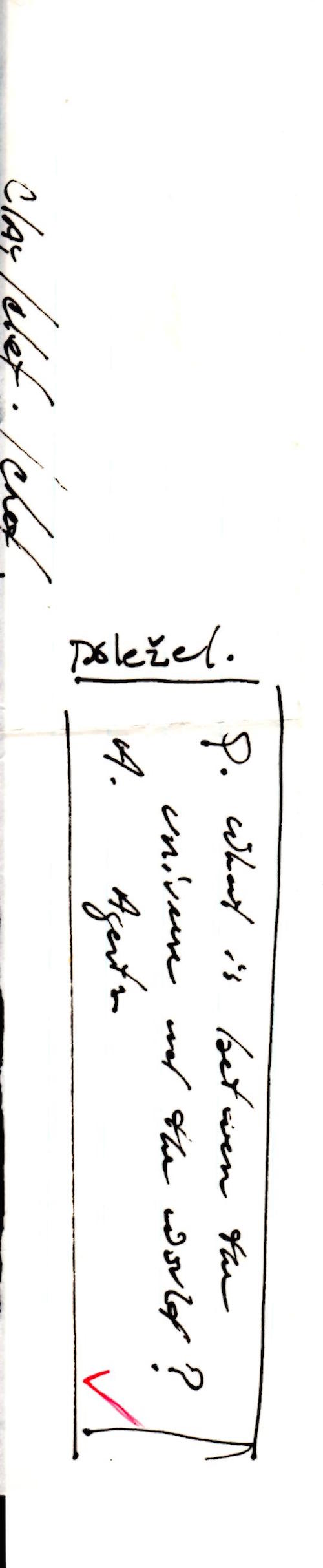
a run found at bottom of a note on agents and worlds

note - clay clef chef

clay / clef / chef

The group becomes intriguing when one considers the French word for “key” and its pronunciation. I do find the visual translations engrossing.

And so for day 1830
17.12.2011

Posted in Uncategorized | Leave a comment

Jogging the Memory

Two lines linked or subtly severed? In my mind these lines from “Old Song, New Song” merge on a scene of an outdoor social under resinous boughs.

a whiff of pine —
didn’t we meet at the strawberry tea?

from Yoko’s Dogs Rhinoceros

Yoko’s Dogs is a collaborative group of four poets—Jane Munro, Susan Gillis, Mary di Michele and Jan Conn—dedicated to writing in Japanese forms.

There’s more to admire. I thought it quite elegant to repeat the turtle-skunk figure in the context of both love and desire. The double take is delightful.

“the turtle buries its eggs / the skunk digs them up — / such is desire”

“love is also / the turtle buries its eggs / the skunk digs them up

And so for day 1829
16.12.2011

Posted in Poetry | Leave a comment

Lingua Franca Revisited

Language Wars: Is English bound to remain the dominant global tongue?
Stephen Henighan

This summer, in Russia, I saw something different: crowds of Chinese tourists entering shops and restaurants, typing their orders into their iPhones in Mandarin, then pressing a button to translate them into Russian and holding up their screens for Russian clerks and waiters to read. Plenty of trading took place, yet no one uttered a word of English. Translation technology that dispenses with the burden of cross-cultural verbal communication at a basic level may yet rein in our language’s global ambitions.

http://reviewcanada.ca/magazine/2015/11/language-wars/

Reminds me of how very similarly Chinese script works across dialects: as a bridge.

And so for day 1828
15.12.2011

Posted in Uncategorized | Leave a comment

A Column Electrified

This bit from Hal Foster The Return of the Real: The Avant-garde at the End of the Century has been reproduced with line breaks set at intervals similar to a newspaper column.

Out of similar symptoms
McLuhan arrives at a different
diagnosis. As in the spectacle of
Debord, so in “the global village”
of McLuhan: distance, spatial as
well as critical, is eclipsed. But
rather than separation, McLuhan
sees “retribalization,” and rather
than criticality lost, he sees
distraction transvalued. Oblivious
to Benjamin, McLuhan develops
related ideas, often only to invert
them. For McLuhan new
technologies do not penetrate
the body “surgically” so much as
they extend it “electrically.” Yet
like Benjamin he sees this
operation as double: technology
is both an excessive stimulus, a
shock to the body, and a
protective shield against such
stimulus-shock, with the stimulus
converted into the shield (which
then invites more stimulus, and
so on). […] Mcluhan sees this
extension as an ecstatic body
become electric, wired to the
world, and sometimes as a
“suicidal auto-amputation, as if
the central nervous system could
no longer depend on the physical
organs to be protective buffers
against the slings and arrows of
outrageous mechanism.”

Hamlet be damned. Foster’s choice of verb (seeing) to describe McLuhan’s meditations on technology displays the latter’s occularcentrism and it is but a step to an analysis of phallologocentrism. Foster continues with brio:

With these contradictory tropes of extension and amputation, McLuhan remains with the logic of technology as prosthesis — as a divine supplement to the body that threatens a demonic mutilation, or a glorious phallicization of the body that presupposes an horrific castration. Operative in different modernisms, this logic presumes both a male body and a split subject, a subject in lack (indeed, in McLuhan the subject remains a Hamlet wounded by slings and arrows).

Foster goes on to question whether or not we have today exceeded such a logic. A question for 1996. And a question for now?

And so for day 1827
14.12.2011

Posted in Dichotomies | Leave a comment

Ordering Counting Questioning

John Cage

Would I have to know how to count in order to ask questions?

A line sandwiched between the following:

Would I have to know how many questions I was going to ask?

[…]

Do I have to know when to stop?

As recorded in the “Composition” section of Silence

And so for day 1826
13.12.2011

Posted in Uncategorized | Tagged | Leave a comment

The Voices of Here We Are

This passage takes on an added dimension when we note that the reader is none too sure what voice belongs to the pronouncements.

This is not a university: it is a sanatorium.

[…]

Here we are, and my father is looking more and more like an old book on a library shelf. Here we are, and there is no going back and no going forward. In this sanatorium the greatest kindness is that there is no time and no place: there are only books. There are only books and the doctors and patients who with infinite care and reverence, watch over them so that they will last, so that something will survive.

The Impossible Mourning of Jacques Derrida. Sean Gaston doing the voices…

And so for day 1825
12.12.2011

Posted in Uncategorized | Leave a comment

Catalytic Middle Term

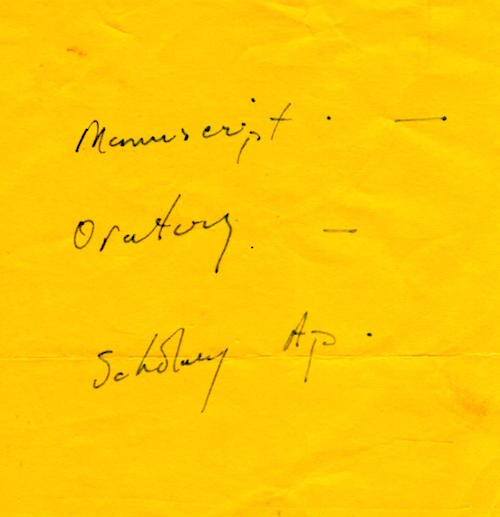
This is a question:

note: manuscript oratory scholary ap.

It looks like a set of words in a column: manuscript, oratory, scholar[l]y ap[aratus].

Position is important. The question: how does the practice of oratory reflect upon manuscript culture to produce the scholarly or critical apparatus? What is implied in the reading top to bottom is the operation “followed by” and what is generated by this group is a challenge to a historiography of rupture where oral cultures are disrupted by the coming of writing — all accomplished with a memorable trio.

And so for day 1824
11.12.2011

Posted in Uncategorized | Leave a comment