The Island: Name Written but Unpronounced

Speaking of reading “Sirocco”…

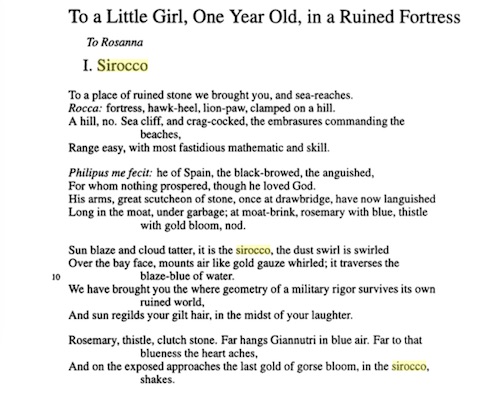
In none of the recordings of Robert Penn Warren that I have heard (from MIT’s Vault and from the Caedmon Poetry Collection) does the poet pronounce the name of the island he has written in his poem — he simple says “the island”.

But there it is in the Collected Poems.

Robert Penn Warren - Sirocco section - to a Little Girl, On Year Old, in a Ruined Fortress

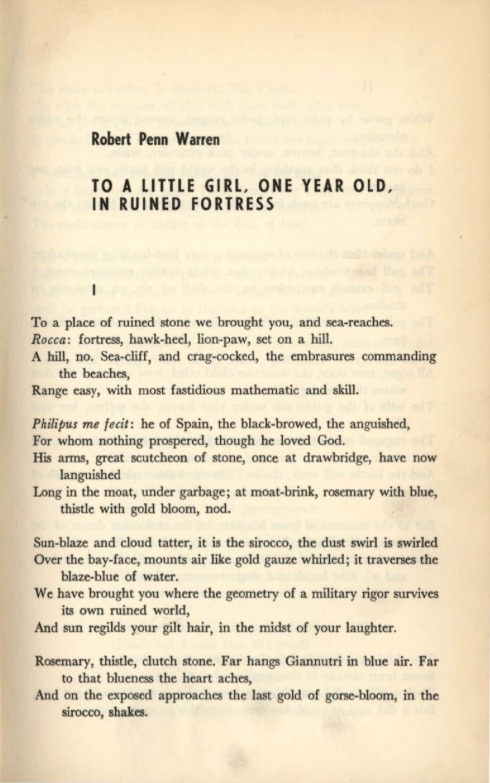
But there it is hanging in the Paris Review when “Sirocco” was but a section of “To A Little Girl, On Year Old, in Ruined Fortress”

Robert Penn Warren - Paris Review - to a Little Girl, On Year Old, in a Ruined Fortress

Giannutri

And so for day 1773
21.10.2011

Posted in Poetry | Leave a comment

Treading Stupidity

Charlotte Shane. “Anne Carson’s Splintered Brilliance: On the pleasures of poetry that deliberately defies our comprehension”. New Republic.

https://newrepublic.com/article/139103/anne-carsons-splintered-brilliance

Calling one’s self “stupid” is akin to saying “my mind doesn’t work like that.” It’s a way of recognizing the distance between the functioning of your mind and the functioning of someone else’s. An experience of our own stupidity, then, is a privilege afforded to us by the best art and maybe especially by the best poetry: We are granted the opportunity to swim a lap in the pool of someone else’s brain, if we can

Back stroke, crawl, butterfly, breast stroke. Drowning.

And so for day 1771
19.10.2011

Posted in Uncategorized | Tagged | Leave a comment

Connections, directions, corrections

Some one sent me a link to “The career advice I wish I had at 25” by Shane Rodgers. It seems to populate many management sites all over the World Wide Web. This is the one item on the list that caught my attention.

6. Management is about people, not things

It is easy to fall into the trap of believing that all people are equal, behave the same every day and have a generic capacity to perform. Humans are simply not made like that. Business guru Jack Welch says the workforce consists of 20 per cent of people who are high performers, 10 per cent that you should get rid of and 70 per cent who do okay. The problem is the 70 per cent. Most managers want everyone in the 20 per cent. We need to be careful not to believe that the 70 per cent are underperformers. Sometimes we need to celebrate the competence of the masses not the superpowers of the elite. As managers, we are not managing things, we are empowering people and making the best use of whatever it is they bring to the table.

I wrote back to my interlocutor that this interesting take on managing performance might lead to some advice for managers about the interactions among themselves. I remarked “Seriously though – I think (from my limited perception from the outside) managers are very hard on managers – we as staff rarely hear managers celebrating each other…”

And of course there is the important aspect of sincerity and specificity:

Beware of the “Praise Trap”

It is important to reinforce when children have done well and worked hard. Reinforcing this by saying “you really worked hard on that puzzle, didn’t you” or “I see you’ve collected all of the cars and put in them in the basket, that’s wonderful Jack!” is much more informative than “good job tidying” or “you are so smart.” The first type of praise encourages the child and fosters motivation from within (intrinsic motivation), whereas the second type of praise can lead to children looking for reward or praise which typically means they work less (extrinsic motivation).

http://www.edu.gov.on.ca/childcare/Clinton.pdf

The article not only has some insight on praise and providing positive feedback it also invites people to consider their C:D:C ratios. That is how much of their interactivity is devoted to

Correction: Direction: Connection

Let me direct you to the early education site for more info on C:D:C including video where Dr. Jean Clinton explains the differences between connecting and directing.

http://www.edu.gov.on.ca/childcare/positive.html

And so for day 1770
18.10.2011

Posted in Uncategorized | Tagged | Leave a comment

Documentation, Discussion, Doing

We begin with the material fluency and move to interpersonal collaboration for the pursuit of projects…

Beyond working in small groups, a key feature of Reggio schools – and prime example of Multiple Intelligences (Gardner, 1983) – is the emphasis on using high quality clay, paints, wire, fiber, pens, and hundreds more “materials” including music, dance, and conversation as stimuli for children to learn to express themselves skillfully. Reggio educators say children learn “100 languages.”

[…]

Another pivotal Reggio innovation is documentation through which teachers encourage children to listen to themselves as a way to pursue a project thoughtfully. Teachers carefully listen to children, record what they hear, and select children’s words, photos of them working, or their work product to display on a large panel. The purpose is to provide a way for children to reflect on what they have done by analyzing and interpreting what they see on the panel. Exchanges among children and with their teacher are lively! Documentation enables children to find meaning to their work and is a way to assess children’s capacity at a particular time. Moreover, it gives visitors a window into the school and is a powerful draw for parents, an impetus for the deep ties that develop between families and school.

Ann Lewin-Benham, Starting Smart: Twenty-first Century Early Education

http://www.education.jhu.edu/PD/newhorizons/Journals/Fall2010/Lewin-Benham

I emphasize that the discussion begins with the child’s interaction with high quality materials.

And so for day 1769
17.10.2011

Posted in Storytelling | Tagged | Leave a comment

Maturely Premature

Hokusai‘s jisei (death poem) has been set to music by Karl Jenkins in his Requiem.

hitodama de / yuku kisanji ya / natsa no hara

now as a spirit / I shall roam / the summer fields

Though my demise is not for all appearances imminent I have tried my hand:

he reads signs /
has become a sign /
always pointing elsewhere

Of course I could ascribe it to Barthes and begin a whole genre what if so-and-so wrote a death poem.

And so for day 1768
16.10.2011

Posted in Poetry | Leave a comment

Fragment Underlining Unrolling

I have on occasion examined the results of my cutting paper into smaller sizes for note taking and list making. Sometimes I observe that the results offer a kind of poetry.

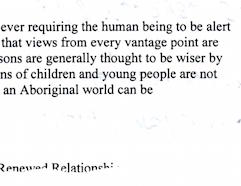
partial text - fragment quoting RCAP - Royal Commission on Aboriginal Peoples

And on this one occasion I returned to underline the preserved text — a way of punctuating and so reading by emphasis … almost like the negative space of silhouettes.

The perception of the world as ever changing, ever requiring the human being to be alert to the requirements of proper relations, means that views from every vantage point are valuable in making decisions. While older persons are generally thought to be wiser by virtue of their longer experience, the perceptions of children and young people are not discounted. The roles of teacher and learner in an Aboriginal world can be interchangeable, depending on the context.

Royal Commission on Aboriginal Peoples (1996)
Volume 1 – Looking Forward Looking Back
Part Three: Building the Foundation of a Renewed Relationship
Chapter 15 – Rekindling the Fire in the subsection “Words Are Not Enough”

Further comments on this passage: https://berneval.hcommons-staging.org/2011/09/12/what-is-taught-and-what-teaches/

And so for day 1767
15.10.2011

Posted in Transcriptions | Leave a comment

Beyond the Sphere of Touch Typing

I have come across a delightful book on the art of writing (Your Penmanship by Kathleen U. Ockendon) which offers a neat little analogy for academic activities and scholarship. As well it has as a swell opening chapter called “Making friends with your pen”. In the introduction, Ockendon writes:

Though we can, of course, take pleasure in the work of craftsmen whose methods are unknown to us, yet it is only after we have begun to manipulate their tools and wrestle with their problems that we come to realise in full the measure of their achievement, and our appreciation of their worth increases with our skill.

It lives by its word and teaches how to trim a quill pen as well as how to shape letters and curlicues.

And so for day 1766
14.10.2011

Posted in Uncategorized | Leave a comment

Disappearing Young Men: Sister Uprising

Einstein on the Beach

(Both texts written by Mr. Samuel Johnson)

OLD JUDGE : PARIS (In Original 1976 Production)

When considering the best liked cities on earth, Paris looms large among them. Paris is one of the world’s greatest tourist attractions. And not without reason, for Paris has much to offer. Paris does not have a multiplicity of skyscrapers like New York, but it has much beauty and elegance. And Paris has an illustrious background of history.

In Paris there is a number of young men who are very beautiful, very charming, and very lovable. Paris is called “the city of lights”. But these young men who are very beautiful, very charming, and very lovable, prefer the darkness for their social activities.

One of the most beautiful streets of Paris is called Les Champs-Elysées, which means the Elysian Fields. It is very broad, bordered with trees, and very pleasant to look at.

One of the most beautiful things of Paris is a lady. She is not too broad, bordered with smiles, and very, very, very pleasant to look at. When a gentleman contemplates a lady of Paris, the gentleman is apt to exclaim : “oo la la”, for the ladies of Paris are very charming. And the ladies of Paris are dedicated to the classic declaration, expressed in the words : “L’amour, toujours l’amour !”

A Russian man once said that the eyes of a Paris lady are as intoxicating as good wine, and that her burning kisses are capable of melting the gold in a man’s teeth.

In Germany, in Italy, in Congo, in China, and in the United states, there are men who say : “If you’ve never been kissed by a lady of Paris, you’ve never been kissed at all.”

OLD JUDGE : ALL MEN ARE EQUAL ( Alternate Speech, From 1984 Revival )

“In this court, all men are equal.” You have heard those words many times before. “All men are equal.” But what about all women ? Are women the equal of men ? There are those who tell us that they are.

Last week, an auspicious meeting of women was held in Kalamazoo. The meeting was addressed by a very prominent lady who is noted for her modesty. She is so modest that she blindfolds herself when taking a bath. Modesty runs in her family. She has a nephew who is just ten years of age. Sometimes, the nephew says “I’m going to the forbidden name store.” The little fellow is too modest to say “I’m going to the A & P.” Well, here is what that modest lady said to the gathering of women in Kalamazoo :

“My sisters : The time has come when we must stand up and declare ourselves. For too long have we been trodden under the feet of men. For too long have we been treated as second-class citizens by men who say that we are only good for cooking their meals, mending their socks, and raising their babies.

“You have a boyfriend, and he calls you his queen. Then, when he marries you, he crowns you. These are the kind of men who, when they become romantic or, I should say, when they are in a certain mood, they want to kiss you and kiss you and kiss you again.

“My sisters, I say to you : Put your faces against it, and, if the man takes from you without your permission, look him squarely in the face, roll your eyes at him, and say to him ‘How dare you, you male chauvinist pig ! You put that kiss right back where you got it from.’

“My sisters, we are in bondage, and we need to be liberated. Liberation is our cry. Just yesterday, I talked with a woman who is the mother of fifteen children. She said ‘Yes, I want to be liberated from the bedroom.’

“And so, my sisters, the time has come when we must let this male chauvinist understand that the hand that changes the diapers is the hand that shall rule the world.

“And now, my sisters, let us stand and sing our national song. For the benefit of you who have not yet memorized the words, here they are :
The woman’s day is drawing near, it’s written in the stars
The fall of men is very near, proclaim it from your cars.
Sisters, rise ! You flags unfurl ! Don’t be a little girl.
Say “Down with men, their power must end : Women shall rule the world !”

Paris and “a number of young men who are very beautiful, very charming, and very lovable.” on the one hand; on the other the battle cry of sisters. Are we to take reported speech as satire?

And so for day 1765
13.10.2011

Posted in Uncategorized | Leave a comment

Erasing Erasure

Jennifer Biddle
Dot, circle, difference: Translating Central Desert paintings
in Cartographies: Poststructuralism and the mapping of bodies and spaces edited by Rosalyn Diprose and Robyn Ferrell
(1991)

Unlike in northern Australia, where images figured historically upon more permanent materials (bark or wood), Central Desert images were drawn in the sand or on the body. It wasn’t until 1971 at Papaya that an art teacher, Geoff Bardon, in inviting some men to paint the school walls, was instrumental in these designs being rendered transferable to canvas. The creation of the acrylic painting as object of attention, comment and permanence has shifted the focus of interpretation from that of the productive aspects of these paintings to that of interpreting their status as product. This is a problematic status for images historically marked by their capacity for erasure — images that are produced within performative or enactive contexts where the production of the designs (who is allowed to mark whom with what and when) is inseparable from the ensuing product itself.

Juxtaposing here with remarks about another artistic practice.

By far the most studied aspect of bebop improvisation is the use of precomposed figures and quotations, selectively borrowed from other musical compositions. the surface repetition, and the use of recognizable quotations — sometimes called licks, tricks, patterns, motives, riffs, or crips by musicians — are distinctive features of this genre.

In Basquiat’s work, originality is defined by premeditation, imitation, and even the repetition of certain compositional elements.

Jordana Moore Saggese Reading Basquiat: Exploring Ambivalence in American Art

If you are still wondering about the juxtaposition, see Japingka for artwork by Australian Indigenous artists. Watch the images move. Be moved.

And so for day 1764
12.10.2011

Posted in Uncategorized | Leave a comment

Impaired or Wrecked

my mind catches on a phrase “wrecked cognition” and lifts it from its context to a place of thinking about how at any time any one of us may be considered as disabled…

Haryette Mullen
Muse & Drudge
in Recyclopedia

odds meeting on a bus
the wrecked cognition

Not much to find at present about “wrecked cognition” but “impairment” is a useful bridge word that led me to a reference to this book now in its second edition Bathing without a battle : personal care of individuals with dementia edited by Ann Louise Barrick et al. and its support material which taps into our collective desire for humane treatment for all…

This battle that often occurs between people with dementia and their caregivers is in most cases preventable. The source of the distress is often the caregiver imposing his or her duty to get someone clean; even when that someone is reluctant or distressed. The caregiver may feel bound by cultural, personal, or supervisory influences to “get the person clean” in some predefined time frame using a set method. Unfortunately, this lack of flexibility can have unpleasant results for both the caregiver and the person they are bathing. However, we believe that bathing can be made into a more humane, gentle experience for persons with dementia.

http://bathingwithoutabattle.unc.edu/about-bathing

Before this useful reminder of cultural imperatives, the battle is described as an escalation of conflict:

Each day hundreds of thousands of people with dementia are bathed against their will. Their overt or nonverbal refusals are often ignored, and they are removed without permission from their beds and wheelchairs and taken to an often cold, impersonal, frightening shower or tub room to be scrubbed down. As a result, the refusals escalate to verbal and physical resistance, and finally to combativeness. The experience is frustrating and dangerous to caregivers, who become the targets of hitting, spitting, biting, and verbal attacks by the person who they are only trying to help. In the fields of nursing and medical research, such behaviors are called “agitated” or “disruptive”, and the impact of such behaviors on caregivers is immense. Nursing assistants report being routinely distressed on the job by patient hitting, verbal aggression, and screaming.

I get edgy simply reading this. Coercion: the practice of persuading someone to do something by using force or threats.

And so for day 1763
11.10.2011

Posted in Uncategorized | Leave a comment