Stanza Stance

Stanza means room. In the valley of its making one finds a room of one’s own to share, to let …

What does it matter if I don’t exchange names with a man, if I never see him again, why should that lessen the value of the pleasure we give one another, a bodily pleasure and also a pleasure of knowledge and recognition? “Now we have met, we have look’d, we are safe,” says Whitman, our great poet of cruising, who doesn’t hesitate to use the word love for transient encounters between otherwise strangers. Like the stanzas of a poem, which offer such unlikely, durable shelter from the crash of public speech, the cramped spaces of back rooms and toilet stalls serve not to lessen value, but to concentrate it. As is the case for poetry in the valley of its making, cruising offers an experience that might look like privation but feels like luxury, a hidden richness, a secret world.

Garth Greenwell
“How I Fell In Love With The Beautiful Art Of Cruising”
Buzzfeed
https://www.buzzfeed.com/garthgreenwell/how-i-fell-in-love-with-the-beautiful-art-of-cruising?utm_term=.vp3VzzDk9#.dlpLqqA96

Greenwell leads me to return to Earl Jackson Jr. “Explicit Instruction: Teaching Gay Male Sexuality in Literature Classes” Professions of Desire: Lesbian and Gay Studies in Literature edited by George E. Haggerty and Bonnie Zimmerman.

The cultural and psychological significance of gay male pornography for its intended audience cannot be understood within normative heterosexual morality. In its role as a medium for self-understanding within a repressive social regime, gay pornography configures visibility in its erotic and political senses.

And brings me to share with trepidation an image of the cover of the first porn mag that I bought as a very young man in small town Kapuskasing …

cover of Numbers August 1980

Putting the carnal back in carnival?

And so for day 1762
10.10.2011
Posted in Ephemera | Leave a comment

Drink Me Lookalikes

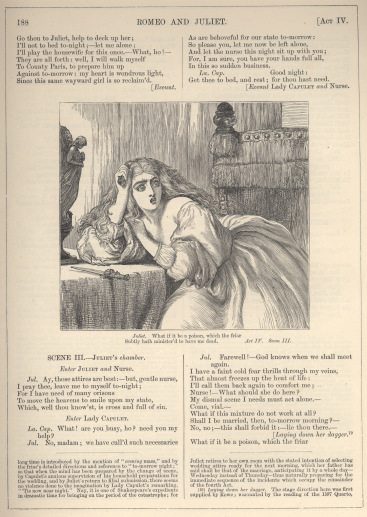
Looks like Alice https://shakespeareillustration.org/2016/08/07/juliet-2/

illustration - juillet

It’s Juliet by H.C. Selous. Used to illustrate the lines: “What if it be a poison, which the friar / Subtly hath minister’d to have me dead. [Act IV. Scene III.]

Source Text: The Plays of William Shakespeare / Edited and Annotated by Charles and Mary Cowden Clarke / Illustrated by H. C. Selous / With Thirty-five Full Page Wood Engravings after Frank Dicksee, RA., H. M. Paget, A. Hopkins, R. W.S., and others / And Thirty-five Photogravure Plates / Special Edition / Parts XXIV-XXV. Published: London, Paris and Melbourne: Cassell & Company, Limited [1864-68?]

Brought to the World Wide Web by Michael John Goodman, The Victorian Illustrated Shakespeare Archive.

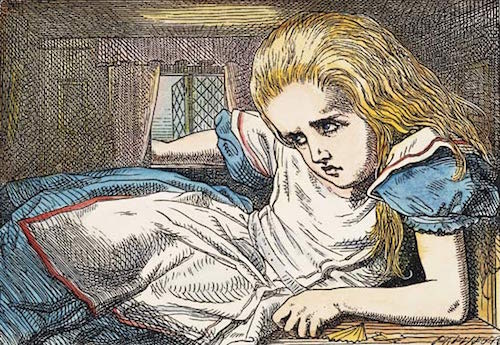
Compare with John Tenniel’s Alice from Alice’s Adventures in Wonderland 1865

alice - drink me

There is the striking pose after the potion has been drunk…

alice - after drink - grown very large

It’s all in the hair.

And so for day 1761
09.10.2011

Posted in Booklore | Tagged | Leave a comment

Clusters of a Single Species

I have begun reading the work of American poet Philip Levine. This little bit from “Winter Words” collected in A Walk with Tom Jefferson is delightful in its exactitude and its animation:

Birthday tulips, twelve hothouse flowers
of royal purple on long stilt-like legs
that sag beside the frosted window.

I wonder what he might have thought about the season for the brilliant incandescence of amaryllis … we know what he does with paperwhites, the above lines continue:

Paper white narcissus uncoiled from bulbs
that had only polished stones to push
their green shoots through. You can grow up here.

I like to think that the here is both in the poem and the referent to a place imagined.

And so for day 1760
08.10.2011

Posted in Metaphor, Poetry | Leave a comment

After All the Reading

Monad deme, in tectology, a unit of the first order of individuality. Monad is an anagram of nomad. Deme is a half-rhyme for dame.

Tectology: a branch of morphology that regards an organism as made up of other organisms.

Technical vocabulary to help with reading this:

it’s clear
after all the reading
mankind speaks
but one language

differences skin deep
reach
one anchored depth

one underlying flow
which to all men is the same

it’s clear
after all the reading
they’ve all overlooked

the monad deme

can be a nomad
and a dame

Lola Lemire Tostevin from Color of Her Speech

And so for day 1759
07.10.2011

Posted in Poetry | Leave a comment

Targetless Rock Throwing

Ken Babstock. “Industry” in Methodist Hatchet. Last line:

What is one voice but a resource?

A question answered by an earlier poet:

maybe even stones have discourse

Robert Kroetsch. The Sad Phoenician. Section M

but it was she who resisted; she, wronged by refusing;
life is what we make it they say; maybe even stones have
discourse, perhaps there is a music of the spheres
heard on quiet nights, far from water
and maybe the fireman only climbs to kiss the flame

One voice is indeed a way to source.

And so for day 1758
06.10.2011

Posted in Poetry | Leave a comment

Towards the End – Endwards

Repartee inhabits the footnotes in Samuel R. Delany Phallos.

The prose of Phallos — even in the three extraordinary scatological chapters toward its end — is written in the past tense of most normative fiction. In order to achieve what registers with me as a more contemporary mode, I have put my own synopsis into a neutral present — to mark it current, if for no other distinction. (10)

10. “Come on, Randy. The present tense hasn’t been ‘current’ since 1974.” (Binky)

This is the first time that the synopsis-maker is invoked by name. Telling that it is in a calling out about bullshit. It’s an apostrophe which invokes a dialogic moment; it cuts across the monologic discourse of the monograph which is inscribed under the synopsis-maker’s name appearing on the title page. Interesting turn.

But what did happen in 1974?

A little Canadian Content: In the Present Tense is a Canadian current affairs television series which aired on CBC Television in 1974. I mention this because Delany’s novella is dedicated originally to a Canadian, Christian Bök. Not that this connection is intended. It may simply be fortuitous.

It was one of the first CBC shows to make substantial use of videotape, which offered the producers more flexibility regarding the timeliness of the subjects they discussed.

http://www.broadcasting-history.ca/programming/television/present-tense

O that’s “timeliness” not “time line ness” (or mess)!

And so for day 1757
05.10.2011

Posted in Uncategorized | Leave a comment

Suspended in Translation; Translated in Suspension

She leaves it untranslated.

une langue
qui abandonne son nid
ne goute plus

aux oiseaux

There is a bit of trickiness in capturing the ambiguity of tasting like a bird but there it is — the language tastes of bird and tastes as a bird tastes. Here’s our go:

a language
leaves its nest
and no longer

tastes as a bird tastes

Lola Lemire Tostevin Color of Her Speech (Toronto: Coach House Press, 1982)

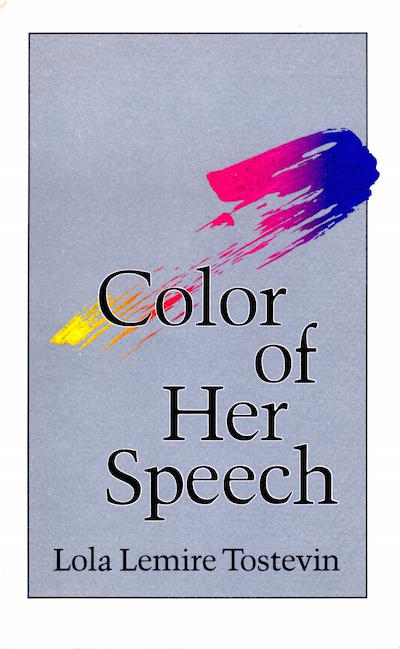
cover - Color of Her Speech - Lola Lemire Tostevin

With a cover design by Gordon Robinson where a daub of paint takes off in flight…

One wonders how the Italian deals with the bilingual elements (Il Colore Del Suo Parlare published by Edizioni Empiria).

And so for day 1756
04.10.2011

Posted in Booklore, Poetry, Translations | Leave a comment

Letters Like Dropping Rain

Untitled poem of three lines (when reconstituted) to be found at the end of “The Silent Poet Sequence” at the end of the The Sad Phoenician but not at the end of “The Silent Poet Sequence” found in Completed Field Notes [note “completed” not “complete”] by Robert Kroetsch.

thir
st sin
myl
if ewe
rel
arg
er tha
n wi
n d
and
r ain
pr
i est
if myl
if ewe
re un
har
med id
not
beb a
dag
ain
chr
i stif
myl o
ve w
ere in
my ar
ms a
nd Ii
n my
bed a
gain

Reconstituted:

thirsts in my life were larger than wind and rain

priest if my life were unharmed i’d not be bad again

christ if my love were in my arms and I in my bed again

And if that last line looks or sounds familiar, it is.

O western wind, when wilt thou blow
   That the small rain down can rain?
Christ, that my love were in my arms
   And I in my bed again!

Anonymous. “The Lover in Winter Plaineth for the Spring” in The Oxford Book of English Verse: 1250–1900 edited by Arthur Quiller-Couch.

And so for day 1755
03.10.2011

Posted in Poetry | Leave a comment

Crono Locomotion

Contemplating the hypothesized state of chronesthesia

Together with language, mental ‘time travel’ allows us to share our experiences and our hopes with many other people, building networks of combined knowledge that are continually growing with each generation. Science, architecture, technology, writing – in short, everything that allows you to read this article – would be impossible without it.

David Robson for the BBC

http://www.bbc.com/future/story/20161108-weve-got-human-intelligence-all-wrong

How would this be connected to musicality?

And so for day 1754
02.10.2011

Posted in Uncategorized | Leave a comment

Blurb Encounters

On the back of the chapbook and framed by a double line rectangle are the following words

Starting with the premise “There are two kinds of people,” Susan Holbrook drives supermarket existentialism through its own vortex and gives it a nifty orgasmic twist into hyperspace. Here’s a ping pong game you’ll never forget — where the tables keep flipping and players’ ironic bats spin the banal into deadly mischievous curves.

Susan Holbrook. Good Egg Bad Seed. (Vancouver: Nomados, 2004)

Between the premise and the expression falls the signifier. Holbrook’s opening line leaves room (unstated) for more than two types of people: “There are people who only cry in private and people who only cry in public.” It is easy to imagine types that do neither or both. There are two kinds but not only two kinds.

And so for day 1753
01.10.2011

Posted in Poetry | Tagged , | Leave a comment