Bang! Bang?

I like to follow the poet’s lead in stretching a conceit to its limit. I especially like Mark Waldron with characteristic verve nibbling away at a sugary confection.

These are the concluding lines of “Guns in Films” in Meanwhile, Trees.

A gun in a movie is not the jam in a donut; it is the pip
in the jam in the donut, the jam being
the character’s motivation, the dough being the script,

the donut’s surface being the scene’s location, and the sugary
coating being you in the cinema,
sprinkled-on-a-seat, wanting everything.

I like how construction and consumption are simultaneous.

And so for day 1712
21.08.2011

Posted in Metaphor, Poetry | Leave a comment

Last Lafs

William Carlos Williams draws a parallel between the “stubborn man” and the “rocks” in “The Seafarer”.

[…] They strain
forward to grasp ships
or even the sky itself that
bends down to be torn
upon them. To which he says,
It is I! I who am the rocks!
Without me nothing laughs.

It was in hearing the poet read the work that I became aware of the echo of “last” in the last line. It is the American pronunciation that betokens the semantic echo of the last laugh. The other (British) pronunciation rhymes with “scoff” and here takes up a partial rhyme with “rocks” but doesn’t convey the phrase “last laughs”.

See the Cambridge Dictionary: http://dictionary.cambridge.org/pronunciation/english/laugh

PennSound houses a recording of the poet reading the work Reading and Commentary at the 92nd Street YM-YWHA Poetry Center, New York. January 27, 1954 in a set of recordings compiled and edited by Richard Swigg.

And so for day 1711
20.08.2011

Posted in Poetry | Tagged | Leave a comment

Collections, Series, Etc.

It’s a lesson in humility and a lesson on the power of drawing to draw us to contemplate infinite series hence the humility.

Roland Barthes. all except you Saul Steinberg (Galerie Mæght, 1983)

Labyrinthe

L’énumération des choses du monde s’étend tout le long de l’œuvre ; à première vue, c’est une énumération plate : variée par glissement d’une image à l’autre (une encyclopédie n’est pas objet métaphysique). […] Tel est bien le malaise inlassablement exprimé par Steinberg : le monde se suffit à lui-même, le monde n’a pas besoin de moi : « All except you. »

Listings of things is found throughout the work; at first glance, the listings are flat: varied by the slide from one image to another (an encyclopedia is not a metaphysical object). […] This is indeed the malaise expressed without a break by Steinberg: the world suffices unto itself, the world doesn’t need me: “All except you.”

L’exception

Qu’est-ce qu’une collection, un défilé ? C’est quelque chose que je regarde. Et ce que je regarde, c’est ce dont je suis exclu. Le spectacle m’attire et me rejette tout à la fois. D’une part, je ressens un mouvement de solitude à l’égard de ce qui défile, et, d’autre part, je perçois, au loin la grande paix de tout ce qui se répète et se rassure de n’être pas seul. Une voix incessante parcourt l’œuvre de Steinberg ; on n’entend qu’elle et elle dit : All except you. Et de cette exception je tire à la fois profit et douleur.

What is a collection, is it a parade? It is something I look at. And what I look at excludes me. […]

Etc.

[…] Le défilé et la file sont infinis, les deux infinis se croisent et se renforcent : c’est comme si, à un degré second, le « etc. » lui-même était répété, réverbéré par deux espaces différents.

[…] the parade and the line are infinite, the two infinities overlap and reinforce each other: it is as if in a second degree of meaning the “etc.” itself was repeated, reverberating through two different spaces.

Loose translations, partial translations, and translations in the mathematical sense of transpositions, etc.

And so for day 1710
19.08.2011

Posted in Uncategorized | Leave a comment

The Taste of Truth

Victor Hazan’s tribute to his late wife Marcella in the dedication to Ingredienti

This guide is the testament of a woman who based her cooking life on the truth of every dish she cooked and taught, the vigorous truth of clear, uncluttered taste, taste that arises neither from obeisance to dogma, not from a craving for attention, but evolves inspired by, and respectful of, the ingredients that nourish it. To that woman I dedicate this work.

To Marcella.

A for instance, her tomato sauce with just three ingredients: tomatoes, butter and onion. The recipe calls for discarding the onion before tossing the sauce with pasta. But it is so flavourful from simmering with the tomatoes that the frugal enjoy the onion on its own. Respecting both sauce and ingredients.

And so for day 1709
18.08.2011

Posted in Food Writing | Leave a comment

Is the Punctum a Perpetuum Mobile?

Fulcrum and vanishing point.

Alain Badiou on the prose of Natacha Michel.

We can see how, in the absence of spectacle, the rhythm decides that any place, no matter how stable it may be, no matter how anchored in ritual and childhood, is never anything but the occasion for a journey of thought and, in this sense, takes place only once.

Still not clear on rereading several times as to why the “occasion” takes place only once.

Is there a universe of prose where sets of rhythms intersect and the question of origin is put paid to?

And so for day 1708
17.08.2011

Posted in Uncategorized | Leave a comment

Beastly Wit

A Child’s Bestiary by John Gardner drawings by Lucy, Joel, Joan and John Gardner.

Three of my favourites:

The Penguin

The Penguin is often compared, wrongly,
To a gentleman in a tuxedo.
The Penguin is all good taste and charm,
The Man, all drunken libido.

The Lizard

The Lizard is a timid thing
That cannot dance or fly or sing;
He hunts for bugs beneath the floor
And longs to be a dinosaur.

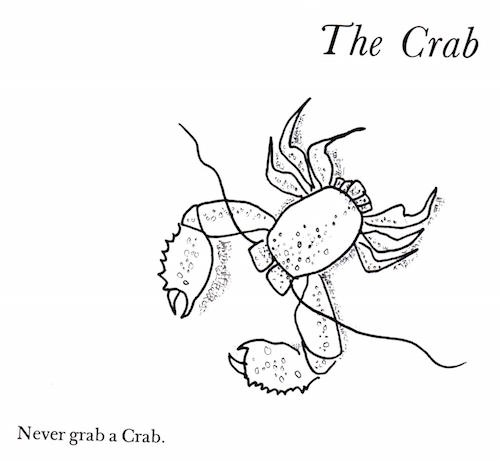
The Crab

Never grab a Crab.

Indeed the illustration for this beast is laid out so that the crab is grabbing this short single line verse or admonition.

illustration of a crab and tag of poem: never grab a crab

Seems like the crab has a libido of its own.

And so for day 1707
16.08.2011

Posted in Booklore, Poetry | Leave a comment

Possible Typology for Psychogeography

Jonathan Z. Smith in Chapter One (“In Search of Place”) in To Take Place: Toward Theory in Ritual quotes Nancy Munn on the notion of ancestral transformations in Walbiri and Pitjantjatjara tribes. She “has provided a precise typology of such transformations, as well as a trenchant statement of their significance”

Three types of transformations are prominent . . . (1) metamorphosis (the body of the ancestor is changed into some material object; (2) imprinting (the ancestor leaves the impression of his body or some tool he uses); (3) externalization (the ancestor takes some object out of his body).

A visit to a local park has me looking for traces of metamorphosis, imprinting and extrusion. The externalized object could be the bench I sit upon; the imprint is left by the flower beds and the fenced-in dog run; the evidence of metamorphosis is present in the public sculpture. All that is missing is an ascription to ancestors.

See “The transformation of subjects into objects in Walbiri and Pitjantjatjara myth” Nancy D. Munn in Australian Aboriginal anthropology : modern studies in the social anthropology of the Australian Aborigines edited by Ronald M. Berndt.

I had drawn upon Munn’s work on Walbiri iconography in my dissertation: I was struck by the possibilities of modelling equivalency of objects and events via modes of narration.

As the neologism indicates, narratival structures are not the same as narrative structures. If Argyros [Argyros, Alex. “Narrative and Chaos.” New Literary History 23:3 (Summer 1992), 659-673.] had not implicitly embedded narrative in a verbal form of discourse, his paradigm case would not resemble the subject-verb-object formula of Indo-European sentences.

And it is at that point that I appeal to Munn — Walbiri Iconography: Graphic Representation and Cultural Symbolism in a Central Australian Society (Ithaca & London: Cornell University Press, 1973).

The narratival structures outlined by Argyros do not provide a model logically powerful enough to explain the equivalency between events and objects. In Australian aborignial visual designs and storytelling, Nancy Munn reports

[T]here is no clear distinction between actor-action and actor-object constructions, and it is convenient to link them both in one overarching figure type with a general meaning that can be stated as “actor (in relation to)-item” (“actor-item”). (Walbiri Iconography 81).

As a category “relationship” opens up more phenomena to narrativity than that of “action”.

Storing and Sorting – Note No. 2

And so for day 1706
15.08.2011

Posted in Storytelling | Leave a comment

In the Grove of Delta Grooves

“Poor” Phil Hall in Conjugation

It begins with a metamorphosis

  Scared   words   jump
over   fly up   scat sing   Ovid

doedove

With an explanation midway

 above a fence   a doe
its hoof’s aim   a beak   v

dove!

And the spell expands by reaching back to Greek (and the symbol for change)

flourish   by   and in   these latticed   guilds
 these tiny   Δ   splitting-wedges   Δ   sung


no way it’s over

And we find an intertext.
Phoenecian dalet — door

“two women in a birth” out of Daphne Marlatt & Betsy Warland Double Negative

(as the women have always sung) this body my
(d)welling place, unearthed.

liminal (door) transformation (delta) — well placed dee

And so for day 1705
14.08.2011

Posted in Poetry | Leave a comment

Movement versus Motion

Rebecca Solnit Wanderlust: A History of Walking

[A] certain kind of wanderlust can only be assuaged by the acts of the body itself in motion, not the motion of the car, boat, or plane. It is the movement as well as the sights going by that seems to make things happen in the mind, and this is what makes walking ambiguous and endlessly fertile: it is both means and end, travel and destination.

Parents, especially fathers, who drive their children to sleep might want to take note. A bit of an amble in fresh air might do wanders for sending the child off to dreamland and the human perambulator might derive a bonus pleasure from the footwork.

And so for day 1704
13.08.2011

Posted in Uncategorized | Leave a comment

Jimmy Moebius

Bending like a never ending story

VISIONARIES

Jamie sites with chin in hand
     Dreaming of a foreign land,
There the children tax their wits
     Dreaming of where Jamie sits

Kenneth Hopkins Collected Poems 1935-1965 (North Walsham Norfolk : Warren House Press, 1981). All the epigrammatic wit found here is also found in the Catalyst 1977 The dead slave, and other poems of Martial : some versions from book XV of Marcus Valerius Martialis.

And so for day 1703
12.08.2011

Posted in Poetry | Leave a comment