A Short Cento

Fiona Tinwei Lam
Odes & Laments

you, stacked with your companions,
like fossilized vertebrae

let each poem be
fallen tree’s tongue.

A harvest of hearts

Soul of the soil

p. 14 “Plate”

p. 39 “Forest”

p. 55 “Dark Mirror”

p. 87 “Potato”

And so for day 3032
31.03.2015

Posted in Poetry, Uncategorized | Tagged | Leave a comment

Horticultural and Culinary Tautology

Scribbled on a postcard in a series mailed out as correspondence art:

If a recipe is a solution,
a garden is a crime.

And one of the series inverted the order:

If a recipe is a crime,
a garden is a solution.

And of course the positions of recipe and garden can switch.

And so for day 3031
30.03.2015

Posted in Food Writing, Gardens | Tagged | Leave a comment

Corps et Textes

Visceral Data: Renderings That & Matter
Digital Humanities at Michigan State University
Jacqueline D. Wernimont
https://www.youtube.com/watch?v=9dIpX2tQCUk

The last slide in the talk/demo caught my attention for its positioning of “narratives”

We are inspired by Diana Taylor’s call to see embodied performance as a “system of learning, storing, and transmitting knowledge” and her methodological model that resists the tendency to “reduce gestures and embodied practices to narrative description” (Taylor [The Archive and the Repertoire] 2003, p. 16)

I read this, perhaps erroneously, as displacing the hegemony of one sensory modality by another (a simple flip of a dichotomy) — triggered no doubt by the implied opposition of fulsome and reduced. An alternative way to call for more respect for embodied being is to stress cross-modal translation. In this light narrative (the story) needs to be situated in the context of narrativity (possibility) and narration (the telling, the performance).

Practice — in and out — of verbal language.

Language — out and in — practice.

I had to check the source:

By shifting the focus from written to embodied culture, from the discursive to the performatic, we need to shift our methodologies. Instead of focusing on patterns of cultural expression in terms of texts and narratives, we might think about them as ‘scenarios’ that do not reduce gestures and embodied practices to narrative description. This shift necessarily alters what academic disciplines regard as appropriate canons, and might extend the traditional disciplinary boundaries to include practices previously outside their purview.

The controlling metaphor is visual (a shift in focus). How is the boundary between the performatic and the discursive negotiated via touch? An impoverished notion of narrative seems to be at play. I want to dislodge “narrative” from its positioning solely as “written document”. There is a writing through as much as there is a writing against. Bodies.

And so for day 3030
29.03.2015

Posted in Perception, Translations, Uncategorized | Tagged , | Leave a comment

Tapping a Path through Percussion

Jacqueline Wernimont, author of “Numbered Lives: Life and Death in Quantum Media” Distinguished Lecture, “Visceral Data: Renderings that & Matter”
at Digital Humanities at Michigan State University.

Link to talk/demo

After listening to this presentation on data renderings in other than verbal or visual means, I was reminded of these concluding lines to Tomas Tranströmer “From March 1979” translated by Robin Fulton:

I come upon the tracks of deer in the snow.
Language but no words.

And the words of the poem led to a musical experience. Mark Duggan makes use of this in his notes to his composition “Language of Landscape” = thirteen minutes of aural joy …

https://markduggan.com/track/778776/language-of-landscape

And the music brought me back to the lecture and a drifting on my intellectual itinerary in theorizing the translations between sensory modalities. And I am brought back to the importance of story:

Objects carry narratives whatever the sensory modalities they may operate in. With our objects we sort, store and shuffle stories. And invite others into the game.

And so for day 3029
28.03.2015

Posted in Perception, Translations, Uncategorized | Tagged , | Leave a comment

Round of Ribbons

Yoko’s Dogs
Caution Tape

Yoko's Dogs - Caution Tape - Front Cover - Collusion Books - Halifax - K'jipuktuk

Between the covers, a circle.

opening page…

you came to me in a dream–
was it by train
or photograph?

good night, that is, good morning
farewell, that is, hello

scouring a burned pot
thinking of poems
the sound of autumn rain

snow on chrysanthemums
I walk the road Basho walked

… closing page

scouring a burned pot
thinking of poems
the sound of autumn rain

snow on chrysanthemums
I walk the road Basho walked

you came to me in a dream–
was it by train
or photograph?

good night, that is, good morning
farewell, that is, hello

Yoko's Dogs - Caution Tape - Back Cover - Collusion Books - Halifax - K'jipuktuk

And so for day 3028
27.03.2015

Posted in Poetry, Uncategorized | Tagged | Leave a comment

Amassed

Stan Dragland
The Difficult

In an essay about poetry from Phil Hall (“Red Skeleton”), Dragland promises (p. 72) to eventually explain an allusion:

How balance outright enmity with good-natured association, smart with dumb, the amassees and the masses (allusion to be glossed below), and so on and on?

On the way to that gloss, the reader comes across a note in the essay devoted to Gail Scott’s The Obituary [p. 84 reference to note 224 found on pages 215-16]. The note references Gloria Anzaldúa, “La conciencia de la mestiza: Towards a New Consciousness”. In part, the note quotes “Soy un amasamiento, I am an act of kneading, of uniting and joining that not only has produced both a creature of darkness and a creature of light, but also a creature that questions the definitions of light and dark and gives them new meanings.” I glimpsed here a promise fulfilled by assimilating the Spanish amasamiento with the English neologism amasses.

Ah, but the explanation found in reading the annotating unconscious is supplemented later (p. 96) in the same essay on Gail Scott’s novel where Dragland traces an expression employed by the character Rosine to its intertextual roots in English Canadian literature.

According to Rosine, “history has two classes: the amassees + the masses.” This looks odd, though a little thought will produce those who amass wealth at the expense of the masses, but it’s later glossed as landlords + tenants. And there’s an allusion behind it. The source is a poem by B.K. Sandwell about the patrician Canadian Massey family […]

Toronto has no social classes
Only the Masseys and the masses.

Addressee + Addresser

Haunted – Haunter

[I inscribe these pairs here because at one point Dragland invokes Nicolas Abraham and Maria Torok.]

And so for day 3027
26.03.2015

Posted in Uncategorized | Tagged | Leave a comment

Voices Preserved

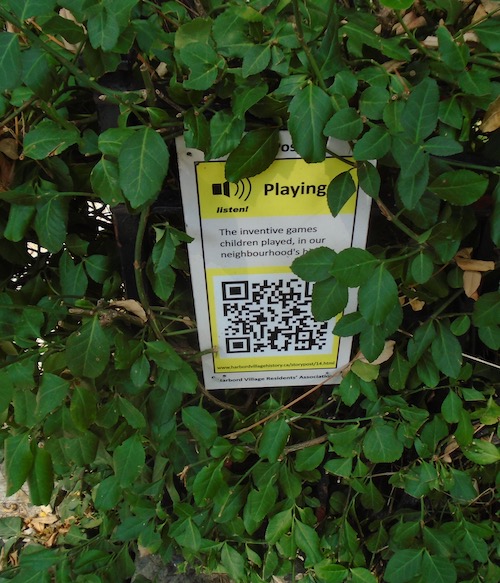
“Playing” – one in a series – this oral history piece collects the voices of older adults reminiscing about the games they played as children. Brilliantly crafted in a way to evoke the intercutting of neighbourhood sounds.

http://www.harbordvillagehistory.ca/storypost/14.html

While out on a daily walk, I spotted the sign for it in the Harbord Village neighbourhood. Not having a phone (I couldn’t access the QR code and listen) I enjoyed the delayed gratification of following a URL (captured via a camera I carried) and of listening at leisure to the cascade of voices.

Sign for the Harbord Village Oral History Project - "Playing"

And so for day 3026
25.03.2015

Posted in Uncategorized | Tagged , | Leave a comment

Thick Moss of Unerasable Longing

J.P Seaton
Bright Moon, White Clouds: Selected Poems of Li Po

from “Two Ballads of Chiang-an”

By the gate, the footprints that you left:
each one grows green with moss,
so deep I cannot sweep them.

Arthur Waley makes much of a repeated “m” sound and so the moss persists:

In front of the door, the tracks you once made
One by one have been covered by green moss—
Moss so thick that I cannot sweep it away,

Interesting, in one the moss cannot be swept away and in the other, the footprints.

The crib:

[door] [front] [slow] [travel] [footprint]
[one] [one] [grow] [green] [moss]
[moss] [deep] [not] [can] [sweep]

And so we want to combine Seaton and Waley:

By the front door, your footprints
one by one grown green with moss–
moss so deep I cannot sweep away

And so for day 3025
24.03.2015

Posted in Poetry, Translations | Leave a comment

On Being Intertextual

A most cogent explanation of intertext and its relation to social experience.

Michael Rosen
Trying to Catch the Moments
The Helen E. Stubbs Memorial Lecture No. 23

I think that’s our job, really: to think of questions about poems we don’t now the answers to. I think that one question we can ask is, “Does this poem, or anything in this poem, remind you of anything that’s ever happened to you?” So, there’s a question you can’t know the answer to. […] Or you could say, “Is there anything in this poem that reminds you of anything that you’ve ever read, or seen on TV, or seen in a film?” And, if you like, there’s a theory behind that as well, which is: what we’re talking about here is the children’s “intertext”, the texts in their lives. And that’s partly what we respond with. Yes, as with my first question, we respond with our experience (the things that happen to us) but also with the texts that we’ve come across. Again, it doesn’t matter whether you’re three or ninety-three, you have a “textual repertoire”, and that’s what you, in part respond with. In fact, there’s an argument for saying that some or even all our experience is “textualized”, that is, made into texts in our heads as we think, or at the moment of our describing them, but we can leave that to one side here.

This, too, from notes for session at Goldsmiths with Postgraduate Certificate in Education (PGCE) students

Intertextuality is the process by which, and how we know and share texts, how texts incorporate other texts, how texts contribute to other texts.

[…]

In many circumstances, intertextuality is the secret process lying behind our critical comments.

And so for day 3024
23.03.2015

Posted in Uncategorized | Tagged | Leave a comment

“What? Say Again.”

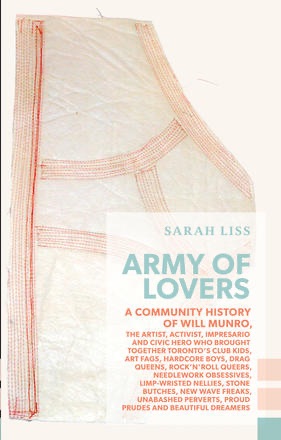
Alex McClelland in Sarah Liss, Army of Lovers: A Community History of Will Munro

He was totally in denial about his hearing problem. He used to have to wear a hearing aid in school, and he just stopped wearing it. I don’t know many people who are functionally half-deaf and fake going through life. He was really good at doing that, and he’d miss so much. He had one good ear, and if he cared, he would turn to you so he could hear you, and would be good at making people think he knew what they were saying. So he missed a lot of stuff.

Cover - Sarah Liss - Army of Lovers: A Community History of Will Munro

Being hard of hearing i.e. deaf in one ear, I glom onto this bit…

He had one good ear, and if he cared, he would turn to you so he could hear you, and would be good at making people think he knew what they were saying.

And I wonder if my own interest in the sequencing of sequences (and the reshuffling of stories across sensory modalities) is not tied with this little bit of biographical biology: strong memory for previous bits and their combinations.

And so for day 3023
22.03.2015

Posted in Perception | Tagged | Leave a comment