Adhesions

Kate Daniels
“Reading a Biography of Thomas Jefferson in the Months of My Son’s Recovery”

As the poem wends its way through reading and recovery, it presents an image of origin that is as startling as it is unsettling.

Before he was my son, he was contained
Within a clutch of dangling eggs that waited,
All atremble, for his father’s transforming glob
Of universal glue.

Cells glued to cells.
History glued to present possibilities.

The poem appears in Monticello in Mind: Fifty Contemporary Poems on Jefferson edited by Lisa Russ Spaar.

And so for day 1622
23.05.2011

Posted in Poetry | Leave a comment

Chacone Encounter

As befitting an event worthy of folklore this piece of reporting has picked up variants in the retelling (so much so that Gene Weingarten wrote a piece for the Washington Post correcting erroneous claims [Gene Weingarten: Setting the record straight on the Joshua Bell experiment). Here are quotations from the original news story — it’s a reverberating tale which I like to recall as the Chacone Encounter.

He’d clearly meant it when he promised not to cheap out this performance: He played with acrobatic enthusiasm, his body leaning into the music and arching on tiptoes at the high notes. The sound was nearly symphonic, carrying to all parts of the homely arcade as the pedestrian traffic filed past.

Three minutes went by before something happened. Sixty-three people had already passed when, finally, there was a breakthrough of sorts. A middle-age man altered his gait for a split second, turning his head to notice that there seemed to be some guy playing music. Yes, the man kept walking, but it was something. A half-minute later, Bell got his first donation. A woman threw in a buck and scooted off. It was not until six minutes into the performance that someone actually stood against a wall, and listened.

Things never got much better. In the three-quarters of an hour that Joshua Bell played, seven people stopped what they were doing to hang around and take in the performance, at least for a minute. Twenty-seven gave money, most of them on the run — for a total of $32 and change. That leaves the 1,070 people who hurried by, oblivious, many only three feet away, few even turning to look.

[….]

There was no ethnic or demographic pattern to distinguish the people who stayed to watch Bell, or the ones who gave money, from that vast majority who hurried on past, unheeding. Whites, blacks and Asians, young and old, men and women, were represented in all three groups. But the behavior of one demographic remained absolutely consistent. Every single time a child walked past, he or she tried to stop and watch. And every single time, a parent scooted the kid away.

Setting conditions response and an important part of setting is the constraints placed on time. Gives new import to the expression “free time”. I want me some of the kind of attention that kids have (minus the parental oversight).

And so for day 1621
22.05.2011

Posted in Uncategorized | Leave a comment

XoX 1985 XoX

You must remember this
A kiss is just a kiss, a sigh is just a sigh
The fundamental things apply
As time goes by
[…]

Thanks to the kind folks at OPIRG Kingston, a piece of local history enters the online world — Anti-Nuke-Kiss-In. I do grin that one of the participant’s names morphs from Ford to Fred. The essentials are correct: two men kissing on the steps of City Hall in a make-love-not-war demonstration. The story is part of the Ontario Public Interest Research Group’s “People’s History Project” and it begins thus

On August 9, 1985, controversy was sparked when a lesbian and gay kiss-in on the steps of Kingston’s City Hall was included as a part of a three-day anti-nuclear vigil to mark the 40th anniversary of the bombing of Hiroshima and Nagasaki.

Elsewhere there’s even an audio tour as part of “The Gay and Lesbian History of Kingston, 1940 to 2000” on the Stones [of Kingston] site.
[…]

A fight for love and glory
A case of do or die
The world will always welcome lovers
As time goes by

And so for day 1620
21.05.2011

Posted in Uncategorized | Leave a comment

Alternatives

Phil Hall
Why I Haven’t Written
“Assessing the Damage”

I could try to go home,
or I could try to change.

Not both.

Being at home and not being changed.
Chrysalised and homeless.

And so for day 1619
20.05.2011

Posted in Poetry | Leave a comment

Two Wheels Keep on Rolling

I was intrigued by the account I encountered in Wired to Create: Unraveling the Mysteries of the Creative Mind by Scott Barry Kaufman and Carolyn Gregoire and went on to check out the search engines for artwork — it was glorious.

Bicycle Day is an international holiday that commemorates the date that Dr. Albert Hofmann first tripped on LSD (Lysergic Acid Diethylamide-25) and bicycled home from his lab in Basel, Switzerland on April 19th, 1943. During the bicycle ride home, he experienced the psychedelic effects of LSD, making this the date of the first acid trip in history, propelling the West into the Psychedelic Age.

http://bicycleday.la

And to be expected there is a ton of images to view and trip out on to the tune of Queen’s “Bicycle Race”.

And so for day 1618
19.05.2011

Posted in Uncategorized | Leave a comment

Pourquoi cuisiner?

Nigel Slater. Appetite. In answer to the question “why cook?” he takes us on a ride of enumeration piled on enumeration.

Cooking can be as passionate, creative, life-enhancing, uplifting, satisfying, and downright exhilarating as anything else you can do with your life. Feeling, sniffing, chopping, sizzling, grilling, frying, roasting, baking, tasting, licking, sucking, biting, savoring, and swallowing food are pleasures that would, to put it mildly, be a crime to miss out on. Add to that the buzz, the satisfying tingle that goes down your spine when you watch someone eating something you have made for them, and you have one of the greatest joys know to man.

Food porn !

And so for day 1617
18.05.2011

Posted in Food Writing | Leave a comment

Really? Only once?

It was James Longenbach’s The Art of the Poetic Line that brought me to Louise Glück’s “Nostos” and its ending that speaks of or to a kind of ironic enlargement.

As one expects of a lyric poet.
We look at the world once, in childhood.
The rest is memory.

The sentence fragment about expectations about lyric poets could be a comment on all the description that precedes or it could be announcing the procedure of observation-rememoration, a conniving between the reader and the writer — that “we” that is all grown up.

And so for day 1616
17.05.2011

Posted in Poetry | Tagged | Leave a comment

Eco-Kantian Thoughts on the Nature of Experience of Nature

The poem circles round the notation, more like a sandwich with a filling of self-quotation. The frame in David Kachinski “A Reflection on Experience in the Natural World” invokes the sound of a Chrysler speeding through the night. But any man-made sound could suit the argument …

I take up my pen and I write:
“Nature is necessarily what connects us to past generations. Aside from all-eclipsing moments of extreme fear and pure pleasure, the only experiences which can be said to be reasonably close to those of someone who has lived fifty, or two-hundred, or three-thousand years ago, are those of one alone in Nature, where there is no sign of civilization whatsoever (civilization has changed too much, too quickly, but while we have altered Nature, her essential forces remain as they always have). These experiences are rare and ephemeral indeed. A plane passing silently overhead or the groan of a distant engine are enough to remind one of their tenuous place —”

from Traffic Cone Quarterly No. 1

And so for day 1615
16.05.2011

Posted in Uncategorized | Leave a comment

The Return of Waterboarding

He has a wide understanding of what constitutes “nationalism” to accompany this colour theory.

All nationalisms have the power of not seeing resemblances between similar sets of facts. […] Actions are held to be good or bad, not on their own merits but according to who does them, and there is almost no kind of outrage — torture, the use of hostages, forced labour, mass deportations, imprisonment without trial, forgery, assassination, the bombing of civilians — which does not change its moral colour when it is committed by ‘our’ side.

George Orwell
Notes on Nationalism

And so for day 1614
15.05.2011

Posted in Uncategorized | Leave a comment

When Saying “First” Is Not Enough

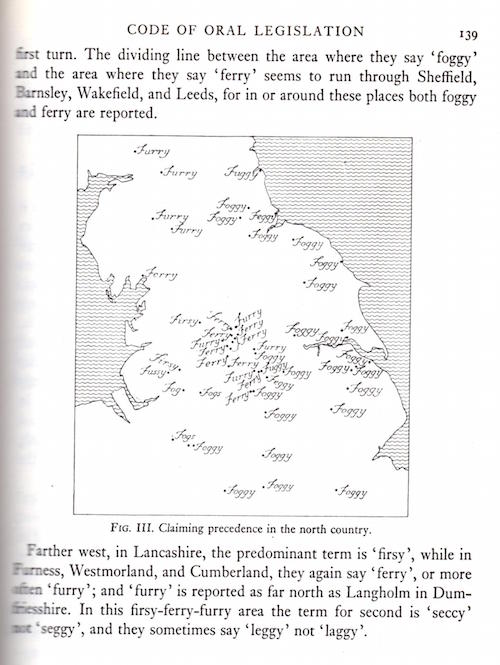
In the section on “Claiming Precedence”, Iona and Peter Opie record in Lore and Language of Schoolchildren that the terms “for gaining possession of an object [are] also commonly used for securing a privilege of first place” and they include “ferry” and “foggy”.

I adore the map that accompanies this exposition.

map

The terms for claiming precedence are found in a section in the chapter devoted to what the Opies call the Code of Oral Legislation which opens with this brilliant beginning:

The schoolchild, in his primitive community, conducts his business with his fellows by ritual declaration. His affidavits, promissory notes, claims, deeds of conveyance, receipts, and notices of resignation, are verbal, and are sealed by the utterance of ancient words which are recognized and considered binding by the whole community.

The Opie opera and collections are indeed a “firsy”.

And so for day 1613
14.05.2011

Posted in Uncategorized | Leave a comment