Flameless Burn

Smoke. Fire. Memory.

Tracy K. Smith
The Body’s Question

I crumple paper to encourage the flame,
And for a brief moment everything is lit.

But the logs haven’t caught,
Just seem to smolder and shrink
As the heat works its way to their center.

Getting to what I want
Will be slow going and mostly smoke.

[…]

Years ago during a storm [….]
While you added kindling to the fire […]
We sat in that room until the wood was spent.

We never left the room.
The wood was never spent.

“Joy”

The two temporal modes, a present failing to ignite and a past of toasty warmness, resolve themselves into a perpetual potential.

And so for day 1592
23.04.2011
Posted in Poetry | Leave a comment

Imagist Moment – Gratuitous Link

Fabric. Fabrication.

Tracy K. Smith
The Body’s Question

Remember my own bright shirt
Like a defeated flag
Among the heap of clothes

“Night Letters”

The image stands out — all the rarer because there are few similes in this body of work and because of a hint of flutter (“defeated” “heap”). Reminds me of a title full of assonance by Michael Holmes: Got No Flag At All — dropped in here like a name on the pile.

And so for day 1591
22.04.2011

Posted in Poetry | Leave a comment

Walking, Talking, Poking

Tracy K. Smith
Life on Mars

Let your fingers do the walking.

I think of your hands all those years ago
Learning to maneuver a pencil, or struggling
To fasten a coat. […]
At night, of the fingers wrangling something
from your nose, or buried in the cave of your ear.

“Song”

Dog walking.

Give a man a stick, and he’ll hurl it at the sun
For his dog to race toward as it falls. He’ll relish

“Eggs Norwegian”

Walking on.

Perhaps one day it will be enough to live a few seasons and return to ash.
No children to carry our names. No grief. Life will be a brief, hollow walk.

“The Speed of Belief”

The genius lies not only in the control of the enjambement but also in the gestural carrying on and a sense of a constant contemplation. A walk through the hollow. A short walk.

And so for day 1590
21.04.2011

Posted in Poetry | Leave a comment

Reading Flight

How this fragment of the poem deals with owls remains to be re-segmented.

Ululae
this mome nt tha tone th ism omen tt h at on
ethi smo men tt hat o net hi smo mento us is

this moment that one this moment that one this moment that one this momentous is

Rearranged holes:
mome tone omen at men hat net us is

An instance of what earlier was …

Filigree
my great story / migratory

Selections from Phil Hall The Little Seamstress.

And so for day 1589
20.04.2011

Posted in Poetry | Leave a comment

Chopping, Shopping and Dodging

charms and amulets
potions and snake oil

Image spam might tell us a lot about “ideal” humans, but not by showing actual humans—quite the contrary. The models in image spam are photochopped replicas, too improved to be true. A reserve army of digitally enhanced creatures who resemble the minor demons and angels of mystic speculation, luring, pushing, and blackmailing people into the profane rapture of consumption.

Hito Steyerl, “The Spam of the Earth: Withdrawal from Representation” in The Wretched of the Screen.

potions and snake oil
charms and amulets

And so for day 1588
19.04.2011

Posted in Uncategorized | Leave a comment

Tangle Tumble

Tracy K. Smith
“The Nobodies”
Duende

If light is both pow-wow
And tango—

For some reason these lines triggered a memory from a long ago viewing of Bruce Elder’s long (eight hour) film-poem Lamentations. I recall a scene with camera peering up through tipi poles to the sky.

One of the trigger words is of course “light”. What else could appropriately allude to a filmmaker? And the montage of two cultural idioms calls to mind the techniques of the experimental filmmaker. There’s something more. Smith’s lines skirt the evanescent: the mention of two musical modes oscillates: the eye sees them in succession as the ear drags them in a bid to occupy the same aural space. We are not sure if we have truck here with layering or with juxtaposition. We sense beauty. And to sense beauty is to recognize mortality. In the words of Bruce Elder:

To say that the beautiful shines within the time-bound is to say also that the beautiful is dynamic, — another aesthetic insight the cinema was created to convey. But if the beautiful is dynamism, and whatever is dynamic requires time, and time implies death, then beauty is allied with death — as closely allied to death as it is to life, as closely associated with violence as it is with charity. Beauty condemns what is beautiful to perish.

From
http://rbruceelder.com/documents/writing/bibliography/film/film_poetics/2001_ThoughtArtAndViolence.pdf

Anything that begins with “if” partakes of perishing. Things yoked by “both … and” struggle against this perishing. We are illuminated by the dynamic.

And so for day 1587
18.04.2011

Posted in Uncategorized | Leave a comment

Great and Grand

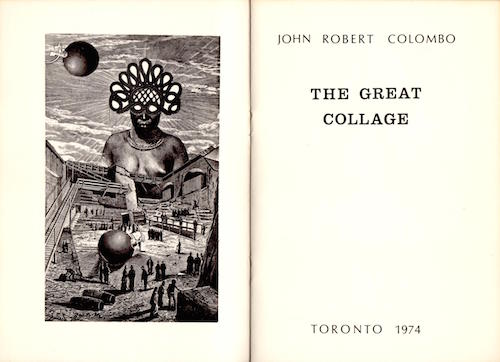
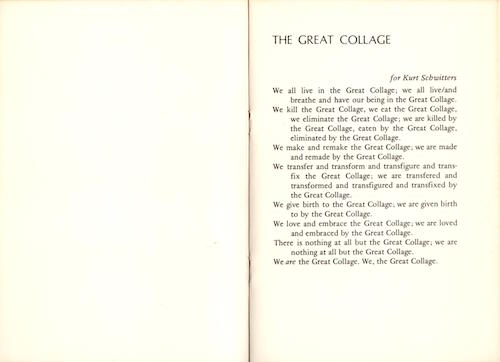
Influenced by one of the translations (“El Gran Collage”) I keep referring to John Robert Colombo’s 1974 chapbook as The Grand Collage when is it “Great”.

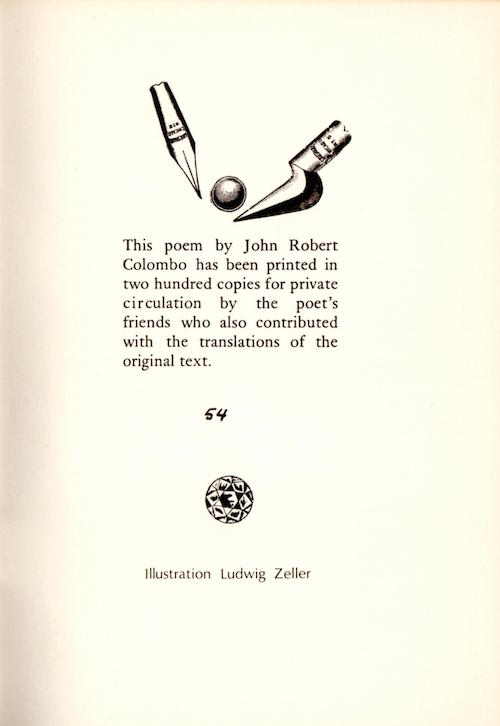
200 copies for private circulation by the poet’s friends. Translations done by friends.

colophon - John Robert Colombo 1974 chapbook - The Great Collage

The Colllage, Great and Grand, is by Ludwig Zeller.

Colombo - The Great Collage - Ludwig Zeller collage

John Robert Colombo 1974 chapbook as The Grand Collage - opening

Excerpt (snippet for other collages):

We make and remake the Great Collage; we are made
     and remade by the Great Collage.
We transfer and transform and transfigure and trans-
     fix the Great Collage; we are transfered and
     transformed and transfigured and transfixed by
     the Great Collage.

Colombo has dedicated the poem to Kurt Schwitters, collagist extraordinaire.

And so for day 1586
17.04.2011

Posted in Poetry | Leave a comment

All About Encounters with Canvas

Throughout War of the Foxes by Richard Siken is a painterly voice.

“Landscape with Rotten Fruit and Millipede” begins

I cut off my head and threw it in the sky. It turned
into birds. I called it thinking. The view from above —
untethered scrutiny.

“Landscape with Rotten Fruit and Millipede” ends

It made no sense. When you have nothing to say,
set something on fire. A blurry landscape is useless.

“Self-Portrait Against Red Wallpaper”

What would a better me paint? There is no
new me, there is no old me, there’s just me, the same
me, the whole time. Vanity, vanity, forcing your
will on the world. Don’t try to make a stronger wind,
you’ll wear yourself out. Build a better sail.

Another encounter with canvas.

And so for day 1585
16.04.2011

Posted in Poetry | Leave a comment

Of Ghosts and Harps

From the program notes from a performance of the initial section of Beowulf by Benjamin Bagby.

The instrument acts as a constant point of reference, a friend and a fellow-performer, a symbol of the scop and his almost magical role in the community of listeners.

Reminds one of Philip Pullman on the writing life (reprinted in The Observer Book of Books 2008).

Every sentence you write is surround by the ghosts of others you might have written, except while they are invisible to everyone else, you can still see them. Sometimes they gesture threateningly, with accusations in their eyes. But you have forbidden them to speak; eventually they fade and drift away.

And back to the program notes:

The harp is a relatively quiet instrument, but in the ear of the performer it rings with an endless variation of gestures, melodic cells and repetitive figurations which give inspiration to the shape of the vocalization: in the course of the story the vocalist may move imperceptibly or radically between true speech, heightened speech, speech-like song, and true song.

flyer - Benjamin Bagby - Beowulf

And so for day 1584
15.04.2011

Posted in Uncategorized | Leave a comment

Corn and Satisfaction

Scott Peacock on Edna Lewis

From 101 Classic Cookbooks – 501 Classic Recipes edited by Marvin J. Taylor and Clark Wolf.

She spoke intensely about the importance of food organically grown from open-pollinated seed, and how her brother, a farmer in Virginia, had told her that corn grown today yields three times as much as it did when they were children. “But he also told me that he noticed the cows eat twice as much of it, because they’re not satisfied,” she said. That was something I had never heard anyone speak about.

Makes me wonder if the crows even touched it.

And so for day 1583
14.04.2011

Posted in Food Writing | Leave a comment