The Lasting Learning of Lovely Syllables

Dennis Lee
“Sixth Elegy”
Civil Elegies

concluding lines

And I will not enter void until I come to myself
nor silence the world till I learn its lovely syllables,
the brimful square and the dusk and the war and the crowds in motion at
    evening, waiting to be construed
for they are fragile and the tongue must be sure.

It’s a pact.

Cover - Civil Elegies by Dennis Lee - Toronto: Anansi, 1968

And so for day 3022
21.03.2015

Posted in Poetry | Leave a comment

Lapping Up the Being Eaten

Ralph Nader
The Seventeen Traditions

In the Arabic language, words of endearment are derived from the world of food. “How delicious you are,” parents tell their children, or “How tasty,” or “How tender.” Sounds funny in English, but in Arabic such comments are ancient, routine and heartfelt. As much as she loved us, though, my mother never asked her young children what we wanted to eat. Why? Because “young children don’t know what is good for them,” she observed after we were grown. “They don’t have to like what they eat; they just have to eat it.” We were expected to eat everything on our plates. “If children find out that not eating will bring lots of attention, then they will frustrate their parents by making a scene again and again at the kitchen table,” she said. “Parents must not lose control here, or else they will have a scene often at dinnertime.” But she knew that children also have an acute sense of fair play. “Parents should eat the same food as their children,” she believed. “No double standard.”

I like how cultivating a taste for fairness comes on the heels of bodily health and psychic well-being.

And so for day 3021
20.03.2015

Posted in Food Writing | Leave a comment

One, One, One, Many

Mark Marino
Critical Code Studies

There is an invitation to

[…] resituate authorship not as something that necessarily emerges out of whole cloth from the genius poised at the computer but instead as an actor of reading and writing, cutting and pasting, patching together and reworking.

Which was earlier preceded by an appeal to heteroglossia:

The many voices of commentary represent not only the multiple authorship but also the heteroglossia of the code, to use Bakhtin’s notion, the many genres and styles within even one set of comments composed by the same programmer. While Bakhtin spoke of novels, these code files are likewise full of genres and styles, such as narratives, accumulated fragments, even some autogenerated comments, organized around the particular operational patterns of the instructions.

I juxtapose the two here to emphasize the polyvocal nature of composition stemming either from the self and its memories or from remixing collected resources. It is not only authorship that is resituated but also attitudes to raw materials.

And so for day 3020
19.03.2015

Posted in Reading | Leave a comment

Changing Letters, Changing Ingredients

Dharamjit Singh
Indian Cookery (1970)

An intriguing piece of culinary history from the headnote to Bhooni Kitcheri (Kedgeree with Lentils).

Kitcheri (which manes ‘a porridge’ or colloquially, ‘a bit of a mess’) is the prototype of kedgeree. However in India, lentils are used and not fish. The idea is to keep the dish light and digestible. The geeli, or moist kitcheri, is given to invalids or children. Here is a recipe for bhooni or dry kitcheri.

Cover - Indian Cookery - Dharamjit Singh

And so for day 3019
18.03.2015

Posted in Food Writing | Leave a comment

Living by Feeding

Elif Shafak
PEN HG Wells Lecture

Democracy is not a medal that once earned can be framed and hung on a wall to hide the cracks. It is a delicate ecosystem, a living and breathing environment of interacting beings, checks and balances, diversity and inclusion, cooperation and coexistence. As such, it has to be nourished all the time.

What I like about this formulation besides its enumeration is that it does not rely on balancing between two poles. It’s not about meeting in the middle. Justice is ineluctable. The smooth operation of the whole dynamic systems depends upon addressing in an ongoing fashion inequalities before they tip into an unrelenting feedback loop. Nourishment here is indeed a forceful metaphor but also a practical activity.

And so for day 3018
17.03.2015

Posted in Uncategorized | Tagged | Leave a comment

Three Within the Three

The three are usually depicted in a cyclical fashion: reduce, reuse, recycle.

The depictions makes them seem as equivalent activities notwithstanding the effort to list them as a hierarchy in any accompanying prose. It is not always evident that their impact will vary.

It is from this perspective that I find myself admiring the wit and pith of the slogan my local thrift shop displays on discount coupons given as appreciation for donations. There is a message that explains the good that is being done. And one finds prominently at the bottom, underlining the message by its placement, in a neat little row of reinforcement:

Refresh Recycle Restyle

They all seem to fall under the common “reuse” rubric. Even “recycle” here means cycling through different hands and not a manufacturing process involving vast quantities of energy. It’s a point rhetorically confirmed by the partial rhyme of recycle and restyle.

And apparently there’s a company selling T-shirts emblazoned with the tag line. I chuckle at the thought that some day one of those ends up at the thrift shop.

And so for day 3017
16.03.2015

Posted in Poetry | Leave a comment

O Book Ends

Brian Dillon
Suppose a Sentence

A set of meditations on a set of sentences. The first author in the series is Shakespeare; the last is Anne Boyer. The one is entitled “What, Gone Without a Word?”; the other, “What How If”. Both muse about the status of a inscribed string of Os.

Dillon remarks that “In Shakespeare, last words are rarely the last.” Beginning with a version of Hamlet and going on to discuss other plays where the “O” plays a role in death scenes.

In the last meditation of the book, Dillon turns to ends and endings, again. If one reads quickly one misses the point demarcating the words of Boyer from the words of Dillon. It’s a thrill to go back and catch the closing quotation mark in the block of text and witness the mimicry at work in what follows. The whole last paragraph deserves extensive quotation:

Towards the end of Garments Against Women, Boyer recounts a narrative from Rousseau’s Émile, later retold by Wollstonecraft in A Vindication of the Rights of Woman. Rousseau had known, he says, a little girl who, eager to learn to write before she could read, continually inscribed the letter O with a needle — no other letter, just a parade of Os. And then one day she caught a glimpse of herself in the mirror as she was writing and, finding herself awkward or ugly, promptly gave up her practice. According to Rousseau, the anecdote points to the natural vanity of women: a lesson Wollstonecraft dismisses as “ridiculous.” Here is Boyer: “Rousseau believed the O’s to be O’s, but every O could have been, also, every letter and every word for the little girl: each O also an opening, a planet, a ring, a word, a query, a grammar. One O could be an eye, another a mouth, another a bruise, another a calculation.” By a line of Os the girl might have meant: “I understand the proximate shape of the fountain.” Or: “Apples are smaller than the sun.” Or: “My mother.” O, o, o, o was a revolutionary code, and when she put down her pen it was because she had already written what she need to write.

And so Suppose a Sentence itself ends.

And so for day 3016
15.03.2015

Posted in Uncategorized | Leave a comment

think, talk, listen, write

shalan joudry
Promptly
A miscellany of writing tips and tales from Nova Scotian authors. A fundraiser for the Writers’ Federation of Nova Scotia.

Head to the land (forest, brook, seaside, tundra — wherever nature is still the boss). Hopefully this is somewhere close enough to home that you will not need to pack for a lengthy journey. Choose somewhere in nature that can house you for an hour or more. Once there, spend the first twenty minutes thinking and talking aloud (if there are not too many people around, staring at you). Think/talk about the writing or story project you have in mind. Tell the land about it. And then once you’ve said enough, spend another twenty to thirty minutes in silence, listening to the sounds of nature. Don’t even worry if you’re not hearing words or “figuring out the next lines,” just be present. Watch the land or water. If possible, do this again a week later.

[…]

Never underestimate the power of the land to feed you.

Works in reverse: write, listen, talk, think.

And so for day 3015
14.03.2015

Posted in Uncategorized | Leave a comment

Progressive Discipline

Ralph Nader
The Seventeen Traditions
“The Tradition of Discipline”

When the look alone didn’t work, they [Mother and Father] relied on a sequence of three Arabic reprimands. the mildest was skoot or skiti (male or female), the next stage was sidd neeyak or siddi neeyik and the third level was sakru neekoon. Translated loosely, these mean “hush your mouth” in varying degrees. If that didn’t work, we might be told to leave the dinner table and/or go to stand in the corner by the sewing machine. Or we might be assigned a chore, to drive the point home in another way. Our parents rarely spanked us, and when they did, it was no more than a gentle smack on the rear. Then as now, too many children have been picked up and shaken — as toddlers, even infants — or beaten by parents losing their self-control and abandoning themselves to rage. My parents were horrified by such behavior.

Whatever the language, one recalls the distinct progression of admonishment. Sometimes conveyed by repeating the same words with a variation in tone …

And so for day 3014
13.03.2015

Posted in Uncategorized | Leave a comment

Anonymous But Unforgotten

Christie McDonald
The Proustian Fabric: Associations of Memory

Each text constitutes an endpoint and a link with others.

There is no credit for the book’s designer. Pity. It’s work that deserves a name to be named.

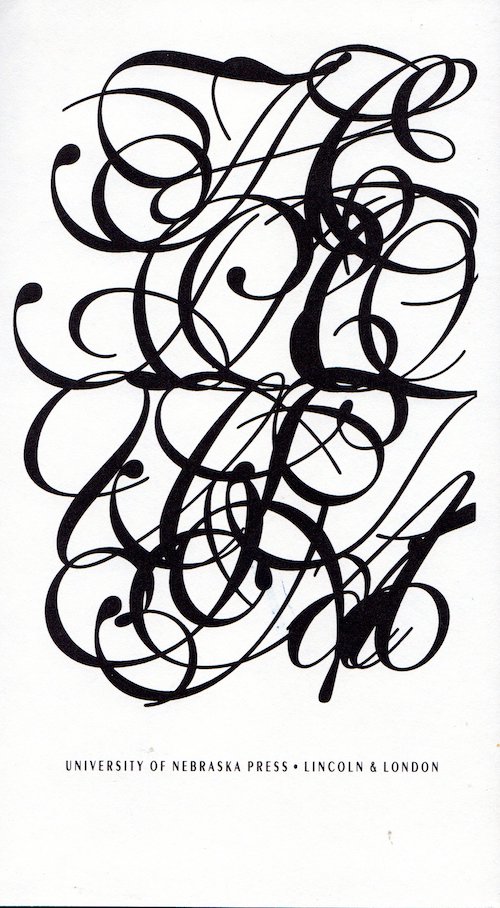
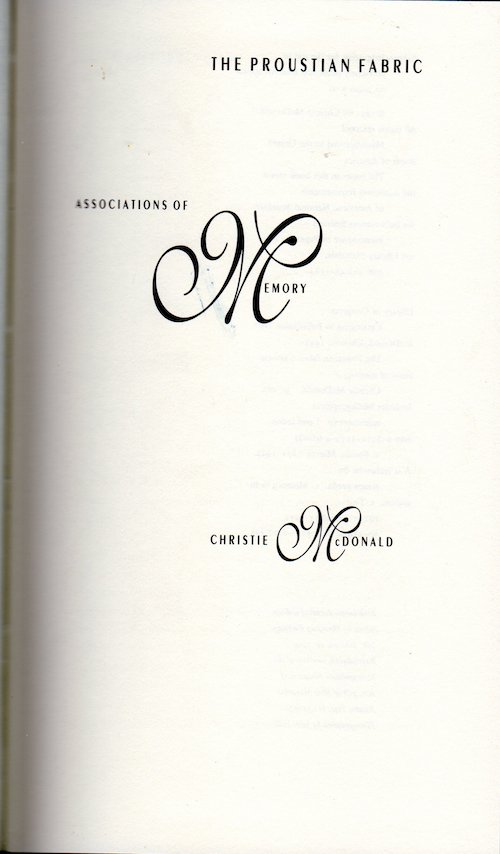
Look at the title page which opens at the fold with the facing frontispiece. It provides a graphic interpretation of the move from a mass of detail to a smooth structure of meaning.

Frontispiece - The Proustian Fabric: Associations of Memory by Christie McDonaldTitle Page - The Proustian Fabric: Associations of Memory by Christie McDonald

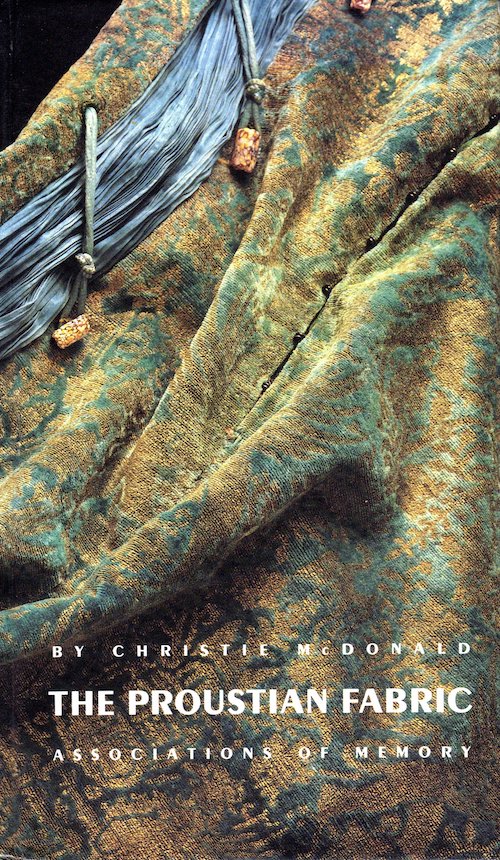
The cover features a detail of a dress fabric by Mariano Fortuny — given a proper provenance note inside.

Cover - The Proustian Fabric: Associations of Memory by Christie McDonald

The other of the link is sometimes absent. But the hand of the designer is always present.

And so for day 3013
12.03.2015

Posted in Booklore | Leave a comment