Frequenting the Fragment

Amy Vladeck Heinrich notes in Fragments of Rainbows: The Life and Poetry of Saitō Mokichi 1882-1953 that in one specific instance “The verb ‘echoing’ is added to the translation because English is not as comfortable with sentence fragments and their implied conclusions as is Japanese” (p. 84). Here then is the poem.

otōto to
aimukai ite
mono o iu
katami no koe wa
chichi haha no koe

My brother and I
sit facing one another,
speaking of things;
our voices to each other’s ears
echoing our parents’ voices …

Let’s see what happens when the explicit reference to echoing is removed.

My brother and I
sit facing one another,
speaking of things;
our voices to each other’s ears
our parents’ voices …

And a further tweak carrying over into English the gendered “chichi haha”

My brother and I
sit facing one another,
speaking of things;
our voices to each other’s ears
mother’s and father’s voices …

And so these considerations of fragments led us to

SENTENCE FRAGMENT A group of words that ends with a period but lacks either a subject or a main verb; a subordinate clause or a phrase or a single word standing by itself. Here are some examples of fragments (in one line of Geoffrey Hill’s “Mercian Hymns”):

A pet-name, a common name. Best-selling brand, curt graffito. A laugh; a cough. A syndicate. A specious gift. Scoffed-at horned phonograph.

A sentence fragment is a mistake, if used carelessly, but a valuable device if used expressively or rhythmically (See FRAGMENT and FRAGMENTATION.)

John Drury. Poetry Dictionary.

And so for day 1562
24.03.2011

Posted in Poetry | Leave a comment

I remember the colour of forget-me-not is light blue

I don’t remember what the rest of the book is about (except for that dig at a passage from William Gass On Being Blue which forces me back to re-reading the book which is now a foggy mass in my memory as faded as the spine of the book).

156. “Why is the sky blue?” — A fair enough question, and one I have learned the answer to several times. Yet every time I try to explain it to someone or remember it to myself, it eludes me. Now I like to remember the question alone, as it remains me that my mind is essentially a sieve, that I am mortal.

Maggie Nelson Bluets

But that passage about the Gass passage, comes back to the fore. It has caught the attention of a number of reviewers including Jocelyn Parr in Brick 96

A critical examination of Nelson’s irreverence reveals how her writing heralds a new kind of order. Just as we’ve not heard enough about the female gaze, we’ve heard too much about the male gaze and all the ways that it disciplines the female body. Nelson establishes the new order by taking down the old one. William Gass, an icon of sexual freedom, writes that readers who want to see under the skirt will only be disappointed:

“What good is my peek at her pubic hair if I must also see the red lines made by her panties, the pimples on her rump, broken veins like the print of a lavender thumb, the stepped-on look of a day’s-end muff ? I’ve that at home.”

In a delicious about-face, Nelson accuses Gass (of all people!) of puritanism: “This is puritanism, not eros,” she says, thereby founding her own moral order (Puritanism is bad! Eros is good!). She defies Gass, the glossy magazines, and anything that would do less than celebrate the female body in all its ways:

For my part I have no interest in catching a glimpse of or offering you an unblemished ass or an airbrushed cunt. I am interested in having three orifices stuffed full of thick, veiny cock in the most unforgiving of poses and light.

Nelson knows that the gaze is a position of power, and she wants women to adopt it. Women should have the right to look at what they want, and they should have the right to be seen as they are. Earlier, I said Nelson’s writing is political. I should have said it is feminist.

Oddly, Nelson declares in the context of distancing herself from Gass “I will not choose between the blue things of the world and the words that say them.”

Well, neither does William Gass. The passage from which Nelson excises the voyeuristic moment is to be found in section IV of On Being Blue. It opens with a thought experiment of being in the possession of Gyges’s ring which imparts invisibility. It spies upon the neighbours unloading groceries; describes at length the depictions in the pattern of blue willow china; in contemplating the non-quarrelling pair there is a digression about being scorched by a blue flame whose burning ends with the remark that “My emotions may be mistaken sometimes, but each is the integration of a very complex and continually changing set of relations only temporarily stabilized this time in a blinding run of tears.” There follow thoughts on the logical layers of emotion before the text turns again to view the woman at the sink preparing salad. Many more paragraphs about the nature of fiction (“The push toward blue in fiction has persisted from the beginning.”) And then we get the passage that generated Nelson’s scrutiny … and its continuation.

I’ve that at home. No. Vishnu is blue in all his depictions. Lord Krishna too. Yes. the blue we bathe in is the blue we breathe. The blue we breathe, I fear, is what we want from life and only find in fiction. For the voyeur, fiction is what’s called going all the way.

[…]

Thus between the aesthetically irrelevant demands of the reader and the aesthetically crippling personal worries of the writer, sexuality reaches literature as an idée fixe, an artifically [sic] sweetened distortion or an outright lie, while the literature itself leaks quality like a ruptured pipe.

What is perhaps more intriguing is how the context of the “peek at her pubic” is set up by Gass as impatience with the long stretches of time where nothing happens. (Hyperrealism is here the target.)

Impatient, we can’t wait for nature to take its course. When we take our textual tour through the slums, we want crime, violence, starvation, disease, not hours of just sitting around. We want the world to be the world we read about in the papers: all news. What good is my ring if the couple I am using it to spy on make love in darkness once a month, and then are quick, inept, and silent? Better rob banks. The money is always there. What good is my peek at her pubic hair if […]

If Gass cavils agains the longeurs, Nelson is too quick to promote hard core, hard core simplicity.

And so for day 1561
23.03.2011

Posted in Uncategorized | Leave a comment

The Dark Side of Green

I have harvested fresh watercress from stream beds — and then enjoyed its pungent taste raw. I’ve also mastered the technique of flash frying watercress in a wok. It turns a splendid emerald that some would call jade.

I found the following delightful bit of lore in Bert Greene’s Greene on Greens.

WATERCRESS can scarcely be dubbed a “garden green” since it requires a babbling brook or a small stream close by to feed its thirsty roots. Watercress thrives best in the shade, a fact that has given it something of a bad name in the past. There was a theory (held by all Puritan diners) that since this plant was grown in the darkness it was a living example of deviltry, “and no consumer of its leaves would profit with good health lest it was mingled with foodstuffs harvested in pure sunlight.” Which may explain in part why a stalk of watercress hardly ever arrives on a salad plate without a leaf of lettuce nearby!

I don’t know about serving watercress with lettuce but I do like mine served sprinkled with toasted sesame seeds — my touch of the sun.

And so for day 1560
22.03.2011

Posted in Food Writing | Leave a comment

Particular Particularities

When are bodies the body’s?

It’s a turn of phrase associated with Jinny in Virginia Woolf’s The Waves. I first thought there might be a topographical error in the edition I was using. Then I noticed the hook was homophonic.

But my imagination is the bodies. I can imagine nothing beyond the circle cast by my body. My body goes before me, like a lantern down a dark lane, bringing one thing after another out of darkness into a ring of light. I dazzle you; I make you believe that this is all.

The phrase comes later in its other form.

I do not temper my beauty with meanness lest it should scorch me. I gulp it down entire. It is made of flesh; it is made of stuff. My imagination is the body’s.

The body’s bodies.

And so for day 1559
21.03.2011

Posted in Uncategorized | Leave a comment

Pondering the Potable

Reprinted in Intertwining, John K. Grande’s review of the 1992 Paul Grégoire show “Alzheimer Social” at the Circa Gallery in Montreal likens the work to other artists.

Paul Grégoire’s creations recall Edward Kienholz’s Pop art recreation of aging insomniacs in The State Hospital (who cannot dream of another reality than their own) […] His [Grégoire’s] disappointment is as much with his own self-constructed illusions of reality as with the status quo of the species homo sapiens.

Impelled by Grande’s allusion, I sought out more information about The State Hospital piece and found Shelly Couvrette providing this description. http://www.cat-sidh.net/Writing/Kienholz.html (no mention of insomnia)

When giving the piece a superficial glance, all that is visible is a large, crate-like box. Details do not become obvious until one looks more closely. The form of the box creates a hulking, institutional-white outer shell. Closer observation reveals a padlocked door in the center of the front wall. In this door is a small, square, window with three bars. High in the upper left-hand corner of the wall is a sign reading WARD 19.

One must approach the barred window to see inside. There is a smell of disinfectant spray. The room is lighted by a single, bare bulb dangling from the ceiling. The scene that it illuminates is repulsive.

There are two identical figures lying on institutional-issue, metal bunk-beds, one upon each bed. Each is shackled to the frame of his bed by a leather strap and wrist-cuff. Their bodies are a pus-like yellow color, roughly rendered with congealed drips and lumps of resin. The figures have the appearance of emaciated mummies. Their bodies rest on thin, blue and white striped mattresses that are filthy and ragged. The figure resting on the upper bunk is encased in a elliptical neon tube; a thought bubble from a comic strip. The tube glows an ominous red. The heads of the men are made from illuminated fish-bowls. Two black fish swim in each bowl. There is a small, and apparently purposeless, hospital-issue bedside table against one wall. A bedpan rests on the floor, but it is not within reach of the bed.

On formal grounds, I agree with a rapprochment between Kienholz and Grégoire (both refigure and pose human forms) but am troubled by the interpretative twist that hints at a strong dose of misanthropy. I think Grégoire demonstrates mirth.

Grande would agree (though I think that there is more mirth than Grande would attest). In his penultimate paragraph he states that “[t]he most lighthearted pieces in the show are those that simply poke fun at the old-fashioned avant-gardist notions of art.” As proof of the case he suggests an intertextual relation to the work of Hans Haacke.

Likewise, Grégoire’s plexiglass cube of water that carries the caption “J’ai soif (I am thirsty)” inverts Hans Haacke’s minimalist motif on encubed condensation to send it straight back from whence it came, to let nature have the final word.

But allow a word from Haacke …

I have partially filled Plexiglas containers of a simple stereometric form with water and have sealed them. The intrusion of light warms the inside of the boxes. Since the inside temperature is always higher that the surrounding temperature, the water enclosed condenses: a delicate veil of drops begins to develop on the inside walls.

At first they are so small that one can distinguish single drops from only a very close distance. The drops grow, hour by hour, small ones combine with larger ones. The speed of growth depends on the intensity and the angle of the intruding light. After a day, a dense cover of clearly defined drops has developed and they all reflect light. With continuing condensation, some drops reach such a size that their weight overcomes the forces of adhesion and they run down along the walls, leaving the trace. This trace starts to grow together again. Weeks after, manifold traces, running side by side, have developed. According to their respective age, they have drops of varying sizes. The process of condensation does not end.

The box has a constantly but slowly changing appearance that never repeats itself. The conditions are comparable to a living organism that reacts in a flexible manner to its surroundings. The image of condensation cannot be precisely predicted. It is changing freely, bound only by statistical limits. I like this freedom.

HANS HAACKE, 1965
http://www.macba.cat/en/condensation-cube-1523

And now a picture

hans hacke -- condensation cube

I have been unable to access the archives of the Circa Gallery for 1992 to find an image to document Grégoire’s cube. The one that sends us back to nature. I have however found in the artist’s own documentation of his sculptural work a 1984 piece with the similar title, “Le grand cri de la soif”.

paul gregoire - le grand cri de la soif

Bas relief réalisé lors de l’événement «Peinture en direct 4X6», au Musée d’art contemporain, à Montréal en 1984. (Moulage sur corps humain. Plâtre peint, vinyle, acrylique, verres remplies de sable) [hand holding glass filled with sand]

Intertexts. Condensations. Displacements. All with the thirst of a light heart.

And so for day 1558
20.03.2011

Posted in Uncategorized | Tagged | Leave a comment

Chopping and Tossing

Mollie Katzen. The Enchanted Broccoli Forest “Improvisation Notes”

Cooking is a very personal statement, whether you follow a recipe, vary it, or invent your own altogether. The same recipe made by different people on different days and in different kitchens can taste new each time. There always seems to be an personal touch — a special elusive quality — from each individual cook.

The first step toward improvisation is to find some cookbooks that appeal to you and just read them without necessarily cooking any of the recipes. This will help you to understand basic procedures and principles of cooking.

Then make a commitment to really notice and taste good food, to ask questions of other cooks, and to become deeply familiar with your own preferences. Your comfort and “vocabulary” will quickly grow, and you will find yourself more and more able to vary recipes, or even to cook without them at all.

Similar advice applies to writing.

The foraged ingredients from J.W. Hackett Haiku Poetry Volume One:

That old empty house,
   now overgrown with years,
      is the only real one here.

Adapted to the Berneval kitchen:

That empty old house,
overgrown now with years,
is here the only real one.

Interesting parallels between sensitivity to syntax and to cooking times.

And so for day 1557
19.03.2011

Posted in Food Writing, Poetry | Tagged | Leave a comment

Diuretic Diectics

Thoughts on Garry Thomas Morse Streams LINEbooks, 2007.

There is a lot of coffee consumed in this book of prose poems. Each is a cup.

Why you may ask that these textual units should be considered as a cup: some crumplable like paper; others refining crucibles; others relating their contents as if through some Surrealist vases communicants?

Percolation is the answer and so is passing water.

Black jet streams and golden showers.

And no, this is not the craving to pee all over you but rather to mark you in some way with my anonymous black coffee breath as excellent as eating and preserve your brown and red lines of colour in the exact correct moment on the way back just before a tire plashes right through. [no. 71 p. 49]

This “you” is a woman.

You are by no means defined by my want and the ways the tip of my tongue wants to shape your skin. But you are the woman in the window in the bed in the adjoining room. And the time is ripe as the date you are tasting. The coffee is concentrated on the table in physic and colour and osmosis but my limbs and palms are boiling and I am dreaming of spooning and cupping your sleeping form. [no. 73 p. 51]

And as to be expected with this sort of coffee service that is highly eroticized there is a moment of identification with the writing process itself.

phrases not formally invited […] Blow upon them until they cool but do not worry. I taste them for poison first. [no. 76 p. 54]

Much relies on the formal folding of phrases and the remembering of sections — as if poured from carafe to cup — so that a welcome shock assaults the senses (both physical and semantic). Take for instance the elevator which smells of urine and then later the elevator that smells of ammonia. Same elevator? A sign of an attempt at cleansing? Or more pissing? Something remains in the gap between the prose poems. There is a stream passing between the cups and it is difficult to apprehend. So too sometimes the stream between words.

I do not want more than this cup of black coffee warming my soft innards, save for that lightly pointed smile. […] So consider this evening in the voiceless dark how the general illusion of my life is worth less than this sublime unreality of your smile.

Note not “worthless” but “worth less” hence worth something.

Or sometimes the reader thinks that the there is a self-referential action at work or a straight-forward description. Take the following which recalls Eliot’s The Wasteland and the passage about the crowd flowing (streams again) over London Bridge where we have a line-up in a coffee shop and a long line of poetry.

Already I am fuming and snorting in a line so long I had no idea sugar and coffee had undone so many. [no. 94 p. 70]

And now three from the earlier presented prose poems that touch upon the fluid notion of form.

And your hands were dearer than ampersands and were at utter liberty to attend to my felicity. [no. 15 p. 16]

And like a bureaucrat startled into a decision on the street, Love has decided to keep me alive in an infinitely long lineup, provided with a smile and then without one I have taken the time to fill in the appropriate forms. [no. 5 p. 9]

My youthful memories are mostly a barrel of mistaken loves and at that confusing age you had to shoplift what is these days virtually free although you might catch something. [no. 7 p. 11]

& free to establish felicity conditions & appropriate forms (appropriating attention) & filling in forms at the STD clinic [?]

Why conjure this pox-side of eros here at the beginning? Because at the end we find an allusion to Baudelaire (and by way of letting biography and oeuvre communicate) …

Forgive this necessary transgression and before it is too late, embrace me and grab hold, my sexy wicked semblable! But whatever you do, tread softly because you tread upon my streams.

There has been a shift in addressee “— Hypocrite lecteur, — mon semblable, — mon frère!” [by way of Eliot’s warning about sprouting corpses?]

treading = t-reading

Other beverages competing in a cross-reading?

But how could they? Despite the allusions to Proust there is no tea, no tisane. Indeed, in the last of the prose poems in the collection (no. 99) we are given the delightful word Kaffeeschlafen in the context of recounting the beautiful death of a grandmother, in the sense of a belle mort, and so we are sent off to dream or read again. To sip. To slip. To stream.

This is the art and the square root of all my erraticisms. [no. 68, p. 47]

And wonder who this speaking voice might be that is produced by Garry Thomas Morse Streams LINEbooks, 2007

And so for day 1556
18.03.2011

Posted in Poetry | Leave a comment

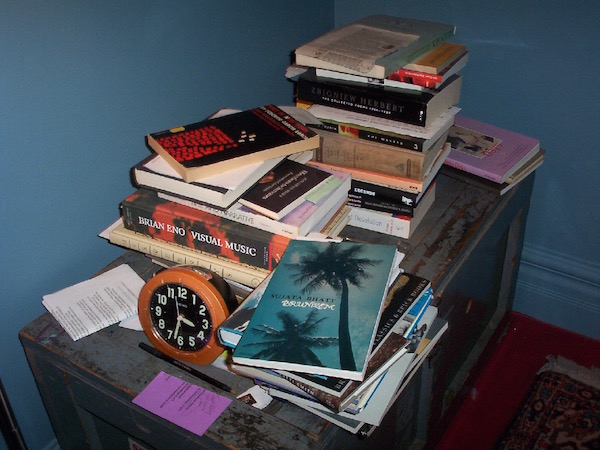
Heap Sleep

1896 Summer

Amid a jumble of
tanka books, haiku books —
noonday nap

From Masaoka Shiki: Selected Poems translated by Burton Watson

a heap of books by a bedside

That is the view of my bedside pile. All prepped for a nap.

And so for day 1555
17.03.2011

Posted in Booklore | Leave a comment

Filiation, Forebears, Forgers

1970s. It was a time of searching for ancestors. (Roots – Alex Haley).

“A literary ancestry long denied”

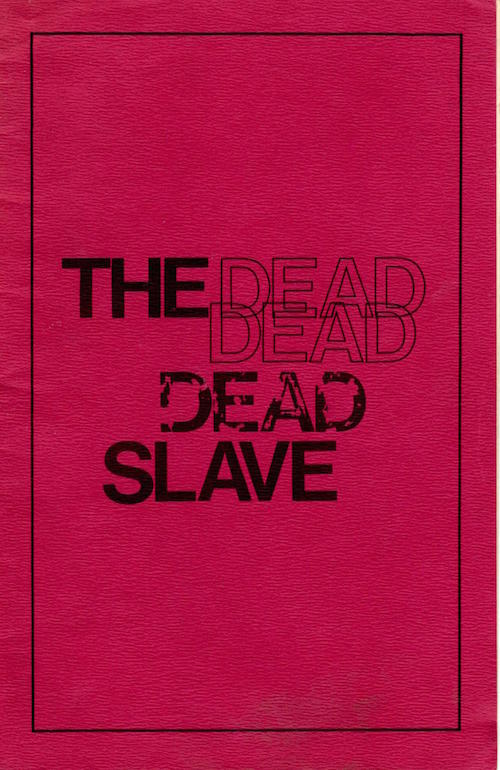
D.D.C. [Douglas] Chambers reviewed three books of poetry: Orgasms of Light: The Gay Sunshine Anthology edited by Winston Leyland, The Dead Slave and other poems of Martial by Kenneth Hopkins, Uranian Roses by Tom [Thomas] Meyer, in The Body Politic May 78, Issue 43, p16. He plays upon this trope of forebears to give depth to comparisons of worth. Note here his framing of Hopkins’s little book from Catalyst Press.

What is good about this is that it draws our attention, as does Kenneth Hopkins’s collection of epigrams by Martial, The Dead Slave, to our literary ancestry long denied. It is surprising enough that these poems have never before been translated; it is even more surprising that the translations are good enough to merit comparison with the work of Ben Jonson or John Donne, the great English imitators of Martial.

Chambers with his use of italics is here winking at the pretense of translation and vouching for the authentic value of imitation. [Hopkins’s imitation was indeed fabrication.]

As David Mason reports in a review of Books in the Blood: Memoirs of a Fourth Generation Bookseller about Anthony Rota, a friend of Kenneth Hopkins.

This account is tinged with sadness for me because one of those days is spent travelling to consult about the dispersal of the library, after his death, of his old friend [and mine] the poet, writer and book collector Kenneth Hopkins. Hopkins, a man of great charm and enormous learning, was poor all his life except in friends and books. He wrote several books on the history of English poetry and several volumes of poetry himself. He once published [in Toronto, incidentally] a pamphlet with some newly discovered poems by the Roman poet Martial which were very favourably reviewed in an academic journal, a review which greatly delighted Kenneth since the publication was a fraud, all the poems attributed to Martial having been composed by Kenneth himself. They were good poems too, even the reviewer said so.

Hopkins, too poor to collect the major poets in England, got the idea to build a collection of minor poets of the nineteenth century. During many years haunting bookshops, he had bought every book of nineteenth-century poetry he saw which was by an obscure or unknown poet. Because of this Hopkins had a comfortable old age, for after many years amassing this huge collection, Rota sold it for him to an American university that like most of the others had neglected the minor poets while they sought the major ones. At the risk of appearing to be one of that ignoble breed, a punster, I cannot help saying that this seems to me to be a perfect example of ‘poetic justice’. This is also one of the best examples I know of which confutes the erroneous view that one must be wealthy to build an important collection. Not money but imagination and passion are the real essentials of successful book collecting, as Hopkins proved. He ended his life travelling, dining with friends and, of course, buying books. Rota reports that despite the space created by such a massive sale, at his death Hopkins’ house was once again overflowing, bursting with books.

Before turning to quote from Hopkins, one epigram from Thomas Meyer in one of the other books reviewed by Chambers. From Uranian Roses with its pleasant tender double entrendre

If he doesn’t come
in the next hour
it’s all off.

I he shows up
tomorrow …

what’s a day lost?

Hopkins’s epigrams would answer — too late — for death is like a thief, day or night. These are the last three epigrams in The Dead Slave arranged in Hopkins’s order but numbered as he says according to the manuscript which gives us two alternative orders or rather a double reading: one top to bottom, the second bottom to top as guided by the note on ordering.

Ep. XI

Perfect in grace, perfect in every limb,
The one thing wanting was but human breath;
Surely a kiss would breathe back life in him!
I never before thought beauty lived in death.

Ep X

They bore him from my presence, and I wept;
In my own bed that restless heart was stilled;
After he laughed, and tumbled as I willed,
I thought him sleeping, so I turned and slept.

Ep IX
They told me he was dead: I disbelieved;
How could my light go out, and nothing said?
He seemed immortal, but I was deceived;
Shall I, shall any live, and he lie dead?

I never thought beauty lived in death … and the cover by Lennel Goodwin attests that the signifier “dead” may be given grace and by such grace hint that “forge” relates not only to swords, partnerships and signatures but to poems enlivened by typography.

cover - The Dead Slave

And so for day 1554
16.03.2011

Posted in Poetry, Translations | Leave a comment

The Art of Recounting Eco-Art

Deduction.

The outdoor eco-art effect is inimitable, the ultimate in theatre, a modest acceptance of nature’s place in the creative process. The backdrop, be it in the city, a public space, a park, or the wilderness is effectively changing by the minute as the light, atmosphere, sound around us changes and generates a heightened sense of connectedness to the culture of nature because our own bodies are sensing all that change. Everything that surrounds us — plastic, wood, cement, glass, etc. — is nature transformed, in its original state or in the process of returning to nature. Nature is the art of which we are a part!

Induction.

The most radical forms of this kind of eco-art without walls are unsigned, undated and ephemeral, enacted in public or unclaimed transitional sites. A tree planter as well as an artist, Doug Buis’ anonymous plantings of seedlings in Montreal which continue to grow imperceptibly are an example of how subtle an artist’s interventions can be … but I have also seen an inukshuk on the highway 401 near Hamilton, Ontario on top of a hill, a beautiful sculpture of a dancer made of toilet paper and wire on rue Clark in Montreal that was washed away by the rain within a few days, a habitation on rue St. Denis built by an artist out of discarded wood and posters that was intermittently occupied by street people before it was torn down.

John K. Grande “”Eco-art Revisited” Intertwining: Landscape, Technology, Issues, Artists.

And so for day 1553
15.03.2011

Posted in Uncategorized | Leave a comment