The Bite of Momordica charantia

There is a lyrical moment in a poem that reports the mashing of names and the misnaming of persons. This is not it:

it happens all the time.
it’s in the name.
it’s in the face.

orientals so hard to tell apart.

This is it.

our faces,
strong, brown,
different as
the bumps
on the skin of
bittermelon.
our tongues,
sharp and fragrant
as ginger,

And the poem goes on to further celebrate further acts of resistance.

“It’s In The Name” by Kitty Tsui in The Words of a Woman Who Breathes Fire

And so for day 1552
14.03.2011

Posted in Poetry | Leave a comment

Rendering the Mellifluous

Judy Grahn had us reaching for the highest apple. But this picker did not at first notice this proverb preserved by Tryphon quoting the Lesbian poet until taking note of its placement by Stanley Lombardo (2002) who sets it as number 39 in his selection (Sappho: poems and fragments] — rearranging the order out of David Campbell’s 1982 Loeb edition (“Having translated these pieces, I felt compelled to order and arrange them into a collection with some kind of esthetic coherence.”). He gives us

For me neither honey nor the honey bee

Neither sweet nor sting?

I leave you to discover the comb — the matrix — that Lombardo builds round this fragment which escapes the cloying two liner by A.S. Kline.

Neither for me the honey
Nor the honeybee…

Lombardo’s assonance achieves through sound an image of the honey comb’s hexagonal cells.

Jim Powell (2007) renders it in three lines

For me
neither the honey
nor the bee.

Which with its end rhymes comes close. But Lombardo’s repeated “honey” buzzes and drizzles sweetness on the tongue.

And so for day 1551
13.03.2011

Posted in Poetry, Translations | Leave a comment

Vegetable Symbolism

Eileen Yin-Fei Lo. From the Earth: Chinese Vegetarian Cooking

Scallions were chung, and were to be considered wise because the characgter for “wise” translated as chung ming. And why were they wise? Because scallions are long and hollow, and their hollowness connotes an open mind, open to knowledge, receptive to thought.

Pascal’s “rouseau pensant” — “open mind is not empty mind” is often rehearsed.

And so for day 1550
12.03.2011

Posted in Food Writing, Metaphor | Leave a comment

Celebrated in Poetry and Free to Cerebrate

Clerihew – a biographical bit of fun that rhymes on the run. I like how this one fits into the flow of prose and contributes to the picture of the genius free to roam.

With the backing of John Maynard Keynes, he was elected a Fellow of King’s College in 1935, at the age of twenty-two. When the news reached his old school, the boys celebrated with a clerihew: “Turing / Must have been alluring / To get made a don / So early on.” With a stipend, no duties, and High Table dining privileges, he was free to follow his intellectual fancy. That spring, attending lectures in the foundations of mathematics, he was introduced to a deep and unresolved matter known as the “decision problem.” A few months later, during one of his habitual runs, he lay down in a meadow and conceived a sort of abstract machine that settled it in an unexpected way.

Jim Holt. “Code-Breaker: The life and death of Alan TuringThe New Yorker, February 6, 2006.

And so for day 1549
11.03.2011

Posted in Poetry | Leave a comment

Combination Therapy: Memes and Narration Health

Paulo Freire’s remarks in the fourth chapter of Pedagogy of the Oppressed (translated by Myra Bergman Ramos) about theories of cultural action are interesting starting points to think about “memes” [discursive carriers] and the processes of ideological adhesion. The remarks I have in mind turn on a situatedness (inside/outside) that perhaps needs to be refined. Freire writes:

The revolution is born as a social entity within the oppressor society; to the extent that it is cultural action, it cannot fail to correspond to the potentialities of the social entity in which it originated. Every entity develops (or is transformed) within itself, through the interplay of its contradictions. External conditioners, while necessary are effective only if they coincide with those potentialities. [Here there is a note to “See Mao Tse Tung op. cit.]

And so we find the 7th note of Chapter 3.

In a long conversation with Malraux, Mao Tse Tung declared “You know I’ve proclaimed for a long time: we must teach the masses clearly what we have received from them confusedly.” André Malraux, Anti-Memoirs (New York, 1968) pp. 361-362.

Friere later on in Chapter 3 writes

It is as transforming and creative beings that men, in their permanent relations with reality, produce not only material goods — tangible objects — but also social institutions, ideas, and concepts. [Note to Karel Kosik]

It is out of the encounter of praxis and the concrete that dialogical approaches emerge. The Malraux – Mao note is anchored at the end of the following sentence:

For the dialogical problem-solving teacher-student, the program content of education is neither a gift nor an imposition — bits of information to be deposited in the students — but rather the organized, systematized, and developed “representation” to individuals of the things about which they want to know more. [Reference to Note #7]

Representation here could be read as a product as well as a process. This is helping me locate the source of my discomfort with the opening of Chapter 2, i.e. the remarks on the narrative of teacher-student relations.

A careful analysis of the teacher-student relationship at any level, inside or outside the school, reveals its fundamentally narrative character. This relationship involves a narrating Subject (the teacher) and patient, listening objects (the students). The contents, whether values or empirical dimensions of reality, tend in the process of being narrated to become lifeless and petrified. Education is suffering from narration sickness.

Reread from the perspective of the work of representation, I now realize it is not so much storytelling per se that is being faulted but a certain mode of narration. If there is such a thing as “narration sickness” might there not be narration health? Freire of course goes on to propose a prescription.

Narration health equivalent to interplay of readings? See Barthes S/Z on “character” being a product of combinations. Recombine with the notion of “meme”.

And so for day 1548
10.03.2011

Posted in Storytelling | Leave a comment

Syncretics

Call it a wheel and it moves.

It appears in the literature in the mid 1990s where its motion is more stationary and map-like.

It is a simple, concrete map that helps people decipher parts of their being and points the way to healing of mind, body, and spirit. This, in turn, helps people to live more wholesome, balanced lives.

Herb Nabigon and Anne-Marie Mawhiney “Aboriginal Theory: A Cree Medicine Wheel Guide for Healing First Nations” in Turner Social Worker Treatment 4th Edition (1996).

[Note: The medicine wheel figures in this article are accompanied (outside the circle) by the illustration of an eagle feather: “The eagle feather represents balance.” The quadrant of the four directions is displayed with a centre.]

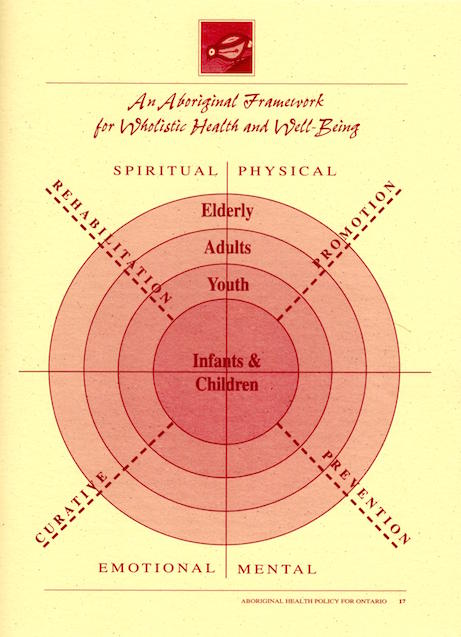
A version of the medicine wheel makes its appearance in government policy — 1994 in Ontario in the Aboriginal Health Policy.
1994 healing circle - An Aboriginal Framework for Wholistic Health and Well-Being

Here a concentric pattern maps onto the life cycle. The quadrant represents four dimensions: Mental, Emotional, Spiritual, Physical, and spokes radiate to represent four possible health interventions: Promotion, Prevention, Curative, Rehabilitation. Note that the circle of “adults” is not separated out into “women” and “men” (see below).

In 2011, the Ministry of Children and Youth Services releases Stepping Stones: A Resource on Youth Development. The model is influenced by Aboriginal research.

The interrelated and interdependent nature of human development can be considered as a circle (Figure 1), in which growth in one domain impacts and is connected to the others (Simard, 2011; Ontario Federation of Indian Friendship Centres, 2011). […] Healthy development of the mind, body and spirit is—as our Aboriginal partners have long affirmed—contingent on balance and interconnectedness.

Stepping Stones places Self/Spirit at the hub. On the perimeter is the Environment/ Context. Distributed in the four quadrants are Social, Physical, Emotional and Cognitive. The Stepping Stones model is also referenced in the Ontario education curriculum (See Grade 1 to 6 Social Studies Curriculum Guide and the Grade 7 to 8 History and Geography http://www.edu.gov.on.ca/eng/curriculum/elementary/sshg18curr2013.pdf).
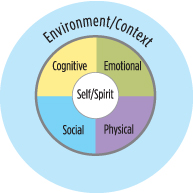
circles - self - Stepping Stones - ontario

A look at sources.

Simard’s diagram is almost identical (minus the presence of the “self” at the centre). “Developing a Culturally Restorative Approach to Aboriginal Child and Youth Development: Transitions to Adulthood” Estelle Simard, Shannon Blight in The First Peoples Child & Family Review Vol 6 No 1 (2011)

circle - Estelle Simard, Shannon Blight - 2011 - Aboriginal Worldview on Development

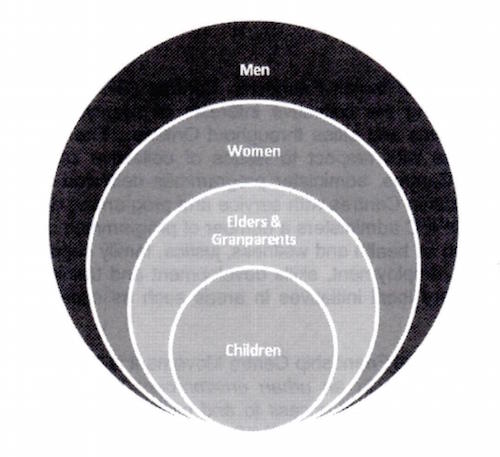
The OFIFC Position Paper “Our Sacred Responsibility – Protecting Aboriginal Children & Youth from Family Violence March 2011”. Its view of the social environment offers a gendered perspective.
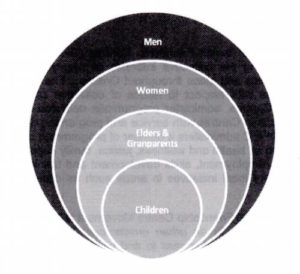
circles - OFIFC Position Paper - Our Sacred Responsibility - Protecting Aboriginal Children & Youth from Family Violence March 2011

In “Setting the Context for Our Sacred Responsibility” the OFIFC paper offers an historical perspective:

Children were at the core of our societies and learned to see all things as interconnected and were given the responsibility to connect themselves in a respectful and caring way to everything around them at every moment and in every interaction. They were surrounded by Elders and grandparents as teachers, women as nurturers, and men as protectors.

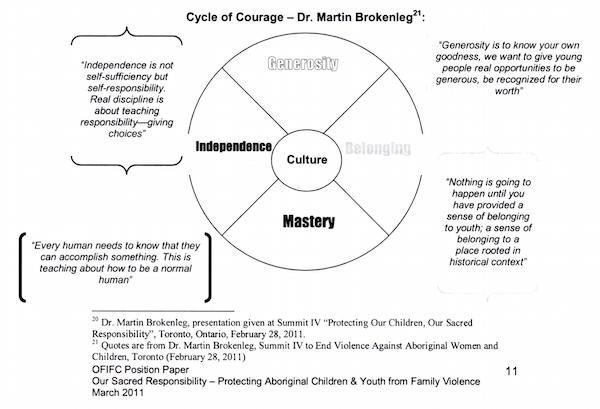
The OFIFC paper puts forward an Aboriginal Resiliency framework based on the Cycle of Courage (Belonging, Mastery, Independence, and Generosity) developed by Martin Brokenleg and which places Culture at the centre.
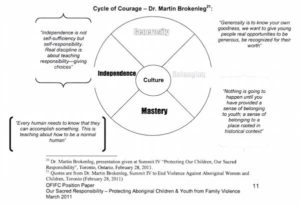
circle - Cycle of Courage (Belonging, Mastery, Independence, and Generosity) developed by Martin Brokenleg

Cross-cultural resonance from a variety of sources:

World Health Organization (WHO) 1947 Constitution defines health as “a state of complete physical, mental and social well being and not merely the absence of disease or infirmity”.

Earlier in the 20th century, post World War I, a holistic view is incorporated into the Waldorf schools:

The Steiner Waldorf early childhood approach takes as given the interdependence of physical, emotional, social, spiritual and cognitive development. It takes account of the whole child, including his/her soul qualities, and believes that children’s learning flourishes in a calm, peaceful, predictable, familiar and unhurried environment that recognises the child’s sensory sensitivities. Young children need to experience the relevance of their world before they separate themselves from it and begin to analyse it in a detached way.

http://www.foundationyears.org.uk/files/2011/10/Guide_to_the_EYFS_in_Steiner_Wardorf_settings1.pdf

Duane Elgin Voluntary Simplicity (1981; revised 1993)

Those choosing a simpler life: […] Tend to work on developing the full spectrum of their potentials: physical (running, biking, hiking, etc.), emotional (learning the skills of intimacy and sharing feelings in important relationships), mental (engaging in lifelong learning by reading, taking classes, etc.), and spiritual (learning to move through life with a quiet mind and compassionate heart).

As Aboriginal and non-Aboriginal sources inform each other, there are many mappings to explore and images to encounter and words and more words to explain the workings.

And so for day 1547
09.03.2011

Posted in Storytelling | Leave a comment

Thoroughly Rough

I first became alive to the potential of word splitting by reading Mary Daly’s Gyn/Ecology. This I came across years later and with no less thrill in the dis/covery.

indigenous culture was tho/roughly
                                                disrupted by

From Garry Thomas Morse in a poem about the painter Paul Kane collected in Prairie Harbour which has on its cover a reproduction of Wheat (1957 by Agnes Martin and I am reminded by the introductory remarks that Souvankham Thammavongsa gave to the podcast of her piece on on Agnes Martin’s Untitled #10 [Poets Spell Art, Recorded: Wednesday, April 21, 2010 at the Art Gallery of Ontario] where she comments about her attraction to the painting mirroring her own interest in what can be accomplished by minimal means: “what a mind can build with what other people would call “little””.

Power of a single slash. To roughly hew the thoroughfare.

And so for day 1546
08.03.2011

Posted in Poetry | Leave a comment

Typologies of Criticism

In an interview with Ekbert Faas, Robert Bly mentions a piece he wrote that appeared in The American Poetry Review that draws on Jung.

I wrote an article for The American Poetry Review recently giving examples in poetry of the “four intelligences” Jung talks about. They are thinking, feeling, grasp of the senses, and intuition.

Curious and not wanting to wade through the microtext searching for an issue from the 1970s, I picked up Bly’s collection American Poetry: Wildness and Domesticity where he revisits the material in a piece called “The Wheel of Intelligence” and stresses that a poet develops maturity by addressing their inferior (or weakest) function. Very little space is devoted to developing or applying the typology.

When I came across the description by David Tacey, “Introduction to Part IV” The Jung Reader p. 295

In addition to the attitude-types, Jung designated four functions of consciousness: thinking, feeling, intuition and sensation. Sensation tells us that a thing exists, thinking tells us what it is, feeling tells us its value, and intuition tells us its possibilities in time.

I thought that the typology has some applicability not so much to genres or poets but to approaches to literary criticism. A critic could be centred on one or more of these different ways of telling.

And so for day 1545
06.03.2011

Posted in Introductions | Leave a comment

Masala Chai & Coffee Cousin

Tasting notes:

Cardamom is to coffee as pepper to tea.

One I drink black and the other laced with milk.

And so for day 1544
06.03.2011

Posted in Food Writing | Leave a comment

Quatres Saisons – Kindness, unbribed.

A Little Chaos is about garden features (a dance space at Versailles). It is also a film about women. This is perhaps no where more evident than in the hinge scene that carries the heroine, Sabine de Barra, through to her presentation to King Louis XIV, the Sun King.

She is handed off by Lauzun to Mme de Montespan who conducts her to room apart where for the first time in the film the story explores an all-female space. The script explains the moment thus

A small room full to the brim of women. Music. They crowd round DE BARRA.

As they are being introduced, they look directly at her, they study her openly, touch her hand, turn it over, take off her rings, try them on themselves. Look at her shoes. One tugs her hair to find out if it is real. DE BARRA yells, they all laugh.

The atmosphere of frivolity turns in an instant to the intent listening of what amounts to a consciousness-raising group as the women enumerate their losses. Mme de Montespan explains why such moments are snatched from the time at court.

We are not allowed to speak of death at court. The King does not like it, so he has banned it. But we speak about it amongst ourselves. Nobody can ban a child from its mother’s heart. So.

Then we get the vital filler of back story about the Marquise de Maintenon who has usurped Mme de Montespan’s place in the King’s affection. In the next scene, Sabine is then presented to the King and its coded exchange about some roses having being “over-scented and overblown” — worth quoting in extenso.

DE BARRA

All roses are open to the elements your majesty. They bud, bloom and fade,

LOUIS

Continue, Madame.

DE BARRA

In the garden the rose grows entirely unaware, she follows a pattern of growth, changing naturally from one state to another, in order that future seasons may exist, and although the elements may treat her cruelly, she knows nothing of it, and continues to her end, without judgement on her beauty. Alas, it is not the same for us.

MONTESPAN listens intently.

LOUIS

If such a rose could speak, what would she say?

[…]

LOUIS (CONT’D)

And what protection can we afford this rose from these harsh elements of change?

DE BARRA

A little warmth, from the sun, can do wonders for the growth of a rose, your majesty.

LOUIS

We shall see, Madame de Barra. Now walk with us, and describe your progress in our garden.

The script’s “little warmth” turns in the movie (see trailer) into a speech that underscores the identificatory moment.

[overblown roses] That fate awaits all roses, sire. […] Under nature’s eye, all roses may bloom. Although the elements may treat us cruelly, patience, care, and a little warmth from the sun are our best hope.

Not a wonder that in both script and movie, Mme de Montespan’s words conclude with wonder “Kindness, unbribed.” Yes, kindness and gentleness born from handling thorns.

And so for day 1543
05.03.2011

Posted in Gardens | Leave a comment