Constant Constatation

I once commented on the structure of the grid in Garry Thomas Morse’s “Petroglyph” from Discovery Passages and so it is not perhaps surprising that my eye would be arrested by the mention of stones in an eddy off to the right margin in the expanse of the projective (à la Olson) verse in the 9th section of Prairie Harbour

 pebbles other
underfoot graves

The lines can of course be read from left to right and up and down and form a cairn.

A simple constatation which might not hearken more attention were it not for the sly allusion in the 20th section to the poetry of Roy Kiyooka. Morse gives

you know, for that sense of
community interactivity
in the online simulation
of that Fontaine Bleu
Dream Machine

Coach House Books published in 1977 Kiyooka’s The Fontainebleau Dream Machine. It gets interesting when you consider the opening of the 1st frame text in Kiyooka’s book ends with the following lines

these stones these stones embody a tongue
tied Speech

Pebbles in the mouth. Demosthenes. Spit out. Back underfoot. Gravel in the Voice.

And so for day 1542
04.03.2011

Posted in Poetry | Tagged , | Leave a comment

Boil!

Florence Fabricant on Craig Claiborne

He was also available for his readers. Once, in East Hampton, where he had a vacation house with a listed phone number, a desperate cook, attempting one of Claiborne’s recipes for his guests, called him because the sauce did not seem to be doing what it should. “What kind of heat do you have it on?” Claiborne asked. “Kind of a simmer,” replied the cook. “Well, boil the bejesus out of it!” came roaring through the phone. Claiborne did not mince words.

From 101 Classic Cookbooks – 501 Classic Recipes, Marvin J. Taylor and Clark Wolf, editors, drawing on the resources of the Fales Library, New York University.

And so for day 1541
03.03.2011

Posted in Food Writing | Leave a comment

Narrative Bent: Within Reach

Goran Simić’s poetry runs by narrative drive which is often pulled short by poem’s end to provoke the reader into reflection. Take “Airport” from Immigrant Blues translated by Amela Simić where the regular repetition “we are flying … we are flying” gets grounded in the last lines

We are flying, I tell you,
though it looks to me
we haven’t even left the runway.

Not unlike the ending to “When I Fall Asleep and When I Wake Up”

Then I think that there is no reason
to travel far and look for poetry
when there it is within reach.

And its reach can be brutal. “Bill’s Uniform” (originally written in English) ends with the eponymous character walking a prison corridor and one set of eyes reminds him of his mother.

The pair of eyes reminds him of
his mother’s sharp eyes,
when he was driven home by a police car
after he had beaten up a newcomer,
some ugly schoolmate
in a wheelchair.

Que dire?

And so for day 1540
02.03.2011

Posted in Poetry | Leave a comment

The Complicities of Genre and Greatness

1978. Ekbert Faas in Towards A New American Poetics on dramatic monologue via Robert Bly

To be sure, Bly’s criticism, if taken cum grano salis, is not entirely irrelevant. For a poet using personæ without the techniques of multiperspective fragmentation developed by Pound, Eliot, and Williams, or without the self-transcendence achieved by D. H. Lawrence, somehow remains caught within a closed ego system. In other words, it seems doubtful whether anybody writing in the second half of this century can adopt a genre as obsolete as the dramatic monologue without falling into patterns, clichés, and sentiments typical of a previous age and alien to our literary sensibility as well as to our understanding of man in our time. And indeed, if poems such as “Slave Quarters” [by James Dickey] avoid these pitfalls by the compelling urgency of their subject and sheer technical brilliance, there are other poems by Dickey which sound like unintentional parodies of Browning. Keats’ prophetic notion of the “chameleon poet” without a personality found an embodiment, appropriate for its time, in the Victorian poet and the proliferating multitude of “men and women” he projected in his dramatic lyrics. But modern man has learned to see his ego as immersed in Jung’s collective unconsciousness, as only another object or event in Whitehead’s open-ended universe of interrelated forces, or even as the final emptiness of Eastern philosophy. And it is possible that no great poetry can be written now which precludes an awareness of such insights.

2012. B.A. Nichols and H.F. Tucker in The Princeton Encyclopedia of Poetry and Poetics – 4th Edition

[I]n later generations Robert Lowell, Sylvia Plath, Elizabeth Bishop, and John Ashbery renewed the discrepancy between poet and speaker by spinning the psychological thread of monologue to a virtually clinical fineness. To rehistoricize this tradition and highlight its political subtexts has been the achievement of such contemporary poets as Richard Howard, Frank Bidart, Ai, and Carol Ann Duffy.

So we are sent back to Keats [Letter to Richard Woodhouse, October 27th, 1818]

What shocks the virtuous philosopher, delights the camelion Poet. It does no harm from its relish of the dark side of things any more than from its taste for the bright one; because they both end in speculation. A Poet is the most unpoetical of any thing in existence; because he has no Identity—he is continually in for—and filling some other Body—The Sun, the Moon, the Sea and Men and Women who are creatures of impulse are poetical and have about them an unchangeable attribute—the poet has none; no identity—he is certainly the most unpoetical of all God’s Creatures […] When I am in a room with People if I ever am free from speculating on creations of my own brain, then not myself goes home to myself: but the identity of every one in the room begins so to press upon me that I am in a very little time annihilated – not only among Men; it would be the same in a Nursery of children

Camel. Lion. Camelion.

And so for day 1539
01.03.2011

Posted in Poetry | Leave a comment

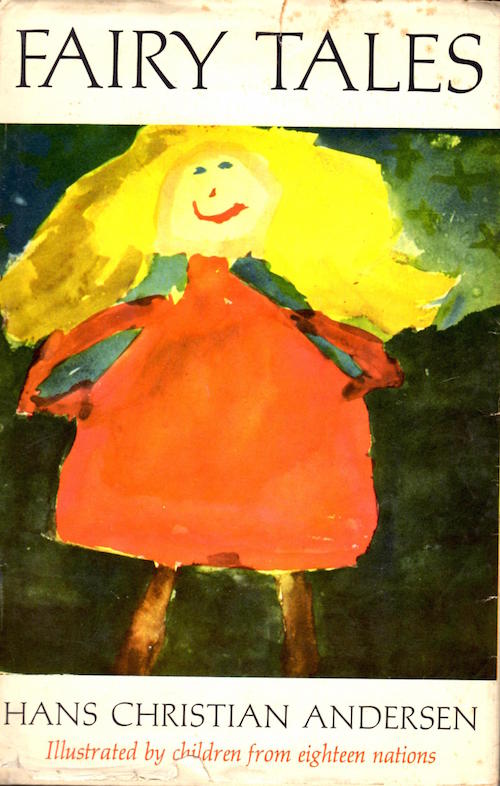
Here’s the image: where’s the tale?

“The Little Mermaid”

She appears on the cover of Hans Christian Andersen Fairy Tales. She is the product of the imagination of a 6 year old in Sweden.

children's art - cover to Hans Christian Andersen - Fairy Tales illustrated by children from eighteen nations

She appears to be missing the ubiquitous tail. But don’t forget that this is a story of transformation. And the hair is perfect!

Fairy Tales of Hans Christian Andersen With 25 Illustrations in Full Color by Children of Eighteen Nations (Orion Press, [1958])

And so for day 1538
28.02.2011

Posted in Uncategorized | Leave a comment

Audio Accompaniment

What is the best music to have in the background while reading Virginia Woolf’s The Waves?

Thursday Afternoon by Brian Eno — at 61 minutes it’s suitable for the long duration of an immersion into the novel.

“We make music in new ways, and we hear music in new places.” notes by C.S.J. BOFOP [Brian Eno], August 1985.

And so for day 1537
27.02.2011

Posted in Uncategorized | Leave a comment

Three Temporalities of Agony

Janine Beichman. Masaoka Shiki (Boston: Twayne Publications, 1982).

From 1895 on, though he was uncertain when death would come, Shiki lived each day with its presence unbearably close. Time as he experienced it had qualities it does not have for most healthy people. First, it moved unbearably slowly and seemed extremely long, so that boredom was one of his chief torments. Second, and paradoxically, it seemed very short, moving swiftly and inexorably toward his own death. A sense of urgency, as expressed in the letter of 1895 about Kyoshi, coexisted with a sense of enormous tedium. Thirdly, time had no firmly imaginable future, for he felt he could not plan for more than a few hours ahead. There was only a past and a present. Death, though he knew it would come, was a darkness, unimaginable; he did not believe in an afterlife. These are the qualities time has when experienced in the midst of great anxiety over a portending and dreaded, but in some ways desired, event.

Ueno yama
yū koekureba
mori kurami
kedamono hoyuru
kedamono no sono

itatsuki no
iyuru hi shirani
saniwabe ni
akikusabana no
tane o makashimu

as evening comes across
Ueno Hill
the woods grow dark and
wild beasts howl in
the wild beast garden

I do not know the day
my pain will end yet
in the little garden
I had them plant
seeds of autumn flowers

Translation and romanization by Janine Beichman accessed at the Japanese Text Initiative at the University of Virginia Library.

And so for day 1536
26.02.2011

Posted in Poetry, Translations | Leave a comment

Galloping Lope

Slide into image and mind-set.

GENTLE SLOPE INTO BOOK

You be the person who sweeps
and I’ll be the one who turns off
the lights at the end of the poem.

Sweepings.

Nations used to center on individuals, then on collectives, and now nations organize around points in a power grid, centers on transaction. Of flux: nodes in a matrix, they follow pulses and search for energetic aggregates; my body nomads through cities, my body acts as a house for a worker; poems or nations startle, shift and settle.

from “Canada Post”

This is a sharp example of how one word leads to another by phonological lines of attraction. Here is one that leads to semantic explosion.

Don’t scarf down your blueberry pancakes before tennis lessons or you’ll get indigestion and make a horrible racket.

from “Skyscraperscrapers”

Brought to you by Jason Christie in his collection Canada Post

And so for day 1535
25.02.2011

Posted in Poetry | Leave a comment

Broccoli Ancestry

Visual intertextuality.

The cover of Tyler Kord’s Broccoli (Short Stack Vol. 7) appears to be a tribute to Mollie Katzen’s The Enchanted Broccoli Forest.

Cover - short stack edition - Broccoli by Tyler Kord cover Enchanted Broccoli Forest by Mollie Katzen

Branches. Upright & Bold.

And so for day 1534
24.02.2011

Posted in Booklore | Tagged | Leave a comment

Out of Storage

Notes to Laurie Anderson Homeland

MEETING THE TUVANS.
After the show the Tuvans were packing their instruments and then they started to walk off into the night. “Hey! Where are you going?” I shouted out into the darkness. As it turned out their Russian manager had forgotten to provide transportation for them back to Lisbon, a two-hour car drive. So they just started to walk, a trip that would have taken until well into the next day. Why? Because they’re nomads, the polar opposite of exasperated Americans who would just stand there saying, “Where’s the van?”

Fun to juxtapose against the later remarks about storytelling.

POLITCS AND STORIES.
Many of the big American stories now, the most-told stories, are apocalyptic. They’re stories about how the world is getting hotter, more crowded, and dangerous. They’re about arctic floods and disappearing resources and entropy and the world winding down. And nobody knows whether all this is fiction or not. But like many complicated stories about the future, there’s no way to predict which version is more likely. It’s just sort of a matter of preference. It comes down to which story do you like better? This is another thing I love about stories — they are wild and alive and always changing.

What are days for?
To wake us up.
To put between endless nights.

Whether we are waiting for the van or walking.

And so for day 1533
23.02.2011

Posted in Storytelling | Leave a comment