French Taste in Etymologies

Po’Boy and Fool

Bee Wilson from the “Appendix: Fifty Notable Sandwiches” in Sandwich: A Global History

There is disagreement about the etymology of po’boy: Becky Mercuri suggests it may come from ‘hungry young black boys requesting a sandwich “for a po’boy”‘ while [John F.] Mariani notes that the term could drive from the French pourboire, meaning a tip.

Elizabeth David A Taste of the Sun [a collection of excerpts from her food writing]

The seventeenth- and eighteenth-century writers do describe a number of fruit fools, fools made from gooseberries, raspberries, strawberries, redcurrants, apples, mulberries, apricots, even from fresh figs; but few of these dishes turn out to be the simple cream-enriched purées we know today. Some were made from rather roughly crushed fruit (the French word foulé, meaning crushed or pressed must surely have some bearing on the English name), often they were thickened with eggs as well as cream, sometimes they were flavoured with wine and spices, perfumed sugar and lemon peel.

The Oxford English Dictionary (OED) follows Skeat

Fool, in the phr. gooseberry fool. Mahn tells us that this is derived from the F. fouler, to trample on hence, to crush. I believe that this is a mere guess, and that there is no evidence for it. It is quite as likely that it was a sort of slang name made in imitation of trifle. Ben Jonson mentions it; we find “your fools, your flawns;” Sad Shepherd, Act i. sc. 2 (not sc. 7 as in Richardson). But Florio in 1598, explains the Ital. Mantiglia by ‘a kind of clouted creame, called a foole or a trifle in English.’

Transactions of the Philological Society, Volume 27 (1885-87) pp. 699-700.

The “Mahn” is in question is C.A.F. Mahn who for the 1864 edition of Webster’s dictionary redid the etymologies.

There may be an example predating Mahn, A Dictionary of the English Language: In which the Words are Deduced from Their Originals; and Illustrated in Their Different Significations, by Examples from the Best Writers: Together with a History of the Language, and an English Grammar, Volume 2 edited by Henry John Todd and published by Longman, Hurst, Rees, Orme and Brown in 1818 gives the French-derived etymology: FOOL [ probably from fouler Fr.] A liquid made of gooseberries scalded and pounded, and of cream.

In these researches I discovered the lexicographer Florio remade as a poet.

Poets have immortalized it in verse and the first-known published reference in England was in 1598, in a poem by Florio called Mantiglia.

What matters is that trifles are delicious and easy to prepare — making it a favorite of English ladies at teatime.

“English “Trifles” take new twist” Lawrence Journal-World Sunday, July 24, 1983 Page 88 [Picked up without attribution by the Observer-Reporter of Washington, Pennsylvania, July 16, 1984 Page C-1 under a different title “It’s The Berries: A Trifle Dessert”].

Some enterprising wit with a flair for bagatelles just might produce a bit of Florio verse on the joys of fool and do so as a po’boy poet.

And so for day 1512
02.02.2011
Posted in Food Writing | Leave a comment

Scrumptious Bottoms

In constructing a marrow bone pie, one of the layers is “souls of artichokes”. I find the expression very evocative. But I find the expression nowhere else at present. It may yet catch on in some fancy circles.

[…] marrow of beef mixed with currants; then upon it a layer of the souls of artichokes, after they have been boiled, and are divided from the thistle […]

The Well-Kept Kitchen Gervase Markham [excerpts from The English Housewife (1615)]

And so for day 1511
01.02.2011

Posted in Food Writing | Leave a comment

Unclipping Oliver

It’s on the jacket as a blurb. It appears in callouts.

My predominant feeling is one of gratitude. I have loved and been loved. I have been given much and I have given something in return. Above all, I have been a sentient being, a thinking animal, on this beautiful planet, and that in itself has been an enormous privilege and adventure.

Fair enough. But the celebration of literacy is missing.

I cannot pretend I am without fear. […] I have read and traveled and thought and written. I have had an intercourse with the world, the special intercourse of writers and readers.

Reassembling the pieces to the two-paragraph status…

I cannot pretend I am without fear. My predominant feeling is one of gratitude.I have loved and been loved. I have been given much and I have given something in return; I have read and traveled and thought and written. I have had an intercourse with the world, the special intercourse of writers and readers.

Above all, I have been a sentient being, a thinking animal, on this beautiful planet, and that in itself has been an enormous privilege and adventure.

“My Own Life” in Gratitude by Oliver Sacks

And so for day 1510
31.01.2011

Posted in Uncategorized | Tagged | Leave a comment

Ancestor Tales

Ferenc Juhász
The Boy Changed into a Stag: Selected Poems 1949-1967
“Brief confessions about myself”

Descendent of men after a different kind of richness…

It’s my belief that even the great-grandparents had slithered into poverty, moulted their fine feathers, in the last years of their lives, and I am increasingly certain that it was not in actual fact economic conditions that made them poor; I believe it was often laziness or daydreaming that wrenched off here and there a piece of their land, crumbling it to smoke-dust. At least that seems to have been the case with grandfather Andresz’s father, who sold off quite a few acres of land on the quiet without his wife’s knowledge and then spent the money on books, stowing away half of them in the attic and the rest near their maize field under a bridge, in a cavity made by removing a stone in one of its arches. From then on he spent his time reading, mostly in the attic or in the maize field. It was during the course of improving his mind thus that the ruse came to light. His wife, wondering why it was taking him almost three weeks to finish hoeing that half-acre of maize, stole after him and surprised the old fellow stretched out on his stomach under the flowering cherry-tree, greasy hat pulled down over his forehead, smoking his pipe, totally absorbed in the pleasures afforded the mind by an encyclopaedia.

Women continue to play the role of anchor in another tale of male adventure seeking.

Grandfather Andresz […] In fact it was from the grocery store that he left for America, flew away from the counter-top (they were sitting there drinking brandy on credit) without his wife knowing about it until the letter came from New York asking her to come and join him there with the children. But his wife refused to risk it, and he, having failed to set himself up with a factory out of what he made by washing dishes, came back after a year or two, as poor as when he had gone, painting the boat for his fare across the ocean back to Europe.

Allure: half-understood and totally risked. Vicarious: secondhand stories that compel admiration.

And so for day 1509
30.01.2011

Posted in Reading | Leave a comment

Pullulating Praxes

Hito Steyerl “In Defense of the Poor Image” collected in The Wretched of the Screen from e-flux journal #10 11/2009. She leads us to recognize a tension in the distribution systems at play.

The circulation of poor images feeds into both capitalist media assembly lines and alternative audiovisual economies.

She earlier in the piece distinguishes between screenings and previews and in doing so contrasts intensity with contemplation. One is almost captured by the enumeration but something sticks if you slow down the reading.

On the one hand, it [the poor image] operates against the fetish value of high resolution. On the other hand, this is precisely why it also ends up being perfectly integrated into an information capitalism thriving on compressed attention spans, on impression rather than immersion, on intensity rather than contemplation, on previews rather than screenings.

Circulations to and by the many. Consumption by crowds. Although operating under the label “poor” we are far away from the notion of “encounter” found in Grotowski Towards a Poor Theatre.

Poor images are thus popular images—images that can be made and seen by the many. They express all the contradictions of the contemporary crowd: its opportunism, narcissism, desire for autonomy and creation, its inability to focus or make up its mind, its constant readiness for transgression and simultaneous submission.* Altogether, poor images present a snapshot of the affective condition of the crowd, its neurosis, paranoia, and fear, as well as its craving for intensity, fun, and distraction. The condition of the images speaks not only of countless transfers and reformattings, but also of the countless people who cared enough about them to convert them over and over again, to add subtitles, reedit, or upload them.

*See Paolo Virno, A Grammar of the Multitude: For an Analysis of Contemporary Forms of Life, trans. Isabella Bertoletti, James Cascaito, and Andrea Casson (Los Angeles: Semiotext(e), 2004).

It’s the footnote on “multitude” that sends me off to read more and think more about le travail de l’image.

And so for day 1508
29.01.2011

Posted in Uncategorized | Leave a comment

After Forethought

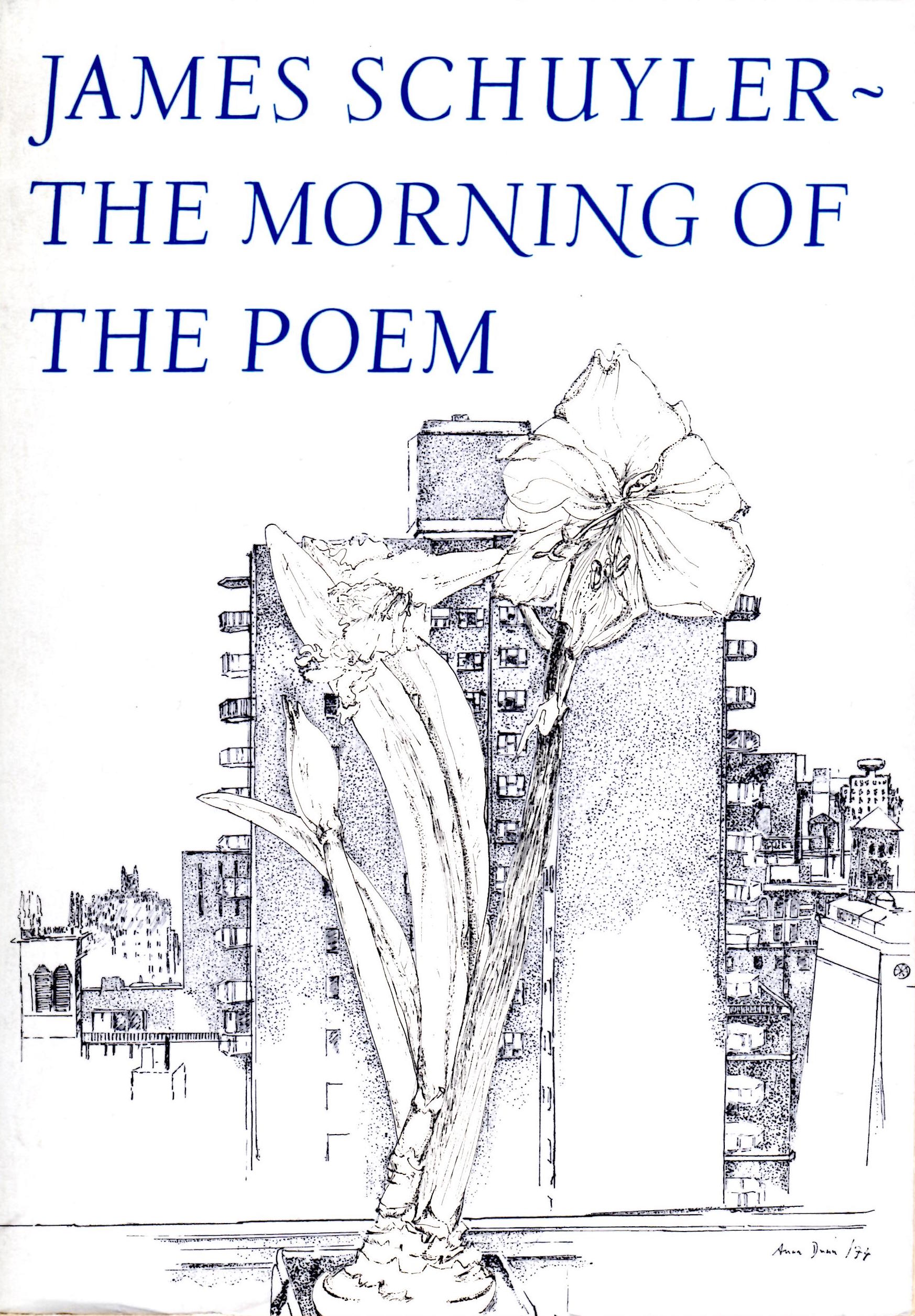
I have characterized the poetry of James Schuyler as being in tune with the moment that comes almost like an afterthought but on retrospect appears as premeditated. Consider the end of a poem to artist Anne Dunn on her name day. The speaker debates the composition of floral tribute with botanical finesse but ends the poem with the following

Gathered with friends
And family to celebrate
Your name day, Anne. (Along
With the flowers, I send
You a New Brunswick lobster.)

Cooked we hope to a beautiful pink.

And there would be in the corpus a poem called “Afterward” which ends with “This room needs flowers.”

The cover illustration to the 1980 The Morning of the Poem is by Anne Dunn.

Cover - The Morning of the Poem - James Schuyler

At first glance it looks like the plant is growing out of the pavement. Upon further observation it is evident that what is on display is an amaryllis growing out of a square pot in front of a window in some cityscape. Double take.

And so for day 1507
28.01.2011

Posted in Poetry | Leave a comment

From Inside the Asylum

From the Payne Whitney poems, the ending to “February 13, 1975”. A sort of weather report.

yet. I wish one could press
snowflakes in a book like flowers.

James Schuyler
New York Review of Books, August 17, 1978

And so for day 1506
27.01.2011

Posted in Poetry | Leave a comment

Canta Contro

Domenico Capilongo
I thought elvis was italian
solo in giappone / alone in japan

You come across a poem completely in Italian. You turn the page, like a twirl of the fork. There awaits for you the English version.

si sente l’odore della pasta
e la musica della forchetta
che canta contro il piatto

I can smell the pasta
the music of the fork
that sings against the plate

I take it that these are not soba noodles. But equally delicious.

Capilongo also has a wonderful take on a bricklayer after Ondaatje’s cinnamon peeler. Some day there maybe somewhere someone to take after alone in japan in some bilingual mode.

And so for day 1505
26.01.2011

Posted in Poetry | Leave a comment

Winter Exhalations

Existential blocks carved out of three different poems in The Latest Winter by Maggie Nelson.

Yes the dissonance is truth,
whether it is killing me or not
is not relevant, as I am trying
to write without knowing
who I am.

Once I thought
I might be lonely, then I knew
my mind would always talk
to me.

A child straps on
her backpack, gets ready
to know.

Without talking, without knowing, a way of writing. Always placing the comma where it counts, where it can be savoured,

All I want to say is
I breathed you, we all breathed you
We breathed the souls of people
I think it was the souls of people

So ends a poem “Report from the Field” which expands beyond its occasion rooted in a New York of 2001 into a generalized take on breathing and the hesitations of the thinking mind.

And so for day 1504
25.01.2011

Posted in Poetry | Leave a comment

Charting Cartographies, Tracking Sounds

Dionne Brand
In Another Place, Not Here
Knopf, 1996, page 117

I first noted this passage for my friend Marlene Goldman who was exploring women and mapping and working on what became Paths of desire: Images of exploration and mapping in Canadian women’s writing.

Today the sound of bees and cicadas singing tautly tightened the air, as if they were drawing a map of the place, as if they were the only ones left to do it. Their singing thick as electric wires, cicadas, bees singing thick, suspended the island, mapping the few hills, the dried rivers of the dry season, the white river stones, the soft memory of the people who lived here, the desire of rain when it came to wash rickety houses away, or the desire of sun to parch old people’s lips, children’s throats, the hot need of hillsides to incline so desperately, to inspire weakness in the knees, the cold-blooded heat of noons melting people into houses and under beds. Cicadas, bees, busy with their cartography, their sound like tender glass above, holding these few things, waiting to set them down again, the simple geography of dirt and water, intact, the way only they knew it, holding the name of the place in their voices, screaming so that the war would pass, interminably pass.

Reading it years later, I am intrigued about the combination: I have never heard bees and cicadas together. My map is limited but in my imagination thanks to Brand’s prose I can go where are the cicadas and the bees. Did find audio files for sale (at Audio Jungle) of stereo recording of bees buzzing and cicadas chirping recorded by tommiwilson — sounds I would never have thought to seek out before now live in my mind side by side or rather in a layered symphony.

And so for day 1503
24.01.2011

Posted in Uncategorized | Leave a comment