Mordant Wit and Medicine

Agatha Christie
The Mirror Crack’d From Side to Side (1962)

A comment on clinical practice …

“The young doctors are all the same,” said Miss Marple. “They take your blood pressure, and whatever’s the matter with you, you get some kind of mass produced variety of new pills. Pink ones, yellow ones, brown ones. Medicine nowadays is just like a supermarket — all packaged up.”

[Her old friend and old-style physician, Dr. Haydock replies]

“Serve you right if I prescribed leeches […]”

Supermarkets (“anathema to the elderly ladies of St. Mary Mead) rate a poor opinion earlier in the novel (“takes a quarter of an hour sometimes to find all one wants –and usually made up in inconvenient sizes, too much or too little. And then a long queue waiting to pay as you go out.” And this earlier passage is recalled by the reader and gives considerable bite to the comment about young doctors and supermarkets.

I have yet to find a doctor prescribing an Agatha Christie novel but Dr. Haydock comes closest in suggesting that Miss Marple needs a mystery to unravel…

And so for day 3012
11.03.2015
Posted in Uncategorized | Leave a comment

Fun Fact

Shari Kasman
Rocks Don’t Move and Other Questionable Facts

In a box outside her home, Shari Kasman collected facts in exchange for books, with the hope of learning something new.

What showed up in the box was a mix of advice, opinions, suggestions, feelings, wishes, hopes, myths, speculations, conjectures, personal information, subjective statements, incorrect statements, partially correct statements, nearly correct statements, and actual true things.

The book sifts, comments and responds with research. <– fact
A trouvaille! <– opinion <– fact.

And so for day 3011
10.03.2015

Posted in Uncategorized | Tagged , | Leave a comment

Tables, Tools, Tasks

Donald Knuth’s Turing Award lecture, “Computer Programming as an Art” (1974)

Well, it’s true, not all programming tasks are going to be fun. Consider the “trapped housewife,,” who has to clean off the same table every day: there’s not room for creativity or artistry in every situation. But even in such cases, there is a way to make a big improvement: it is still a pleasure to do routine jobs if we have beautiful things to work with. For example, a person will really enjoy wiping off the dining room table, day after day, if it is a beautifully designed table made from some fine quality hardwood.

This is a loop. The routine can be beautiful; the beautiful, routine. Well there is the simple but complex category of pleasure to contend with. At some other point in the lecture, Knuth observes about pleasure: “One rather, curious thing I’ve noticed about aesthetic satisfaction is that our pleasure is significantly enhanced when we, accomplish something with limited tools.” The connoisseur as maker via the routine shaper.

And so for day 3010
09.03.2015

Posted in Uncategorized | Tagged | Leave a comment

Performance, on Show

Monty Don
Japanese Gardens: A Journey

Ikebana, like so much of Japanese life and everything in their gardens, is a performance, and the more that the skills needed to create that performance are on show, the more they are appreciated.

Like the commas in this sentence, the negative space in ikebana performs an appreciated skill.

And so for day 3009
08.03.2015

Posted in Gardens | Leave a comment

Querying and Queering Digital Humanities

A seriously engaging tour de force.

“Why Are the Digital Humanities So Straight?” by Edmond Y. Chang in Alternative Historiographies of the Digital Humanities edited by Dorothy Kim, Adeline Koh

It is described as “An essay in the form of a program, a program in the form of an essay. Written in PC BASIC.”

My favourite line in the code/essay:

5000 REM Play, Don’t Play, or Just Read

One way to read this: reading is neither play nor not playing. It is sui generis. Or it is otherwise. Either/Or or And/Or

There was a delightful discussion hosted by Digital Humanities at X University where considerations of noise to signal ratio morphed into collective annotation and interpretation of ascii art. The participants also enjoyed the “decoding” of code switching esp. irony in REM notes. And pondering just what it is one is reading and what it references: is the remark referencing the artefact before one or the social context in which artefacts circulate and are produced?

Well worth reading for the playful fashion in which ontological implications — the what of digital humanities — is laid out. A fine mind game for testing assumptions. One last little bit of quotation:

[…]
10 GOSUB 4000
[…]
4000 REM Set Starting Variables
4002 REM The player must assume the computer and the playing field are leveled.
4004 RANDOMIZE(999)

This to me is a clever way of inviting reader-players to envisage text and context as equivalent levels. Or I may be skewing the passage to a metaleptic encounter…

And so for day 3008
07.03.2015

Posted in Uncategorized | Tagged , | Leave a comment

Seaton and Syntax

He invites us to play.

J.P Seaton
Bright Moon, White Clouds: Selected Poems of Li Po

I’ve started with a word-for-word, and worked my way toward something that might even enable you to have a go at making your own translation.

I find myself dwelling on “Quiet Night Thoughts”. There is an earlier version in Seaton’s The Shambhala Anthology of Chinese Poetry

Before the bed, bright moonlight.
I took it for frost on the ground.
I raised my head to dream upon that moon,
then bowed my head, lost, in thoughts of home.

There are two later versions in Bright Moon, White Clouds (He has a thoughtful appendix leading to a freer version). I like this one which cleaves closely to the word-for-word.

Before the bed, bright moon light.
I took it for frost on the ground,
I raised my head to think of the moon,
then bowed my head to dream of home.

Taking my cue from him, I proffer Seaton’s version with a slight adjustment to syntax:

Before the bed, bright moon light.
I took it for frost on the ground,
I raised my head to think of the moon,
then, to dream of home, bowed my head.

And so for day 3007
06.03.2015

Posted in Poetry, Translations | Leave a comment

Grind: The Mechanical and the Memorable

Anissa Helou
Levant: Recipes and Memories from the Middle East

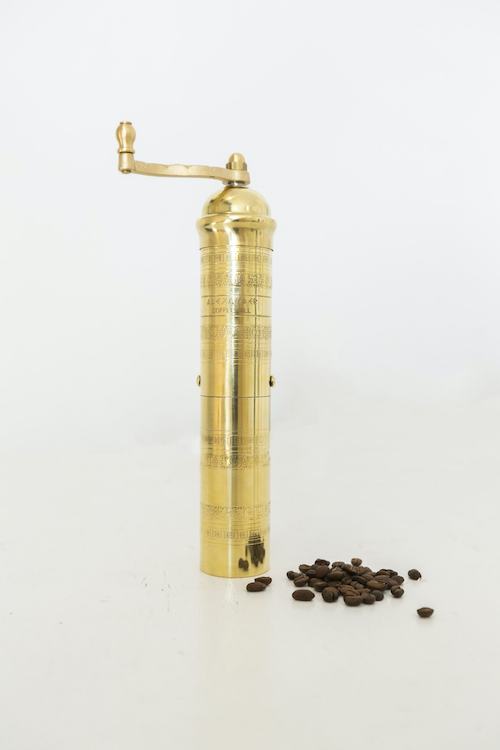
In those days we ground the beans for every brew and we did it in a beautiful narrow cylindrical brass grinder that had geometric patterns etched all over. I carefully poured the roasted beans into the top part of the grinder, then fitted the domed lid on top and slotted the articulated handle (which folded to fit inside the grinder when it was not in use) onto the grinding pole. I then slipped the bottom part, into which the ground coffee would fall, beneath the top one and started turning the handle to grind the coffee beans.

Brass hand-cranked coffee mill

And so for day 3006
05.03.2015

Posted in Food Writing | Leave a comment

Three Assumptions

little lessons …

These days, those phones in our pockets are changing our minds and hearts because they offer us three gratifying fantasies. One, that we can put our attention wherever we want it to be; two, that we will always be heard; and three, that we will never have to be alone.

Sherry Turkle
TED Talk
2012

My 2 cents:

Attention wanders and there is joy in distraction.
Not being heard can make us strive to be more eloquent.
We are alone sometimes and that feeds the other times.

And so for day 3005
04.03.2015

Posted in Uncategorized | Tagged | Leave a comment

A Book Speaks

It begins:

In silence between writer and reader
A memory of words and hands takes form.

The Booksellers, directed by D.W. Young, is a documentary about a group of established antiquarian book dealers in New York City. The documentary ends with a beautiful, eloquent ode to the book, a poem written and spoken by Henry Wessells, from his short book of poems titled The Private Life of Books. The voice of the titular poem is that of a book reflecting on the history of books and their relations with readers. It works through the figure of handling. It ends:

Lost, forgotten, thumbed, split : we bear the scars
Of patient decades and centuries’ dreams.

Whose hands will next hold me I do not know —
The book, too, reads its readers in real time.

Reading as a form of touching and being touched and activated and activating.

And so for day 3004
03.03.2015

Posted in Booklore | Leave a comment

Time and Gardens

Marjorie Harris
In the Garden: Thoughts on Changing Seasons

She begins her book with autumn.

I want this to be the richest, most satisfying time for the garden. If I draw enough sensual satisfaction from the autumn months, it will somehow help transport me over the long distances of winter and right into spring. So I cram myself with sensation and color and most years I do pretty well at convincing myself this is a beginning not an ending of the year.

I would claim that a true gardener is mindful of all seasons no matter what the calendar says. The imagination carries the gardener through the changes wrought by weather and time. Gardening is not only an art of place, it is also a time-based practice.

And so for day 3003
02.03.2015

Posted in Gardens | Leave a comment