Nostalgic Risks

Having been taught long ago to live in the present, I find fondness for nostalgia puzzling. It has always been seen by me as a benign appreciation of the past. Or so it was until I read a story by Kim Stanley Robinson “The Lucky Strike” in The Best Alternate History Stories of the 20th Century edited by Harry Turtledove. The protagonist, a reluctant soldier, looks upon the future of men whose most vital experiences were honed by war.

His mind spun forward and he saw what these young men would grow up to be like as clearly as if they stood before him in businessmen’s suits, prosperous and balding. They would be tough and capable and thoughtless, and as the years passed and the great war receded in time they would look back on it with ever-increasing nostalgia, for they would be the survivors and not the dead. Every year of this war would feel like ten in their memories, so that the war would always remain the central experience of their lives — a time when history lay palpable in their hands, when each of their daily acts affected it, when moral issues were simple, and others told them what to do — so that as more years passed and the survivors aged, bodies falling apart, lives in one rut or another, they would unconsciously push harder and harder to thrust the world into war again, thinking somewhere inside themselves that if they could only return to world war then they would magically be again as they were in the last one — young, and free, and happy. And by that time they would hold the positions of power, they would be capable of doing it. […] And to what end? To what end? So that the old men could hope to become magically young again. Nothing more sane than that.

Ah, sanity. I think I will stick with my present madness for the present.

And so for day 1472
24.12.2010

Posted in Uncategorized | Leave a comment

To Keep a Diary

Thomas Meyer. “Isis’ Memory” in The Umbrella of Aesculapius

Practice attunes one.

At first the diary of day &/or dream does no more than record, but in its persistence & dullness it instills the keeper with a certain & previously unknown link to matter or hyle. These elements, fundamental matters, are oddly enough not par of personal perception; they come upon us unawares. They are sought indirectly by the heart.

*
Ears, thoughts, words & the day echoes


Shakespeare by way of T.S. Eliot “This music crept by me upon the waters”

Why now? Why here? A fil conducteur … the bare thread of a connection in the simple preposition “upon” and the souffle of a constant “w”.

always upon us unawares

And so for day 1471
23.12.2010

Posted in Poetry | Leave a comment

Who?

Thomas Meyer is a master of the epigrammatic form. His condensations open up and waft like honeysuckle.

Ghost stories have all the facts
& none of the
                       answers.

from The Bang Book

And so for day 1470
22.12.2010

Posted in Poetry | Leave a comment

Con Stellations

Souvankham Thammavongsa in Small Arguments has a number of portraits of fruit. This one is not there. It shines in another galaxy. It comes from an earlier chapbook Still Life and provides a lovely coda to the suite of poems gathered therein.

“A Starfruit” has an epigraph from Nietzsche: “One must still have chaos within oneself to be able to give birth to a dancing star.”

Its constellation is bounded / to ground / where you can reach / without the earn of sky // When you do this / time will be no birds / who will lose their navigation, / no boat will run off course, / no light lost to some farmer // There is no consequence / when you offer to plate / the stars / that do not come / from sky, from a chaos within

The “earn of sky” — one yearns for it. Like a debt balanced out.

And so for day 1469
21.12.2010

Posted in Poetry | Leave a comment

Pet Metaphors

Robert Kelly introduction to Thomas Meyer The Umbrella of Aesculapius.

Each age of poetry seems to have a pet metaphor drawn from other arts for an inward vision of its own nature; so in the sixteenth the stage, seventeenth the choir, eighteenth the senate or the coffee-house, so in our century [20th] we seem to have toyed with the image of ourselves as dancers and our shared work as a most complex dance. […] Writing the poem, then, is discovery, trobar, finding the music and cooperating with the linguistic event — a dance sometimes of standing aside. [dated Feb. 1974]

And would the informing metaphor for this our 21st century be the network? Link to link, node to node.

To borrow and extrapolate Jane Gregory’s blurb to Julie Joosten’s Light Light, poetic practice involves putting

the hive back in archive, the source in the resource

Net Work – the great task of knitting the knots. That is poetry for our time.

And so for day 1468
20.12.2010

Posted in Introductions, Metaphor, Poetry | Leave a comment

Matériel

Monique Wittig on the challenge from “One is not born a woman” (1981) in The Straight Mind and Other Essays

This operation of understanding reality has to be undertaken by every one of us: call it a subjective, cognitive practice. The movement back and forth between the levels of reality (the conceptual reality and the material reality of oppression, which are both social realities) is accomplished through language.

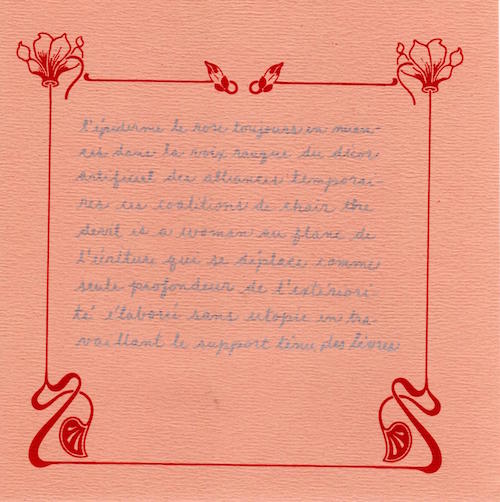
Which va-et-vient leads me to Claude Beausoleil Promenade Modern Style (Montréal: Éditions Cul-Q, 1975) — the text is gathered on cards in a small portfolio, each card carrying handwriting and on the verso a different picture of Marlene Dietrich. The elements of course in good modernist style can be shuffled and read in any order.

Claude Beausoleil - card from Promenade Modern Style 1975

l’épiderme le rose toujours en murmures dans la voix rauque du décor artificiel des alliances temporaires ces coalitions de chair the devil is a woman au flanc de l’écriture qui se déplace comme seule profondeur de l’extériorité élaborée sans utopie en travaillant le support ténu des lèvres

an attempt to transfer the works

epidermal pink always murmuring in the husky voice set in an artificial decor of temporary alliances and carnal coalitions – the devil is a woman – flanked by writing displacing itself as the only depth (response) to the elaborated exteriority without utopiques while working the thin frame of the lips

it deserves another reworking, perhaps softer lighting

And in case you are wondering about the pairing of Beausoleil and Witting, Promenade Modern Style has an epigraph from Rose poussière by Jean Jacques Schuhl which reads “Marlène Dietrich notre seule déesse avec Karl Marx”. Simply nowhere but in the coming and going of language.

And so for day 1467
19.12.2010

Posted in Translations | Leave a comment

In the Mode of Overheard

John Adams on the meaning of transmigration [from an interview was originally posted on the New York Philharmonic web site in September of 2002], a meaning the matches well with his intent to create a “mind space” for meditation.

And I don’t just mean the transition from living to dead, but also the change that takes place within the souls of those that stay behind, of those who suffer pain and loss and then themselves come away from that experience transformed.

http://www.earbox.com/on-the-transmigration-of-souls/

His goes on to caution against a simple reception.

I am always nervous with the term “healing” as it applies to a work of art. I am reminded that we Americans can find a lot of things “healing”. These days a criminal sentenced to death is executed and then we speak of “healing”. It’s perplexing. So it’s not my intention to attempt “healing” in this piece. The event will always be there in memory, and the lives of those who suffered will forever remain burdened by the violence and the pain. Time might make the emotions and the grief gradually less acute, but nothing, least of all a work of art, is going to heal a wound of this sort. Instead, the best I can hope for is to create something that has both serenity and the kind of “gravitas” that those old cathedrals possess.

Perhaps the gravitas is also related to scale. As David Schiff writes in the liner notes to the CD [On the Transmigration of Souls] reprinted from an essay that appeared in the April 2003 issue of The Atlantic Monthly

In the months that followed the catastrophe, 9/11 became a source more of civic pride than of nationalism. The heroes were policemen and firemen, not soldiers; a mayor, not a president. The names read on television and the short biographies in the Times reminded New Yorkers of their diversity and their commonality. […] He has created a music the mirrors and exalts the public wisdom.

In an NPR interview Adams likens the naming of names in his piece to the AIDS quilt (The Names Project). This lead be back to a “mind space” of my own and finding the Canadian quilt online and remembering Chris Ingold “chemist, leatherman, dead by his own hand, fighting” and I now learn that there is a bursary in his honour at Queen’s. And Tubular Bells just came into my sound stream – Chris would have loved that.

And the recitation of names as a form dates back to long ago…

A calendar, or obituary register, was maintained, in which the names of all those entitled to commemoration were entered on the appropriate day. As the years went by the number of anniversaries naturally multiplied, but it was enormously increased by agreements between monastic communities for mutual commemoration, and one of the attractions of such great confederations as the Order of Cluny was precisely the interchange of names for commemorative purposes. The result was that by the twelfth century some of the registers of names contained thousands of entries, ranging from kings and bishops to ordinary monks and laity. (p. 152) [With a marked impact on the distribution of food to the poor that was the custom to mark these anniversaries…] By the middle of the twelfth century the great abbey of Cluny itself was overwhelmed by its cumulative obligations to the dead and was obliged not only to abandon the attempt to commemorate every monk and benefactor individually, but also drastically to cut down its distribution of food to the poor. (p. 153)

Howard Colvin, Architecture and the After-Life

Of mourning there shall be no end… Mark 14:7 “For ye have the poor with you always, and whensoever ye will ye may do them good: but me ye have not always.”

I return to listening to Tubular Bells and remembering Chris.

And so for day 1466
18.12.2010

Posted in Uncategorized | Leave a comment

Wink Wink

The limitations of flirtation.

IX

our winks
waste a good thing

Thomas Meyer, from “Ten love notes”
in The Umbrella of Aesculapius

The flirtations of limitations.

And so for day 1465
17.12.2010

Posted in Poetry | Leave a comment

A Viral N

Jim Smith.
Virus
Underwich Editions, 1983

A truncated alphabet (each section being labelled with a letter and the series ending at O)

N is distinguished by its line breaks (the others have run on prose).

You wake up one morning and you’ve never seen the colour blue. No one told
you. You realize they all felt sad.
One hundred years of solitude sits on your beside table.
Blake lies on the floor by your bed.
The Spicer book is beside the bottle of Canadian Club.
It is still life. With or without blue.
Your penis was larger last night.
Technological terrorism.

This reads like a set piece that could be updated with a pastiche swapping out the authors and titles but not the Canadian Club. The one book presiding but unmentioned is William H. Gass On Being Blue.

And so for day 1464
16.12.2010

Posted in Poetry | Leave a comment

States of Denial

This seems to be a call against stringent skepticism.

Science can no more deny that there is something to “know” and that knowledge stands for a worth, than can religion deny that there is something to worship.

from Robert Duncan, As Testimony (San Francisco: White Rabbit Press, 1964)

But it seems to invoke for this reader Francis Bacon’s categorization of Idols (and hints at a serpentine return of skepticism were it not for the divine idols).

According to Aphorism XXIII of the First Book, Bacon makes a distinction between the Idols of the human mind and the Ideas of the divine mind: whereas the former are for him nothing more than “certain empty dogmas”, the latter show “the true signatures and marks set upon the works of creation as they are found in nature” (Bacon IV [1901], 51).

http://plato.stanford.edu/entries/francis-bacon/#NatTheIdoSysSci

Could it be that two senses of “deny” cover different domains? Deny: contradict. Deny: reject, rebuff. The one action belonging to science and the other to religion, respectively.

And so for day 1463
15.12.2010

Posted in Uncategorized | Tagged | Leave a comment