Ears Pricked to the Darned Stars

Fan Wu
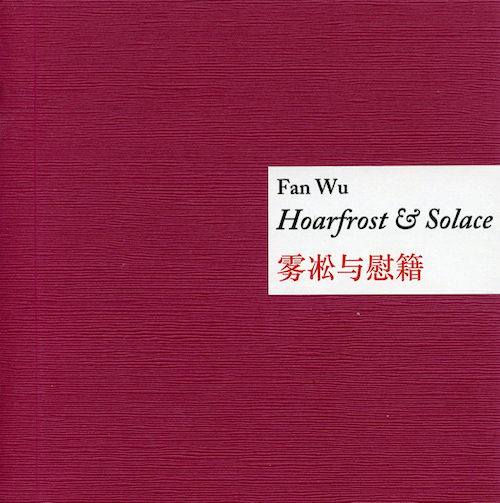
Hoarfrost & Solace: Variations on Tang Poetry

Sitting across the room from me, DWR asks what I am reading: “Horseshoes and Saddle”?

Fitting.

This is the start of Fan Wu’s third variation on Li Bai’s “Drinking Alone”. It begins simply and grows into a baroque tangle.

Third Bowl

Hyacinth Boy, nude astride the moon in water,
proclaims himself caliph of the unkissed anus,
stroked lewd by an unspent night which, in falling,
darned with stars a virgin body for a boy defiled
by his perfect purity.

And it continues in a tone punch drunk where nothing is stable or in its stable.

Ride on!

Cover - Fan Wu - Hoarfrost & Solace

And so for day 3002
01.03.2015

Posted in Poetry | Leave a comment

In A Previous Life I Was a Crème Caramel

Brooks Haxton, translator
Fragments: the collected wisdom of Heraclitus

17

Pythagoras may well have been
the deepest in his learning of all men.
And still he claimed to recollect
details of former lives,
being in one a cucumber
and one time a sardine.

This has the hallmarks of a parlour game.

And so for day 3001
28.02.2015

Posted in Uncategorized | Tagged | Leave a comment

Plenum: Translating as a Form of Smuggling

VERSschmuggel / reVERSible: An Anthology of English Canadian Poetry / Poésie du Québec / Dichtung aus Deutschland

Three books in one. Not only because of the three languages but also because of the three routes (sections). And of course one can double back on any route. One language’s version suggesting a re-reading of another language’s version. Interestingly and tantalizingly not every version in one language is translated into both of the the other two: in the anthology as a whole the German meets either the French or the English or both. What is on offer is a project with possible continuations.

The reader is positioned in a space similar to the translators and poets: as Nancy Hünger writes: “we know that poems are much smarter than we are.” And so we are placed in a place where “we mistrust ourselves but never the poem, because it speaks for itself.”

And in time the poem speaks again. Translation is a game of time. It’s about revisiting.

And for me, I am delighted by detail. The hefty volume offers up a cartography of small, magical, intimate moments. Take for instance one word: ce verbe (Monique Deland), dieses wort (Maren Kames), these textual cogs and gears (Sandra Ridley). A lovely meta-moment ensues.

There are other intricate pleasures to explore in these records of translational encounters. Pleasures that arise from reversible re-reading. Pleasures that yield to the power of the smarter poem.

Contemplating diffuse, dispersed working of “these textual cogs and gears” as per Sandra Ridley, I note the lowercase “wort” in Maren Kames’s intriguing intervention (avoiding the usual German capitalization). Each translating that Logos evocation of “ce verbe” of Monique Deland.

And so for day 3000
27.02.2015

Posted in Poetry, Translations | Leave a comment

The Interval of a Sip – Always a Meanwhile

Warren Peltier
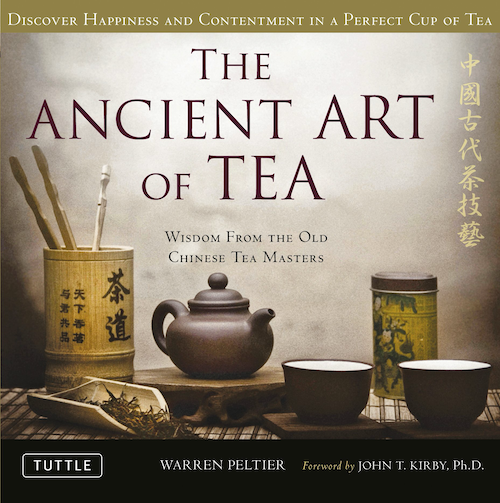
The Ancient Art of Tea: Wisdom from the Old Chinese Tea Masters

From Feng Ke Bin on “Yi Cha” — Properties for Tasting Tea

One of seven tea taboos

Busy and hectic lifestyle. When one is busy with social activities and duties, then there is no time to properly appreciate and slowly sip tea. Tea is wasted when one does not have enough time for it.

Blowing the steam from my cup, letting it cool, admiring the design of the book cover.

Cover of book by Warren Peltier - The Ancient Art of Tea

And so for day 2999
26.02.2015

Posted in Food Writing | Leave a comment

Cascades and Corrections

Patti Smith

from “notebook” in Early Work 1970-1979

[after a number of lines exploring what it means to be american]

Freedom is a waterfall, is pacing
linoleum till dawn, is the right to
write the wrong words. and I done
plenty of that …

april 1971

For the longest time I carried with me a misquotation of the passage: I conceived the right to write the wrong words as being singular — the right to write the wrong word — supplemented by the right to review and correct …

And so for day 2998
25.02.2015

Posted in Uncategorized | Leave a comment

Style and Obscure Necessity

Neither, nor, but nevertheless … necessity.

Style is a matter of bending and transforming language so as to create the personae and the contest or game for those singular ideas for which there preexist neither the words nor the story, but which nevertheless press upon us with an obscure necessity.

John Rajchman
The Deleuze Connections

And so for day 2997
24.02.2015

Posted in Uncategorized | Leave a comment

Leavings

Ronna Bloom
“Use These Poems”
Cloudy with a Fire in the Basement

[closing lines]

Hafiz says, Here’s a pillow of words for comfort.
Take it, if it works, use these poems. Or leave them
on a plane, in someone else’s bed, in an envelope
on the table, across the sentient grid.

or in a blog entry

And so for day 2996
23.02.2015

Posted in Poetry | Leave a comment

Pro-retro

From an interview in Surface Magazine:

What’s the future if we can’t learn from the past?

Sébastien Léon, artist, designer and sound sculptor

This was set as an either/or question:

Remember or forget? Remember. What’s the future if we can’t learn from the past?

Of course we learn from the past the best ways of forgetting.

And remembering.

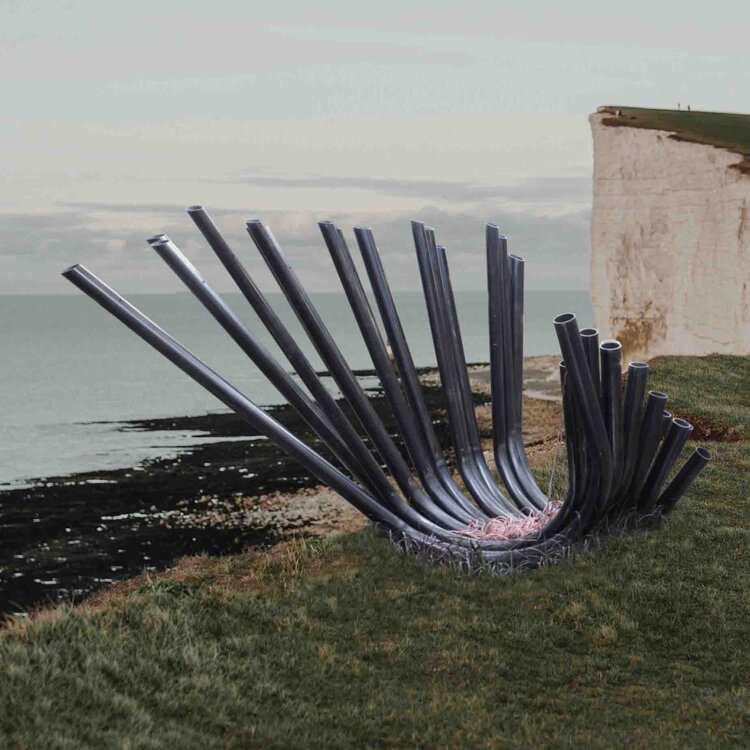
Take for example, Léon’s “The Diffracted Symphony”, inspired by the rib cage of a whale washed ashore, plays an altered version of Verdi’s Requiem as a funeral mass for the biological state of the world.

Sébastien Léon - The Diffracted Symphony - sound sculpture inspired by the rib cage of a whale

And so for day 2995
22.02.2015

Posted in Uncategorized | Tagged | Leave a comment

The Elegance of Refusing Closure

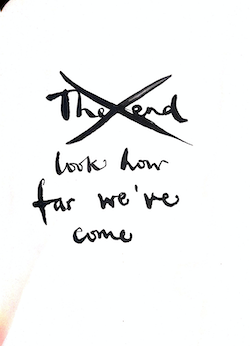
Charlie Mackesy ends or rather relaunches the imagination sous rature in The Boy, the Mole, the Fox and the Horse with this gentle reminder:

the end
look how
far we’ve
come

what makes this so serene is the pen work — a gesture from one hand at work — a singular moment.

Story End-Beginning from Charlie Mackesy The Boy, the Mole, the Fox and the Horse with this gentle reminder: "the end look how far we've come"

And so for day 2994
21.02.2015

Posted in Uncategorized | Leave a comment

Leave it, she said, I like it.

Monty Don on Bunny Mellon’s Oak Spring garden
from American Gardens

The main terrace – and there are numerous seating areas within this part of the garden – is paved with stone quarried from the estate. Apparently, two men laboured over this for months, cutting the individual slabs, ferrying them all to the garden and then, with great care and skill, laying them. Bunny Mellon was watching them at work one day and a corner of one of the slabs got broken. The workman lifted the stone and was about to replace it when Bunny stopped him. Leave it, she said, I like it. Then she got a hammer and went round deliberately chipping and breaking others with the precision of an artist with a brush. Into the gaps she had created she sprinkled flower and herb seeds, which quickly grew and spread into the cracks, giving this newly laid terrace a patina of age. This was the epitome of her style, encompassing a certain patrician grandeur and absolute self-confidence with a result that was expensive and meticulous and yet appeared modest and natural.

Result versus process.

And so for day 2993
20.02.2015

Posted in Gardens | Leave a comment