Reductions Introduce Nuances

In a type of braiding experiment, Brian Henry weaves a poem where the lines that appeared in five-line stanzas get carried over in a different order in four-line stanzas and the repetition continues through three and then ultimately in couplets. The location of the repeated lines adds a different coloration to each of the lines given the new locale and change in neighbouring lines. I am quite taken by how these two ended up side-by-side.

Some days the tongue needs a prophylactic
Medusa could use a snaky excuse

First to appear was the Medusa line in the initial five-line stanza:

Decide on deciduous or remain ever green
My love     for envy is not your color
Today     un dieu des mauvais cheveux
Medusa could use a snaky excuse
Hotwired straight to the stripping point
Vanishment in ravishment will produce a

And some five-line stanzas later our line about tongue and prophylaxis begins another — do note how much has got stripped away to produce the couplet quoted above.

Some days the tongue needs a prophylactic
Contusion me blue     confluence of lung-
Less bodies     less impact than palaver
Stupefy the progeny     do it for prosperity
The children frying in cast iron skillets
Beachfront propriety so up this season

What happens when the lines are uprooted and recombined is very much a combing out of the snaky stanzas into couplets that remind one of ghazals and serve as a kind of reminder of the malleability expressed in a stripping away. Progression by a sort of regression.

Brian Henry. “The Stripping Point” in The Stripping Point.

And so for day 1142
28.01.2010
Posted in Poetry | Leave a comment

sans Hypatia sans

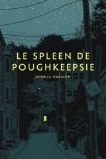
Cover Le Spleen de PughkeepsieIn a message to a friend, I mis-transcribed the title of the poetry collection as Le Spleen de Pouchkeepsie instead of “Poughkeepsie”. That “C” should have been a “G”. It just so happens that the typeface is Hypatia Sans and its “G” is very much sans serif and it is very easy to mistake a “G” for a “C” especially when viewing at an angle instead of head on (The book was to my side as I typed away on screen). Take a peek at Hypatia Sans and savour its graceful contours in caps.

That canine resurgence of “pouch” (when pronounced as “pooch” due to the residue of the correct spelling of “pough”) suits the recursive doggedness this collection of poems by Joshua Harmon where the encounter with grittiness results in some grace notes of grit. Much of the effect is achieved through enjambement flowing into further enjambment. Take for instance this mini-portrait from “Tableaux Poughkeepsiens”

[…]
or the schoolteacher arriving

at a late regard for wine
by the glass and his own minimal

importance: if you break the rules
then you deserve the consistencies:
[…]

I like how the suggestion of an expansive oenophilia is reigned in by budgetary considerations (“by the glass”) but the minimal is also maximal in that more taste experiences are possible than if one stuck to consuming by the bottle. And there is that unexpected tension between rule breaking and “consistencies” not the expected “consequences”. Minimal departures full of full-bodied taste.

And so for day 1141
27.01.2010

Posted in Poetry | Tagged | Leave a comment

Broken Chains

Inspired by Lucas Cranach’s The Judgement of Paris, our poet liberates the word’s syllables.

She exhibits herself
to us with a goddess’s instinctive
                              certitude. She holds her
                         wrists back, servile and opaque, as
                         if submitting herself to man-
acles. Her eyes engage

Easy to read “servitude” for “certitude”. All under the sign of “as if”.

The wicked enjambement is courtesy Scott Hightower Natural Trouble.

And so for day 1140
26.01.2010

Posted in Poetry | Tagged | Leave a comment

House and Garden

From a poetry workshop.

House & Garden

in the shadows
after the dishes
before the night cap

sitting in the house
viewing the garden

snow drifts
insulate

our slumbering bulbs
as we keep vigil
as ever we did.

This was the product of a workshop on love poems by Giles Benaway. Giles distributed three poems: Sonnet XVIII “Shall I Compare Thee to a Summer’s Day” by William Shakespeare with its polysemic play with “fair” as both “just” and as “beautiful”; “Having a Coke with You” by Frank O’Hara with its accumulative repetition of “partly” leading us to know that the subject is not exhausted; “Poem About Your Laugh” by Susan Glickman with its mastery of metaphor in the service of unfolding some far out conceits.

Giles asked us to compose a piece from 5 to 10 lines, no rhymes and no words ending in “ly”. So I produced a few lines on domestic hibernation with a tinge of melancholy.

And so for day 1139
25.01.2010

Posted in Poetry | Leave a comment

Dream Waiting

24/7: Late Capitalism and the Ends of Sleep by Jonathan Crary.

On systemic restrictions on day dreaming and reverie.

One of the forms of disempowerment within 24/7 environments is the incapacitation of daydream or of any mode of absent-minded introspection that would otherwise occur in intervals of slow or vacant time. Now one of the attractions of current systems and products is their operating speed: it has become intolerable for there to be waiting time while something loads or connects. When there are delays or breaks of empty time, they are rarely openings for the drift of consciousness in which one becomes unmoored from the constraints and demands of the immediate present. There is a profound incompatibility of anything resembling reverie with the priorities of efficiency, functionality, and speed.

Later, for the patient reader, there is a discussion of waiting in the context of the film by Chantal Akerman De l’est and its dwelling on line-ups.

Certainly, Akerman lets us see the queue as Sartre did, as a plurality of separations that become “the negation of reciprocity.” But one of her revelatory achievements is also to show the act of waiting as something essential to the experience of being together, to the tentative possibility of community. It is a time in which encounters can occur. Mixed in with the annoyances and frustrations is the humble and artless dignity of waiting, of being patient as deference to others, as a tacit acceptance of time shared in common. The suspended, unproductive time of waiting, of taking turns, is inseparable from any form of cooperation or mutuality.

Set the timer for a time-out.

And so for day 1138
24.01.2010

Posted in Uncategorized | Tagged | Leave a comment

Theatre of Quotation and Gesture

But soft, the story starts anew.

It is the last line of the last poem in Randall Mann’s Breakfast with Thom Gunn. And its somewhat Shakespearean tone befits the poem “Fictions” which it concludes for it combines a lullaby sentiment with sad intimations of mortality (this is after all a poem that begins “For years, there was no hope. We had grown up / believing the dead, while dead / might stay a while.”

In a similar gesture, Mann concludes an earlier collection (Complaint in the Garden) with a poem entitled “The End of the Last Summer” with lines that invoke the spirit of the dead (“The peninsula grows dark; / the dead stay dead. / The sea is rising … and the world is sand.”) — a poem whose last line is a quotation from a concluding line of a poem by Wilfred Owen (and so we are informed by the last text of the book – a note to this effect).

Starting anew … the world is sand .. and so dream . again

And so for day 1137
23.01.2010

Posted in Poetry | Tagged | Leave a comment

intimate time

Daphne Marlatt. Liquidities in the section “Some Open Doors” closes the poem “innuendo” with these suggestive lines

his laugh her shrug the time it takes intime fake brass
reflects used shine of coffee mug she lifts to wipe
his place clean

in time the intimate plays here with the gesture appropriate to the diner setting but also fitting for the home front

And so for day 1136
22.01.2010

Posted in Poetry | Leave a comment

And Then Narration

Gerald L. Bruns. “KAREN MAC CORMACK AMONG THE PAGANS”. Drawing on the work of Jean-François Lyotard [The Differend: Phrases in Dispute, trans. George Van Den Abbeele (Minneapolis: University of Minnesota Press, 1983)], Bruns outlines different regimes:

there are multiple and heterogeneous forms of linkages, some of them syntactical (subject-verb-object), some logical (if-then), some propositional (s is p), some hermeneutical (this as that), and some narrative (this then that), but Lyotard’s point is that there are (indefinitely) more forms of enchainment than those we learn to use in school (reasoning, describing, questioning, narrating). Phrasing is not systematic construction. We inhabit a universe of phrases that are rhizomatically proliferating and tangling like crabgrass.

Of his forms of linkages, I want to focus on the last listed. Then, that. It is of course a temporal relation which Bruns associates with narrating. I want to generalize this from the mere temporal to succession in general. Narration (see the distinction between plot and story) rules these pairings. For there is always this then that and the relation arising.

Found Bruns’s essay on the WWW at UPenn’s site
http://www.writing.upenn.edu/library/Bruns-Gerald_on-Karen-Mac-Cormack.html
(24-Jun-2007 16:35 62K)

See also What are Poets For?: An Anthropology of Contemporary Poetry and Poetics
See also Antiphonies: Essays on Women’s Experimental Poetries in Canada edited by Nate Dorward.

And so for day 1135
21.01.2010

Posted in Uncategorized | Leave a comment

Inducing Reverie

Steven Heighton uses the pretext of taking aim at screen devices to call for a renewed interest in the creative aspects of boredom.

Whatever. The issue here is screen media. The issue is that staring into space—in that musing, semi-bored state that can precede or help produce creative activity—is impossible when you keep interposing a screen between your seeing mind and the space beyond. The idea is to stare at nothing—to let nothingness permeate your field of vision, so that externally unstimulated mind revs down, begins to brood and muse and dream.

Steven Heighton. Work Book: memos & dispatches on writing.

Eyes closed and there are screen memories to contend with. Eyes open and they still alight on details of our environment. It is very very difficult to focus on nothing. Easier to stare and to gaze. And tune out and let the mind wander at will.

One wonders if the flicker of screens cannot in some circumstances invoke a hypnotic state and lead to the nothingness that helps the mind rev down. Would it be any different from watching waves?

And so for day 1134
20.01.2010

Posted in Perception | Leave a comment

Landscape Translations

Canadian sketch after Lachlan MacKinnon

Deep as forever
Great river of stars
Above cabin in the woods

Inspired by MacKinnon’s opening to “A Suffolk Sketchbook” in Small Hours

Deep as forever
the great field of stars
over the cottage garden.

This all started as a thinking through of how close to (and how far from) a compressed haiku do the lines of MacKinnon resemble. And from there we thought about forms of transplantation.

And so for day 1133
19.01.2010

Posted in Poetry, Translations | Leave a comment