Testing Tautologies

There is a didactic element to Kit Robinson’s “Lyric Strand” in Writing 25 (1990). It sports the following few lines

Sound is an antidote to words,
meaning lies. It can be used
to show that they are used and only
exist by their use and are made of it.

It begs reworking as a reversal.

Words are an antidote to sound,
meaning rises. They can be used
to show that it is used and only
exists by its use and is made of them.

Meaning rests.

And so for day 1013
21.09.2009

Posted in Poetry | Tagged | Leave a comment

Calligram II

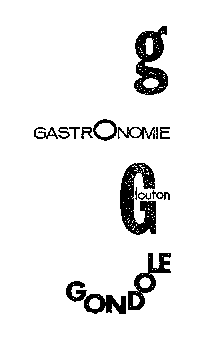
Karl Petit. Le Dictionnaire des Citations du Monde Entier. (1960). Entertaining displays of typographic fantasy adorn the alphabetically arranged sections of the book. The “G” page offers three words

G from Dictionnaire des citations

The link between gastronomy and glutton seems evident (it’s an inverse relationship). The typography seems to create a great ladle when the scoop of the “gondola” registers upon the imagination that is stretching to try and hold the words in one semantic field. I dream of boatfuls of ice cream.

And so for day 1012
20.09.2009

Posted in Booklore, Poetry | Leave a comment

Calligram I

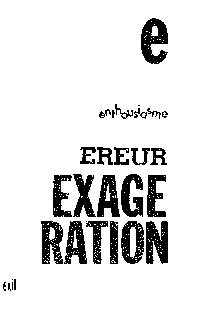
The book is a collection of quotable passages. It is arranged alphabetically and each of the sections begins with a display of bravura typography. For example, take the E. Here transcribed from the French for the visually impaired:

Justified right a big lower case letter.
Next line with “enthusiasm” all in a jumble of jumping letters.
And then “eror” with a missing “r”
Next word split over two lines and in bigger point size to mark its “exageration”
And finally almost lost in the gutter in tiny type justified left is “exile”.

See

E from Dictionnaire des citations

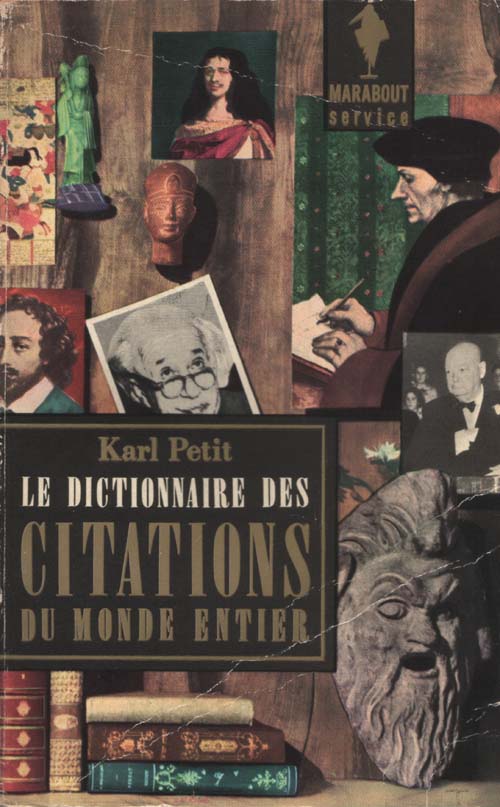
And the cover of the book itself is a collage of famous heads

Cover Karl Petit Dictionnaire des citations

Karl Petit. Le Dictionnaire des Citations du Monde Entier. (1960).

And so for day 1011
19.09.2009

Posted in Booklore, Poetry | Leave a comment

Alive to the Cold

Because he can encapsulate lots of complex history into smooth prose:

As the urbanization of the world gathers speed in the 1870s, what has been a solstice holiday in origin becomes a harvest holiday in realization.

We readily accept his extended metaphors for the underground city that works in a metropolis like Montreal

The multidimensional city depends on a subway to serve as its nervous system, and a series of tunnels and walkways to serve as its connective tissue. […] when people are brought in below ground they are eager to come up above ground. You create a permeable membrane between the underworld and the overworld, all based on foot traffic — on the pedestrian, the walker, who is the city’s red blood cell, without whom the city pales and sickens and dies of anemia.

We are there with him not only because of the address to a “you” but because we can picture ourselves arriving and walking, after all by this point he has made us believe that hockey is as much a mental as a physical contact sport. Winter is his season. And we are so much the warmer for having shared his experiences and musings.

Adam Gopnik. Winter: Five Windows on the Season

And so for day 1010
18.09.2009

Posted in Uncategorized | Leave a comment

Stasis and Flight

They are by temperament different. By métier, poets. Both attentive to detail.

Sandra Kasturi in Come Late to the Love of Birds, just before her homage to Ursula K. Le Guin, has a poem, “Bird Logic”, which ends in a way that sets up marvellously the themes that follow in the poem to Le Guin which ends on a couplet (“Let pages turn as they may and locks come undone; / Let one world unravel, as another’s begun.”) which comes as an echo of the two concluding stanzas of the previous poem “Bird Logic”

Be careful
when birds are sleeping:
sometimes they’re dreaming the universe
and you in it.

I woke a bird once
but he was from another universe
and I was from another dream
so it all worked out in the end.

I just so happens that a few days later I came across the passage from Jan Zwicky in Forge towards the end of a sequential poem “Practising Bach” (apologies for not doing the typography justice)

          This may also be thought of as the problem of metaphor: the metaphor’s truth, its charge of meaning, depends on the assertion of identity and difference, on erotic coherence and referential strife, on meaning as resonance and meaning revealed through analysis.

The one describes the other. Despite their very varied ways of approaching matter, diction (you know a Kasturi poem from a Zwicky poem like you know apple from orange) and despite the different ways they unravel words and knit worlds — they let us fly and bring us by an abrupt turn to the spot where stopping seems just.

And so for day 1009
17.09.2009

Posted in Metaphor, Poetry | Leave a comment

Placer Epiphanies

There is an invitation to reflect in the words of “Practical Meditation” in Ash Steps by M. Travis Lane. We are invited to contemplate the similarities between our life and the firefly’s brief flicker “as splendid in its vanishing / as in its blaze.” This calls to mind an earlier poem from An Inch Or So Of Garden where the totem animal providing the meditative moment is a bit larger … a bear in “The Mine” disturbs “A placer stream, slow, speckled in gold, / wrapped in warm perfectness […] And on the perfect filmlessness / the skaters skim.” All is quiet and placid until the bear bursts on the scene

Until the oaf thwacks down the bush,
breaks twigs. He comes
from grubbing worms, will mine

The waters are muddied and the fish and creatures upset. But by poem’s end we are expected to imagine the bear missing the catch and that all returns to a previous state and the not previous state.

Suppose
he mines no dinner, goes again.
Then wait, not long,
all things return
beneath the sun’s soft negligence —
all things, all visions, walkers, fish —
and even bears.

This is wry commentary with its wink at the folk song derived from Ecclesiastes. Travis Lane will pick up the motif of disturbed water in many images of mirrors that populate the later poetry. Take for instance the beginning of “Ash Steps”

No frog
jumped into the water bin.
But something fell, and for a while
that tepid mirror shifted, squirmed,
and shook beige shreds of floating leaf,
a pigeon feather, dust
larvae perhaps.

Further on in the collection, one encounters a whole panoply of disturbers and a most intriguing catch and release method to not restore circumstances but to trigger the meditative reflection. “Les Pêcheurs d’eau” ends with a complex figure of exhaustion and renewal:

For centuries they’ve caught our music,
Poets, moths, flies, frogs, dogs, cats, and lunatics.
Some years an iceberg, snagged, overturns.
So little’s left, they have been fishing for so long!
Whatever they catch, they do, at least
they do throw it all back again:
but hooked, unhooked, now maimed.

The ecological scale seems vast and the focus on decline poignant but we recall other instances of disturbed mirrors and earlier in the collection the wisdom of “Practical Meditation”.

Epiphanies splash up like waves on windy days
against the green edge of a pier;
you don’t have to go out to look for them,
abundant, brief, like fireflies as they are.

I like how whether it be plethora or scarcity, there is opportunity with and without our ursine cousins. Exeunt pursued by a bear. And the re-citing of the stage direction from The Winter’s Tale is in a sense rewritten as our pursuit. Chased and chasing. Firefly flickers. Mined and mine.

And so for day 1008
16.09.2009

Posted in Poetry | Leave a comment

Mirage Murmurs

A selection from “Sentimental Intervention” by Dorothy Trujillo Lusk appearing in Writing 25.

Plucked of a miragement of video-control systems while others murmured towards her an ill-will. He reproached himself with his devotion to/in any case. The different trees afforded a changing spectacle, however of its time. By roots in Idealist Abstraction, an itinerant astronomer.

Obviously this type of writing resists. Resists sense making. Nevertheless, there are micro-moments that provide keys. Consider the hyphenation of “video-control” and “ill-will”. A parallel of negative intent. Further on the reader is oriented in/to which is holding a kind of tension with out/from as reading moves on/back. Now, consider the possibility that the changing spectacle is plucked from the condensation of mirage and management: miragement. It’s the neologism, “miragement” that slows down the reading and unhitches us from whatever to/in case we might be going round and round. And by association we as readers become itinerant astronomers, voyaging through the stars/constellations of such language tracks. And by our roots we work with mirage produced by the looking at. Murmur produced by murmur. Language resisting language. Mi-rage-ment: partial affordances for the terror of more cutting approaches: m/i/ra/ge/ment. Like a signal system held on pause and reapproaching abstraction. And so we come to quote the last of these stanza/paragraphs.

He found himself offering. The actress had not a minute to spare. Mass assesses itself in a further dissolution. By day, the daily disturbance effects engineering unity in parallel with rhythmic extension as heard in some of the more mathematically restrictive musics, the joy engaged, the caress of the past.

In case we are going, we encounter disturbance and music. See La Monte Young

His Compositions 1960 includes a number of unusual actions. Some of them are un-performable, but each deliberatively examines a certain presupposition about the nature of music and art and carries ideas to an extreme. One instructs: “draw a straight line and follow it” (a directive which he has said has guided his life and work since). Another instructs the performer to build a fire. Another states that “this piece is a little whirlpool out in the middle of the ocean.” Another says the performer should release a butterfly into the room. Yet another challenges the performer to push a piano through a wall. Composition 1960 #7 proved especially pertinent to his future endeavors: it consisted of a B, an F#, a perfect fifth, and the instruction: “To be held for a long time.”

With Trujillo Lusk: murmur and admire result. Repeat. It’s like an unending line. It’s miragement. It’s its.

And so for day 1007
15.09.2009

Posted in Poetry | Leave a comment

Reversals

Part of the section “Jones” from The Alphabet by Ron Silliman appearing in Writing 25.

— who knows what a fact is, solid ground … versus, say, drip grind in the rain forest … versus, say, verses.

I’m not sure if the ellipses mark out pieces left behind in the selection or if they are part of the piece — I/we would have to check against the published version of The Alphabet. It is so often the case that periodical publication is later revised for the book form…

In any case, complete or incomplete, it is the play on “versus” and “verses” that drew me to this passage. What kept my attention was the assonance and the repetition of sound (like the rain). “gr” [ground/grind], short vowel “i” [solid/drip], terminal “nd” [ground/grind]. And taken word by word, there emerges from a slow reading an image of the brewing of a fine cup of coffee and the verses float above it all like steam. In case you may think that the invocation of a cuppa java is a stretch consider that “Jones” is dedicated as an “Homage to Bromige” — David Bromige begins “Are You Coming or Going Through That?” with what could be interpreted as instructions for Silliman’s piece:

In order to recognize it name it before you know it.

Having begun, stop before you can begin, or lose what you began.

And this as much as it is instruction is also description. It is what we do when we turn. When we compose verses. And whether Bromige’s lines appear before or after Silliman’s matters little — they are joined by the transversal of language… and its possibilities.

And so for day 1006
14.09.2009

Posted in Uncategorized | Leave a comment

A Moment Apart

This is an excerpt from a poem not particularly focused on the preparation of a good cup of coffee. But the lines and the gesture they describe are arresting. [Note: the word “steady” has a vocal echo in “steam” that follows. Intriguing as to how a coffee might be steadied and there is the evocation of “eddy” and stability in the swirl.]

I pour a cup of coffee, steady it
with milk, stir until it turns from
coal to caramel, the steam rising,

from “The Letters”
from Practicing to Walk Like a Heron
by Jack Ridl

And so for day 1005
13.09.2009

Posted in Food Writing, Poetry | Leave a comment

Deter Gently

For Giles who loves soap

Reading After Jack by Garry Thomas Morse, I am struck by his genius for translation and invention offering us a complex chain of chemical traces to reread Jack Spicer and beyond his “After Lorca” to reread Lorca and beyond his “Ode to Whitman”, Whitman.

It is in the minimalist moment that these voices and layers (song from Lorca, catalogue from Whitman and wit from Spicer) slide into Morse’s own gift for control and compression. Take “Hybridity”

Red tits of the sun
Blue tits of the moon

Part cotton
Part lycra
Part spandex
Part polyester

Part shadow

Wash separately

There is delicious ambiguity at work here. Is shadow to be separate from the fabrics? Each fabric to be separated from the others? Both of these alternatives combined? Why care so much about washing?

Turn the page and you encounter one of the letters to the predeceased poet (Spicer) in which you read that language is “naturally dirty.” In one of Spicer’s own letters to the predeceased poet (Lorca) you can read

Words are what sticks to the real. We use them to push the real, to drag the real into the poem. They are what we hold on with, nothing else. They are as valuable in themselves as rope with nothing to be tied to.

I repeat — the perfect poem has an infinitely small vocabulary.

Spicer’s “real” puts added pressure on Morse’s “naturally dirty”. And Morse’s response is set in the context of a dialectic between speech and silence. Here is the paragraph from that letter in which the dirtiness of language comes to the fore (mind the gaps; the periods have been washed out):

Even if we can’t get together, the poem & language go on talking     Things are disclosed & revealed in places where nobody is     Language outgrows any mens rea, any evidence of intent     I didn’t mean it really     That was language talking     We were both a kind of misleading question mark     Even those polite requests for reassurance do you love me don’t you want to go to bed with me do you love me sound abhorrent beside the altercosm of language which is naturally dirty     The very real pause or clause is a threat to shatter that beautiful loneliness so necessary to poetry     So we go to bed together without a word while language whispers from dusty aisles & pissy alleyways & sore asses

In the poetics proposed in After Jack one move in dealing with the dirt of language (or rather the dirty altercosm of language) is not segregation but the more nuanced notion of separation. For as the voice in “Sonata for a Chair and a Table” says “Words arrange things. Make” and in the temporality of the poem the pile of laundry remains both a pile and through its closing injunction, sorted — the poem itself and its dominant image inhabit a type of hybridity. Words keep getting stuck by their sticky nature. And Morse helps us come to terms with the dirt by subtle spacing in which a deter agent can cleanse even the most minimal of vocabularies. And make magic from more than a laundry list.

And so for day 1004
12.09.2009

Posted in Poetry | Tagged | Leave a comment