Numbing and Splitting

Susan Buck-Morss “Walter Benjamin’s Artwork Essay Reconsidered” October 62 (Fall 1992).

We are — by a long detour — back to Benjamin’s concerns at the end of the Artwork essay: the crisis in cognitive experience caused by the alienation of the senses that makes it possible for humanity to view its own destruction with enjoyment.

How we think is connected to how we feel (perceive) and how we imagine.

This gains some purchase on the reader because earlier in the essay Buck-Morss comments on a passage in Husserl:

This separation of the elements of synaesthetic experience would have been inconceivable in a text by Kant. Husserl’s description is a technical observation, in which the bodily experience is split from the cognitive one, and the experience of agency is, again, split from both of these.

Agent, body and observer. Their relations argues Buck-Morss are influenced by the social distribution of the technologies of anaesthesia.

And so for day 500
26.04.2008

Posted in Perception | Leave a comment

Surprises

Edmund White concludes his memoir My Lives with a rich evocation of friendship whose final words are

Being predictable is one unforgivable sin in a friend.

And he has so nicely arranged the book so that strangers and friends can read the chapters in any sequence they desire and so participate in the pleasurable surprises that acquaintance with this volume brings.

And so for day 499
25.04.2008

Posted in Booklore | Leave a comment

Lawn Parties

In A Good Heart and A Light Hand (1968), Ruth L. Gaskins writes about lawn parties in the introduction ‘A Negro Welcome’

These lawn parties weren’t big affairs, and I doubt whether they added much to the church treasury, but they certainly did liven up a hot summer night in the city. Very often you wouldn’t know that one was going on until friend ran by and shouted, “Get a dime and come on over to Ebenezer Baptist.” You wouldn’t stop to put your shoes on, because you were going to be on the lawn of the church. If you were going inside, you’d not only have to put on shoes, but your best dress and hat and gloves as well. Negroes save their best clothes for church, not for parties. Those were nice nights, but they’ve given way to movies, amusement parks and night clubs; all the things that weren’t open to us then.

And so for day 498
24.04.2008

Posted in Uncategorized | Leave a comment

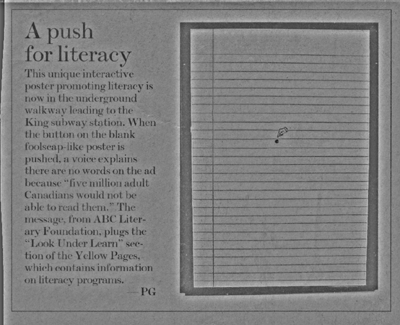
Literacy Promotion

A newspaper clipping explaining “When the button on the blank foolscap-like poster is pushed, a voice explains there are no words on the ad because ‘five million adult Canadians would not be able to read them.'”

Newspaper piece on literacy advertisement

An explanation of an interactive literacy advertisement

The message from the ABC Literaray Foundation plugs the “Look Under Learn” section of the Yellow Pages.

And so for day 497
23.04.2008

Posted in Reading | Leave a comment

Contiguous Files

File F is located close to File G. And this closeness allows me to read these passages close together.

Jane Flax. Thinking Fragments: Psychoanalysis, Feminism, and Postmodernism in the Contemporary West (1990)

[p. 217] “In Foucault’s work the aesthetic is connected with subjectivity in his idea of replacing the technologies of self with the ideal of making one’s own life a work of art. Yet paradoxically, despite his criticism of Derrida’s mystification of writing, Foucault does not ask himself the question “What forms of life make such a notion possible?” about this own aesthetic ideal. Such a constant remaking of the self presupposes a socially isolated and individualistic view of the self. It precludes the possibility of enduring attachments or responsibilities to another in which the other can rely on one’s stability and “continuity of being.” [our emphasis. Why does Flax make this link between individualism and change of the self?]

Gaytri Chakravorty Spivak. The Post-Colonial Critic: Interviews, Strategies, Dialogues (1990) ed. by Sarah Harasym.

p. 27 “The Post-modern Condition: The End of Politics?”

Questioning a text to get a companion

“Since we are not looking for a perfect analysis, but we are looking for the mark of vulnerability which makes a great text not an authority generating a perfect narrative, but our own companion, as it were, so we can share our own vulnerabilities with those texts and move. It seems to me that those are the places where we would begin to question.”

p. 29 “The Post-modern Condition: The End of Politics?”

who you choose to address might connect to who you want to be

“It seems to me that what I was saying was not that you should consider all other subjects. I was saying that you might want to entertain the notion that you cannot consider all other subjects and that you should look at your own subjective investment in the narrative that is being produced. You see, that is something that I will continue to repeat, it is not an invitation to be benevolent towards others.”

So back to Flax, who asks at the conclusion of her book [p. 236] “Does all knowledge necessarily inflict violence on things, ourselves and other persons?” with an answer: it does if you reduce aesthetic interactions to presuppositions of individualism.

And so for day 496
22.04.2008

Posted in Uncategorized | Tagged | Leave a comment

Thesis Report

Things mutate while they are being written, especially big pieces. I found a copy of a “report” to file that documents what I was trying to accomplish in the argumentation of a key passage in my dissertation where I move from critique to speculation and build a model. In some ways it is better and more accessible than the thesis (in part perhaps through the use of first person singular)…

Another way to pose questions is to posit axioms. For example, to claim the play of the senses is connected to questioning or the maintenance of the interrogative mood. The central question is not how to keep questioning open but how do perception and questioning connect.

I come to the conclusion that the material practice of translation is the key for imagining a sensorium that is more than merely receptive, one that is interactive in regards to its modalities and its environment. The stumbling block in imagining such a sensorium has been the means of translating from one modality to another. Verbal language seemed to be the best candidate. However it privileged sight and hearing, the distance senses, over those of closer contact: smell, touch, and taste.

So I began again. In re-evaluating the closer contact senses, especially their action under conditions of distress or extreme pleasure, I realized that the sensorium not only is a receiver but also a dispatcher of information. The senses are not only receptors. The senses also transmit. the senses in operation provide events for interpretation. The blinking of eyes, the cocking of an ear, the flicker of a tongue, all signal.

The human senses produce events. They preserve the trace of something happening at a certain time. Events can be connected.

The transformation of discrete somatic signals into sequence explains cross-modal encoding. The pathways between sensation and narration are particularly evident in non-linguistic narrative. I am thinking here of the anthropological studies of Nancy Munn on Walbiri iconographic practices; the films of Kay Armatage, especially Storytelling; the examples collected by Jerome Rothenberg in Shaking the Pumpkin and Technicians of the Sacred. A case for the separation of narration from verbal language is also made on neurophysiological grounds. Howard Gardner in Frames of Mind offers the conjecture that “sensitivity to narrative, including the ability to communicate what has happened in a series of episodes, seems more closely tied to the pragmatic functions of language (and thus proves more fragile in cases of right-hemisphere disease) than to core syntactic, phonological, and semantic functions” (89).

and so it goes on to tell a story and to get on with the telling…

And so for day 495
21.04.2008

Posted in Perception, Storytelling | Leave a comment

Why Make Babies

Very gnomic. Very pixie. Such are the comments at the bottom of this attempt at a preface for a scholarly work. Didn’t quite fit (a tad polemical). Glad I kept it all these years to bring it to the fore here.

A gay man asking “why make babies” risks being unheard. Gay people pretend he is addressing straights. His question is aimed at closet cases so claim straight folk. The sophisticated lesbians have him talking to himself. So do the unsophisticated.

A gay man is always overheard. His questions sound like baby talk. His gestures resemble so many abstractions swirling around the asking, how he has been made, how he made it, so narcissitic. Knowing he is overheard he turns the made into a making like turning a trick, forever a boy.

None can ever quite reproduce his productions, unless they listen for the unhurriedness of the unheard at play and then know the risking at work.

Yes, very gnomic. Very pixie.

And so for day 494
20.04.2008

Posted in Uncategorized | Leave a comment

Taint

From “The Kreig Anthology” opening poem of Under the Clock: new poems by Tony Harrison has a first-person satirical piece on Tony Blair. These lines leap out:

None of the blood and shit of war
ever clogs a single pore.

The repugnance all that stronger as the reader is resisting alignment with the first person speaker.

And so for day 493
19.04.2008

Posted in Poetry | Leave a comment

Randomness and Reproduction

Came across a proposal from the mid 90s. The proposal is very lapidary in its prose. At this late remove, it seems too simple and yet under-explained. The proposal began thus

Characterizable by certain investments, reproductive consciousness manifests a desire to preserve ways of experiencing the world. A history of the senses is also a history of relations of reproduction. History begins with a count of the players.

and then the proposal later packed a lot into a short space with this:

“Belonging” represents a complex semantic field in which adhesion, membership, possession, and ownership criss-cross. The generated is no longer the simple embodiment of a relation between generators when relations cease to be one-on-one, when the dyad is no longer the fundamental unit of interaction. Discursive moves that reify the couple, moves stemming from folk models of biological reproduction, when brought to bear upon theories of social reproduction, downplay the heterogeneity of the social field. The social is constructed monologically and determinitically.

And now a good decade later I recall a passage from David Weinberger Small Pieces Loosely Joined, the chapter on “Knowledge” because in some sense it too is about the stories that are told about reproduction, of how a decision is born:

And what could be wrong with delivering the right information to the right people at the right time as an ideal to strive for? What’s wrong is that it misunderstands how humans make decisions. […] Making a decision means deciding which of these “inputs” to value and how to fit them together to make a coherent story. That means the causality runs backwards: the inputs don’t determine the decision; the decision determines which of the inputs will count as influences. Then why do we like the phrase “The right information to the right people at the right time”? Perhaps because it implies that there’s a way to eliminate the risk inherent in making decisions and in acting. Of course, that requires conceiving of ourselves as predictable machines made of matter — as computers — rather than as what we feel like to ourselves: an unpredictable disruption of the world of matter. […] A version of these comments was published in the Harvard Business Review (September 2001) under the title “Garbage In, Great Stuff Out”.

Computers can be programmed to both generate and utilize random numbers. The clash with matter is not so obvious. Count the players.

And so for day 492
18.04.2008

Posted in Uncategorized | Tagged | Leave a comment

Swallowing Secrets in Tiny Bits

“Spice” by A. Cinqué Hicks in Shade: An Anthology of Fiction by Gay Men of African Descent begins with a listing of the ingredients need to make gumbo.

To make gumbo, you need rice. Mama preferred brown rice. Then you also need an onion, butter, oil, flour, okra, green onions, tomatoes, shrimp and oysters, and an assortment of spices and herbs.

In the story it is the tradition for guests to bring a spice to add to the pot. Our protagonist adds an unusual ingredient.

And so for day 491
17.04.2008

Posted in Food Writing | Leave a comment