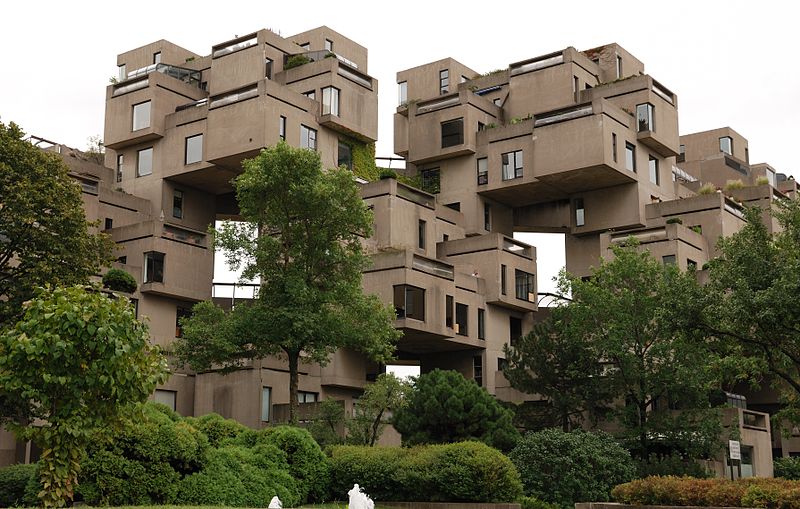
urban cubes

Approaching Montreal from the Maritimes, the speaker of “from the ocean, inland” in Matt Robinson’s A Ruckus of Awkward Stacking reminds me of Frye encountering the contours of Quebec City.

on approach montreal is a spilt pallet
of cardboard boxes, bleaching in the sun.

This recalls for me views of Moshe Safdie’s Habitat 67.

Habitat 67 - Montreal

Habitat 67 – Montreal
Image Source: Wladyslaw

And so for day 361
10.12.2007

Posted in Poetry, Uncategorized | Leave a comment

Apostate Beetles

There are two poems some pages apart but both touching upon the theme of consuming or eating in Mary Di Michele’s first book of poetry Tree of August. The first poem describes the labours and predation of the buffalo beetle (dermestes vulpinus). These particular specimens are at work in the Royal Ontario Museum where in the opening stanzas they eat the carcass of a camel and are considered “prized employees”. But they are ravenous and this is how the poet describes the turn to other feeding.

But some grow greedy on camel grease
and acquire a more exotic taste
for mummies, well aged and smoked
beyond the steel doors.

They attack other “delicacies”

until they are force-fed fumigation
and die, professionals.

And we come some pages later to “Sunday Dinner” where a father berates a daughter and the scene gets caught up in the ironies of transubstantiation.

I remember how the eucharist
used to stick to the roof
of my mouth, a gummy wafer
I had to peel back with my tongue.

Some things will not be swallowed.

From the depiction of the spoils of omnivorous scavenging to the gesture of refusal, the theme of appetite bites and deserves to be digested.

And so for day 360
09.12.2007

Posted in Poetry | Leave a comment

Gathering Flowers

Its etymology partakes of the botanical. Its practice, of specimen gathering. Who cares why?

Michael McFee in “Anthologizing” (Epoch, Volume 62, Number 1 – 2013) does.

One of Robert Pinsky’s excellent pieces of advice for young writers is: “Make your own personal anthology.” This exercise requires you to (1) read widely and carefully; (2) select thirty to fifty of your absolute favorite poems; (3) type each one of them out — a lot to ask, in these online copy-and-paste days, but a great manual way to learn things about how the poem’s words work on the page; (4) figure out how to organize them.

I’ve used this assignment a few times with my students, and added a fifth requirement: (5) write an introduction to your anthology that gives the reader an idea of why you chose and arranged as you did. The results have been most enlightening, for anthologist and teacher. Could and should “Anthologizing” be a course in creative writing programs, at whatever level, an extended and very instructive lesson in how this corner of the literary garden is tended?

Blogging differs from anthology making because of the open set nature of the serial. A blog seems more open to the aleatory. At any point there may be a divergence or the introduction of innovations (meatless recipes once a week, a run on biographies of Canadian poets, a set of notes on the art of translation, pictures of favourite bookmarks from defunct bookstores). An anthology seems closed by nature. There is an air of exclusivity hence McFee’s calls for justification of principles. Blogging demands persistence; anthology making demands insistence.

And so for day 359
08.12.2007

Posted in Booklore, Poetry | Leave a comment

Little Breeze Lifting Hair

Robyn Sarah in The Essential Don Coles has collected one of his marvels — a portrait of a young son at play at the seashore and the play of the breeze in his hair. All by itself the image is conveyed with lightness and gentle repetition however Coles’s pretty picture gains by a telescoping of time in the last lines:

a little breeze passing by
on its way to oblivion —
as this day is on its way there too,
and as that day, twenty years ago,
was, too.

Go see how Coles captures the child’s laughter. The whole poem, “My Son at the Seashore, Age two”, is available online at
http://www.library.utoronto.ca/canpoetry/coles/poem2.htm
along with others.

And so for day 358
07.12.2007

Posted in Poetry | Leave a comment

Twist Turn Buzz

Epictetus may for a single passage in The Enchiridion sport the title of camp philosopher. As proof here I quote from the translation by Thomas W. Higginson in the Liberal Arts Press edition.

If anyone tells you that a certain person speaks ill of you, do not make excuses about what is said of you, but answer: “He was ignorant of my other faults, else he would not have mentioned these alone.”

What looks like a trick of rhetoric that leads to some sage advice is also a theme of Ricardo Sternberg’s “The Bees” collected in Some Dance. The poem ends with these lines:

Teach your vengeful bees
the trick (or is it wisdom?)

that allows them to distill
from the thorn of grievance,
the sweetest honey.

Certainly a stoic take on apiary business which may not align with the facts of pollen and nectar yet is sweet nonetheless.

Sugary camp acid.

And so for day 357
06.12.2007

Posted in Poetry | Tagged | Leave a comment

Glass Box Towers

Matthew Holmes concludes the four part “Starling’s Law of the Heart” in Hitch with a contemplation of the human and the urban condition.

Inside, the hiss of the air was on, circulating something warm through the building. Down the street he could see a few people in other offices: standing at their windows, walking by. Each building housing its own season, opposite to the one outside. Each person somewhere else, or in another time.

Bringing to mind last lines from John Ashbury in the fourth (but not last) of his “French Poems” in The Double Dream of Spring.

And finally and above all the great urban centers, with
Their office buildings and populations, at the center of which
We live our lives, made up of a great quantity of isolated instants
So as to be lost at the heart of a multitude of things.

And be found again by the tenuous link of words.

And so for day 356
05.12.2007

Posted in Poetry | Leave a comment

Visual and Biological

One imagines festivals like Burning Man. One imagines the lost world of labyrinth walking. Tracing a path as a means not to forget.

These thoughts were inspired by Bruce Brown “Memory Maps and the Nazca” in Reframing Consciousness where he revisits the landscape of ancient Peru to draw us into a practice of cultural transmission formidable in its scope …

The most dramatic example example of this process can be seen in the gigantic drawings made by earlier Nazca cultures on their desert pampas. These enormous images of birds, animals and fish were not intended to be looked at by some other being. They were intended to be transported from desert surface into the memory landscape of each person. A closer look will show that each drawing is made from one continuous line. Each a processional route to be walked, not to be looked at or seen. And the proportions of each line conformed to the digital mnemonic of all other structures in the culture. By walking over the surface of each symbol, the digital information it contained would be transported into the memory of each person with the images finally being held within the landscape of memory.

The explanation of the Nazca lines bolsters the take later in the article on the transition from oral to literate culture in the West (a take that eschews that brand of technodeterminism that one associates with McLuhan).

The invention of the printing press also saw the end of a tradition whereby objects and buildings were seen as texts. For example, it was no longer necessary for the side of a bowl or the wall of a church or cathedral to visualise a story from the Bible when it could be read in book form. So the role of objects and images as carriers of knowledge began to decline. And this gradual loss of our capacity to handle visual language resulted in a progressive erosion of our ability to design and navigate biological memory.

Pattern recognition, implanting information in the pattern, retrieval. What seems to mediate visual language and biological memory is tactile or kinesthetic manipulation. Famous slogan: “Let your fingers do the walking”. Automatism. Even stronger associations can be built with tactile and sonic processing of visual material. Mantra. Mandala. Mala. (Keyboard, screen, speakers). A constant sensory translation to register what is not to be forgotten.

And so for day 355
04.12.2007

Posted in Perception | Tagged | Leave a comment

Parts, Patches, Processes

Nathalie Stephens At Alberta.

We are invited to partake of the morcellement of language.

Translation, from the Latin, translates, for ‘carried across’. What we carry must be lifted and borne. What we carry risks further disintegration in the course of its passage. (Further because, before even we arrive at the threshold of the text, on a verge of translation, the process of decay is already begun. It precedes us and exceeds us). None of it remains intact. Not the text from which we borrow, not that which we maim. Nor the body, our own, and the many others, that fall to pieces as we come into contact with them.

How out of this falling to pieces, this disintegration to dust, is one to come upon an ethics of translation (as is the goal of the essay)? Stephens introduces a self-organising element. The pieces trace a circuitry.

However ironically, these dislocations, these strange temperaments and temptations, actually enable encounter; they enable the expression of desire, which traverses the body into the text, through innumberable interchangeable intersecting circuits that entangle one with other, such that in touching through text to the other, we touch, not just ourselves — onanistically, sometimes self-destructively — but the untouched untouchable part that awaits, seductively, undecidably.

And I am left to ponder the links between infinite regression, apophenia and the emergence of consciousness. How very like a piece is a connection. Object relations.

And so for day 354
03.12.2007

Posted in Translations | Leave a comment

On Sharing

The Royal Commission on Aboriginal Peoples built its report around four principles: Recognition, Respect, Sharing and Responsibility.

https://www.aadnc-aandc.gc.ca/eng/1307458586498/1307458751962

The description of “sharing” harkens to discussions of sustainability and good stewardship.

During the nineteenth century, the prevailing viewpoint held that relations of economic co-operation can evolve and be maintained through calculations of immediate self-interest alone. This outlook stands in contrast to an older view, held by Aboriginal people and early administrators alike, that forms of economic co-operation can evolve and be sustained only with a strong element of sharing. In this view, the participants in an economic exchange see themselves not only as calculators of immediate advantage but also as partners engaged in relations of mutual benefit and reciprocity over time.

The report moves from historical considerations and continues with a description of a modern outlook:

The partners lookout for their long-term shared interests and shape their conduct accordingly. If this dimension of sharing is overlooked, the acid of ingratitude may corrode the social fabric. In more recent times, the dimension of “sociability”, as it is called, has once again come to be recognized as an essential aspect of the highly complex relations involved in modern forms of economic and political co-operation.

Ecosystem view of relationships…

And so for day 353
02.12.2007

Posted in Uncategorized | Tagged | Leave a comment

Embedded Interactivity

The encyclopedia entry (Americana, Canadian Edition 1960) contains its own how to instructions. How to build a table to illustrate seasons and months.

Revolutionary Calendar, a calendar adopted during the French Reign of Terror. It was decreed on Nov. 24, 1793, to commence from the foundation of the French republic, Sept. 22, 1792. The 12 months were Vendémiaire, Brumaire, Frimaire, Nivose, Pluviose, Ventose, Germinal, Floréal, Prairial, Mesidor, Fervidor or Thermidor, and Fructidor. The first three constituted autumn, the second three winter, the third spring and the fourth three summer. Napoleon I restored the old system Dec. 31, 1805.

Notice how the entry writer avoids “third three”.

Autumn:
Vendémiaire, Brumaire, Frimaire
Winter:
Nivose, Pluviose, Ventose
Spring:
Germinal, Floréal, Prairial
Summer:
Mesidor, Thermidor, Fructidor

I like how the suffix indicates season. And no traces of Roman emperors (July and August).

And so for day 352
01.12.2007

Posted in Uncategorized | Leave a comment