What People Quote

At one point in the history of Internet communication by email, it was the custom to append various snippets of poetry or prose to the signature block. Sometimes they enticed one to read more. Take for example:

“The three rules of the Librarians of Time and Space are: 1) Silence; 2) Books must be returned no later than the last date shown; 3) Do not interfere with the nature of causality.”

– Terry Pratchett, _Guards! Guards!_

And I learn from a Wikipedia entry “that in large quantities all books warp space and time around them.” http://en.wikipedia.org/wiki/Other_dimensions_of_the_Discworld

And so for day 271
11.09.2007

Posted in Uncategorized | Leave a comment

Danny Cockerline

Writing in Now, Gerald Hannon opens the obituary for Danny Cockerline (1960-1995) with extraordinary freshness.

With age comes innocence. That is why we need the succulent, corrupting young. That is why we have lost so much with the suicide on December 11 of Danny Cockerline. He was just 35 years old, and had about him still the blatant fearlessness the world misunderstands and calls corruption.

There is also on line somewhere a more nuanced appreciation by Chris Bearchell. She called him “Brilliant and reckless. Beautiful but insecure. Destined to provoke. Queer. But a queer queer; an outsider among outsiders. Danny was always ahead of his time in fashion, decor and politics.” See the posting at walnet.org http://www.walnet.org/97_walnut/danny_cockerline/c_bearchell.html

And so for day 270
10.09.2007

Posted in Uncategorized | Leave a comment

Missing Spooks

I was engrossed in William Gibson’s Spook Country when I discovered a binding error in my copy. Ironic since the missing chunk occurs just after Chapter 55 “Phantom Gun Syndrome”. So I managed to locate a complete version of the text and avoid the gap between pages 246 and 311.

Elsewhere while reading Pattern Recognition I came across a misprint which led to some interesting interpretation. See Sine Die 15. Dealing with what’s on the page is quite different from speculating about the missing…

Still it’s eerie to read the line “From behind, he saw Brown’s hand touch the place where his gun wasn’t” and then turn to a lot of prose that wasn’t.

And so for day 269
09.09.2007

Posted in Booklore | Leave a comment

Three Word Descriptions

I got asked to summarize McLuhan in a few succinct words. Came up with three: “international intellectual provocateur”. And wondered what three could apply to me. Came up with: “commonplace book keeper”. Commonplace all one word. Book keeper, two words.

And so for day 268
08.09.2007

Posted in Uncategorized | Leave a comment

Re-creased Readings

Place the entry from day 265 “Reading Creases” alongside the entry from day 266 “In the shadow of should” and scan the table mentioned at day 265…

memory, mimesis, middle term, body

Memory, Mimesis, Middle Term aligned with Tech, Aesth. Response, Perception — body

and see if you cannot map construction onto technology, collaboration onto body and communication on mimesis

building the tool, tending to the body, managing substitutions

the potential recursiveness is eerily enchanting… for the reading can be further elaborated so that construction, collaboration and communication are as a repeated grouping connected to each of technology, mimesis and body.

To achieve such giddy structures and suggestive juxtapositions is in some respects being alert to metaphysical interpretations, alive to how words mesh with words to world create. It is however more akin to exercising the skill of memory: one can carry a shape a long time before remembering a shape that fits its boundaries and opens the mind.

And so for day 267
07.09.2007

Posted in Uncategorized | Leave a comment

In the shadow of should

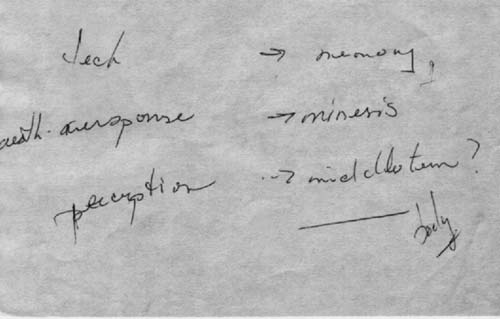
One of those notes followed by a list of nouns set in a table format.

the deontic considerations of permission and pleasure resonate with the application of mnemonic technologies . . .

and now the “table”

tech [arrow pointing right to] memory

aesth. response [arrow pointing right to] mimesis

perception [arrow pointing right to] middle term?

[and scribbled under “middle term” is a line and the word “body” so that “term” and “body” line up]

I am still not sure what I was striving at by positioning the body as a middle term between memory and mimesis but I do observe that the middle term comes after in the listing. Indeed there may be a syntagm in the ordering of memory, mimesis and body. It is mimesis that may be the middle term and if so then any one of the three can be the middle for the other two. The table can be redrawn as a triangle.

And so for day 266
06.09.2007

Posted in Transcriptions | Leave a comment

Reading Creases

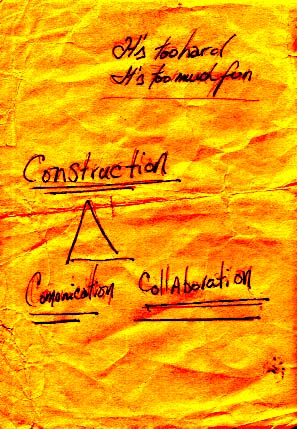
On a piece of yellow orange paper there is a diagram of the elements of constructivist pedagogy: an isosceles triangle oriented along a vertical axis with the bottom vertices labelled “communication” and “collaboration” with the apex, “construction”. An evident interpretation is to view construction as based in communication and collaboration, i.e. as the conditions for successful building.

Above this schema on the piece of paper are two lines that summarize anti-intellectual and anti-erotic positions:

It’s too hard

It’s too much fun

That the two attitudes are related to “construction” is likely since the paper is creased — truncating the triangle — and the fold tucks “collaboration” and “communication” to the underside leaving “construction” on the same side as the two lines. Makes one want to relate communication and collaboration to intellectual and erotic activities.

Uncreasing the paper and turn it over to the verso, one finds a listing that puts construction last after communication and collaboration, almost as if it were an outcome.

communication
collaboration
construction

Amazing what can be extracted from a small piece of note paper, folded and preserved for meditation and seeing anew.

Three Cs - Construction - Communication - Collaboration

Note – diagram
Construction – Communication – Collaboration

And so for day 265
05.09.2007

Posted in Transcriptions, Uncategorized | Leave a comment

Productive Renewal

Jan Lars Jensen. Nervous System or Losing My Mind in Literature
“A Can Opener for Our Times”

Serious people read non-fiction, after all. But non-fiction books can accommodate readers who drop in and out of their breadth. A person can still derive something useful from a fragment: maybe that’s what made non-fiction easier for me, with my perforated concentration.

Go to the chapter “Very Tricki Woo” to read more about the struggles to regain the faculty of reading with ease and the struggle posed by fiction for a mind struggling with delusions. “Hallucinatory prose is no fun if you yourself are hallucinating.”

And so for day 264
04.09.2007

Posted in Reading | Leave a comment

Ownership Patterns

Garet Garrett Ouroboros or the Mechanical Extension of Mankind Chapter VII “Dim Vistas New”

It must occur to you that what the world requires to find is a new conception of commerce among nations — one that shall be free of the predatory impulse, above the exploiting motive, competitive in some nobler sense.

[…]

This is very different from parasitism, which is one-sided, for gain only. And there is a very curious suggestion that organisms now existing together in a state of permanent symbiotic union were once parasitic and learned better.

I first picked up this slim volume because the title reminded me of Marshall McLuhan’s formulation of media as prosthetics. What I found was a treatise on macro economics. What I found in its confrontation of peasant and industrial interests was the foreshadowing of the growing importance of agribusiness.

In the language of the economist, the agricultural index will rise and the industrial index will fall. It will require a greater quantity of manufactures to buy a bushel of wheat; fewer bushels of wheat to buy a manufactured article. This will not be for one year or two. It will be lasting. It will affect the status of great groups and classes of people. In the cities and industrial centres the cost of living will move in a vertical manner.

Garrett concludes in an open ended fashion:

In any light, man’s further task is Jovian. That is to learn how best to live with these powerful creatures of his mind, how to give their fecundity a law and their functions a rhythm, how not to employ them in error against himself — since he cannot live without them.

The solution to surplus production is twofold: nurture the fashion system and harness to this system, storage. The surplus can serve as an archive for the self-renewing moves of the fashion system. Ouroboros, indeed.

And so for day 263
03.09.2007

Posted in Uncategorized | Leave a comment

little x little

Stewart Brand. How Buildings Learn: What happens after they’re built Chapter 6 “Unreal Estate” on lot size:

Small lots give greater individual control and thus greater variety, and they encourage more pedestrian activity. The more owners, the more gradual and adaptive the ongoing change. It’s a conservative, wholesome kind of change — the place looks a little different every year, but the overall feel is the same from century to century.

One wonders if an analogy might be drawn to the world of blogs — small incremental shifts at the local level — an essentially conservative genre.

And so for day 262
02.09.2007

Posted in Uncategorized | Leave a comment