Opening in the Key of Closure

Thanks to a birthday gift from a friend, I sought out after reading one of his novels
the poetry of Steven Price.

I am reading Steven Price’s Anatomy of Keys which takes as its subject the life and lore of Harry Houdini. First line of the first poem :

The trunk alone understands the journey.

It almost arrests the reading from the get go. But it turns like a key in a lock because of its liminal position set off as a single line, almost an epigraph. From its position at the head of a section it sets a course for the reading that follows. Packs a mystery. Will we, the challenged readers, reach understanding?

Where has our trunk been?

What do we need to contain? To release?

And so for day 2871
22.10.2014

Posted in Poetry | Leave a comment

Anxiety on Getting Thin

The Pooh Cookbook
Virginia H. Ellison
Illustration: Ernest H. Shepard

The Pooh Cookbook - Virginia H. Ellison - illustration: Ernest H. Shepard - cover

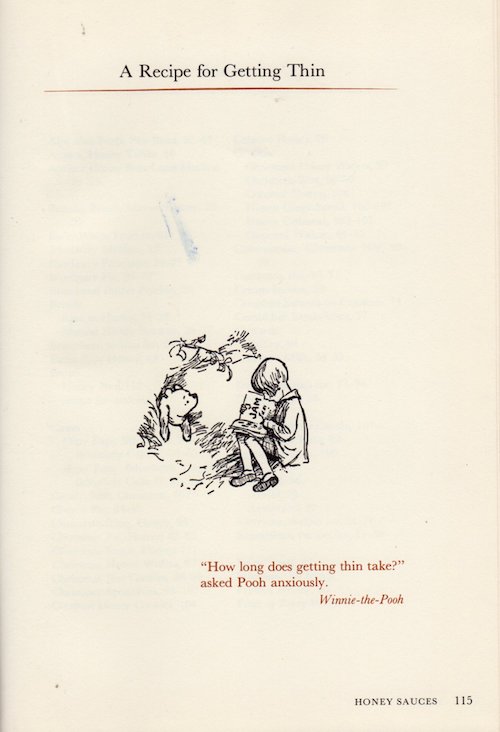
This is a trove of extravagant recipes: a variety of honey sauces; marmalade on a honey comb. It enticingly lists in the table of contents a recipe for getting thin. Well, it is a rather thin recipe.

The Pooh Cookbook - Virginia H. Ellison - illustration: Ernest H. Shepard - recipe for getting thin

Only a title and a blank page decorated with an illustration and a wee bit of dialogue: “‘How long does getting thin take?’ asked Pooh anxiously.” And with such a text … time stretches out.

And so for day 2870
21.10.2014

Posted in Food Writing | Leave a comment

Travel Triggers

Donald Culross Peattie
An Almanac for Moderns
excerpt from entry for “October Twentieth”

There is the utmost charm about collecting lichens for a hobby. Nothing is easier to press and mount. And there is an exquisite fragrance that lingers around even a venerable lichen herbarium, that calls back every mind with any nose for Nature at all — to days of emerald delight in the rainy woods of Maine where the long gray beards of Usnea sorrow over the sad dignity of old spruce boughs, or to sun-bitten, frost-tended rocks above the tree line on Mt. Washington. Or to the tundras of Lapland and the jungles of Surinam, if you happen to have been there!

and the prose itself like a preserved fragrance carries us away

And so for day 2869
20.10.2014

Posted in Perception | Leave a comment

The Quality of Slow

Like typing out a passage in lieu of copy and paste …

I wonder sometimes if there will be a revolt against the quality of time the new technologies have brought us, as well as the corporations in charge of those technologies. Or perhaps there already has been, in a small, quiet way. The real point about the slow food movement was often missed. It wasn’t food. It was about doing something from scratch, with pleasure, all the way through, in the old methodical way we used to do things. That didn’t merely produce better food; it produced a better relationship to materials, processes and labour, notably your own, before the spoon reached your mouth. It produced pleasure in production as well as consumption. It made whole what is broken.

https://www.lrb.co.uk/the-paper/v35/n16/rebecca-solnit/diary
London Review of Books
Vol. 35 No. 16 · 29 August 2013
DIARY
In the Day of the Postman
Rebecca Solnit

And so for day 2868
19.10.2014

Posted in Food Writing | Leave a comment

Unguarded Premises

Ursula K. Le Guin
“Escape Routes”
in
The Language of the Night: Essays on Fantasy and Science Fiction

What science, from physics and astronomy to history and psychology, has given us is the open universe: a cosmos that is not a simple, fixed hierarchy but an immensely complex process in time. All the doors stand open, from the prehuman past through the incredible present to the terrible and hopeful future. All connections are possible. All alternatives are thinkable. It is not a comfortable, reassuring place. It’s a very large house, a very drafty house. But it’s the house we live in.

Time to find that shawl or bulky sweater and settle in for more reading with a nice hot cup of cocoa.

And so for day 2867
18.10.2014

Posted in Metaphor | Tagged | Leave a comment

Voracious

Andreas Malm
Fossil Capital: The Rise of Steam Power and the Roots of Global Warming

Some blazing rhetoric to stoke the machine of revolution:

Capital does not eat because someone is hungry: capital always eats. The ecological voracity of this relation-in-process cannot be captured by a model of substitution and relief, precisely because it is not embedded within the natural limits of ecosystems. It operates on a higher level, above that of the use-value, in the thin abstract air of exchange-value, and just as it must pump out surplus labour in perpetuity, so it must pump out material substrata from the ground whether or not they are scarce. Capital is supra-ecological, one could say: a flying biophysical omnivore with its own peculiar social DNA. It is not a timeless growth pursuit bumping into walls of shortages and transcending them by moving on to abundant goods, not a universal process unfolding through reaction upon specific constraints. Rather, it is a specific process unfolding through a universal appropriation of biophysical resources, insatiable in its appetite, starting and ever continuing with energy.

This brilliant burst comes after pages and pages of careful historical analysis.

And so for day 2866
17.10.2014

Posted in Uncategorized | Tagged | Leave a comment

Cercis canadensis

View of our Eastern Redbud in its fall beauty. A friend reminded me of the joyful colour of the redbud in the fall. It is truly magnificent in the spring with its bloom of tiny pink flowers along the branches but in the fall the heart-shaped leaves reveal a yellow translucence. Her reminder affected the way I looks at the trees on my walks and in my yard.

Autumn shot of cercis (redbud) - yellow leaf

butter-rich leaves
groundward bound

And so for day 2865
16.10.2014

Posted in Gardens | Tagged | Leave a comment

Heterochrony

Mieke Bal
Narratology: Introduction to the Theory of Narrative
Fourth Edition

“Heterochrony”

My choice of the term heterochrony is motivated by the emphasis on difference, rather than multiplicity only. Migration, a much-discussed topic of our time, is the exemplary situation of the experience of time as multiple, heterogeneous. The time of haste and waiting, the time of movement and stagnation; the time of memory and of an unsettling present not sustained by a predictable future.

Ignoring, for an instant, the subtle punctuation here, one can list a set of oppositions, all devoid of a predictable future:

haste — wait
movement — stagnation
memory — present

What is remarkable upon further examination is that the terms and their relations are not limited to parallel pairings:

haste (present) — memory (stagnation) — movement (wait)

which is of course indicated by the punctuation (note that semi-colon that separates out the positioning of memory … ).

And so for day 2864
15.10.2014

Posted in Uncategorized | Tagged | Leave a comment

Ecologies of Performance

Aram Saroyan – Crickets

Two recordings:

Exhibit A

Performance of “Crickets” a poem by Aram Saroyan, during Other Minds Festival 23 – Sound Poetry: The Wages of Syntax. Recorded on April 9, 2018, at ODC Theater in San Francisco, California.

Exhibit B
1975 American sound poetry recording, 10+2.
Released December 21, 2004 on CD
Available via Naxos (if your library subscribes)

Exhibit C
The score:

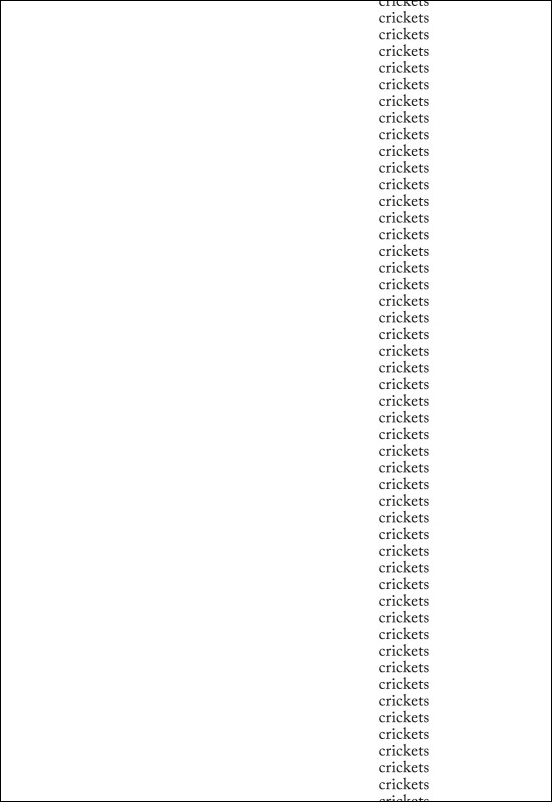
Aram Saroyan - Crickets

The 1975 version is rendered by one voice only… the 2018 version is more participatory and makes suggestive use of a recording of actual crickets to conclude. The score is wide open.

And so for day 2863
14.10.2014

Posted in Poetry | Tagged | Leave a comment

phanopoeia > montage > creation

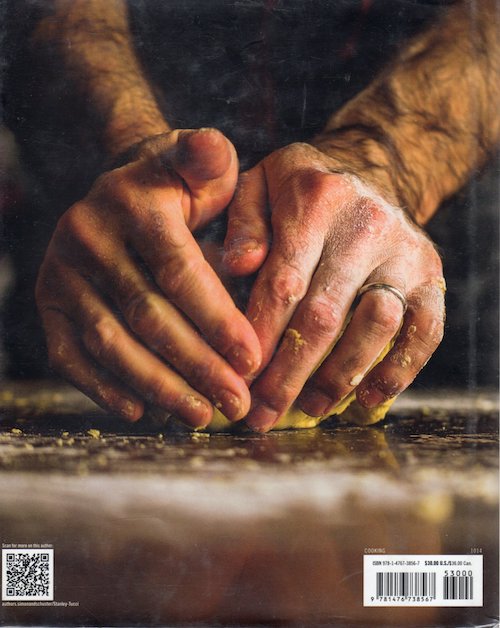
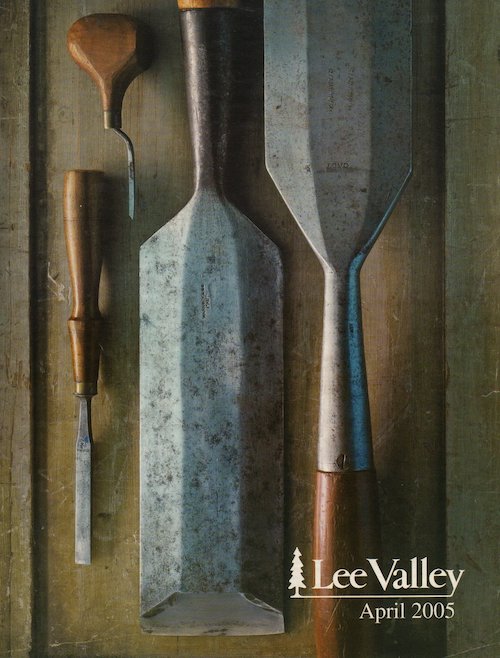
Images sometimes stay with one for a long while (e.g. this cover from a 2005 catalogue for Lee Valley) before they rhyme with another that opens up the imagination (the back cover of Stanley Tucci The Tucci table : cooking with family and friends). The theme of course is “work by hand”.

Hands kneading dough - back cover of The Tucci Table : cooking with family and friends

The hands of Stanely Tucci kneading dough from the back cover of The Tucci Table : cooking with family and friends

Cover of Lee Valley April 2005 catalogue - chisels

Marjorie Perloff in The Poetics of Indeterminacy: Rimbaud to Cage notes

Rimbauldian — or Poundian — phanopoeia is not, of course, a mere aggregate of concrete visual images. Eisenstein, who shared Pound’s predilection for the ideogrammatic technique of Chinese poetry, defined montage as follows:

… the juxtaposition of two separate shots by splicing them together resembles not so much a simple sum of one shot plus another shot — as it does creation. It resembles a creation — rather than a sum of its parts — from the circumstance that in every such juxtaposition the result is qualitatively distinguishable from each component element viewed separately.

Still perplexed by how memory is triggered to produce such “rhymes”. But not perplexed about the why: it’s about pure pleasure.

And so for day 2862
13.10.2014

Posted in Perception | Tagged , , | Leave a comment