
1 ) Breathe
2 ) Reduce the number of goals I set including reducing the number of goals I set.
3 ) Smile
And so for day 2861
12.10.2014
1 ) Breathe
2 ) Reduce the number of goals I set including reducing the number of goals I set.
3 ) Smile
And so for day 2861
12.10.2014
Dear Friend,
Thank you for the long view over the Montreal skyline into the landscape beyond. I, myself, tend to capture specimens in my own or “borrowed” gardens when out on walks. My long view is temporal. For some gardens that I have observed over many years the trees are now shading out the original plantings…
I have been making good use of the resources of the Toronto Public Library including their audio recordings. I discovered a BBC series (made from recordings in the British Library) of poets reading their own work. I have heard the three discs of the Americans and have on order the British. I find for the most part that poets are actually poor readers of their own work. There are two noteworthy exceptions among the Americans: e.e. cummings and Amiri Baraka. I find their cadences conversational, like invitations that build a space of reciprocity, an awareness of the listener. Or so I believe.
This return to aurality makes me wish I was teaching online. I would have my students read a passage aloud and choose another student to provide a verbal comment on the selected passage who would then choose someone else to produce a written note to share with the class. Rinse and repeat. The trick, learnt from language teaching, is to have them speak, listen, read and write. And with audio-visual records being easy to produce an environment is provided for full language use by the students.
But instead of being in the classroom, I am engaging with colleagues through the Humanities Commons where I blog and participate in two groups: one on narratology and another on literary theory. Perfect for whiling away the time in retirement.
Interestingly, I was doing a blog entry on Benjamin Franklin’s sayings from Poor Richard’s Almanack and in the research came across the Wikipedia entry for John Lancaster, who coined the phrase “a place for everything and everything in its place.” I found out that he was an educator.
Lancaster’s ideas were developed simultaneously with those of Andrew Bell in Madras whose system was referred to as the “Madras system of education”. The method of instruction and delivery is recursive. As one student learns the material he or she is rewarded for successfully passing on that information to the next pupil.
The online environment allows the teacher to witness these acts of transmission peer-to-peer.
Well, enough of my ramblings. And wishing you clear skies for your vista. Or mists should you prefer Keats.
F
And so for day 2860
11.10.2014
The Sayings of Poor Richard (Toronto: The British Educational Society, [nd]) reprints a biography from 1938 published by The Grolier Society Limited in which one reads:
He never countenanced the accumulation of wealth for its own sake, but for its uses, — its prompt convertibility into social comforts and refinements.
Beside which we put this saying from the 1734 Almanack (encountered several pages early in this fine pamphlet):
An egg to-day is better than a hen to-morrow.
One is reminded, à chaque jour, of the French homophones: fin and faim.
And it is wise to have an end to the hunger of accumulation.
Via contemplating Benjamin Franklin.
And so for day 2859
10.10.2014
#picnic
“Breaking bread with the dead is not a scholarly task to be completed but a permanent banquet, to which all who hunger are invited.”
Alan Jacobs – Breaking Bread with the Dead: A Reader’s Guide to a More Tranquil Mind
#banquet #hunger
And so for day 2858
09.10.2014
Roland Barthes towards the end of Criticism and Truth in the last section (“Reading”) translated by Katrine Pilcher Keuneman gives an account of four functions in the Medieval transmission of verbal artefacts:
scriptor: who copies without adding anything
compilator: who adds nothing of their own
commentator: who makes a personal contribution to the copied text only to render it intelligible
auctor: who gives their own ideas, always justifying their views with reference to other authorities
These four functions I recognize in the writerly and readerly activity across contemporary social media: I salute those who fulfill scriptor, compilator, commentator, auctor and lurker roles.
For though Barthes doesn’t mention the reader-who-is-silent there is room in this taxonomy for their contribution to the writing-that-is-to-come.
And so for day 2857
08.10.2014
Stanley Tucci
Preface
The Tucci Cookbook
My family spends hours deciding what to make for a certain meal and days preparing it, and while the food is being eaten, discusses not only its merits and its faults, but what it tasted like when prepared at such and such a restaurant, or by this and that family member or friend, and what it really should be served with, which inevitably leads to a discussion of where it was first eaten and with what, and how that dish was prepared and how one day wouldn’t it be really nice to make that dish, which really is one of the best dishes ever eaten, though it could never compare to a dish once eaten in … and so on and so on.
A scrumptious, almost run-on, sentence reminding one of others …
And so for day 2856
07.10.2014
Winnie the Pooh
“Well,” said Owl, “the customary procedure in such
cases is as follows.”“What does Crustimoney Proseedcake mean?” said
Pooh. “For I am a Bear of Very Little Brain, and long words
Bother me.”
Winnie L’ourson
— Ma foi, dit Hibou, la procédure coutumière dans un cas de ce genre est la suivante.
— Que veut dire : Prosucré Croûtumiel ? dit Winnie. Car je suis un Ours de Très Peu de Cervelle, et les mots trop longs m’Embarrassent.
I do admire how “honey” and “sugar” got in there. Simply delicious. Care of Jacques Papy translating A.A. Milne.
And so for day 2855
06.10.2014
I have been following the postings of José Angel García Landa at the Humanities Commons Narrative Theory and Narratology site. One posting brought me to rethink again the status of the relation between narration and description:
To the temporal preoccupations stated there I attached a link to the world-game-narrative posting on Berneval.
The temporal aspect of narration allows us to approach the description/narration relations from another angle:
https://berneval.hcommons-staging.org/2014/09/16/3n-plus/
A widened understanding of narration (that includes acts of description) allows us to see narration as the process that generates world, game and narrative. Narrativity is the potential, narration is the (temporal) process and world, game or narrative are the products (figurations).
I want to explore more.
Narration in a material sense consists of Description, Deposition, Disposition.
These three (Description, Deposition, Disposition) are material practices akin to the three different types of mimesis outlined in Paul Ricoeur’s Time and Narrative: refigure, configure, prefigure. I have reversed their usual order of presentation. Ricoeur is centred on the creation of texts from an authorial prefiguring through the configuring in the act of reading and finally the refiguring of the reader’s own self. In a world of endless semiosis the trajectories need not follow this singular path. A refiguring of the self-in-relation can prefigure a novel configuration.
Description is oriented outward and disposition is inner-directed. Description could be related to pre- or re-figuration. The deposition is what we find in configuration.
In a network, each node is an opportunity to devote attention narration and thus move to world making, game playing or storytelling.
And so for day 2854
05.10.2014
In tracing a web site from a URL from a piece of ephemera, I realized that the effort to build a community of likemindedness routed itself via belief. But when I reviewed the inspiring words, they did not reference acts of belief.
Led me to contemplate how “believing” is often wedged between “knowing” and “being” (“doing”).
If one were to lay out the states of mind along the syntagm of say a Bildungsroman, one would have the following schema:
knowing — believing — being — doing
In our Bildungsroman scenario, believing seems to me to be a hurdle. It represents a significant investment of mental energy. Could there be a metafictional moment where the wedge of believing is dislodged? In its place would be an imagination driven by hypothesis: asking “what if” and testing the results. Minimal investments but it seems that such a fictional world that is constantly tested would be more precarious than one built upon belief. There seems to be in inverse curve between investment and stability.
In our Bildungsroman scenario is there a potential moebius reversibility to the narrative syntagm?
believing — knowing — doing — being
A re-lodging as a way of addressing the precarity triggered by a total dislodging?
There’s a lot of fiction to read (or write) before figuring this one out. A significant investment.
And so for day 2853
04.10.2014
From the period following Jack Layton’s death: name sticker inviting the wearer to identify as believing in love, hope and optimism.
In the New Democratic Party orange …
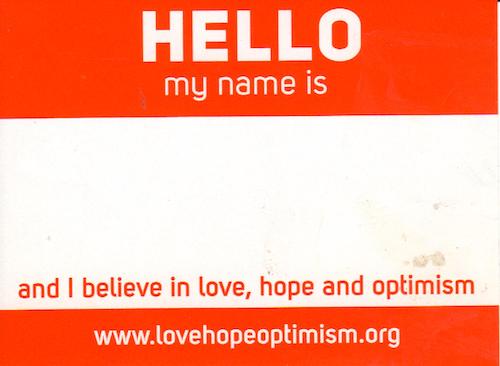
Name sticker / advert circulating in wake of Jack Layton’s death
The web site referenced by the URL is now defunct but parts are available through the Wayback Machine:
https://web.archive.org/web/20120615115115/http://lovehopeoptimism.org/
We learn that this was designed by marketers:
FreeFlow Marketing is a Toronto based Internet Marketing Company that is helping us bring this community online. Pulp & Fiber helped us create and print all of the stickers you see being handed out across the city. Without the generosity of these two companies, this just wouldn’t be possible!
The name sticker is but a piece of ephemera. The portal to the online community defunct. The words that triggered the campaign and sail beyond its heyday …
Quoted on the front page of The Globe and Mail (August 23, 2011)
My friends, love is better than anger. Hope is better than fear. Optimism is better than despair. So let us be loving, hopeful and optimistic. And we’ll change the world.

You don’t need to believe. You need to be.
And so for day 2852
03.10.2014