National Temperaments

Waverley Root
The Food of Italy

“What is the basic difference between French and Italian cooking?” Enrico Galozzi, the noted Italian gastronomic expert, echoed my question. “French cooking is formalized, technical and scientific. Order Béarnaise sauce in 200 different French restaurants and you will get exactly the same sauce 200 times. Ask for Bolognese sauce in 200 different Italian restaurants and you will get 200 different versions of ragù.”

Is this observation still relevant today?

And so for day 2851
02.10.2014

Posted in Food Writing | Leave a comment

Lifting Lines, Shuffling Words, Plucking Strings

one of those haiku moments aided by the disposition of the longer text into couplets

in the closet full
of guitars and stomped hay

Gillian Conoley
“We Don’t Have to Share a Fate”
from the book A Little More Red Sun on the Human: New & Selected Poems

the startling visual impact of the lines is attributable in part to an early exposure to film:

Film was my first experience of art. As a writer, I envy film’s ability to immediately draw us in to a world that looks so much like the one we walk in.

https://www.poetryfoundation.org/poets/gillian-conoley

the mind is arrested and reels back:

guitars, stomped hay, closet full

And so for day 2850
01.10.2014

Posted in Uncategorized | Leave a comment

Banquet Hunger

Alan Jacobs
Breaking Bread with the Dead: A Reader’s Guide to a More Tranquil Mind

In his book Jacobs offers a reading of Kipling’s poem “The Gods of the Copybook Headings

Here are two extracts from Jacobs’s book that would make good headings for a future copybook:

Wisdom lies in discernment, and utopianism and nostalgia alike are ways of abandoning discernment.

Breaking bread with the dead is not a scholarly task to be completed but a permanent banquet, to which all who hunger are invited.

Perhaps not enough to satiate a monstrous banquet-hunger but surely enough to furnish the fixings for a good picnic for those with frugal discernment.

And so for day 2849
30.09.2014

Posted in Uncategorized | Leave a comment

Crumbs of Metadata

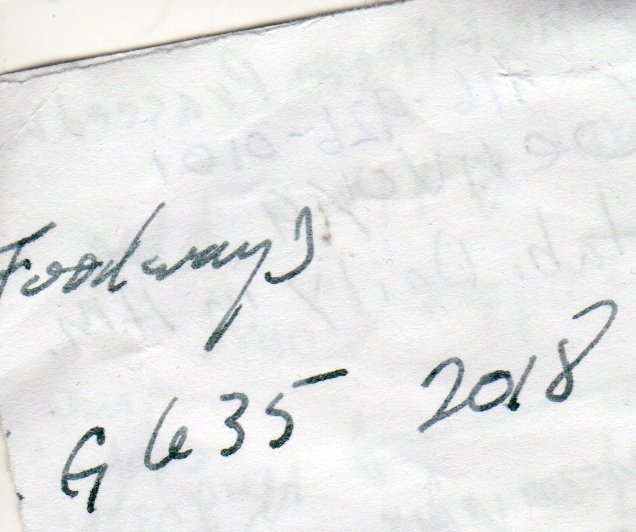
A habit I picked up from my parents: recycling paper by cutting up sheets with printing or writing on one side but blank on the other. The tearing up is meditative and bonus it creates a stack of slips great for note taking while reading or jotting down a shopping list.

And sometimes one grows curious about the traces left by this practice. Note part of a title, part of a call number and a publication date on this example:

Foodways G635 2018 -- a scrap

Part of a title
Part of a call number
A publication year

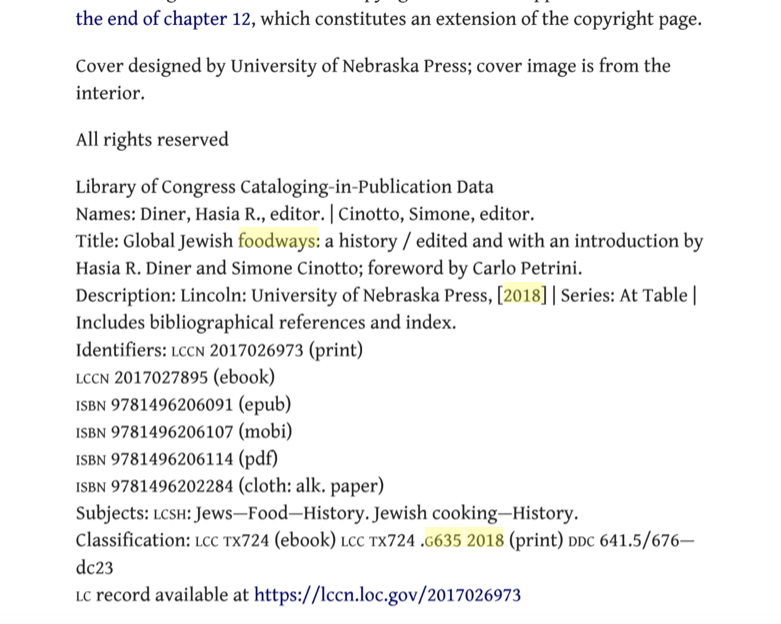
A quick online search restores the reference:

Metadata with highlights - Foodways G635 2018

Google Books – screenshot of metadata

This appears to be a reference work I consulted in my search for the origin of “sugar bones” and Yiddish connections to this appellation.

Searching for the Origin of Sugar Bones

Still amazed by the robustness of the metadata structures that allowed for the recuperation of a full reference from three small elements.

And so for day 2848
29.09.2014

Posted in Food Writing | Leave a comment

Masks

Akwaeke Emezi
Pet

But when realities diverged and you found yourself on a different path from people you used to share a path with … well. Masks were useful then; not quite lies, not quite truths. Just decisions about what to be and what to show. Curation.

I like how the passage oscillates between competing approaches to social interaction, alternating between truth-telling or truth-concealing. And finally opts for context-sensitive tactics by landing on the all encompassing word: curation.

And so for day 2847
28.09.2014

Posted in Uncategorized | Leave a comment

Blind Spot: The Backstory on Night Writing

Naomi S. Baron
Words Onscreen: The Fate of Reading in a Digital World

Touch is obviously a critical component of reading for people using Braille. Those raised dots representing letters of the alphabet have an interesting backstory. While it was Louis Braille who in 1824 created the system currently used for making written text accessible to those with visual impairment, we have a French army captain to thank for the idea. In response to a demand from Napoleon to devise a system enabling soldiers to read messages in the dark without needing light. Charles Barbier de la Serre invented “night writing,” a system based on twelve raised dots.

And so for day 2846
27.09.2014

Posted in Uncategorized | Leave a comment

Cues for Search and Rescue

rupi kaur
the sun and her flowers

on the particularities of nostalgia

leaving her country
was not easy for my mother
i still catch her searching for it
in foreign films
and the international food aisle

And so for day 2845
26.09.2014

Posted in Poetry | Leave a comment

Ingress and Egress

John Ota
The Kitchen: A journey through history in search of the perfect design

I’ve always felt that a front door holds special significance as an architectural element. It is the point of welcome. It is the place of happy first hugs and greetings and, later, of long goodbyes.

“Gamble House Kitchen”

And so for day 2844
25.09.2014

Posted in Uncategorized | Leave a comment

Fear Not!

Akwaeke Emezi
Pet

Jam, our protagonist, upon viewing pictures of angels in an old book:

They were supposed to be angels, but they were terrifying; eyes filled with licking flames even as they look out form the page, armoured faces that weren’t faces, wings full of mouths, wheels of reddened eyes, four-headed forms that weren’t even vaguely human. […]

This recalls for me this passage in Silence, Simplicity, and Solitude where David A. Cooper quotes Louis Ginzberg (The Legends of the Jews Vol. 3):

The story of Moses on the mountain, as told in the Bible, is only half-complete. The collection of Jewish folklore, called the Midrash, gives us the other side. There we read that Moses not only saw “all of the seven heavens, and the celestial temple,” hearing the angles praising God […] But also, “when he started to descend and behold the hosts of the angles of terror, angels of trembling, angels of quaking, and angels of horror […]”

Jam’s mother, Bitter, points out to her daughter (and thus reminds the reader) that good is not innocent.

And so for day 2843
24.09.2014

Posted in Uncategorized | Leave a comment

Sounding

Matthew Rubery
The Untold Story of the Talking Book in the chapter on Caedmon

Still, there were limits to what cold be translated across media. Certain poems worked on the page alone. One of Caedmon’s album sleeves reprinted Christian Morgenstern’s “Fisches Nachtgesang,” a concrete poem with alternating lines of macrons and breves loosely arranged in the shape of a fish. No attempt was made to record it. What was the narrator supposed to do with a soundless poem?

Look:

https://de.wikipedia.org/wiki/Galgenlieder#/media/Datei:Galgenlieder_025.jpg

I wonder what my friend Jeanne Iribarne author of Sound strategies: the acoustic in early modernist poetry, 1910-1935 would make of the challenge. Would she agree that the layout of macrons and breves could act as a score for a translation of sorts into audio form?

And so for day 2842
23.09.2014

Posted in Uncategorized | Leave a comment