The Ideal Spot for the Ideal Plant Person

Beth Chatto
Woodland Garden: Shade-loving Plants for Year-round Interest

I like the analogy between people and plants in the opening paragraph of the introduction:

Most people have some shade in their garden; it may be dry and dusty, or dark and damp; often it is a problem. Whether it is a bed shaded by a wall or fence or an area beneath trees or shrubs, somehow it tends to look dull. Plants grow tall and lanky, or disappoint by failing to flower, generally because the gardener is keen to fill every space with colour — with flowers, of course — and uses plants that thrive in open, sunnier parts of the garden. But plants are like people and do not take kindly to being thrust into any situation, any more than we can tolerate being pushed into any kind of job.

Hard to imagine a better case to champion finding one’s niche by respecting those of others.

And so for day 2831
12.09.2014
Posted in Uncategorized | Leave a comment

Idiolect: Weathers

From Michael Enright, host of CBC Sunday Edition

Canadians are a winter people and we know the indifference of nature — Michael’s essay

From time to time, I am roundly criticized by listeners for using the phrase, “all the news and all the weathers.” Plural.

I make no apologies. I take my cue from Mr. Twain: “In the spring, I have counted 136 different kinds of weather in 24 hours.”

Writers and poets have made the weather a staple of their creative work.

The English critic, John Ruskin, rhapsodized about every element of weather.

“There is no such thing as bad weather,” he wrote, “Only different kinds of good weather.”

And so for day 2830
11.09.2014

Posted in Uncategorized | Leave a comment

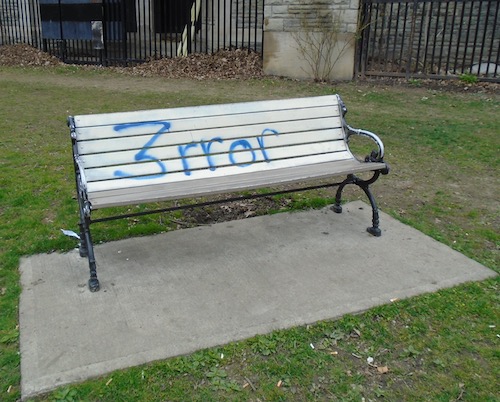
Error or Terror

Our eyeballs spotted this graffito repeatedly, on benches, on windows, on walls, in parks and allies…

3rror

graffito found on walls and benches in the west end of Toronto


A signature? A message about the state of the world?

And so for day 2829
10.09.2014

Posted in Uncategorized | Leave a comment

Pluralities

Louis MacNeice
Snow

The second stanza

World is crazier and more of it than we think,
Incorrigibly plural. I peel and portion
A tangerine and spit the pips and feel
The drunkenness of things being various.

It’s the mid section between the end of the first stanza “World is suddener than we fancy it” and the end of the last “On the tongue on the eyes on the ears in the palms of one’s hands— / There is more than glass between the snow and the huge roses.” It is us in between and between us.

And so for day 2828
09.09.2014

Posted in Perception, Poetry | Leave a comment

3 Solitudes

London Review of Books
Vol. 3 No. 9 · 21 May 1981
“Sexuality and Solitude”
Michel Foucault and Richard Sennett

Let me now say something about what the word ‘solitude’ means. We know three solitudes in society. We know a solitude imposed by power. This is the solitude of isolation, the solitude of anomie. We know a solitude which arouses fear on the part of those who are powerful. This is the solitude of the dreamer, of the homme révolté, the solitude of rebellion. And finally, there is a solitude which transcends the terms of power. It is a solitude based on the idea of Epictetus that there is a difference between being lonely and being alone. This third solitude is the sense of being one among many, of having an inner life which is more than a reflection of the lives of others. It is the solitude of difference.

Richard Sennett
https://www.lrb.co.uk/the-paper/v03/n09/michel-foucault/sexuality-and-solitude

And so for day 2827
08.09.2014

Posted in Uncategorized | Leave a comment

Working Without a Net

At 5:20 minutes …

I’m not interested in an insurance plan for my work.

Leonard Cohen in an interview with Adrienne Clarkson 1966

And so for day 2826
07.09.2014

Posted in Uncategorized | Leave a comment

Choices: Impossible Not to Make

forever open to semiosis

the all-but-infinite array of potential explanations, illustrations, associations, glosses and exempla, even stories, that may be said to lie not only behind any verbal formulation but also behind any real-world image, scene, action, interaction. Enough said?

John Barth “Click
The Atlantic Monthly; December 1997; John Barth; Volume 280, No. 6; pages 81-96.

And so for day 2825
06.09.2014

Posted in Uncategorized | Leave a comment

Dreamwork versus Working the Dream

Bernard Dieterle and Manfred Engel write in the preface to Writing the Dream Écrire le rêve

Comparing the literaricized dream-report with the empirical one shows the workings of two different concepts of factual dream-notation: whereas the latter tries to remain faithful to the memorized dream, the former strives for the creation of a plausible dream-experience for the reader.

memory, notation, dream — notice the position of notation between dream and memory — facing backwards in an archaeological fashion and retaining the teleology of more dream fabrication to come

https://hcommons-staging.org/deposits/objects/hc:29980/datastreams/CONTENT/content

And so for day 2824
05.09.2014

Posted in Uncategorized | Leave a comment

Curiouser

Richard Hughes
A High Wind in Jamaica (1929)

So much for Rachel. The inside of Laura was different indeed: something vast, complicated, and nebulous that can hardly be put into language. To take a metaphor from tadpoles, though legs were growing her gills had not yet dropped off. Being nearly four years old, she was certainly a child: and children are human (if one allows the term “human” a wide sense): but she had not altogether ceased to be a baby: and babies of course are not human — they are animals, and have a very ancient and ramified culture, as cats have, and fishes, and even snakes: the same in kind as these, but much more complicated and vivid, since babies are, after all, one of the most developed species of the lower vertebrates.

In reading these descriptions of the inner life of child characters, I found myself thinking of Virginia Woolf and The Waves (1931). And my thoughts wondered to the topic of the representations of children in literature and to the discovery of a bibliography that grows to include a fair-sized niche in queer theory. And I wonder if in some small tidal pool there is not a study of the sea and the child to be found.

And so for day 2823
04.09.2014

Posted in Uncategorized | Leave a comment

Parameters for Partners

Let us count the ways …

One of the things I have wanted to do in both of my books is to treat gay male relationships – whether partnered or promiscuous, durable or transient – as what they are: models for sociality that are as complex, as ethically and emotionally rich, as productive of meaning and value, as any other.

Garth Greenwell

https://www.theguardian.com/books/2020/may/08/i-wanted-something-pornographic-and-high-art-joy-of-writing-about-sex

And so for day 2822
03.09.2014

Posted in Uncategorized | Leave a comment