Eros, Dialectic, Self and Futurity

Matthew B. Crawford
The World Beyond Your Head: On Becoming an Individual in an Age of Distraction

Rethreading some passages in a different order so as to bring out the future-directed topos.

On dialectic (p. 210)

[T]his orientation toward the future requires a critical engagement with the designs and building methods of the past. They learn from the past masters, interrogate their wisdom, and push the conversations further in an ongoing dialectic of reverence and rebellion.

On the erotic (p. 67)

[W]e are erotic: we are drawn out of our present selves toward some more skilled future self that we emulate. What it means to be erotic is that we are never fully at home in the world. We are always “on our way.” Or perhaps we should say that this state of being on our way to somewhere else is our peculiar human way of being here in the world.

On individuality [as opposed to individualism] (p. 250)

I suggested that it is by bumping up against other people, in conflict and cooperation, that we acquire a sharpened picture of the world and of ourselves, and can begin to achieve an earned independence of judgment.

There is something Epicurean at work here. The future emerges from our orientation (and attention) to the world and others. The world presents novel situations and the situated self responds.

And so for day 2811
23.08.2014

Posted in Uncategorized | Leave a comment

Human Alliance & Network Games

A game … A name …

Bolo is a video game created for the BBC Micro computer by Stuart Cheshire in 1987, and later ported to the Macintosh in its most popular incarnation. It is a networked multiplayer game that simulates a tank battlefield. It was one of the earliest simultaneous multiplayer networked games.

[…]

that his Indian wife inspired the name. As Cheshire noted in his original documentation for the game, “Bolo is the Hindi word for communication. Bolo is about computers communicating on the network, and more important about humans communicating with each other, as they argue, negotiate, form alliances, agree strategies, etc

https://en.wikipedia.org/wiki/Bolo_(1987_video_game)

And so for day 2810
22.08.2014

Posted in Uncategorized | Tagged | Leave a comment

Tao and the Sensory Modalities

D.C. Lau in the introduction to the Penguin edition of Lao Tzu remarks:

[O]ne sometimes gets the feeling that the line is blurred between the tao as an entity and the tao as an abstract principle that is followed. These two are confused because they share in common the characteristic of transcending the senses. This a confusion not unlike the one mentioned in chapter XIV:

What cannot be seen is called evanescent;
What cannot be heared is called rarefied;
What cannot be touched is called minute.
These three cannot be fathomed
And so they are confused and looked upon as one.
[…]

And so I am brought to Ursula K. Le Guin’s version of chapter 14 “Celebrating Mystery”

Look at it: nothing to see.
Call it colorless.
Listen to it: nothing to hear.
Call it soundless.
Reach for it: nothing to hold.
Call it intangible.

Triply undifferentiated,
it merges into oneness,
[…]

And recall that the sensory modalities are also featured in chapter 12 “Not Wanting”

The five colors
blind our eyes.
The five notes
deafen our ears.
The five flavors
dull our taste.
[…]

In D.C. Lau’s version

The five colours make man’s eyes blind;
The five notes make his ears deaf;
The five tastes injure his palate;
[…]

In this discursive universe, the naming (calling) runs a kind of interference for an apparatus that is already defective or limited.

Le Guin’s version leads me to construct a table of imperatives that bring back the sensing to naming and the naming to sensing.

look listen reach
call call call

And so for day 2809
21.08.2014

Posted in Perception | Leave a comment

Skewer

Sometime, oh sometimes, I have to admit loving the thrust and parry found in the reviews. Witnessing courteous delivery of comeuppance appeals to a sense of justice.

Where language is concerned, Sokal and Bricmont, bigots to the last, lose the plot altogether, and sink to the low point of declaring that their gallery of impostors have no title to any ‘poetic licence’ (a concept I was startled to discover was still in the land of the living), for ‘their intention is clearly to produce theory, and … their style is usually heavy and pompous, so it is highly unlikely that their goal is principally literary or poetic.’ The noise you hear, reading an insultingly simplistic sentence like that, is of the ocean rushing hungrily back to fill the channel dividing those time-honoured adversaries, the Two Cultures.

John Sturrock “Le pauvre Sokal” (London Review of Books, 16 July 1998) reprinted in The Meaninglessness of Meaning.

For an insightful set of lectures on the history of the controversy over the arts-science divide see Lisa Jardine’s 2012 Tanner Lectures.
https://tannerlectures.utah.edu/Jardine%20Lecture.pdf

And so for day 2808
20.08.2014

Posted in Uncategorized | Leave a comment

Poetry, Science, Insects

I have been beginning my day by dipping into a daily reading of naturalist Donald Culross Peattie from the collection An Almanac for Moderns (1935 rpt 1980). The conclusion to the entry I read today with its theme of poetry and science is striking:

I accept the challenge of the artists that cool investigation may often be the death of poetry. As knowledge lessons the terror of plague, so it may take some of the soulfulness out of nature. There is a sort of Wordsworthian sermonizing that shrinks before the biological frame of mind, just as the childish abhorrence of insects vanishes with familiarity. But not all poetry is really good poetry (however good it may sound). Good poetry is swift-winged, essential and truthful description — and so is good science.

I like the image of overcoming fear of insects by a biological turn of mind. One can no doubt imagine many other cases where an inquiring frame of mind does likewise.

And so for day 2807
19.08.2014

Posted in Uncategorized | Tagged | Leave a comment

A Breakable Vessel

“Human Bodies”
by Yehuda Amichai
Paris Review Issue no. 122 (Spring 1992)

Do not give me your soul,
Give me your body I shall never know to the end,
Give me the vessel, not the wine.

Which reminds me of the Hassidic tale of the jug

https://berneval.hcommons-staging.org/2009/04/20/jug-jug/

And so for day 2806
18.08.2014

Posted in Poetry | Leave a comment

Food & Writing

Classic Koffmann
Pierre Koffmann

From the cover

Classic Koffmann - cover

there is no secret. it is all
about working hard, using
few but the right ingredients
and enjoying food.

oh, and you need a bit of luck!

For “food” read “writing”.

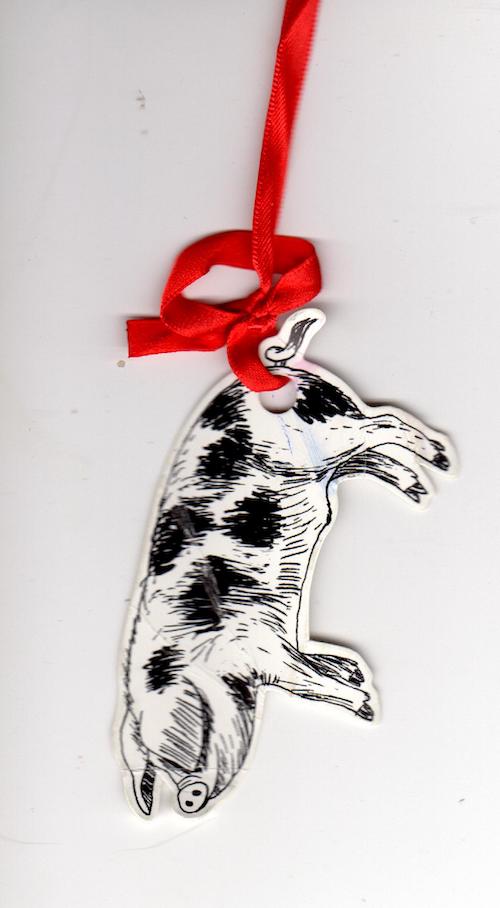
In addition to this smartly designed paratext there is a lovely book marker that reprises the stylized pig.

Classic Koffmann - book marker

And so for day 2805
17.08.2014

Posted in Food Writing | Leave a comment

Pronouns and Invitations

Dear X

Your analogy of the exchanged glasses offering a different view has inspired me to elaborate.

I begin with the observation that the embodied I is reflected in the imagined you. We come to speech via a model of who we wish to address.

I note that in your analogy of the glasses that the “you” gains perspective and moves from a position of not knowing to one of knowing. This could easily be construed as a conversion narrative (“I was blind and now I see”) but I think you are striving for a conversation narrative. I think in your practice, the “you” is formulated as an interlocutor willing to listen, to entertain a perspective (whether new to them or not). In a sense you are inviting the interlocutor to come along on a trip to visit some terrain and see what might be discovered — even if it is a well-traveled trail there is always serendipitous events along the way. In your ideal interlocutor, there is a willingness to be surprised. That is at the core of the conversation (which you model in yourself).

[…]

I speak because I trust the other is willing to listen. This amounts to a trusting of silence at the core of my own speech.

The pronouns don’t always matter. You could conduct a whole conversation with the first person plural and still structure it as a conversation, a set of invitations to ponder something from a particular angle … “if we consider …” “let us pause and reflect …” These are the phrases that entice the listener to try on the glasses being offered. To embrace an apparatus that will allow them to perceive differently.

I guess there is a koan at play: speaking to listen.

You are running with a pack. I, you, we. They are yours to occupy and spring from.

[…]

Your devoted auditor,

F

And so for day 2804
16.08.2014

Posted in Uncategorized | Leave a comment

Ackermann on W’s Sanitation Philosophers

Robert John Ackermann
Wittgenstein’s City

Last chapter – “Philosophy” – opens by casting this image forth:

The basic thrust of Wittgenstein’s view of philosophy as a descriptive critique of language remains in place as his survey reveals more and more of the City. Wittgenstein’s philosophers function as sanitation corps within the City. They speak the local language while they sweep up and dispose of the trash, leaving the City clean and orderly. Philosophy is not the teaching of a set of philosophical doctrines but the activity of putting the City in order. At one point, Wittgenstein compares philosophy to arranging the books of a library, in which putting a few books on the same topic together is a modest sign of progress. In the same way, when order is established in any part of the City, the condition of the whole City is improved.

A call to the dignity of work? A reminder of recurrence?

And so for day 2803
15.08.2014

Posted in Metaphor | Leave a comment

Of Pronouns, Balance and Being Canadian

Dear X

Yes “our discourse” has been less than positive. More my contributions to it have been nit picky and darn ornery.

I do want to commend you for speaking up and holding me to account.

I have thought a lot about what I was really driving at in so inept a fashion. I think I confused your call for balance for a call for neutrality. Reminded by Pierre Berton’s remarks about Canadians and canoes, I can now see that the call to stay balanced is also a call to keep paddling.

I am willing to wager that your canoe will bring you back to podcasting and that the little portage through writing/scripting will allow you to shoot the rapids. I know I’m stretching the analogy. So why not imagine that the podcast conversations take place in a canoe? Who all is in the canoe? I bet there is an “I” rooted in time and place and willing to speak from a specific locale. I know from your call out there is a sense of a “you” — someone who has some basic paddling skills — your imagined listener. I imagine your “we” is not an expansive, amorphous, universal but a construction out of the embodied I and the imagined you.

[…]

I truly believe that you have a unique voice. One that deserves to be heard. I for one definitely want to hear more of your “I”. Out on a calm lake or shooting the rapids…. or guiding the water cooler chatter.

BTW what Pierre Berton said was cast in the third person (opening up a non-coercive space for a “you” to project themselves into) : A Canadian is someone who knows** how to make love in a canoe.

With that image in mind, I leave you to your ruminations. F

** Note: knowing and making are distinct activities.

And so for day 2802
14.08.2014

Posted in Metaphor | Leave a comment