The Big Big Picture

Shades of Octavia Butler Xenogenesis and the Oankali

Bethany Nowviskie
“Capacity and Care”

And some of these re-framings hinge on metaphors that seem particularly well-suited to our current scene: ways, for instance, in which we might begin to position culture and human production as just one part of a huge, complex, and long-term data-processing system—a system that’s biological and ecological and evolutionary and geological in nature, as well as social and historical.

Source: http://nowviskie.org/2015/on-capacity-and-care/

Reminds me of some of the stuff that Robert Bringhurst wrote on ecosystems.

Mythtellers however are prone to remember (and writers to forget) that the languages of words are not the only kind of human language, and the languages spoken by humans are only a small sub-set of language as a whole. Some deeply human stories tell us this is so.

Source: https://cjee.lakeheadu.ca/article/viewFile/252/122

we live in a small, small place with a long, long memory

And so for day 2801
13.08.2014

Posted in Uncategorized | Leave a comment

GAIA – Italian Style

Tracking down the acronym GAIA after seeing a BBC short on Sardinian longevity.

Explained by Dr. Raffaele Sestu at 41 seconds in … and floating by fast.

(for more https://www.bbc.com/reel/playlist/elixir-of-life?vpid=p08blgc4)

And a print source:

Da anni Gianni Pes, studioso di longevità, ricercatore all’Università di Sassari e Raffaele Sestu, medico e presidente delle Pro Loco, cercano di spiegare ai forestieri quale sia la soluzione dell’arcano per campare chent’annos. «Determinante è il fattore Gaia, acronimo di genetica, ambiente, alimentazione, integrazione e autostima». Pes e Michel Poulain, pionieri degli studi sui centenari, davano chiare coordinate su dove fosse nascosto il Graal: «La famiglia; lo scarso o nullo tabagismo; il semivegetarianismo; l’attività fisica moderata ma costante; la percezione di esser utili socialmente; il consumo di legumi».

Translation with some machine assistance…

For years Gianni Pes, longevity scholar, researcher at the University of Sassari and Raffaele Sestu, doctor and president of the Pro Loco, have been trying to explain to foreigners what the solution of the esoteric question of living to a hundred years. «The determining factor is the Gaia factor, an acronym for genetics, environment, nutrition, integration and self-esteem». Pes and Michel Poulain, pioneers of the studies on centenarians, gave clear coordinates on where the Grail was hidden: «The family; little or no smoking; semivegetarianism; moderate but constant physical activity; the perception of being useful socially; the consumption of legumes “.

I media stregati dal fascino dei centenari ogliastrini from L’Unione Sarda.it

G = genetica
A = ambiente & alimentazione
I = integrazione
A = autostima

I like how it all interlocks … social integration both fosters and is encouraged by self-esteem; environment and nutrition are linked.

And so for day 2800
12.08.2014

Posted in Food Writing | Tagged | Leave a comment

What Peaks Through

Shoshana Zuboff
The Age of Surveillance Capitalism: The Fight for a Human Future at the New Frontier of Power

[525 pages plus notes]

It is a whopper and for most of the book it is a relentless description of power and greed and danger.

There are a few glimmers. This recognition of frailty, an “unrelenting hunger” offers a hint of other ways of satisfying needs.

p. 255

This process can be accomplished successfully only in the presence of our unrelenting hunger for recognition, appreciation, and most of all, support. [process = rendition of personal behavioural data]

And we are left to understand that it may be that very hunger that will gum the works ..

And much much later we get the shopping list:

p.306-307

The capacity for self-determination is understood as an essential foundation for many of the behaviors that we associate with critical capabilities such as empathy, volition, reflection, personal development, authenticity, integrity, learning, goal accomplishments, impulse control, creativity, and the sustenance of intimate enduring relationships. [Note — critical in the sense of vital, not necessarily critical in the sense of analytical]

There is a hint of a dialectic in the way personal relationships are mediated by social infrastructure. But, unless one remembers that mention of “hunger” so many pages back, a certain circularity is inscribed with little hope of exit when it comes to the logic of surveillance capitalism:

p. 444

Self-determination and autonomous moral judgment, generally regarded as the bulwark of civilization, are recast as a threat to collective well-being. Social pressure, well-known to psychologists for its dangerous production of obedience and conformity, is elevated to the highest good as the means to extinguish the unpredictable influences of autonomous thought and moral judgment.

There is a tension between the individual and the group (see hunger above) that needs to be unpacked in a fashion that doesn’t merely set “individualism” (in its typically American variant) against conformism (easily confused with “collectivism”) in the addressing of the predatory practices of the economic juggernauts.

I wonder if in this exercise of calling out the emperor there is room to cultivate the irony of collective action rooted in autonomy.

This is a book in search of a companion. It is a tactical naming. It wants a story of strategy. A recipe book to address the hunger? And we know that every recipe is given its own touch by the cook.

And so for day 2799
11.08.2014

Posted in Uncategorized | 1 Comment

Pencil Poetry

R.H. Lola Koundakjian
The Moon in the Cusp of My Hand

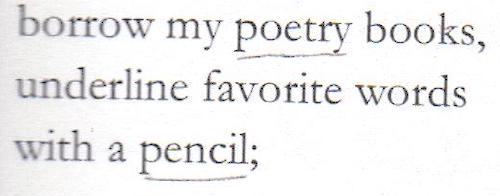
“You Can Tell Me Anything” opens with an invitation to play a game of underlining and marginalia.

R.H. Lola Koundajian - The Moon in the Cusp of My Hand -- You Can Tell Me Anything (excerpt)

borrow my poetry books,
underline favourite words
with a pencil;

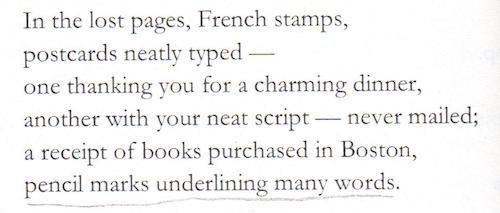
It is a gesture that is recast in a retrospective mode in a poem in honour of Neery Melkonian, “To Nerry”, which recollects what has been passed down:

R.H. Lola Koundajian - The Moon in the Cusp of My Hand -- To Neery (excerpt)

In the lost pages, French stamps,
postcards neatly typed —
one thanking you for a charming dinner,
another with your neat script — never mailed;
a receipt of books purchased in Boston,
pencil marks underling many words.

I’ve taken the liberty in my copy to _________

And so for day 2798
10.08.2014

Posted in Poetry | Leave a comment

A Wash A Wave

Paris Review Interview
Carl Phillips, The Art of Poetry No. 103
Issue no. 228 (Spring 2019)

I tell people, especially if I’m giving a reading, it’s okay to let the words wash over them, the way one experiences abstract art. I’m not trained in visual art. I often see things in a museum and don’t know what to make of them, but I still have an experience, a response to what I can see. Likewise, I don’t think poems have to have easy translation. I believe strongly in emotional and psychological narratives. I think of many of my poems as emotional gestures. Context isn’t always essential—or maybe it’s that I resist context as an absolute. I like what happens when context begins to wobble a bit.

words wash over … emotional gestures … wobble a bit.

And so for day 2797
09.08.2014

Posted in Poetry | Leave a comment

The Past is Not Immutable

Two views with slightly different valences…

Walter Benjamin:

The only writer of history with the gift of setting alight the sparks of hope in the past, is the one who is convinced of this: that not even the dead will be safe from the enemy, if he is victorious. And this enemy has not ceased to be victorious.

Translation: © 2005 Dennis Redmond; https://www.marxists.org/reference/archive/benjamin/1940/history.htm

Thich Nhat Hanh:

If we know that the past also lies in the present, we understand that we are able to change the past by transforming the present. The ghosts of the past, which follow us into the present, also belong to the present moment. To observe them deeply, recognize their nature, and transform them, is to transform the past.

Our Appointment with Life in Everyday Mind edited by Jean Smith.

And so for day 2796
08.08.2014

Posted in Uncategorized | Leave a comment

Arriving and Leaving: the Exchange

The Graywolf Annual Five: Multi-Cultural Literacy: Opening the American Mind (1988)

“”Documented/Undocumented”
Guillermo Gómez-Peña

What strikes me is that a historically situated subject position is rhetorically conveyed in an identificatory prose, the reader is seduced to be on side:

Our generation belongs to the world’s biggest floating population: the weary traveler, the dislocated, those of us who left because we didn’t fit anymore, those of us who still haven’t arrived because we don’t know where to arrive at, or because we can’t go back anymore.

Our deepest generational emotion is that of loss, which comes from our having left. […]

In exchange, what we won was a vision of a more experimental culture, that is to say, a multi-focal and tolerant one.

Is what was won still in our/their possession?

And so for day 2795
07.08.2014

Posted in Uncategorized | Leave a comment

TIME EMIT TIME EMIT

The anagram and palindrome was kindly pointed out to me and it has stuck. I bring it to an appreciation of the transit of water through lakes.

For example, Lake St. Clair:

Water retention time in the lake is seven to 10 days compared to Lake Superior with a retention time of 197 years.

Source: https://www.canr.msu.edu/news/heart_of_the_great_lakes

A friend equally fascinated by the view sent the image of the lake seen from space, frozen in time…

https://www.esa.int/ESA_Multimedia/Images/2019/11/Lake_St._Clair

Lake St. Clair - Canada - source: European Space Agency

Thanks to the European Space Agency (ESA) one learns about the delta and the silting from the St. Thomas river.

https://www.esa.int/ESA_Multimedia/Videos/2019/11/Earth_from_Space_Lake_St._Clair

And so for day 2794
06.08.2014

Posted in Uncategorized | Leave a comment

The Yield from the Search for Foundations

Acts of Perception

Turtles all the way down
Elephants all the way up
Cows forward and back (sides)
What colour are the cows at night?
Black on the side we can see at the time we can see**

**the colour of cows is from a joke shared with Michael Sperberg-McQueen eons or but moments ago…

And so for day 2793
05.08.2014

Posted in Perception, Storytelling | Leave a comment

Training & Turning

Gillian Parrish notes: “Communicate your exercises in an inviting tone that generates excitement so students want to take part in them. This is key.”

https://www.facultyfocus.com/articles/teaching-and-learning/jedi-training-developing-habits-perception-disciplines/

Parrish observes

A recent student’s final reflection captured the purpose of these seemingly small weekly exercises: “Instead of just sitting behind my laptop to get an assignment ready once or twice a week, poetry becomes a walk, an everyday walk and a way of seeing out in the world. Poetry is not something that just happens behind a screen—it is everywhere: in overheard conversations, in dreams, on billboards, out of the mouth of a homeless man or a soccer mom. It’s up to us to pay attention.”

One student recently remarked that while graded weekly assignments would sometimes “put me in completion mode, tackling it like a computer,” the jedi trainings “allowed me to move past [that]” so he could encounter the week’s concepts in a more process-oriented, immersive way.

I would challenge this computer/non-computer dichotomy — working with the computer is an equal method of tapping into eternal semiosis… Indeed working with a computer is a fine way of planning, playing, and reviewing (Thanks to Robert Delius who brought to my attention High/Scope (Plan-Do-Review) pedagogy. See https://dhhumanist.org/volume/33/817/ )

The question is always ever present — one must choose when to turn from the flow (to another flow).

Process is there with or without excitement.

And so for day 2792
04.08.2014

Posted in Dichotomies, Perception, Reading | Tagged | Leave a comment