Tasting truth: three transcriptions

transcription : A taste for truth is not necessarily a taste for non fiction. FL 14.01.07

A taste for truth
is not necessarily
a taste for non
fiction.
FL
14.01.07

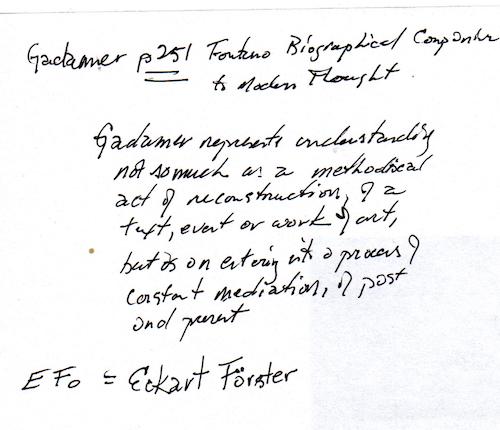
transcription: Gadamer represents understanding not so much as a methodical act of reconstruction of a text, event or work of art, but as an entering into a process of content meditation, of past and present

Gadamer p. 251 Fontina Biographical Companion to Modern Thought

Gadamer represents understanding
not so much as a methodical
act of reconstruction of a
text, event or work of art,
but as an entering into a process of
content meditation, of past
and present

EFo = Eckart Förster

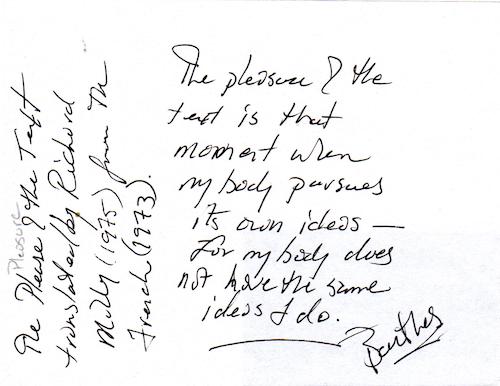
transcription: The pleasure of the text is that moment when my body pursues its own ideas -- for my body does not have the same ideas I do

Roland Barthes The Pleasure of the Text translated by Richard Miller (1975) from the French (1973).

The pleasure of the
text is that
moment when
my body pursues
its own ideas —
for my body does
not have the same
ideas I do.

And so for day 2791
03.08.2014

Posted in Reading, Uncategorized | 1 Comment

Intercession Deserves Its Own Verb Form

Northrop Frye on Sir James Frazer in Architects of Modern Thought: 12 talks for CBC Radio

A ritual, in magic, is done for practical purposes, to make the crops grow, to baffle enemies, to bring rain or sunshine or children. In religion, a ritual expresses certain beliefs and hopes and theories about supernatural beings. The practical results of magic don’t work out; religious beliefs disappear or change in the twilight of gods. But when deprived of both faith and works, the ritual becomes what it really is, something made by the imagination, and a potential work of art.

magic — religion — art

One wonders if Frye is tracing a trail here.

I ask because sometimes the confluence brings the aesthetic into the channel of the theistic.

Flipping through a cookbook, I came upon a page quoting an entire Vatican II song “Spirit of God” (words and music by Sister Miriam Therese Winter), words and tune that I remember from my childhood (“Spirit of God in the clear running water / Blowing to greatness the trees on the hill.”) What was this doing in the prefatory matter of a book with the title The Chinese Vegan Kitchen? The author Donna Klein supplies an answer

China is temple heaven. The sublime states of loving-kindness, compassion, balance, and harmony emanating from these pillars of Eastern wisdom and philosophy are woven into the fabric of everyday life in China — showing up in formal attire simply isn’t necessary to receive the gift of such bliss, only presence. Climbing into a landscape painting of Chinese tranquility can help.

China is open to Western religions as well. I attended services at Changsha’s Roman Catholic Church on a glorious Pentecost Sunday. In this Gothic-style structure with its rose petal-pink walls and arched midnight blue ceilings resembling starry skies, a breathtaking Madonna floats on a heavenly orb […] Received were the twelve fruits of the Holy Spirit, flowing in infinite abundance everywhere I went in China: kindness, joy, peace, patience, goodness, forbearance, gentleness, faith, modesty, self-control, purity, and love — always love. As I sat in the pew in stillness, blown away by the music, listening to a hymn familiar from my childhood but sung in Chinese, I surrendered to the sanctity of the spirit-filled moment — a clear connection to an endless wellspring of love and light. A foreigner, I never felt more at home in my life.

By opening the book, I have accidentally entered a temple.

ritual — temple — childhood

The practice of repeated gestures and words creates a space (from Latin templum ‘open or consecrated space’) through which to connect with the magic of childhood. The poet Robin Skelton in the introduction to Spellcraft places an epigraph from Sybil Leek at the outset: “Magic is a joyous exceptional experience which leads to a sense of well-being …” aka as childhood. Worth creating the verb “intercession” for.

And so for day 2790
02.08.2014

Posted in Poetry | Tagged | Leave a comment

Simple Words Touching

Roopika Risam

“Telling Untold Stories: Digital Textual Recovery Methods” in lewis levenberg, Tai Neilson, David Rheams (eds) Research Methods for the Digital Humanities.

As the digital cultural record continues to be developed, it is critical to ensure that writers who are elided from literary canons are not simultaneously omitted from digital cultures. The process of marking-up a text to create an edition and making it available online can bring new attention to texts from writers who have previously received little attention or have disappeared from readership. Greater availability of these texts increases the chance that they will be subject to critical inquiry and scholarship, thus, adding new stories and voices to the digital cultural record. Engaging in the work of digital textual recovery is, therefore, an ethical and political intervention in digital humanities that is essential to cultural survival for marginalized voices.

In this article Professor Risam provides the origin story for the Harlem Shadows Project (http://harlemshadows.org) and an overview of how TEI Boilerplate (developed by John Walsh, Grant Simpson, and Saeed Moaddeli) can be used to initiate students into textual editing.

They too may like the invoked youth in the concluding lines of “When I Have Passed Away” ponder a little while

And he may softly hum the tune and wonder
   Who wrote the verses in the long ago;
Or he may sit him down awhile to ponder
   Upon the simple words that touch him so.

From Claude McKay Harlem Shadows (1922)
http://harlemshadows.org/when-i-have-passed-away.html

And fortified, that youth may tackle learning about a fascinating backstory to the Harlem Shadows Project:

http://cforster.com/2012/06/drill-baby-drill/

And so for day 2789
01.08.2014

Posted in Booklore | Leave a comment

Humming and Sweeping

Little City Book by Annie Ingle illustrated by Edward Miller
c. 1994 ISBN 0-679-85290-5

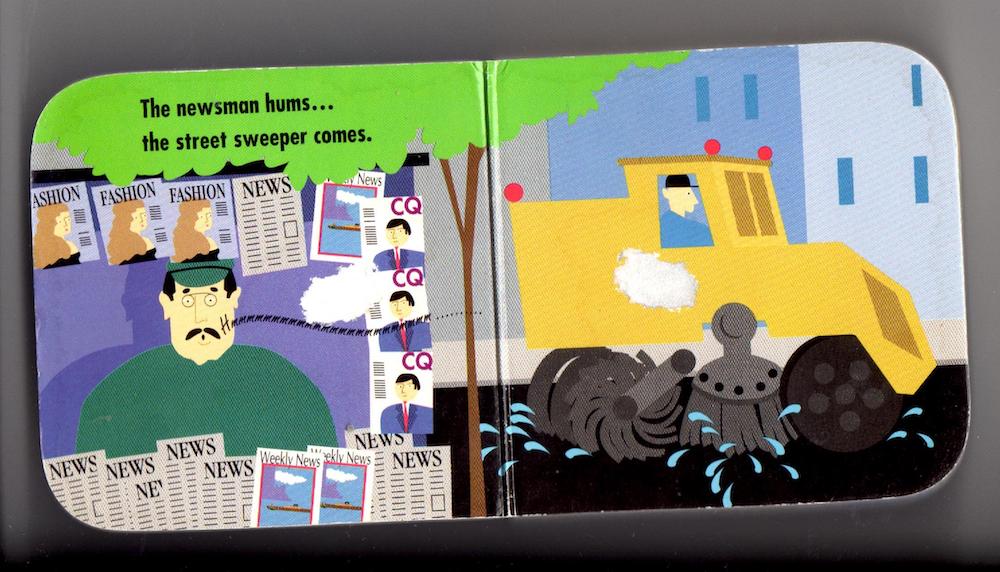
Little City Book by Annie Ingle illustrated by Edward Miller c. 1994 ISBN 0-679-85290-5 Back cover

The book that came my way is damaged and there is no copy in the Toronto Public Library not even in the Lillian H. Smith Collection and the offerings from resellers are rather on the expensive side for a non-collector.

Little City Book by Annie Ingle illustrated by Edward Miller c. 1994 ISBN 0-679-85290-5 Back cover

The newsman hums…
the street sweeper comes.


I am captivated by the rhymes and by the bold verging on the abstract design.

One online bookseller describes the chunky book thus

Bold, colorful illustrations capture all the teeming excitement of the city, from commuters rushing to work to the nighttime skyscrapers sparkling with millions of lights. For children under three.

And over 40.

I went searching for more art by Edward Miller and found a portfolio on line

https://edmiller746eb24.myportfolio.com/book-little-city

Where I found a variant illustration (there is surely a story here).

Edward Miller illustration - The Little City Book - alternative

The newsman hums … the street sweeper comes.


Which do you like better? The blues and blacks? Or the orange, rose and yellow?

I do like the one with a tree spanning the gutter.

And so for day 2788
31.07.2014

Posted in Booklore | Leave a comment

Leander Echoed Pearls

James Schuyler
“A Blue Towel”
Hymn to Life

[…]
I saw
your chest and side be-
side me, pearled with
water drops.
[…]

Note the spilt word and enjambement

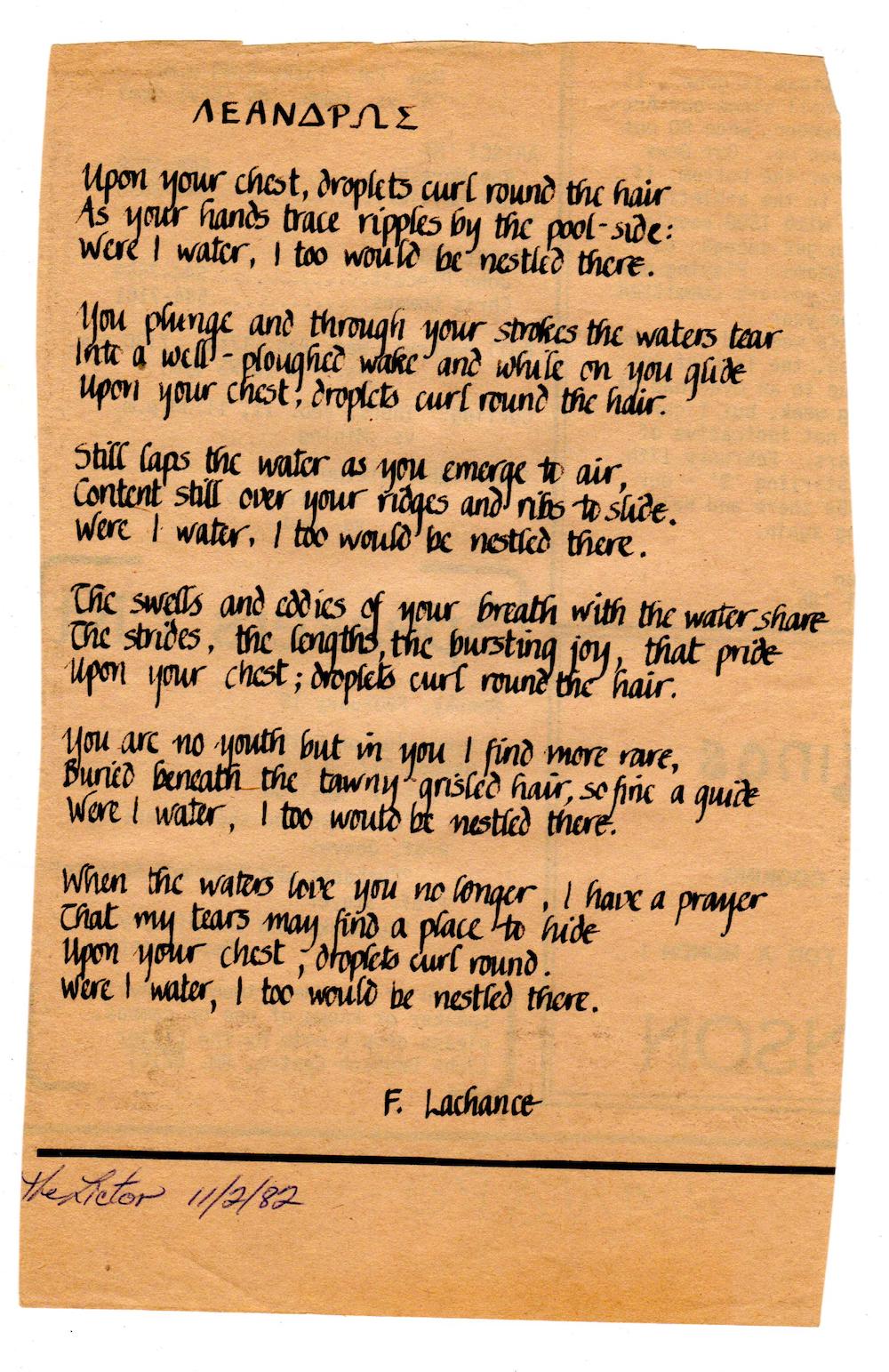
I recalled something from my undergraduate days at Queen’s (Kingston). Here then is the text of Leander which I swear was written long before I knew of Schyler’s poem.

Leander

Upon your chest, droplets curl round the hair
As your hands trace ripples by the pool-side:
Were I water, I too would be nestled there.

You plunge and through your strokes the waters tear
Not a well-laughed wake and while on you glide
Upon your chest, droplets curl round the hair.

Still laps the water as you emerge to air,
Content still over your ridges and ribs to slide.
Were I water, I too would be nestled there.

The swells and eddies of your breath with the water share
The strides, the lengths, the bursting joy, that pride
Upon your chest; droplets curl round the hair.

You are no youth but in you I find more rare,
Buried beneath the tawny grilled hair, so fine a guide
Were I water, I too would be nested there.

When the waters love you no longer, I have a prayer
That my tears may find a place to hide
Upon your chest, droplets curl round.
Were I water, I too would be nested there.

First appeared in The Lictor 11/2/82

Calligraphy -- Leander in Queen's student publication - The Lictor 11/2/82

And so for day 2787
30.07.2014

Posted in Poetry | Leave a comment

No, more pipelines

Note the comma placement.
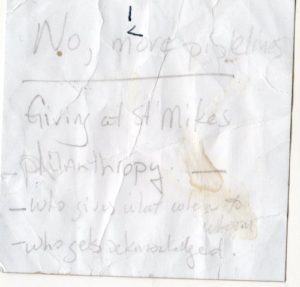
Handwritten note in ink and pencil - No, more pipelines

Transcription:

[in ink]

|
<
[centred over "more"]

[in pencil]
No, more pipelines

Giving at St. Mikes
philanthropy
who gives what when to
                                             whom
who gets acknowledged .

* * * * * * *

I have been practising with delimiters in subject headers in email. I have a director who really wants people to manage the subject line (change the subject when the conversation veers into another direction). I like to keep bits of history alive. So my favourite delimiter was the angled bracket.

tangent < subject

I found that three to four of these is the max. After that it reads like a biblical begat.

I also have been getting reacquainted with Unix and have incorporated the pipe in delimiting subjects

Eclairs | Food | Baked Goods

Goal Displacement | Problem Displacement

Day of Tweets | Year of Treats

Very useful for assigning multiple subjects to one message.

And so with delimiters in mind, I revisited the lowly comma

No, more pipelines

And behold I discovered a technical term from the world of philanthropy: prospect pipelines. With a Canadian twist:

Let’s start with a definition – what exactly do we mean when we say prospect pipeline? Simply put, the prospect pipeline places cohorts of prospects at different stages of the development cycle (identification, cultivation, solicitation, stewardship) and then measures their progress as they move from an unqualified lead to a donor.

Philanthropic Trends Quarterly, 2011, Issue 1

https://kciphilanthropy.com/wp-content/uploads/2018/11/2011_Q1_KCI-Trends-2011-Q1-Prospect-Pipeline.pdf

I have in mind all the micro-donating that can build goodwill and support for a project.

Signs of a healthy pipeline:

  1. Active prospects at all gift levels.
  2. Active prospects at all stages of the development cycle (identification, cultivation, solicitation and stewardship).
  3. Mechanisms to feed new prospects into the pipeline.
  4. Means for measuring progress.
  5. Access to good data.

I foresee much discussion of the etiquette of panhandling.

Good Technique Pays

More pipelines, yes?!

Begging to Learn | Learning to Beg

And so for day 2786
29.07.2014

Posted in Uncategorized | Tagged | Leave a comment

Goal Displacement | Problem Displacement

Cyphert, Frederick R.; Gant, Walter L.
“The Delphi Technique: A Tool for Collecting Opinions in Teacher Education”
[1969]

Dr. Cypher was Dean of the University of Virginia’s Curry Memorial School of Education and Dr. Gant was Director of the Department of Adjustive Services, Norfolk City Schools.

It is a truism that many schools of education have for too long attempted to be all things to all people. They have been prime targets for the phenomenon of goal displacement, i.e. the tendency for organizations to turn away from original goals and to substitute means for ends. It is reasonably obvious that giving the Master’s degree has become an end in itself, and schools of education have long since forgotten the goal which originally called for that degree program. Added to this concept of goal displacement is a second prevalent phenomenon which has been labeled problem displacement. This is the substitution of organizational concern for trivial problems in place of significant problems because the significant problems appear unsolvable. Clearly, schools of education need to give fresh attention to the clarification and hierarchal ordering of goals if they are to increase their effectiveness.

It also appears that most schools of education and, for that matter, most universities, operate on the apparent assumption that persons inside the organization control its destiny. While no one can deny the significant and essential influence of students, faculty, and administration, it is equally fallacious and dangerous to deny or ignore the powerful impact of forces and persons outside the organization on its welfare and mission. […]

https://files.eric.ed.gov/fulltext/ED042691.pdf << Accessed via ERIC May 4, 2020

And so for day 2785
28.07.2014

Posted in Uncategorized | Tagged | Leave a comment

Arethusa & Artemisia

Anna Banti’s novel Artemisia reviewed by Susan Sontag in a game of hide and seek, of lost manuscript, lost novel, found character, found subject …

‘Non piangere.’ Don’t cry. Who is talking to whom? It is the stricken author talking to herself, telling herself to be brave. But she is also addressing the heroine of her novel, ‘my companion from three centuries ago’, who had lived again on the pages in which Banti had told her story. And, as she mourns, images of Artemisia surge through Banti’s mind, first of ‘a disillusioned and despairing Artemisia’, middle-aged, in Naples, not long before her death, then of Artemisia as a child in Rome, ten years old, ‘her delicate features expressing pride and ill-treatment’. Mocking the loss of the manuscript, ‘the images continue to flow with a mechanical, ironical ease, secreted by this shattered world.’ Artemisia is lost, but Artemisia, her lamenting phantom presence, is everywhere, irrepressible. Soon – Artemisia’s distress, and Banti’s, are too keen – the anguished first-person voice of the author makes way for the voice of Artemisia, and then gives itself permission to become intermittently, then for longer stretches, the third-person voice that narrates the painter’s life.

[…]

Never has the passion of novelist for protagonist been so intently formulated. Like Virginia Woolf’s Orlando, Artemisia is a kind of dance with its protagonist: through it course all the relations that the author can devise with the fascinating woman whose biographer she has decided to be. The lost novel has been recast as a novel about a haunting. Nothing so crude as an identification: Anna Banti does not find herself in Artemisia Gentileschi – any more, or less, than Woolf thinks that she is Orlando. On the contrary, Artemisia is for ever and supremely someone else. And the novelist is her thrall – her amanuensis. Sometimes Artemisia is coquettishly inaccessible. (‘In order to further reproach me and make me regret her loss, she lowers her eyelids, as though to let me know that she is thinking about something and that she will never tell me what it is.’) Other times she is yielding, seductive. (‘Now it is for my benefit alone that Artemisia recites her lesson; she wants to prove to me that she believes everything that I invented.’) The book is a testament, dictated by Artemisia. But also a tale, propelled by whim and filled out with figments of the author’s imagination, not at all at Artemisia’s behest, though she may waive her objections. Banti asks and receives Artemisia’s permission to tell. She runs up against Artemisia’s reluctance to admit the author to her thoughts. The game of concealment is mutual: ‘We are playing a chasing game, Artemisia and I.’

Source:
London Review of Books
Vol. 25 No. 18 · 25 September 2003
“A Double Destiny” by Susan Sontag

The chasing game tugs in an intertextual flow in the direction of a fountain, another tale “propelled by whim and filled out with figments of the author’s imagination”. The fountain — allusive / illusive — of Arethusa

And so for day 2784
27.07.2014

Posted in Storytelling | Tagged | Leave a comment

For the Kid-at-Heart Who Banged Her Head

Dear W.,

I hope all is well with the concussion recuperation.

As you know I have been concentrating on one sensory modality per week for the last little while. I meant to get the proprioception one out earlier — got side tracked into reading dictionaries and pondering — here is the result

https://berneval.hcommons-staging.org/2014/07/22/proprioception-interoception-exteroception/

Also a little lagniappe, keeping in tune with our exchanges on gift economies… the opening from Andrea Cohen “Gift Economy” in Nightshade

I give you a gift card for a store that doesn’t accept gift cards.

The store is in another galaxy.

I give you a paper airplane and a paper ticket for the plane.

I let you fly the plane.

Be well and eat your kimchi : )

And so for day 2783
26.07.2014

Posted in Perception, Poetry | Tagged , | Leave a comment

Reduplications Reduplicated

Andrea Cohen
Nightshade
p. 25 “Blizzard”

[opening]

All night plows plow.
Snows snow. Lovers

somewhere somehow love.

Reminds me of Émile Nelligan “Soir d’hiver” which begins:

Ah! comme la neige a neigé !
Ma vitre est un jardin de givre.

in Poésies complètes 1896-1899 (Bibliothèque Québécoise, 1989).

I have struggled since my undergraduate days (I fondly recall Mme (Collette) Tonge‘s classes in translation) to capture the nuances of the French reduplications. Over the years I have tried “o how the white has whitened” which sounds like a detergent commercial. I tried to cleave closely to the verb with “o how the snow has snowed” but this creates an attribution of agency that is absent, I believe, in the French. Now with Andrea Cohen before me and understanding the power of the repeated “n” I offer:

o how the snow has whitened
a garden frosts my window

I hope Mme Tonge would be proud.

And so for day 2782
25.07.2014

Posted in Poetry, Translations | Leave a comment