3 Lecture-Letters on Wabi-Sabi

for Pauline and Désirée

Letter One

Hello

So glad you signed up for the weekly Wabi Sabi info flow.

This week — surprise — there are no pictures.

I was looking at the well seasoned wok in which almost nothing now sticks. I thought of our well-seasoned cast iron frying pans. And a crepe pan and an omelette pan which we acquired for those special occasions when you whip up batter or get cracking.

In any event it made me ponder the nature of wabi sabi surfaces — are they meant to have a fine patina where nothing sticks or are they meant in some cases to trap rain droplets, seeds, and dust.

Is there a difference in the wabi sabi essence of a well seasoned pan or one that that has rusted? Neither in my opinion they both offer humans with something to do …

F

Letter Two

Hello Again

This week I invite you to think about time series and wabi sabi.

Interior designers often associate wabi sabi with that weathered look, a fine patina.

But there is also instant wabi sabi.

I recently found some tulips left at the curb side near a plastic bottle of water (with some water left in it) and so the reclining tulips received a little shower and I snapped a picture. Wabi Sabi is about the transience of all things and so itself need not last forever.

http://homes.chass.utoronto.ca/~lachance/dropbox/wabisabi/Tulip-Curbside.jpg

Left the water bottle in the picture for good measure.

Tulips lend themselves well to time-released wabi sabi.

Indeed, in our house bouquets

http://homes.chass.utoronto.ca/~lachance/dropbox/wabisabi/Tulip-Vase.jpg

tend to last well beyond what a real estate stylist would want in staging a house for sale. We have house lived in. In French a still life is called a “nature morte” and we love to see the various parts of the flower head that get exposed when the petals shrivel.

Half the fun of wabi sabi is the process of witnessing the weathering or the fading or the aging and not just contemplating the final product for that product too is subject to time.

F

Letter Three

Again Hello

This will be the last of my little speeches on wabi sabi. I may have exhausted what I want to say at the present moment but not my commitment to exploring wabi sabi through images.

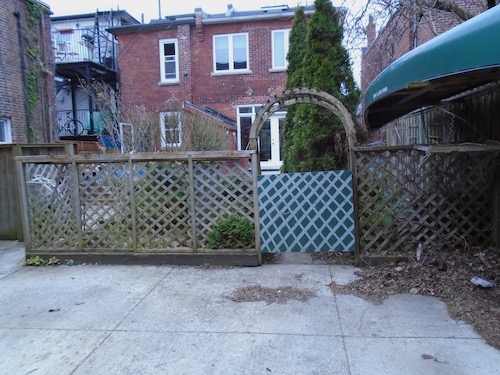
I shot this picture in a lane near us called appropriately “Shady Lane”. It’s a picture of a gate and fence with a canoe rack to one side. I draw your attention to the gate. It is not made out of the trellis work that composes the fence. It is actually a piece of board painted to imitate the trellis. Fascinating piece of mimesis. Is the fencing imitating the gate or the gate, the fence?

Gate in the Shady Lane - Toronto - April 2020

A prime example of wabi sabi and mimesis — the gate echoes the pattern of the trellis-fence


This reminds me that wabi-sabi (as it is usually spelt with a hyphen) is actually two words: wabi and sabi. The hyphen acts like a gate linking the two concepts.

Here’s a little bit from a Wikipedia entry

The words wabi and sabi do not translate easily. Wabi originally referred to the loneliness of living in nature, remote from society; sabi meant “chill”, “lean” or “withered”. Around the 14th century these meanings began to change, taking on more positive connotations. Wabi now connotes rustic simplicity, freshness or quietness, and can be applied to both natural and human-made objects, or understated elegance. It can also refer to quirks and anomalies arising from the process of construction, which add uniqueness and elegance to the object. Sabi is beauty or serenity that comes with age, when the life of the object and its impermanence are evidenced in its patina and wear, or in any visible repairs.

https://en.wikipedia.org/wiki/Wabi-sabi << Accessed May 2, 2020

Happy to continue exchanging pictures. I am going to be quiet for a while. Work in the garden. Repairs.

F
And so for day 2781
24.07.2014

Posted in Gardens, Perception, Storytelling | Leave a comment

Day of Tweets | Year of Treats

[submitted to Humanist, May 1, 2020]

Willard,

At your prompting and with the kind enticements of Elli Mylonas appearing at suitable intervals on Humanist, I have dipped a toe into the Twitter waters.

Things I learnt:

Twitter functions like an investment bank for social capital (likes, mentions, retweets, urls). It reminds me of Delphi Pools [1] especially as envisioned in the novel Shockwave Rider[2] by John Brunner.

And like many corners of the WWW, you can be recursive and search Twitter itself for Delphi Pools.

Very few people use the polling function (it is structured as an either/or input on a selected question). A parlour game but one sometimes worth playing if one conceives contraries as being good for cultivating taste (see Aristotle).

You don’t have to follow everyone that your followers are following — they can serve as filters and curate enticements from their own streams. And you don’t even have to sign up to Twitter — the good stuff will flow beyond the proprietary ecosystem — indeed I continue to exercise the option of lurking by examining tweets when not logged in (o the joys of multiple browsers with different caches!!) …

And things sometimes happen automagically, I am sure I saw this URL appear in the Twitter stream for Day of Digital Humanities 2020 but it’s not there when I crawl through the day’s tweets. I may have hallucinated seeing this in the Twitter feed … but I did read it on DDH 2020 and now on the blog it’s dated May 1, 2020 (and I thought I was the only one with a fine appreciation of the anachronistic : ))

https://clairewarwick.blogspot.com/2020/04/reasons-to-be-cheerful.htm

[Any clarification how Claire Warwick’s blog post got associated with Twitter much obliged.]

As Claire Warwick writes “Today, as we DHers tweet each other about what we are up to, there will, necessarily, be variations on quite a narrow theme.” I would like to add that the tweets are there out in the world and we tweet in a fishbowl. We model as we explain.

It is perhaps ironic that I have been intending to read Shoshana Zuboff’s The Age of Surveillance Capitalism: The Fight for a Human Future at the New Frontier of Power since the beginning of March (2020) and at the end of April (2020) I committed myself to a day of tweeting a year (I intend to participate in next year’s festivities by retweeting a selection from this year’s stream (such is my learning curve — I put off practicing the gentle art of retweeting until 2021, polling in 2022?). I raise Zuboff for two reasons: the index has an entry for Twitter but no entry for Delphi method or pool; a passage from dust jacket blurb very much reminds me of Brunner’s novel:

Zuboff vividly brings to life the consequences as surveillance capitalism advances from Silicon Valley into every economic sector. Vast wealth and power are accumulated in ominous new “behavioral futures markets,” where predictions about our behavior are bought and sold, and the production of goods and services is subordinated to a new “means of behavioral modification.”

Behavioural modification cuts many ways. This takes me to the craft of the #hashtag and cross-pollination. I did not hesitate to “pollute” the #burningman stream with digital humanities content. Micro-micro marketing. I salute the digital humanists that are bending the bow by tweeting and making new musics. They have the potential to (re)shape culture.

And let me tell you tweeting is hard: it demands attention to detail and an acute sense of timing. And disciplined moderation since every tweet is its own rabbit hole. (All attributes cultivated by being an assiduous reader of Humanist and the non-twittering world).

Chapeau to the DH content producers and consumers, may your info flows spark joy.

[1] https://en.wikipedia.org/wiki/Delphi_method
[2] https://en.wikipedia.org/wiki/The_Shockwave_Rider

And so for day 2780
23.07.2014

Posted in Storytelling | Tagged | Leave a comment

Proprioception, Interoception, Exteroception

After Harryette Mullen Sleeping with the Dictionary

From the Apple Dictionary (Version 2.3.0 (239.5))

proprioception | ˌprə(ʊ)prɪəˈsɛpʃn |
noun [mass noun] Physiology
perception or awareness of the position and movement of the body: exercises to improve balance and proprioception.

The adjective :

proprioceptive | ˌprəʊprɪə(ʊ)ˈsɛptɪv |
adjective Physiology
relating to stimuli that are produced and perceived within an organism, especially those connected with the position and movement of the body. Compare with exteroceptive and interoceptive.

This is the same advice (to see also) as Webster’s (The New Lexicon Webster’s Encyclopedic Dictionary of the English Language Canadian Edition (New York: Lexicon Publications, 1988) [Main dictionary section c. 1972 Libraire Larousse as The Larousse Illustrated International Dictionary, Revised and Updated 1988. ISBN 0-7172-4572-1])

This tour of the dictionary nets a model of the body organized along three major zones: viscera (interoception), muscles & tendons (proprioception), outside (exteroception). I am not here challenging that model. I am simply noting that the three zones communicate with each other in various modes of proximity. Reminded of Derrida on invagination, I think of viscera and the outside being along one continuous ribbon with medial zones (such as the mucous membranes as gateways between the inside fold and the outside). When contemplating the zones that connect muscle (proprioception) and skin (exteroception), one is tempted to produce a neologism : kinoception. However if modalities were to proliferate, the model would quickly become unwieldy (I do like the trinitarian structure for its mnemonic grace). The perception of movement and rhythm of course depends upon the intercourse of several senses in conjunction of the conductor that is memory.

Webster’s via Larousse does something interesting….

Exteroceptor is defined as a nerve ending or an organ which responds to impressions or stimuli outside the organism

Interoceptor is capable of receiving stimuli form within the organism.

Proprioceptor is capable of receiving stimuli from within the organism through muscles, tendons, joint.

I read the dictionary like a spread sheet or table:

Extero impressions stimuli
Intero ? stimuli
Proprio ? stimuli

I am invited by this reading to contemplate impressions as distinct from stimuli. The one would be the mark left on the organism by stimuli, a memory trace.

Anyone who has suffered from an ulcer, an abscess, a cutaneous irruption can attest that interoception also involves memory traces and impressions.

What of proprioception? Is it open to memory traces?

I take my cue here from Le Petit Robert. The 1968 edition does not contain the word “proprioception”. The 1989 edition informs us at an entry on the adjectival form that the term is not found before 1951:

Proprioceptif, ive adj. (av. 1951 ; de propre, et l’élément de réceptif, perceptif […] par opposition à la sensibilité tactile (dite extéroceptive et à la sensibilité viscérale (intéroceptive). [p. 1551]

In its apposite opposition to them, proprioception could mediate between interoception and exteroception? It would work as a meta-sensory fashion on the memory traces of the other senses… pure speculation but interesting nonetheless to think of one sense at some time or other serving as a meta-sense for the others…

I am pushing this interpretation because I have long taken on board that the sensory apparatus not only receives the impressions created by stimuli, it also communicates the status of its doing so. See http://homes.chass.utoronto.ca/~lachance/S6.HTM

5.26

In re-evaluating the closer contact senses, especially their action under conditions of distress or extreme pleasure, one discovers that the sensorium not only is a receiver but also a dispatcher of information. The senses are not only receptors. The senses also transmit. By their operation the senses provide events for interpretation. The blinking of eyes, the cocking of an ear, the flicker of a tongue, all signal.

I would like here to add that the sensory apparatus couples with memory, it stores sensations and perceptions in memory and to be clear the memory of sensation is not always equivalent to the memory of a perception. Note how Le Petit Robert opens two semantic fields: reception (sensation) and perception (sensation plus [interplay with other senses?]).

What does this have to do with walking the dictionary?

I think we have a terminological gap at least in the lay space of general purpose dictionaries. There is no term to encompass both proprioception and interoception. Even without an umbrella term, it is possible to set the pair of inside senses in a triangle with exteroception. And to begin to think in terms of a sensoria that accounts for relations between guts, brawn, and the traditional 5 senses.

Cross-cultural explorations of course are de rigeur.

Why this matters is revealed by placing this little technical question on names for sensory modalities into the body of knowledge shaping up about cognitive embodiment. See Michael Kimmel, The Arc from the Body to Culture: How Affect, Proprioception, Kinesthesia, and Perceptual Imagery Shape Cultural Knowledge (and vice versa) https://integral-review.org/issues/vol_9_no_2_kimmel_the_arc_from_the_body_to_culture.pdf

Waking with the Dictionary after Harryette Mullen

And so for day 2779
22.07.2014

Posted in Perception | Tagged | Leave a comment

paratexts and patter

Ever noticed that a truncated acronym can have a marked effect on the public perception of an organization’s mandate? Take for instance CDC which expanded should net “Centers for Disease Control and Prevention”. Minding ps and qs.

In another matter, Malcolm Gladwell towards the end of a long evening’s Munk Dialogues (April 9, 2020) << accessed April 26, 2020 >> is invited to pivot by the interviewer to the themes of his latest book: Talking to Strangers: What We Should Know about the People We Don’t Know. A visibly tired Gladwell graciously acknowledges the compliment but then uncharacteristically veers off into gross generalizations by musing about humans as trust machines. I’m not so convinced by the hard-wired nature argument as lovely as it may sound.

This led to my own musings, shared with a group of colleagues also tuned in to the Munk Dialogues:

BTW — I heard the Malcolm Gladwell – Munk Dialogues piece — not quite on board with him at the conclusion where he characterizes humans as machines hardwired to trust others — I would want something a bit more nuanced: we are story telling and story listening machines — this opens the way for the appropriate application of the hermeneutics of suspicion.

I, now for the first time ever, want to read and engage with a Malcolm Gladwell book … Talking To Strangers (which I believe goes astray from the get go — its title should be Talking With Strangers).

Are we not always strangers to ourselves? Encountering ourselves again and again in community?

I may have to rely on a trusted digest before I get around to reading the book:

People, like books, can be difficult to read. Assumed ‘universal’ grammars of demeanour and facial expression seem not to translate across all cultures. Even within communities, there are individuals who react differently — who might, for instance, look most honest when they are not.

Source: Nature, 09 September 2019

https://www.nature.com/articles/d41586-019-02666-6 << Accessed April 27, 2020

I would carry over those remarks (about the difficulty to read) to “assumed universal machine models”.

Take it on trust.

CDCP, anyone?

And so for day 2778
21.07.2014

Posted in Introductions, Reading | Tagged , | Leave a comment

Sympathy Strikes

Andrea Cohen meets Ricardo Sternberg on the picket line…

Opening and closing stanzas (but equal gateways) to “Let Me Die in Madrid” in Furs Not Mine by Andrea Cohen:

Let me die in Madrid
when the grave diggers
are on strike. Let the drivers

[…]

let me raise an empty glass
to the empty graves, empty buses,
empty pockets of my unpaid mourners.

I have a wish to hear Andrea Cohen read with Ricardo Sternberg either in person or online. They have similar sensibilities and I think similar approaches to cadence and story telling. It never ends. It just pauses.

Ricardo Sternberg on the endless openness of the creative process, or any process:

At the time I began the long poem in Some Dance, I was both reading The Odyssey — out loud this time — and — not at the same time, mind you — watching Mexican soaps. There is something about how narration at both classical and trashy levels allows or even invites one to take “one more kick at the can.”

from an interview with Diana Kuprel
https://www.artsci.utoronto.ca/news/fantasy-unbound-then-hard-work

She has a poem called “The Invention of Grief” and he a book called The Invention of Honey. It would be nice to engage in a seminar on the work of these poets.

And the wish list grows.

And as pointed out by Ricardo to me: “[S]he has a book called The Cartographer’s Vacation and I have a book called Map of Dreams.

I so like introducing friends to books they might like and poets they might read with.

And so for day 2777
20.07.2014

Posted in Poetry | Leave a comment

“I’m just saying, ‘Can we be slightly less stupid, and we’ll all be better off for it.'”

Dear Lindsay,

On my walk today I noticed less pigeons and leaner pigeons and the squirrels were also looking slimmer.

Less people feeding them less.

The animals (including people) look more healthy. Everything is finally slowing down.

In my slow moments today, I read, I listened, and I wrote.

One very interesting piece I read was offered by the LRB [London Review of Books] Bookshop

LRB has moved some of its bookshop talks/interviews online

https://media.londonreviewbookshop.co.uk/2020-04-22-dorling-williams.mp3

Daniel Dorling interviewed by Zoe Williams.

His latest book is available from the Toronto Public Library as an e-book << as of today 9 holds on 2 copies << today = April 23, 2020

Slowdown : The End of the Great Acceleration — and Why It’s Good for the Planet, the Economy, and Our Lives. The podcast is so rich in info you can listen to it with the background music of your choice for a layered info load… Remember that name:

Dorling, Daniel

Have fun with the slow down and its extension.

F

P.S.

He identifies five sets of beliefs – elitism, exclusion, prejudice, greed and despair – that he claims are replacing Beveridge’s five social evils at the dawn of the welfare state (ignorance, want, idleness, squalor and disease), and have become so entrenched in Britain and some other affluent countries that they uphold an unjust system that perpetuates extreme inequality.

Source: https://www.theguardian.com/society/2010/apr/21/danny-dorling-charles-dickens-social-inequality << Accessed April 23, 2020

And so for day 2776
19.07.2014

Posted in Introductions | Tagged | Leave a comment

Captioning Affirmative

Any one who has watched a video resource with closed captioning (whether or not we are permanently deaf) owes a debt of gratitude to those who have gone before…

https://www.theguardian.com/society/2020/apr/21/alan-haythornthwaite-obituary

Alan Haythornthwaite obituary

From 1980 to 1998 he was manager of the Bradford Centre for Deaf People. One of a small number of people to gain the newly established British Sign Language/English interpreter qualification in 1984, he later became a freelance interpreter, and consultant, until his death.

While at Bradford Alan co-founded the Deaf Broadcasting Campaign, which helped to bring about the use of subtitling and sign language on television, notably through the 1990 Broadcast Act. He also became treasurer of a memorial trust that was set up in honour of Peter Greenwood, deputy head of the Thorn Park School for Deaf Children in Bradford, who died in the Bradford football club fire of 1985.

What sign is he making in the picture (Yes? !! << or so I deduct with my limited ASL and no BSL)

(a search "british+sign+langugae+sign+for+yes" finds us indicating that The Guardian did indeed select an image of Haythornthwaite making the sign for yes. It is a static image of a pose in the sequence of yes. There are variations now captured and made accessible by video for hearing and deaf alike:

https://www.signbsl.com/sign/yes

The videos and the search string used to find them give a nod to the power of the reduplicative

* * * * * * *

Follow up: research BSL and ASL and compare on their use of reduplicative structures

Off to read (or have read to me) Joyce’s Molly Bloom monologue and its 24 instances of — Yes —

Bloomsday Molly Bloom Soliloquy 2018

Viewed with close captioning/subtitles << April 23, 2020 << another way of being open to the rhythms of the word/word

And so for day 2775
18.07.2014

Posted in Perception, Storytelling | Tagged | Leave a comment

Provenance Marking Inventions

Dr. Hilary Green
@HilaryGreen77
Associate Professor, University of Alabama. Author of Educational Reconstruction: African American Schools in the Urban South (2016).

via

Julian Chambliss
@JulianChambliss
#Professor
@MichiganStateu
#BlackImaginary Exploring #Digital, #Comics, #Cities, & #Culture. #AssemblingtheMCU #CitiesImagined

via

Kathleen Fitzpatrick
@kfitz
Director, Digital Humanities & Professor of English, MSU. Author of GENEROUS THINKING: A RADICAL APPROACH TO SAVING THE UNIVERSITY (Johns Hopkins UP, 2019).

Reframing History
“… I tell people sometimes you start off by yourself or you don’t know and you make mistakes along the way, but you keep thinking. What is that grounding point? For me, it’s that student who said slavery did not exist at the university.”

EP [Episode] 207 Hilary Green and Transformative Digital History

www.bit.ly/RFH_DH

www.bit.ly/RFH_DH

Hilary Green and Transformative Digital History

APRIL 21, 2020

In this episode, I spoke with Dr. Hilary Green Associate Professor of History in the Department of Gender and Race Studies at the University of Alabama. Her research and teaching interests explore the intersections of race, class, and gender in African American history. Her first book Educational Reconstruction: African American Schools in the Urban South, 1865-1890, explored how African Americans and their white allies created, developed, and sustained a system of African American education schools during the transition from slavery to freedom.

Dr. Green’s digital humanities project entitled Hallowed Grounds began in the Spring of 2015. While she has described it as her “side project,” it has grown into a unique example of a digital humanities project that engages students and the public around questions of race and memory. It is also a startling example of how a scholar working alone [can] use a digital methodology to build an engaging and transformative digital project.

Listen to the conversation with Julian Chambliss:

https://podcasts.apple.com/us/podcast/reframing-history/id1399889989

It beings with the an audio montage of voices on the word “Negro”. I believe I recognize one voice in the mix == the great James Baldwin …

A worthy class project would be to produce a transcription of the podcast and identify all the voices — thus making the lessons of history accessible and ingrained. The audio is identified as coming from a 1965 documentary called The Heritage of the Negro, another transcription, editing project.

I accessed the Hollowed Grounds project, today on April 21, 2020 …

https://hgreen.people.ua.edu/hallowed-grounds-project.html

And found a quotation used as an epigraph :

“To accept one’s past – one’s history is not the same thing as drowning in it; it is learning how to use it. An invented past can never be used; it cracks and crumbles under the pressures of life, like clay in a season of drought.” – James Baldwin

I remarked elsewhere … “Clay in a season of drought can be collected to make pottery (which will eventually be smashed).”

It brings to mind for me the interlocking nature of imagined communities and imagined histories (and the Latin roots of invention = to find).

Cf. MoMa – Jacob Lawrence’s Migration Series – One Way Ticket (recalling Baldwin’s The Price of the Ticket)

https://www.moma.org/interactives/exhibitions/2015/onewayticket/

And here I recall the word lagniappe

A Merriam-Webster word of the day podcast for October 13, 2017 < accessed April 21, 2020 [the 2017 podcast updates a 2012 podcast with "What Twain didn't know is that the Spanish word is from Quechua, from the word yapa, meaning “something added.”]

– – – – – – – and ponder the gift economies of the academy.

And so for day 2774
17.07.2014

Posted in Introductions, Uncategorized | Tagged , | Leave a comment

Trolling the Troll

I keep stumbling across references to the President of the United States in the Apple Dictionary (A lexicographer’s gem) :

“comity”

(Definition #2) [mass noun] courtesy and considerate behaviour towards others: a show of public comity in the White House.

“couth”

noun [mass noun] good manners; refinement: he has no couth, no brains and doesn’t know the meaning of the word diplomacy.

Source: Apple Dictionary, Version 2.3.0 (239.5)

Interesting to note that “couth” only is attested from the late 19th century on as a back-formation from “uncouth”. I do wonder what social forces may have been at play to usher such a word into the common vocabulary of English speakers.

Work of the translator at Google… gives the form “couth” for the French with oddball pronunciation.

https://translate.google.ca/?hl=fr&tab=wT#view=home&op=translate&sl=en&tl=fr&text=couth
< Accessed April 20, 2020 < suggested they use "savoir faire"

Back translation leads me to Word Hippo and a definition for savoir-faire : "The ability to do or say what is appropriate for the occasion" and a long list of synonyms including "manners", "social graces", and "urbanity".

https://www.wordhippo.com/what-is/another-word-for/savoir-faire.html < Accessed April 20, 2020

Oh and let's not forget "tactfulness".

The lexicographers may not be trolling but I am.

And so for day 2773
16.07.2014

Posted in Uncategorized | Tagged | 1 Comment

Cited for UnSpeakable Speech Acts

Juvrianto Chrissunday Jakob, English Lecturer, An English Enthusiast and Coffee Lover (https://medium.com/@markriand) < I learnt today about https://medium.com (a modest payment to view the articles housed there $5 per month as of April 20, 2020).

I came across this fellow coffee lover and English Enthusiast via Presentase Macropragmatics speech acts Austin and Searle (the examples display a little dated heterosexist bias but are quite useful nonetheless).

https://www.slideshare.net/juvrianto/presentase-macropragmatics-speech-acts-austin-and-searle < Accessed April 19, 2020.

27 slides in total.

See especially slide 8 for definitions of Austin's three types: locutionary, illocutionary and perlocutionary.

Note — one utterance can have one or more types associated with it (see slide 9). Juvrianto Chrissunday Jakob captures this quite well.

Searle is found from slide 11 on

  • Directives
  • Commissives
  • Representatives
  • Declaratives
  • Expressives

Coming to a dictionary near you: “commissives” related to “comity” [ [mass noun] courtesy and considerate behaviour towards others: a show of public comity in the White House. Source: Apple Dictionary, Version 2.3.0 (239.5)].

There needs to be a transition before slide 17 (It and some previous slides could use some indenting to read more clearly)

The examples taken from Mey could use a more explicit citation: Mey who? when? where? It is a lovely curation but provenance needs to be more explicitly stated: Jacob L. Mey is the author of several books. See

https://benjamins.com/catalog/persons/255070536

Future projects (notes to myself):

Map Searle’s classification (it would useful to have a more complete citation in the slide show < for an example, see http://www.coli.uni-saarland.de/projects/milca/courses/dialogue/html/node66.html) to Austin’s three (3) types. Explore if this has been done before.

Yes I think there is something to explore in mapping Searle’s classification to Austin’s 3 (three) types.

Cf. (confer and compare) – denotation and connotation

Cf. (see also) – this interesting climax flow of by Pius Akhimien at Lagos State University, Lagos, Nigeria. I call it “climax flow” as a short form for its description: “Diagram showing utterance / perlocutionary act relationship”,

https://www.researchgate.net/figure/Diagram-showing-utterance-perlocutionary-act-relationship_fig1_301675781 < Accessed April 19, 2020 < Citation: Akhimien, Pius. "Perlocution: Healing the "Achilles' Heel" of Speech Act Theory" California Linguistic Notes (Winter 2010) Vol XXXV No. 1. < I do love the pun on heel/heal.

Off to explore more about speech acts by going a little mum to listen to the conversations… (is listening a speech act?)

And so for day 2772
15.07.2014

Posted in Transcriptions, Uncategorized | Tagged | Leave a comment