The Mashup of Mashups

Produced by artistic (collective?) zzthex … this is a visual and aural treat. Imagine all the care and time in assembling, selecting, and stringing together. One minute and fifty-five seconds.

good morning
good evening
i’d like to welcome all of you here today

allright, so the beginning of all this was 1997
the early universe was almost all hydrogen and helium
in this roaring extend feathered wing to feathered wing
the universe is beginning to clump up and build galaxies from scratch
like an ocean of solutions, you dive in there, and these solutions come
this was the period in which you assembled the mass into galaxies
streets, subways, window ledges
in fact the stars only account for 1/2 a percent

gods and stars and stars or totems are not game animals
incidentally i’ve kind of switched on you

we don’t know when it hits us, but we become seekers, we start asking questions, we start getting curious
what next, you know
you can choose where to work, you can choose to buy television sets, you can choose to travel

this all turns out to be wrong
it’s very very unusual to want it if you don’t like it

so you see the galaxy in the center there, that doesn’t look like a spiral or an elliptical, it’s kind of chaotic
what you’re seeing is two phases of forms of social integration
finally you see constitutional law evolving in response to political, social, and constitutional pressure
the same people who had been unproductive you know, for 100 years plus, suddenly became very productive and very dynamic
ahh, the people, the people, merely they are flesh of my flesh

but I think it’s a question with more than one context

what would you do if all the lovers of your years passed by at midnight, dressed in the flesh that they wore when you last loved them
you’d be able to see the charactaristic size of these waves in an otherwise chaotic ocean
that’s, that’s actually kind of profound

A mash up of lectures given at UC Berkeley. Music is Grace by Bobby McFerrin and Yo-Yo Ma.

Lectures:
* Advancing Integrative Psychological Research on Adaptive and Healthy Aging – Session 3: Decision Making in Aging – May 21, 2009
* David Lynch: Consciousness, Creativity and the Brain – November 6, 2005
* Memristor and Memristive Systems Symposium – November 21, 2008
* 2009 Frickey Symposium – Plenaary Session 1 – April 24, 2009
* The Dawn of Creation: The First Two Billion Years – Steven Beckwith – April 23, 2008
* Lunch Poems – Robin Blaser
* Conversations with History – The rise of Asia and the Decline of the West – Kishore Mahbubani

And so for day 2740
14.06.2014
Posted in Uncategorized | Leave a comment

Some Assembly Required…

Nella’s puzzle. I offered to post the prototype by snail mail. She challenged me to send the thing by the Internet. I thought it would require some fancy coding to create a stack of flash cards that could be shuffled for surrealist word games or made to touch edge-to-edge in the manner of a jigsaw puzzle.

It dawned upon me that the tools are on the receiver’s machine.

Deriving inspiration (and cut up from a takeaway) from Grayson James “After Alexandria”
https://berneval.hcommons-staging.org/?s=after+alexandria

And hoping that we all live in universe where derivative works are covered by an implicit share alike Creative Commons license …

Derivative work from Grayson James After Alexandria

File under: dopplegamer

And so for day 2739
13.06.2014

Posted in Uncategorized | Leave a comment

Some Translation Required…

Vincenzo Cardarelli (1)

Translated by Pierette Renard-Georges

Conclusion to Estivale (Estiva)

Et maintenant, en ces matinées
si lasses
où j’ai cessé d’interroger et d’espérer,
à mon mal, somptueusement,
je pense aux amis que je ne reverrai plus,
aux choses chères qui ont été,
aux amantes refusées,
à mes jours de soleil …

inputted with one-hand-pecking … (using keyboard viewer on Apple) …

(1) Sa renommée reste liée aux nombreuses poésies et œuvres en prose autobiographiques sur les façons de vivre et les voyages, rassemblées dans Prologhi (1916), Viaggi nel tempo (1920), Favole e memorie (1925), Il sole a picco (1929), Il cielo sulle città (1939), Lettere non spedite (1946), Villa Tarantola (1948). [https://fr.wikipedia.org/wiki/Vincenzo_Cardarelli]

And so for day 2738
12.06.2014

Posted in Poetry | Leave a comment

Right Words in the Right Place – Overcoming Stigma

If one looks at the jour le jour (Day by Day) page for Berneval

https://berneval.hcommons-staging.org/jour-le-jour/

One sees listed medications. One is for HIV+ the other for a mental health condition.

I thus avoid a clinical label and it is up to persons to search out what these drugs are meant to treat.

For the longest time, I remained silent about my condition except when conversing with colleagues who had a child or relative going through something similar. The revelation suited the context.

Lately, I have realized that my self-discipline in recognizing stress patterns in myself and others has arisen from recouperating from bouts of mania and psychotic breaks. I have grown to understand a way of “coming out” that makes sense to me and isn’t just the rehashing of a clinical label. I have experience. Why deny it?

I now feel more comfortable simply stating in passing whenever appropriate that I had experienced psychotic breaks, further explaining that “break” is not quite the right word to describe “a voyage to the outer reaches of being human” and to add that I am glad I got to come back.

I own this language. And I can grow to be as casual (or not) about it as dropping my lover’s name into conversation.

It has been a long journey to reach this point. I am indebted to people who have shared their stories with me and to those who have pushed the discourse of neurodiversity. It is good not to think in deficit terms.

And so for day 2737
11.06.2014

Posted in Uncategorized | Tagged | Leave a comment

Various Positions

This is not a review of the biography of Leonard Cohen by Ira B. Nadel Various Positions: A Life of Leonard Cohen

It’s a little plucking from “Flowers Talk in Languages of All Races”

From Jackson Daily News 1930

reproduced in Eudora Welty Early Escapades

The expression of flowers is varied by changing their positions. “Place a marigold on the head,” says the etiquette book, “and it signifies ‘mental anguish;’ on the bosom, ‘indifference.'”

[…]

The flower custom in the nineteenth century stared out to be a contest. Now it remains only a commercialized custom — beautiful none the less, of course, but the really coy feature of it, the repartee between the sexes, has been thrown over to other pursuits like the straw vote polling on prohibition.

An old article breatheing new meaning to the phrase “say it with flowers” and invites one to invest some time to pour over some old sources:

Floriography – the language of flowers – had gained popularity during the Victorian era to the extent that it had become a complex means of coded communications. Using particular blooms or even just their scents, Victorians were able to convey emotions that the strictures of the time made impossible to speak about openly. Thus, if a man sent the target of his affections a red chrysanthemum (meaning ‘I love you’) he would be hoping to receive in return perhaps a Jerusalem Oak (‘Your love is reciprocated’) and not a striped carnation (a symbol of refusal). It all got so complicated that floriography dictionaries were published allowing flustered romantics to check the meaning of the latest delivery – is that a chickweed (‘I cling to thee’) or a burdock (‘Touch me not’)?

https://www.creativereview.co.uk/say-it-with-flowers/

I do like that term: floriography.

And so for day 2736
10.06.2014

Posted in Uncategorized | Leave a comment

In lieu of going for coffee

Extending what is on offer via two previous blog entries
https://berneval.hcommons-staging.org/?s=after+alexandria

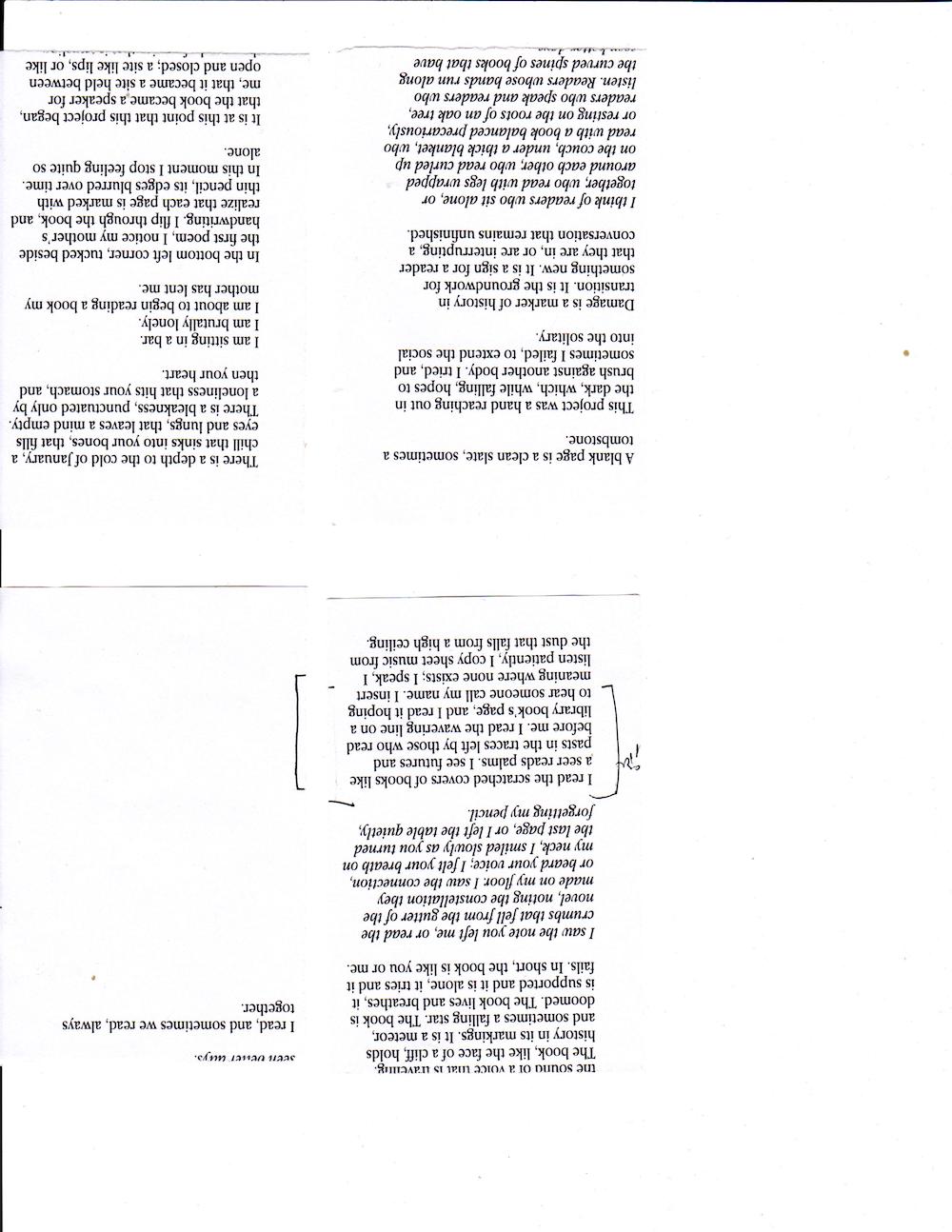
I have a friend who takes delight in well-designed or content-rich ephemera. I sent this to the friend via email…

And quoting a little bit from the takeaway photocopy sheet

I read the scratched covers of books like a seer reads palms. I see futures and pasts in the traces left by those who read before me. I read the wavering line on a library book’s page, and I read it hoping to hear someone call my name. I insert meaning where none exists.

May all your reading be so potent

and then later sending on the addition:

Continuation of the quotation from Grayson James

I speak, I listen patiently, I copy sheet music from the dust that falls from a high ceiling.

I like how the broken up quotation affects my reading. Allowing me to focus on the micro-textures of the text.

And so for day 2735
09.06.2014

Posted in Ephemera | Leave a comment

Horticultural Rorschach

The front of a card sent by my friend Nicola made by her friend and hairdresser Kevin. Sent to mark my birthday.

Picture of a card sent by my friend Nicola made by her friend and hairdresser Kevin - parrot tulips -scabiosa - open interpretation

I love the translucent quality of the bloom. I think they are parrot tulips. Nicola says they could also be scabiosa aka pincushion flower.

I also love the tracing of the provenance of the image in her note.

Made for a very fine contribution to a very fine day.

Upon retrieving this fine bit of ephemera, I am reminded of the practice of Jan Morris who has a use for her books beyond reading: “I put letters and photographs and cards in them to find later.” So here tucked away on Berneval is a picture-holding memory.

And so for day 2734
08.06.2014

Posted in Gardens | Leave a comment

The Use of a Broken Arrow

A broken arrow: look to the balance of the feathers not just the quality of the shaft or the piercing point. Although a broken arrow may not fly, it still may point the way.

And so for day 2733
07.06.2014

Posted in Perception | Leave a comment

IF WHEN

A passage from the program notes for the world premiere of Frame by Frame based on the life and work of Norman McLaren

I went to London and went to the ballet; I’d never seen ballet before and was utterly fascinated, because I saw several types of ballet. But I was more interested in the nondramatic ballet, the ballet of movement and the creation of the choreography and the changing forms and patterns on the stage. If I’d been born in London and could have gone to the ballet from the age of 8 or 10, I might have wanted to be a ballet dancer and eventually a choreographer.

In a sense he played with forms and patterns in his animated films. The attention to repetition and form is even evident even in the prose about dance.

And so for day 2732
06.06.2014

Posted in Uncategorized | Leave a comment

Magical Bookcases

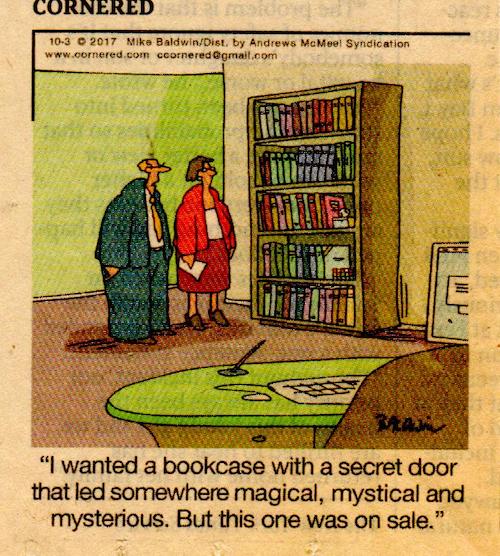
There is this cartoon by Mike Baldwin, the creator of Cornered, which shows what looks like a boss showing off a new bookcase and remarking: “I wanted a bookcase with a secret door that led somewhere magical, mystical and mysterious. But this one was on sale.”

So the implication is that the character settled for a cheaper version. But the evidence is even more damning. The magical portal is there. It’s in the books waiting to be read and even in the empty space to be filled by the joying of hunting for other books. The guy is not so much cheap as illiterate.

Mike Baldwin - Cornered - cartoon - magical bookcase

It took me awhile to get past the monetary remark and conclude that literacy is a companion beyond the price of rubies.

And so for day 2731
05.06.2014

Posted in Booklore, Reading | Leave a comment