
Archives
Categories
Mastodon (hcommons.social)
Finger
I have elsewhere remarked on anaphora and the erotic.
https://berneval.hcommons-staging.org/2011/07/01/litanies-of-lust/
I know by the time (1983) I wrote “Finger” I had read Ginsberg’s “Please Master”.
Looking back I am amused by the undulating lines that mark the deletion of the retrospective remark referencing Coleridge’s “Kubla Khan” which were likely triggered by the notion of flow that arose from the previous reference to the energy of erotic play and Tai Chi.
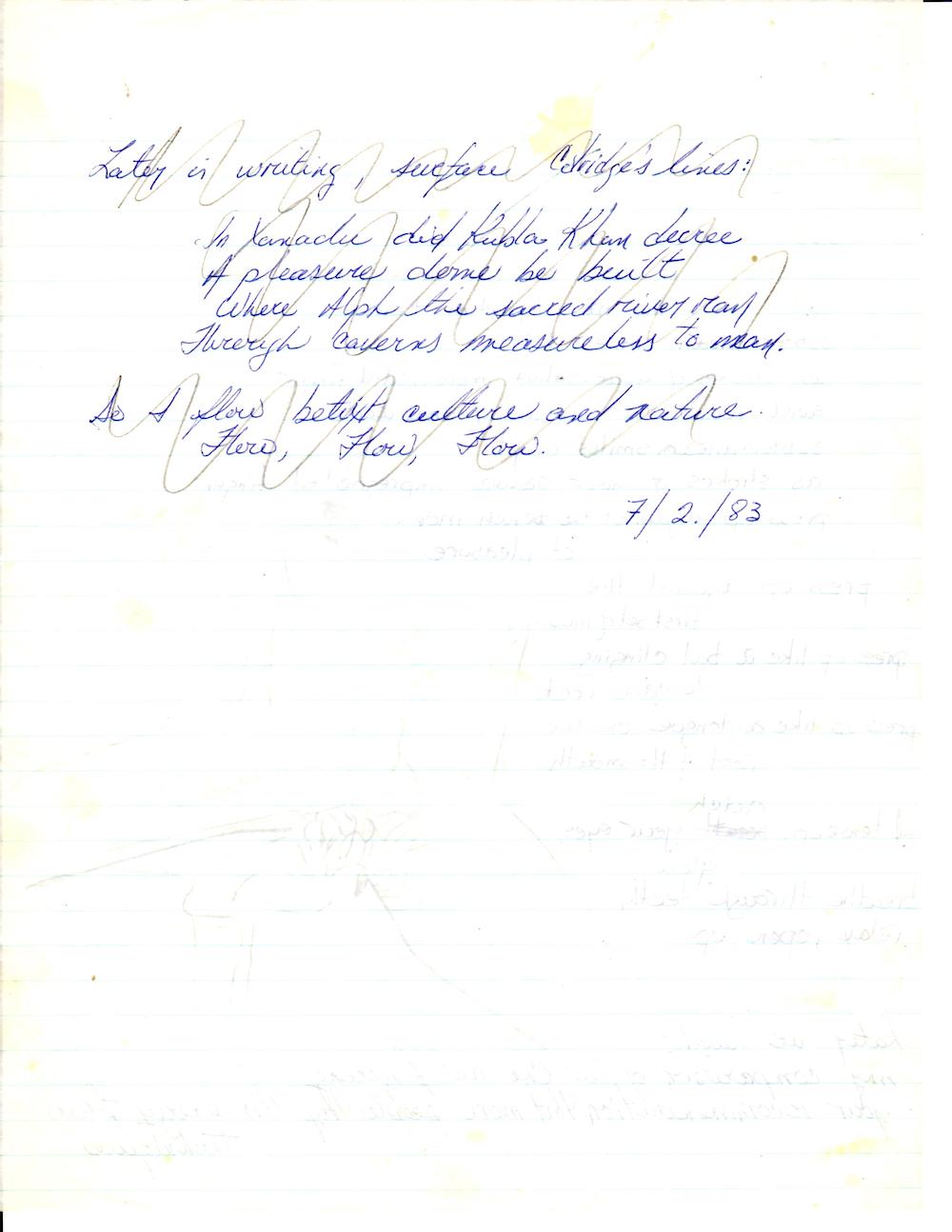
Later in writing, surface Col[e]ridge’s lines:
In Xanadu did Kubla Khan decree
A pleasure dome be built
Where Alph the sacred river ran
Through caverns measureless to man.So I flow bet[w]ixt culture and nature.
Flow, Flow, Flow.7/2/83
Tucked in a pocket is the recto with the poem and a drawing
Finger [password – stanza]
And so for day 2690
25.04.2014
Posted in Poetry
Leave a comment
Texture, Colour and Time
Gemma Gorga
Translated from the Catalan by Sharon Dolin
Forever fused in my mind — pomegranate seeds and cat’s tongue — unforgettable.
Pomegranate
I pry out the seeds with my fingers and all
my memories spill onto the frosty marble
counter. Little, lit up like ruby-red carnival lights,
rough as the cat tongue of Time
inviting us to sit at the table to gobble us up
in a mouthful. The pomegranate returns
[…]
it stains our fingers that pensive, murky color,
the color hours take on that won’t
clot—-the open color of memory.
Appears in translation in The Brooklyn Rail
https://intranslation.brooklynrail.org/catalan/ten-poems-from-optical-instruments/
What is also striking is how the to be eaten swallows up the eater. Or there is an invitation to do so. Always on the verge.
And so for day 2689
24.04.2014
Posted in Poetry
Leave a comment
S.T.O.P.
the lack of punctuation gives the reader a choice to stop or carry on at the line breaks
Maged Zaher
from If Reality Doesn’t Work Out
Everything is grey
All i can do is experiment with punctuation
And resist looking for a poem
To mark a soft day
Without anger or cleverness
which of course means that the resistance ends at looking for a poem or ends at looking for a poem to mark a soft day
And so for day 2688
23.04.2014
First Lesson: Proper Names
T.H. White
The Sword in the Stone
Merlyn is not yet officially Wart’s tutor but the lessons have begun.
Two points to capture the implications of this scene:
1) Arthur is nicknamed Wart, (rhymes with Art, short for his real name)
2) The owl’s name is Archimedes
The Wart did not quite see, but was just going to say that he was sorry for Merlyn if these things made him unhappy, when he felt a curious sensation at his ear. “Don’t jump,” said Merlyn, just as he was going to do so, and the Wart sat still. Archimedes, who had been standing forgotten on his shoulder all this time, was gently touching himself against him. His beak was right against the lobe of his ear, which its bristles made to tickle, and suddenly, a soft hoarse little voice whispered, “How d’you do,” so that it sounded right inside his head.
“Oh, owl!” tired the Wart, forgetting about Merlyn’s troubles instantly. “Look, he has decide to talk to me!”
The Wart gently leaned his head against the soft feathers, and the brown owl, taking the rim of his ear in its beak, quickly nibbled right round it with the smallest nibbles.
“I shall call him Archie!” exclaimed the Wart.
“I trust you will do nothing of the sort, ” cried Merlyn instantly, in a stern and angry voice, and the owl withdrew to the farthest corner of his shoulder.
“Is it wrong?”
“You might as well call me Wol, or Olly,” said the owl sourly, “and have done with it.
“Or Bubbles,” added the owl in a bitter voice.
Merlyn took the Wart’s hand and said kindly, “You are only young, and do not understand these things. But you will learn that owls are the politest and most courteous single-hearted and faithful creatures living. you must never be familiar, rude or vulgar with them, or make them to look ridiculous. Their mother is Athene, the goddess of wisdom, and, through they are often ready to play the buffoon for your amusement, such conduct is the prerogative of the truly wise. No owl can possible be called Archie.”
“I am sorry, owl,” said the Wart.
“And I am sorry, boy,” said the owl. “I can see that you spoke in ignorance, and I bitterly regret that I should have been so petty as to take offence where none was intended.”
The owl really did regret it, and looked so remorseful and upset that Merlyn had to put on a very cheerful manner and change the conversation.
What intrigues me is that the proposed nick name works visually (Archimedes –> Archie) but not phonically (the “ch” is a “k” sound as in “klaxon” and not as “ch” in “cheese”) [unless one likens the pronunciation to the French Archimède].
All Greek to me that speaking in ignorance…
And so for day 2687
22.04.2014
The Claims of Youth – The Claims on Youth
I once had a teacher who said that youth thinks it has a monopoly on sex. By his tone we knew that this claim was being challenged. This debunking nicely complements this bit from Natalia Cecire, a counter-claim about learning.
It is not only the young who are learning; it is, however, more socially acceptable for the young to admit that they are learning. Learners should not be shamed for learning at any age.
http://natalia.cecire.org/works-cited/
The piece goes on to explore how appeal to generational difference is sometimes figured as a “paying the price” which displaces a “doing the reading”.
The enjeu is political:
This conflation of newnesses, and the erasure of learning beyond emergency learning on which it depends (the learning that takes one outside oneself), is a way of relabeling violence as pedagogy, and it is anti-intellectual as well. It is “teaching a lesson” as beating. It rests on the fallacy that learning is an office of youth, where youth is a category of subjection to legitimate violence. (That is to say: it makes plain the violence on which the designation of “youth” is constituted under patriarchy.) We can learn something from paying a price, but being made to pay is not a pedagogy. Pedagogy means: letting people who are new at this learn, and not imagining that we have nothing to learn ourselves. I absolutely do not mean this in some liberal “let’s all be nice to each other and hear all sides” way. In fact, I believe that “being nice” and the regimes of favor that it entails often lead straight to abuse. What I mean is: let’s not confuse doing the reading for paying the price.
And so for day 2686
21.04.2014
sometimes a mirror: the fog of breath
About the Cameron Jamie show at the Gladstone in Brussels
Jamie is presenting what the enterprise is terming a “rogues’ gallery of ceramic masks.” Some are faced away from the viewer, a signature move that the artist seems to use to invite viewers to venture into the alternate states that he conjures, or simply to embody the hidden ones that he recognizes in us all.
https://www.surfacemag.com/events/cameron-jamie/
[…] Jamie has been experimenting with hanging his ceramic masks toward the wall, subverting expectations by negating a clear frontal view. While the traditional function of the mask is to disguise the identity of its wearer for the purposes of ritual, these backwards masks instead expose what is usually hidden. They allow the viewer to psychically inhabit the disguise, taking on a potentially new persona or soul for the self. Revealing the mask’s interior structure not only confounds the viewers’ initial expectations, but also refocuses their attention from external appearances toward a more enigmatic interiority, essentially functioning as a metonym for every individual’s psychological malleability. In his prolonged exploration of the mask’s form and function, Jamie elucidates how persona and performance are not only slippery constructs of social factors, but also aesthetic postures of being.
https://www.gladstonegallery.com/exhibition/6428/cameron-jamie/info
As I read and transcribe this stuff about psychological malleability and aesthetic postures of being, I am listening to Max Richter’s “The Trees” — transported by the music and the opening voice over read by Tilda Swinton …
When Thomas brought the news that the house I was born in no longer exists – neither the name, nor the park sloping to the river, nothing – I had a dream of return. Multicoloured. Joyous. I was able to fly. And the trees were even higher than in childhood, because they had been growing during all the years since they had been cut down.
Not caring which side of the mask is presented to me… ready to find interiority in any moment, I find that the mask also affords an outwardness — there is a mouthpiece. Sound passes. Masks help us fly.
Which reminds me that in narratology there is a concept of focalization wherein who speaks is distinguished from who sees.
I offer here an appropriated portal — from a being looked at to a looking out — or just an excuse to bring attention to this image/mask where aesthetic postures of being are complicated. From the work of graphic novelist Mœbius

And so for day 2685
20.04.2014
Judith Kerr on Mog the Cat: images and words
From an episode of BBC’s Desert Island Discs
https://www.bbc.co.uk/sounds/play/p07kjbsv
At 22:55 into the interview
Sue Lawley:
The text and the pictures, your illustrations are very interwoven aren’t they? Sometimes one takes the narrative lead; sometimes the other.Kerr:
I started doing the Mog books when my children were learning to read. And I thought that children shouldn’t be made to read anything unnecessary. And so I would never put anything in the text that was in the pictures. You know, if you say ‘he was wearing read trousers’ and you see a boy with red trousers. I mean it’s a waste of their energy. I didn’t want them to have to do that. So I tried to use as few words as possible as well as possible.
I admire that formulation: as few words as possible as well as possible.
And so for day 2684
19.04.2014
Mise-en-place and Mindset
Thomas Keller
Ad Hoc at Home
On mise-en-place …
Be organized in your mind too. Think ahead, and think one step at a time. Take sixty seconds to write down a list of the tasks you need to accomplish so that you don’t waste time trying to remember what you were going to do next. As you’re finishing one task, think about what your next step will be. When preparing a meal, try to set yourself up from beginning to end so that the food that takes the longest is done when the shorter-cooking items are ready. I visualize each step of the way, almost as if I were taking a picture of it in my mind: how much oil should be in the pan as I sauté, how it ought to look, how my cutting board should look, how much liquid should be in the pot when I’m cooking potatoes, what the simmer looks like — anything, everything. Try to visualize what you expect to see as you move through a recipe. Then if what you see differs from that expectation, try to understand why and adjust if possible.
Being organized is the first and most important part of cooking.
And so for day 2683
18.04.2014
Posted in Food Writing
Leave a comment
Working the Angles
My Amazon review of Chèvre by Tia Keenan. An exercise in limits.
It won’t melt
I like the intro advice on goat’s cheese: “Chèvre does not melt — Think of chèvre as most similar to ricotta in the way it reacts to heat.” Knowing the limitations opens possibilities.
Food writing lends itself well to the aphoristic. See. Smell. Taste.

And so for day 2682
17.04.2014