Raising

“Detroit as Barn”
in Detroit as Barn
Crystal Williams

[concluding stanzas]

Still, folks click their teeth & wonder on which day,
at what time, the pitiful barn will give. The farmer too
scratches his mighty, balding head.

But he’s forgotten the good wood he used,
the hard nails, the family, the friends & their strong backs,
that long ago barn raising, the cider & fine punch.

The last three lines masquerade as a simple enumeration. Community rises up out of the simple materials and the actions of friends and family. And we raise a glass, toast the poem and the poet. That punch sure is fine.

And so for day 2671
06.04.2014

Posted in Poetry | Tagged | Leave a comment

Colour Moods – From a Riot to Contemplation

Cicely Mary Barker
A Flower Fairies Treasury

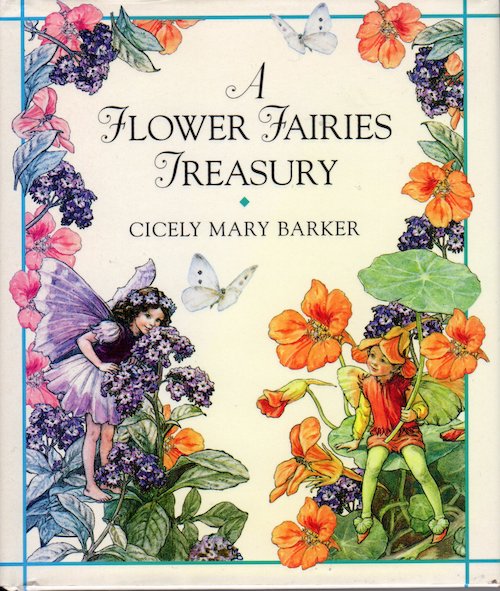
The cover, a riot of colour, appeals to the sense of smell (heady purple heliotrope) and taste (peppery orange nasturtium)

Cicely Mary Barker - A Flower Fairies Treasury - cover

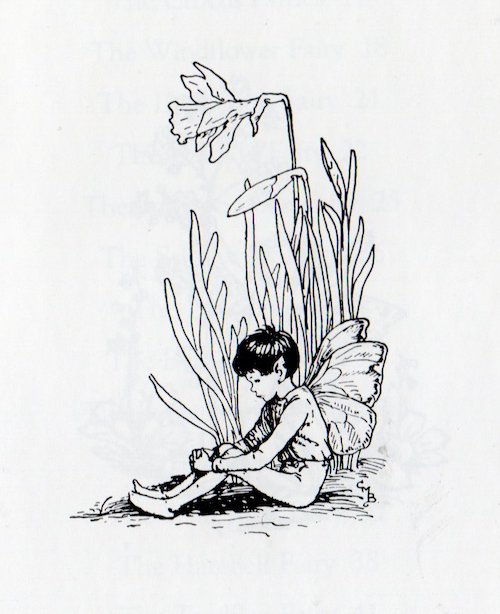
Inside, the frontispiece is a restful black and white drawing of the daffodil fairy who looks like he is sitting in an enforced time out

Cicely Mary Barker - A Flower Fairies Treasury - frontispiece

Or is there some other purpose to his brooding?

And so for day 2670
05.04.2014

Posted in Booklore | Leave a comment

Practice

Judith Martin
Common Courtesy in which Miss Manners Solves the Problem that Baffled Mr. Jefferson

However, the failure to distinguish between manners and morals also suggests, erroneously, that from personal virtue, acceptable social behavior will follow effortlessly. All you need is a good heart, and the rest will take care of itself. You don’t ever have to write thank-you letters.

It is probably more sensible to hope that practicing proper behavior eventually encourages virtuous feeling; that if you have to write enough thank-you letters, you may actually come to fell a flicker of gratitude.

https://www.nytimes.com/1985/11/10/books/does-politeness-lead-to-virtue.html
DOES POLITENESS LEAD TO VIRTUE
By Alison Lurie
Nov. 10, 1985

This is the theory of the Happy Hypocrite, most memorably illustrated in Max Beerbohm’s tale of the same name, in which an unpleasant and miserable man adopts a lifetime mask of smiling politeness that is found after his death to have transferred itself to his features.

The summary is a bit off. The revelation does not come after death. A spurned lover unmasks the man before his wife on their mensiversary. But all is well, the face beneath as taken on the features of the mask:

George stood motionless. La Gambogi stared up into his face, and her dark flush died swiftly away. For there, staring back at her, was the man she had unmasked, but lo! his face was even as his mask had been. Line for line, feature for feature, it was the same. ‘Twas a saint’s face.

There is always time for a thank-you. To Ms. Martin for her sage advice on etiquette. To Ms. Lurie for an insightful review. To Mr. Beerbohm for a pleasant conte. And to you Gentle Reader …
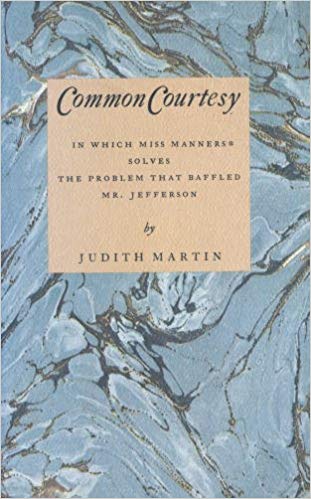
Cover -- Common Courtesy by Judith Martin
And so for day 2669
04.04.2014

Posted in Uncategorized | Leave a comment

Pareidolia?

Italo Calvino
“Without Colours”
The Complete Cosmicomics

Translated by William Weaver:

The Day returned, to paint the Earth with grey; and my gaze moved around and didn’t see her. I let out a mute cry: “Ayl! Why have you run off?” But she was in front of me and was looking for me, too; she couldn’t see me and silently shouted: “Qfwfq! Where are you?” Until our eyesight darkened, examine that sooty luminosity and recognized the outline of an eyebrow, an elbow, a thigh.

There is something Ovidian about this passage – a reverse-engineered metamorphosis.

Silent shouts. Mute cries.

Yet heard. And therefore seen.

And so for day 2668
03.04.2014

Posted in Perception | Leave a comment

Infox

It is a lovely French neologism to capture what English refers to as “false news” or old-fashioned “misinformation”.

mot-valise créé à partir d’information (info) et d’intoxication (intox) qui signifie information fallacieuse

https://dictionary.reverso.net/french-definition/infox

I like the conflation of information and toxicity in one word.

And so for day 2667
02.04.2014

Posted in Translations | Leave a comment

Betting on the Alphabet

Canadian Journal of Communication
Vol 29, No 2 (2004)

“Dispelling the Alphabet Effect”
Paul Grosswiler

https://www.cjc-online.ca/index.php/journal/article/view/1432/1540

This non-Western ethnocentric interpretation of the impact of Chinese script stands in stark contrast with Logan’s. What Gernet lauded as political unity, Logan mistrusted as hegemonic political power. What Gernet understood as a respect for erudition and the lettered person, Logan construed as a conservative cultural force.

[…]

Although it is easy to identify technological achievements in China, it is difficult to identify science as it deals with theories and ideas. As in Europe, laws of nature were not formulated to allow the growth of systematic positive knowledge in China before 1600. Despite its technological marvels before 1600, why did the scientific revolution not occur in China, Bodde asked. He speculated that Confucian opposition to war and Taoist distrust of technology might explain some of the answer, since so much Western science has come from its glorification of warfare and the resultant technology of global destruction that it has spawned.

Bodde, Derk. (1991). Chinese thought, society, and science. Honolulu: University of Hawaii Press.

Gernet, Jacques. (1982). A history of Chinese civilization. Cambridge: Cambridge University Press.

Logan, Robert. (1986). The alphabet effect: The impact of the phonetic alphabet on the development of Western civilization. New York: William Morrow.

And so for day 2666
01.04.2014

Posted in Uncategorized | Tagged , | Leave a comment

Paying Dues

There is a line towards the end of a New Yorker article on Edward Albee that attributes to the playwright a certain take on the unconscious. Larissa MacFarquhar, author of the article writes:

An unconscious has its own ways and moods and thoughts, he feels, and they should be respected by its host. Albee is a union man. The unconscious does work; therefore the unconscious has rights.

p.. 77 The New Yorker, April 4, 2005

https://www.newyorker.com/magazine/2005/04/04/passion-plays

And so for day 2665
31.03.2014

Posted in Uncategorized | Leave a comment

Avian Names

There are lots of birds in this collection by Linda Bierds The Hardy Tree.

Traces of the poet-writer self? Or persona?

Figures of fleeting moments and form…

The ending of “The Hardy Tree”

[…] young birds
that just a year ago were not birds at all,
but only particles of grain,
and earth, and air, and rain.

The ending of “Evolution” (the non-italicized lines are from Schrödinger’s What is Life?)

In no case, then, is there a loss of personal existence to deplore–
marten, whitethroat, blackbird,
lark–nor will there ever be

From the middle of “Metamorphosis: 1680”

From the eagle, swan, crow, lark,
the diminishing quills.

And they fly out of sight but in memory they remind us of passage…

And so for day 2664
30.03.2014

Posted in Poetry | Tagged | Leave a comment

Mirror Poems

Linda Bierds
“Bone Cockerel: Norman Cross Prisoner-of-War Camp, England”
The Hardy Tree

In Michael Ondaatje’s The Collected Works of Billy the Kid there is one poem in a style developed by Ondaatje as he says in the Afterword to the 2008 edition “I attempted everything. I took a stanza and wrote it backwards and in one case I kept the result”. Kuldip Gill picks up the form and makes it her own in one of the poems in Valley Sutra. Linda Bierds may have come across the form independently. There is no entry for “mirror poem” in the Princeton Encyclopedia of Poetry and Poetics. If the form becomes more popular there just might be an entry in future editions.

Here then is an aperçu of Bierds’s poem:

Any year in any tilting hemisphere,
any set of bones, split and polished, gathered
from the cooking pots… But I am —
this hour — here, he wrote, my art a single shape lifted
from whatever squealed or snarled or lowed across
war’s holding pen. Just touch and feathered bones hatched
into a bird, a set of wings, a textured silence throughout
[…]

[…]
into a bird, a set of wings, a textured silence throughout
war’s holding pen. Just touch and feathered bones hatched
from whatever squealed or snarled or lowed across
this hour. Here, he wrote, my art a single shape lifted
from the cooking pots… But I am
any set of bones, split and polished, gathered
any year in any tilting hemisphere.

BTW “reverse order” isn’t in the Princeton Encyclopedia either. Our examples could at a stretch be “antimetabole”.

And so for day 2663
29.03.2014

Posted in Poetry | Tagged | Leave a comment

Captivated

Linda Bierds
“The Bird Trap”
The Hardy Tree

A poem in part an ekphrasis on a painting by Pieter Brueghel the Younger

And under their laughter and guttural chirrups
lies nothing but the scrape of skates
and the dull chatter of curling stones
as they slip, like great rounds of granite bread,
toward some gradually vanishing target
etched on the scored ice.

That vanishing point etched on ice puts one in mind that the painting itself is a trap for the viewer. And the poem for the reader.

And so for day 2662
28.03.2014

Posted in Poetry | Tagged | Leave a comment