Star Crystal

This began as an exchange about the Pantone Color Institute and wishfully getting jobs there setting the colour of the year. We then moved on to found our own colour consultancy agency. My friend thought I would be good at the descriptions. She liked my style.

So I gamely offered to gift her with a description. She chose the colour of her couch which is a yellow tone. This is the result:

Star Crystal

You’ve been reading Italo Calvino’s “The Light Years” from the Collected Cosmicomics. And you have been contemplating great distances and the time communication travels the universe and the impossibility of reversing images projected and explaining away initial intentions.

You sit and your light shines on the person sitting next to you. Together your glow radiates to the entire room. You leave and the couch is saturated. Golden. Pollen. Petal Dust. Star Glitter.

And you are thankful for proximity.

A yellow that emanates. Recalls the collision of helium. In a collapsing core. Forecasts ever occurring rise of chains of carbon and life. And stories. A yellow of emanation.

An origin surpassing itself.

A pause that extends beyond light years. Or beyond the moment of reading “The Light Years”. Aglow in the contemplation.

And so for day 2641
07.03.2014

Posted in Ephemera | Tagged , | Leave a comment

Dare I Teach a Peach?

Reading and participating in the discussion surrounding Kathleen Fitzpatrick‘s Generous Thinking made me primed. I immediately perked up to the possibilities of an analogy with scholars and librarians and teachers and farmers in David Mas Masumoto‘s description of a farmer’s social and professional network.

The journey of my peaches begins with a hand-crafted flavor, born from a regional advantage: the common geography I share with the other family farmers, a proximity that promotes interaction and exchange of information. We hope to learn from and trust each other. Living in this community can become a competitive advantage. Just as my peaches can’t be grown elsewhere, farmer-to-farmer friendships can’t be replaced and our farm stories can’t be duplicated. Small speciality farming depends on collective learning within competitive structure. A chance meeting in town, at a dinner or funeral, provides opportunity to pass on information about market demand, coming legislation, labor trends, and regulations. We exchange our own “consumer’s reports” on equipment and new innovation, especially with pest control. Solutions from the established industry need to be questioned; many of us have learned firsthand about the limited of conventional scientific research.

from Four Seasons in Five Senses: Things Worth Savoring

And so for day 2640
06.03.2014

Posted in Storytelling | Leave a comment

surrender “to” to avoid surrender “of”

Emily Dickinson

I was first attracted by this evocation of a decisive moment in the English-French struggle over Canada: The Battle of the Plains of Abraham, 1759 … The similarity of the general’s responses to death is belied by the contrast in the syntax of their utterances. One serves a collective enterprise; the other is focused on the individual.

678

Wolfe demanded during dying
“Which obtain the Day”?
“General, the British” — “Easy”
Answered Wolfe “to die”

Montcalm, his opposing Spirit
Rendered with a smile
“Sweet” said he “my own Surrender
Liberty’s beguile”

The parallelism and the ellipsis in the last two lines trip me up.

This is how I read the lines:

“Sweet” said he “my own Surrender [i.e. to death]
Liberty’s [surrender] [may] beguile”

I take that last verb to be in the subjunctive mood.

I do like the construction:

surrender “to” to avoid surrender “of”

It is a sentiment I believe found in other poems by Dickinson. Time to hunt. Like a bee.

And so for day 2639
05.03.2014

Posted in Poetry | Leave a comment

Road Back to Semantics

Umberto Eco
“Porta: Rhythm and The Poetic List”
translated by Samuel Fleck
in Piercing the Page

[A formulation he repeats from the Postcript to The Name of the Rose]

I said that signifiers engender a thought and not that a thought engenders signifiers, the words to express it — and this is my notion of poetry; while on the one hand prose and narrative follow in particular the Ciceronian precept of rem tene verba sequentur, poetry and that of Porta in particular follows the principle in which verba tene, res sequentur. And he says so himself:

[…]

Let us return to the concept of physicality of the poetry; let us discuss, that is to say, poetic language more so than mere “poetry,” of doing more than being, of the signifier over the signified. Let us put on hold queries into “what it means,” what it communicates, in order to concentrate our attention on how it is on what sort of thing it is, on how it sounds, on how it is pronounced, on how it stirs the language.

John Picchione introduction to Antonio Porta selections in Italian Poetry Today edited by Ruth Feldman & Brian Swann [p. 413]

In its first stage, Porta’s creativity is guided by a poetics which, on one hand, advocates poetic writing as a cognitive medium capable not only of presenting reality, or history, but also of projecting hypothetical or utopian models of existence, and, on the other, expresses an autonomous conception of art. Poetry is intended as a world in itself and not as a metaphor of the world. The most striking example is represented by Cara (1969), which seems to hypothesize that language represents only the material presence of itself. Poetry is identified solely with its linguistic construction, with the rhythmic and syntactic space in which it moves.

****

It begins in sound…

Joy Harjo
Beautiful Baby, Beautiful Child (a lullaby)
in Conflict Resolution for Holy Beings

Beautiful baby, beautiful child
Hokosucē herosē, Estuce herosē.

H

Mvskoke Word List

It carries on in words, songs, toughness and love…

“One Day There Will Be Horses (a traveling song)”

One day, I will have words enough
One day, I will have songs enough
One day, I will be tough enough
One day, I will have love enough
To go home.

Eco, again, ““Thus I rediscovered what writers have always known (and have told us again and again): books always speak of other books, and every story tells a story that has already been told.” Postscript to the Name of the Rose.

One of those stories twice-told is the return to language. Home. A trip to be always undertaken anew.

And so for day 2638
04.03.2014

Posted in Poetry | Tagged | Leave a comment

Daughter of the Dust

Crystal Williams
“For the Woman Who Didn’t Know My Name”
Kin

Like a grain of dirt a letter rises

In some old men there is a softness
in voice a hint of dust y Alabama

a bit of grit

And later in the book we come across this appreciation of dirt (and an equal art of spacing)

When I die
my manicured hands,
which have always been plump
and found keyboards necessary,
will have a fine layer of dirt under their nails,
and will be known for their slow and gentle touch.

         I have planted cosmos, asters.

from “At 25, I Have Already Begun to Like Lou Rawls”

In case you missed it, there is a kinship between Kin and dust …

And so for day 2637
03.03.2014

Posted in Poetry | Leave a comment

Prints

Gathered from different renga, displaced in time and space and yet united between the same covers.

Alison Strumberger and Gillian Sze
Redrafting Winter

from “A Grip on the Stars”

Reflected by snow
the sky cradles my impressions,
a new footprint for each step.

        As if even snow were discrepant, disordered, suspect;
        as if it were mild, papery, and fell to the sky instead.

from “Foolish Fire”

A lifetime of print is in my wake,
and I am left reading my palms —
fiend, vagabond, voyeur, brute.

        I learn to subsist on a diet of mimesis,
        creating equations with beachy, stormy residue.

I like the enumerations that partake of the passing prints…

And so for day 2636
02.03.2014

Posted in Poetry | Leave a comment

La Guerre, Yes Sir!

Jacques Derrida
trans. Geoff Bennington
“Two Words for Joyce”
In Post-Structuralist Joyce: Essays from the French
edited by Derek Attridge and Daniel Ferrer

Derrida comments at length on HE WAR — two words from Joyce’s Finnegans Wake. At one point he notes

One is constrained to say it either in English or else in German, it cannot therefore be received as such by the ear. The homography retains the effect of confusion, it shelters the Babelism which here, then, plays between speech and writing.

Makes us attempt a French version.

Naguère il

In the notes Derrida points to the translation by Philippe Lavergne which was not known to him at the time of his talk. We may have had more on temporality had that been the case. Lavergne renders the words as “Et il en fut ainsi” — much more biblical and context sensitive to the scene…

Mais, moi, je fuis …

I am waving a white flag and retreating from treating the whole of the Wake.

And so for day 2635
01.03.2014

Posted in Translations | Leave a comment

Shhhh!

Spotted on a tote bag offered for sale at Longo’s Supermarket

All my family secrets are recipes

And so for day 2634
28.02.2014

Posted in Ephemera | Tagged | Leave a comment

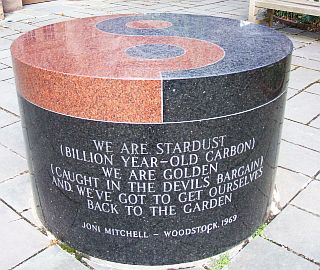
Stardust Thoughts in Granite

In a 1996 summer stay on the campus of Princeton during the CETH [Center for Electronic Texts in the Humanities] Summer Seminar I was delighted to come across this evocative sculpture/installation in a quiet sunny corner. I later learnt more about textual instance before me quoting some of my favourite lines…

In honor of its 25th reunion in 1994, the Class of 1969 donated this marble sculpture and the garden behind Murray-Dodge. The lyrics inscribed on the stone, from Joni Mitchell’s famous song “Woodstock,” conjure up the spirit of the class’s Princeton era.

Princeton Alumni Weekly

We are stardust inscription - Princeton Class 69 - Joni Mitchell

It was (and still is) amusing to contemplate the haecceity of this textual instance in the midst of thinking about electronic text.

What intrigues me is the parentheses —

we are stardust
(billion year-old carbon)
we are golden
(caught in the devil’s bargain)
and we’ve got to get ourselves
back to the garden

They (the parentheses) don’t appear in the lyrics posted to Joni Mitchell’s official web site (the words in parentheses do appear). They, the parentheses, do make sense if you listen carefully to the song on the Ladies of the Canyon album. The words enclosed by the parentheses are sung almost as asides by Joni with a chorus. It’s the last refrain. In the previous instances of the refrain the parenthetical asides to billion year old carbon and devil’s bargain are absent:

We are stardust
We are golden
And we’ve got to get ourselves
Back to the garden.

The printed version of the lyrics accompanying the CD reissue of the 1970 album does not contain the carbon-bargain lines but listen to the track — clearly the class of ’69 were smart text encoders.

And so for day 2633
27.02.2014

Posted in Transcriptions | Leave a comment

High Voltage Circuits

Because you as reader supply the link, it’s more devastating. Two examples, though not sonnets, exhibiting the volta.

26

Each week
  on network television
  hundreds of terrorist attacks
  are thwarted
  by members
  of the Actors Guild.

Perhaps they could visit
  schools
  when they’re not
  on set.

Thomas King
77 Fragments of a Familiar Ruin

****

John Berryman
“The Captain’s Song”

[after recalling the memory of being a child and leaping streams…]

You crippled Powers, cluster to me now:
Baffle this memory from my return,
That in the coldest nights, murmuring her name
I sought her two feet with my feet, my feet
Were warm and hers were ice and I warmed her
With both of mine. Will I warm her with one?

in Homage to Mistress Bradstreet and other poems

****

“January” by Charles Simic
Paris Review, Issue no. 212

Children’s fingerprints
On a frozen window
Of a small schoolhouse.

An empire, I read somewhere,
Maintains itself through
The cruelty of its prisons.

And so for day 2632
26.02.2014

Posted in Poetry | Leave a comment