They Pop Up Everywhere

I recently viewed the film Mary Poppins from beginning to end (I had only seen snippets in the past). I was struck by the scene with Ed Wynn as Uncle Albert and the levitation by laughing. I thought how gay! And later when it is reported that Mr. Dawes Sr. died laughing (we last see him levitating to the same tune “I Love to Laugh“), I thought someone should write a paper about the death drive in Mary Poppins…

I confess I went looking for such a paper. I did come across a kindred confirmation of my hypothesis of the gay features of Uncle Albert’s mirth. Lindsay Amer at Lions Tigers Queers Oh My!

The “I Love To Laugh” dude. Gay = happy. This guy is so damn happy he floats! Sounds pretty gay to me.

And about that Irish fox… swish?

And so for day 2631
25.02.2014

Posted in Uncategorized | Leave a comment

A Stray Homing

From “Misreckoning“, a renga by Gillian Sze and Alison Strumberger which appeared in the Literary Review of Canada, one of the middle stanzas

Slow hands tick over each surface,
Mother’s silver, Father’s atlas, Lover’s jawline.
Every hour chases its tail.

The incongruence of the objects is softened by the sounds. One doesn’t quite care how the poets arrived here and yet …

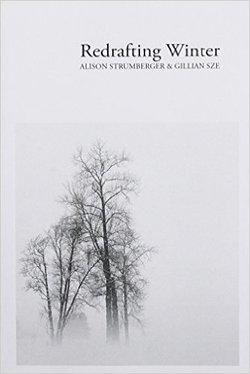
This particular stanza in this particular renga made me search out their set of other renga and epistolary work, Redrafting Winter

cover - redrafting winter - gillian sze and alison strumberger

And so for day 2630
24.02.2014

Posted in Poetry | Leave a comment

Memory, Rhyme and the Scene of Birth

Someone else has been (mis)quoting from memory:

Robert Stam
Keywords in Subversive Film / Media Aesthetics

One is reminded of Bakhtin’s three spasms — birth, orgasm, and death — and of Yeat’s “god of love” who “pitched his tent/ near the place of excrement.”

I had always thought it was “in the place of excrement”. But the concluding stanza of Yeat’s “Crazy Jane Talks with the Bishop” has no trace of tent except in the rhymes:

‘A woman can be proud and stiff
When on love intent;
But Love has pitched his mansion in
The place of excrement;
For nothing can be sole or whole
That has not been rent.’

This search was triggered by John Berryman’s Homage to Mistress Bradstreet where the birth scene cuts across three stanzas and culminates in a sense of pride:

[…] Kin,
gather. My world is strange
and merciful, ingrown months, blessing a swelling trance.

[19]
So squeezed, wince you I scream? I love you & hate
off with you. Ages! Useless. Below my waist
he has me in Hell’s vise.
Stalling. He let go. Come back: brace
me somewhere. No. No. Yes! everything down
hardens I press with horrible joy down
my back cracks like a wrist
shame I am voiding oh behind it is too late

[20]
hide me forever I work thrust I must free
now I all muscles & bones concentrate
what is living from dying?
Simon I must leave you so untidy
Monster you are killing me Be sure
I’ll have you later Women do endure
I can can no longer
and it passes the wretched trap whelming and I am me

[21]
drencht & powerful, I did it with my body!

A scene and sentiment worthy of Crazy Jane.

And so for day 2629
23.02.2014

Posted in Poetry | Leave a comment

A Disappearing Act

Thomas King
77 Fragments of a Familiar Ruin

A kind of erasure is at work and so form and content mesh.

34

Let us now discuss
  missing and
  murdered
  aboriginal women.

Let us now discuss
  murdered
  aboriginal women.

Let us now discuss
  aboriginal women.

Let us now discuss.

Not sure that I am quoting this whole poem. Not even sure the CBC gets it right either.
https://www.cbc.ca/books/read-work-from-thomas-king-s-first-poetry-collection-77-fragments-of-a-familiar-ruin-1.5306406

By the logic of the poem, the last line to disappear should leave white space. A void. But no way to measure its duration either in time or on the page.

The only way out is to retrace steps, uncomplicate the erasure, focus on specifics. From an agreement to discuss. Begin again.

Or else entropy wins.

And so for day 2628
22.02.2014

Posted in Poetry | Leave a comment

The few and the many via the unique

The rhetoric soars and dips…

Literature as religion, however, is a project doomed to failure. For one thing, the cultivation of the former involves too few people to be a plausible substitute for the latter. Religion is a symbolic form or ritual practice, sometimes of a highly arcane kind, which nevertheless engages countless millions of men and women in the course of their sublunary lives, and which connects their beliefs about when the universe was created with their beliefs about when it is permissible to fib or fornicate. If the champions of cultural studies were not so theologically illiterate, they would long since have identified it as history’s most astonishingly successful solution to the division between high and low culture. Within a single ecclesiastical institution, an intelligentsia of clerics is organically linked by both theory and practice to the mass of the faithful. No secular cultural project has come even remotely close to matching this extraordinary achievement, bought often enough at the cost of blood, bigotry and oppression. If culture in the artistic sense is too minority a phenomenon for such purposes, culture in the anthropological sense is a good deal too contentious.

Terry Eagleton
Having one’s Kant and eating it
London Review of Books
Vol. 23 No. 8 · 19 April 2001

And so for day 2627
21.02.2014

Posted in Uncategorized | Tagged | Leave a comment

Charm

For every child who saw the wet colour dry to dull …

Hoard and praise the verity of gravel.
Gems for the undeluded. Milt of earth.

Seamus Heaney
“The Gravel Walks”
in The Spirit Level

… and knew what a redipping would produce.

And so for day 2626
20.02.2014

Posted in Poetry | Leave a comment

Garnishes, Guests and the Failure of Conversation

Discuss.

Arabella Boxer’s Book of English Food

The introduction to the First Courses section contains a bit of commentary on soups and garnishes

This practice of handing round a number of elaborate garnishes separately, amused the English. Part of its appeal was that by enabling the guests to assemble their own dishes it pandered to their distrust of what they described as ‘mucky food’. In practice it must have been quite tedious, in that the conversation was constantly interrupted.

Talk among yourselves while I slip out to the kitchen…

And so for day 2625
19.02.2014

Posted in Food Writing | Leave a comment

From Body to Poem and Back Again

Lola Lemire Tostevin
from Double Standards
as reproduced in Sp/elles

do not be deceived by appearances
I am not a woman   I am a poem

[…]

do not be deceived by appearances
I am not a woman    I am a sequence
dismembered    each organ fastened
to a verb    the mouth to speak
the ear to hear    the eye to see
saw to and fro the contours of my
topic    the red raw of lips that
spread to read mine    the voice
that travels the long curves and
turns of the poem’s socket    as it
locks it    to bear in mind

Gwen Benaway
from “Fuck Your Fear”
Holy Wild

a body is a paragraph,
a poem waiting to be written.

a body is a story,
a character in an imagined world.

a body is a grave,
a dead space between lovers.

a body is a promise,
a gift of histories colliding.

And so for day 2624
18.02.2014

Posted in Poetry | Leave a comment

A simple prop. A newspaper.

The poet posits. The poem conducts.

For him, death will lie
Open like a newspaper in a dream,
A paper he ransacks his apartment for,
And when he lays his hands on it at last,
As he smooths the crinkled page to read,
He will simply spread before his face
Not a page but, oddly a black comet,
Or rather a rococo ornament in empty space
Hanging intriguingly before his eyes,

And the enjambement jumps to another stanza. And note that in this stanza there are no full stops.

Gjertrud Schnackenberg
“A Monument in Utopia”
A Gilded Lapse of Time

And so for day 2623
17.02.2014

Posted in Poetry | Leave a comment

A Matrimonial Conjunction or Procreative Disjunction

Chris Banks
“Narrative Versus Lyric”
The Cloud Versus Grand Unification Theory

Beginning versus end…

A narrative poem leaves a trail of crumbs
in a fairy tale. A lyric poem introduces
a swan, its neck bowed low, feather-soft,
to eat them. […]
When
the night is over, the drunk narrative poem
admits the lyric poem’s flowers are lovely.
The lyric poem says it has always secretly
loved the narrative poem’s honesty. They
fall into each other’s arms. A child is born.

Chris Banks - narrative versus lyric - the cloud versus grand unification theory

Somewhere in the middle …

A narrative poem takes no prisoners.
A lyric poem says the only prison is longing.

The child of course exists in the space of longing that is the poem.

And so for day 2622
16.02.2014

Posted in Poetry | Leave a comment